Cyprus vs Portugal: Tax Guide for Remote Workers

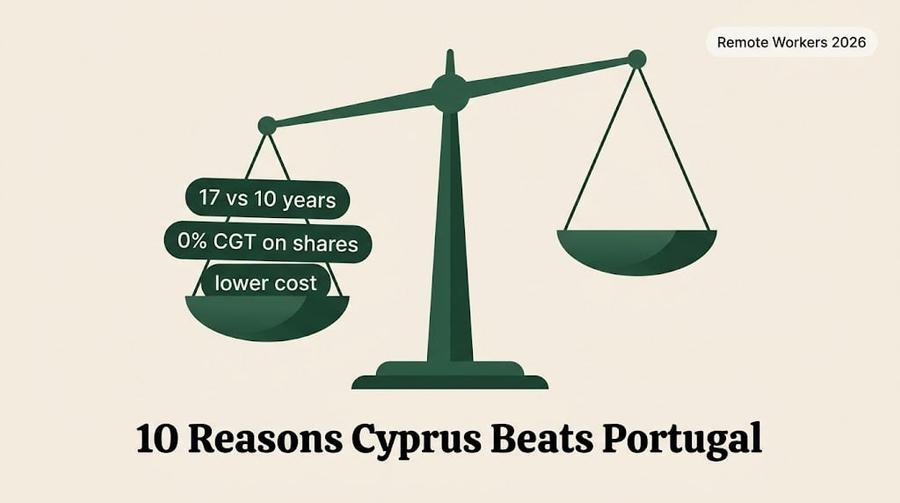
Cyprus and Portugal are two of the most popular EU destinations for remote workers seeking tax efficiency. For a detailed side-by-side, see /cyprus-vs/portugal. This post covers the 10 concrete reasons Cyprus comes out ahead for location-independent workers in 2026.
Both jurisdictions offer preferential tax regimes for new residents. But the structure, duration, and post-regime treatment differ significantly. These 10 points address the differences that matter most for remote workers and founders receiving dividend income.
Tax Regime Advantages
1. Non-Dom Lasts 17 Years vs NHR/IFICI's 10 Years
Cyprus Non-Dom exempts you from SDC for 17 years, compared to Portugal's IFICI regime which lasts only 10 years before standard Portuguese tax rates apply.
According to PwC Tax Facts 2026, Cyprus corporate tax is 15%, Non-Dom dividend rate is 2.65% GHS only (no SDC), giving approximately 5% effective rate on profits extracted as dividends - compared to Portugal where dividends face 28% witholding tax after the NHR regime ends after 10 years.
Key differences for remote workers choosing between Cyprus and Portugal:
- Dividend tax: Cyprus 0% (Non-Dom) vs Portugal 10% flat (IFICI 2025)
- Residency requirement: Cyprus 60 days vs Portugal 183 days
- Regime duration: Cyprus permanent vs Portugal IFICI maximum 10 years
- Salary income tax: Cyprus 0-35% progressive vs Portugal 20% flat (IFICI)
- Crypto tax: Cyprus 8% flat vs Portugal 28% (or 0% if held >1 year)
- Cost of living: comparable, Lisbon slightly more expensive than Larnaca, cheaper than Limassol
- Language: English widely spoken in Cyprus; Portugal requires more Portuguese in daily life
- Climate: both Mediterranean/Atlantic, Cyprus is hotter and drier, Portugal has cooler summers
- EU access: both full EU members, equal work rights across EU
When NHR/IFICI expires in Portugal, the preferential tax treatment ends. Standard Portuguese rates apply: dividends at 28%, employment income at up to 48%. There is no renewal option.
For a remote worker planning a 10-15 year stay, Cyprus's longer window provides significantly more certainty and time to benefit from the favourable rates.
Non-Dom explained: /learn/non-dom
2. Dividends Taxed at 2.65% GHS vs 28% After NHR Expires
Non-Dom residents in Cyprus pay only 2.65% GHS on dividends for 17 years. In Portugal, after NHR/IFICI expires, dividends are taxed at 28%.
On EUR 100,000 of annual dividends: in Cyprus a Non-Dom pays EUR 2,650 GHS (for 17 years). In Portugal after year 10: EUR 28,000 tax.
Even during the NHR period, Portugal's treatment of domestic dividends is less clear than often presented. Cyprus's position is unambiguous: 0% SDC + 2.65% GHS for the full 17-year Non-Dom period.
Dividend tax comparison: /learn/dividend-tax
3. No CGT on Shares - Portugal Taxes at 28%
Cyprus has no capital gains tax on shares. Portugal taxes share disposal gains at 28%, and NHR did not provide CGT exemption on domestic transactions.
For founders, investors, or anyone planning a business exit, Cyprus's 0% CGT on shares is a material advantage. A EUR 1M exit gain: Cyprus 0%, Portugal EUR 280,000.
This is one of the clearest structural differences between the two jurisdictions - and one that becomes increasingly important as assets appreciate.
CGT in Cyprus: /learn/capital-gains-tax-cyprus
4. Simpler Company Formation
A Cyprus Ltd can be incorporated in 5-7 working days by a licensed service provider, with no minimum share capital requirement and straightforward nominee arrangements available.
The company formation process in Cyprus is well-established with a large ecosystem of professional service providers (lawyers, accountants, fiduciaries) experienced in serving foreign entrepreneurs.
Portugal does not have an equivalent structural advantage for company formation - NHR was a personal tax regime, not tied to corporate structure.
Cyprus company formation: /learn/company-formation
Lifestyle and Practical Advantages
5. Lower Cost of Living: Larnaca vs Lisbon
Larnaca costs 30-40% less than Lisbon for rent, food, and everyday expenses while maintaining comparable infrastructure and EU lifestyle standards.
A 1-bedroom apartment in central Larnaca rents for EUR 700-1,100 per month. In Lisbon, the equivalent is EUR 1,400-2,200. The gap has widened as Lisbon's popularity with remote workers has driven prices up significantly since 2020.
Groceries, restaurants, and utilities are also lower in Cyprus. The lower cost base effectively increases the after-tax income benefit of the Non-Dom regime.
6. English Widely Spoken Across Cyprus
Cyprus was a British colony until 1960. English is effectively a second official language - used in courts, government offices, banks, and business - without requiring any language learning.
For English-speaking remote workers, Cyprus requires no language adaptation. Contracts, official documents, and tax filings can all be handled in English. This reduces both friction and professional fees.
In Portugal, while English proficiency is higher in Lisbon than elsewhere, government interactions often require Portuguese or a local representative.
7. More Consistent Sunny Weather
Cyprus averages 340+ days of sunshine per year and has very mild winters. Portugal has a wetter, cooler Atlantic climate particularly in the north and Lisbon.
For remote workers valuing outdoor lifestyle, Cyprus's Mediterranean climate - warm from April to November, mild in winter - is a consistent advantage. Sea temperatures allow swimming from May to October.
This is a lifestyle factor rather than a financial one, but quality of life matters for long-term residency decisions.
8. Direct Flights to 50+ European Cities
Larnaca International Airport connects directly to 50+ European cities year-round, with additional connections from Paphos airport.
Despite being geographically eastern, Cyprus is surprisingly well-connected to Western Europe. Direct flights operate to London, Frankfurt, Amsterdam, Paris, Rome, Barcelona, and most major EU hubs.
Portugal (Lisbon) has more direct connections globally, but for EU-based remote workers, Cyprus's connectivity is sufficient for regular European travel.
Residency Process and Community
9. Simpler EU Residency Process
EU citizens registering in Cyprus complete the Yellow Slip (MEU1) process at a civil registry office with no points system, minimum income threshold, or language requirement.
Portugal's NHR required registering as a Portuguese tax resident, which in turn requires a visa or right to reside. For non-EU nationals, this is more complex. For EU citizens, both are comparable in complexity.
For EU citizens specifically, Cyprus's Yellow Slip process is straightforward: bring documents, attend appointment, receive registration. Processing takes 1-3 months.
Yellow Slip guide: /learn/yellow-slip
10. Growing Community, Lower Competition
Cyprus's international expat community is growing but has not yet reached the saturation point of Lisbon, meaning lower competition for housing, services, and lifestyle resources.
Lisbon has become one of Europe's most popular remote worker destinations, which has driven rents up and created a very competitive market for housing and co-working spaces.
Cyprus - particularly Larnaca and Paphos - offers a growing English-speaking expat community with lower prices and less competition, while still providing the infrastructure needed by remote workers.
Cyprus vs Portugal: Key Comparison
| Factor | Cyprus | Portugal (NHR/IFICI) |
|---|---|---|
| Preferential period | 17 years (Non-Dom) | 10 years (NHR/IFICI) |
| Dividend tax after regime | 2.65% GHS (ongoing) | 28% standard rate |
| CGT on shares | 0% | 28% |
| Company formation | 5-7 days, simple | More complex |
| Language | English widely spoken | Portuguese required |
| Average rent (1BR central) | EUR 700-1,100 | EUR 1,400-2,200 |
| Annual sunshine days | 340+ | ~280 |
| Direct EU connections | 50+ cities | 70+ cities |
Frequently Asked Questions
Is Cyprus or Portugal better for remote workers in 2026?
For tax efficiency, Cyprus is stronger: Non-Dom lasts 17 years vs 10 for NHR/IFICI, dividends are taxed at 2.65% GHS only vs 28% in Portugal after NHR, and there is no CGT on shares. Portugal scores higher for global connectivity and Atlantic lifestyle.
What happens to your Portugal NHR tax rate after 10 years?
After NHR/IFICI expires, standard Portuguese tax rates apply. Dividends are taxed at 28%. Employment income is taxed at progressive rates up to 48%. The preferential period is finite and non-renewable.
Can you have a company in Cyprus while living in Portugal?
You can incorporate in Cyprus, but if you live in Portugal, you are Portuguese tax resident. Portuguese CFC rules or management-and-control principles may attribute the Cyprus company's profits to you in Portugal. Tax residency determines which country taxes your income - not where your company is registered.
Is the cost of living in Cyprus lower than Portugal?
Yes, particularly for rent. Larnaca and Paphos are significantly cheaper than Lisbon. Even Limassol, the most expensive Cypriot city, is comparable to or cheaper than Lisbon for most expenses.
Does Cyprus have a digital nomad visa for non-EU citizens?
Cyprus does not have a specific digital nomad visa. EU citizens use the Yellow Slip. Non-EU digital nomads typically use the company formation route (director of a Cyprus company) or other investor/employment visa categories.
Sources: PwC Cyprus Tax Facts 2026, Cyprus Tax Department.
Need personalized advice? Book a consultation with an expat tax specialist.
Which is better for remote workers: Cyprus or Portugal?
For most remote workers earning above EUR 60,000/year, Cyprus offers a better long-term tax position: 17 years of Non-Dom status vs 10 years NHR/IFICI in Portugal, 2.65% GHS on dividends vs 28% after Portugal regime ends, 0% capital gains on shares and crypto vs 28% in Portugal, and lower living costs (EUR 700-1,100/month rent vs EUR 1,400-2,200 in Lisbon).
How long does the Portugal NHR regime last compared to Cyprus Non-Dom?
Portugal NHR (now replaced by IFICI) offers 10 years of preferential tax treatment. Cyprus Non-Dom status lasts 17 years from the date you become a Cyprus tax resident. After the NHR regime expires in Portugal, dividends are taxed at 28%, capital gains at 28%, and income at up to 48%. In Cyprus, the Non-Dom benefit of 0% SDC on dividends continues indefinitely (17-year cap on the formal Non-Dom status).
What taxes does a remote worker pay in Cyprus vs Portugal?
In Cyprus (via Cyprus Ltd + Non-Dom): 15% corporate tax on profits + 2.65% GHS on dividends = approximately 5% total effective rate on EUR 100,000 revenue. In Portugal (NHR): 20% flat rate on qualifying income, 0% on foreign dividends during NHR period, but 28% on dividends/capital gains after 10 years. Portugal also has a NHR renewal fee and additional complexity for company structures.
Can a remote worker qualify for Cyprus residency under the 60-day rule?
Cyprus offers a 60-day residency rule for non-domiciled individuals who: spend at least 60 days in Cyprus per year, do not spend 183+ days in any single other country, maintain a Cyprus registered address (rented or owned), and have no tax residency in another country. This rule is particularly suited to frequent travellers and digital nomads who cannot commit to the standard 183-day rule.
What are the main disadvantages of Cyprus vs Portugal for remote workers?
Cyprus disadvantages: smaller country with fewer direct flight connections (50+ vs 70+), less developed startup ecosystem, limited public healthcare (GESY is available but quality varies), fewer co-working spaces, and requires company setup for optimal tax structure (EUR 1,000-2,000 one-time + EUR 2,000-5,000/year). Portugal disadvantages: higher living costs in Lisbon, 28% taxes post-NHR, Portuguese language barrier for non-speakers.
How much does it cost to set up a Cyprus company for a remote worker?
Setting up a Cyprus Ltd for a remote worker: incorporation EUR 1,000-1,500 (legal fees), registered office EUR 500-800/year, annual accounting and audit EUR 2,000-5,000 (depending on complexity), TIN and VAT registration (no fee, 4-6 weeks). Total first year: approximately EUR 4,000-7,000. From year 2: EUR 2,500-5,000/year in ongoing costs. At EUR 60,000+ annual revenue, the tax savings (approximately EUR 20,000+) far exceed these costs.
Is Cyprus safe and suitable for families compared to Portugal?
Both countries are safe EU member states. Cyprus has one of the lowest crime rates in Europe, English is widely spoken (official language alongside Greek), international schools are available (EUR 5,000-15,000/year), and the Mediterranean climate offers 340+ sunshine days. Portugal offers better infrastructure in Lisbon/Porto and a larger expat community. Cyprus is smaller (population ~1.2 million) which some families prefer for community feel.
Sources: PwC Cyprus Tax Facts 2026, Cyprus Tax Department.
Comparing Cyprus and Portugal for your situation? Speak with a specialist
![Cyprus Ltd vs Irish Ltd: Company Tax Compared [2026]](https://cdn.sanity.io/images/glqahhks/production/84e3d82538a859345d8d2447e8e097c5777fb238-1679x937.png?w=700&q=75&auto=format)
![Cyprus vs Malta Company Formation [2026]](https://cdn.sanity.io/images/glqahhks/production/97db89d0ce729a9e931d09bc1522631faa6c3474-1679x937.png?w=700&q=75&auto=format)