Cyprus vs Bulgaria 2026: Which Is Better for Expat Entrepreneurs?
Bulgaria has 10% flat corp tax vs Cyprus 15%, but Cyprus Non-Dom wins with ~5% effective total (vs 14.5% Bulgaria). Better banking, English, IP Box and 65+ tax treaties. Full 2026 comparison.
Last updated: 2026-06-01
Effective tax rate comparison
~14-20%
Bulgaria
~5%
Cyprus Non-Dom
Which Is Better For You?
Remote worker / freelancer
Cyprus wins. Despite Bulgaria's lower 10% corporate tax, the total effective rate (corp + dividends) is 14.5% in Bulgaria vs ~5% in Cyprus. You save EUR 9,500+ per EUR 100,000 revenue, plus get English-language environment and better international banking.
Holding company / IP owner
Cyprus wins clearly. Cyprus has an IP Box (~3% effective on qualifying IP income), participation exemption on dividends from subsidiaries, and 65+ tax treaties vs Bulgaria's 60. For any international holding or IP structure, Cyprus is the right base.
Retiree / passive investor
Bulgaria wins on cost: Sofia is EUR 300-600/month cheaper. But if you have pension income from abroad, Cyprus's Non-Dom status exempts foreign-source dividends entirely. Run the numbers: the tax saving usually exceeds the cost-of-living difference.
Crypto investor
Cyprus wins. Bulgaria taxes crypto gains at 10% capital gains. Cyprus taxes crypto at 8% flat rate (new in 2026) for professional traders, or 0% CGT for personal investors on non-Cyprus property. Cyprus is materially better for crypto income.
Tax Comparison: Bulgaria vs Cyprus
| 🇧🇬 Bulgaria | 🇨🇾 Cyprus (Non-Dom) | |
|---|---|---|
| Corporate tax | 10% | 15% |
| Income tax | 10% flat | 0% (dividends) |
| Capital gains tax | 10% | 0% (no Cyprus property) |
| Dividend tax | 5% | 0% income tax + 2.65% GHS |
| Wealth tax | None | None |
| Social contributions | ~13.78% employee + ~18.92% employer | ~4% on salary (capped) |
| Effective rate (entrepreneur) | ~14-20% | ~5% |
| VAT | 20% | 19% |
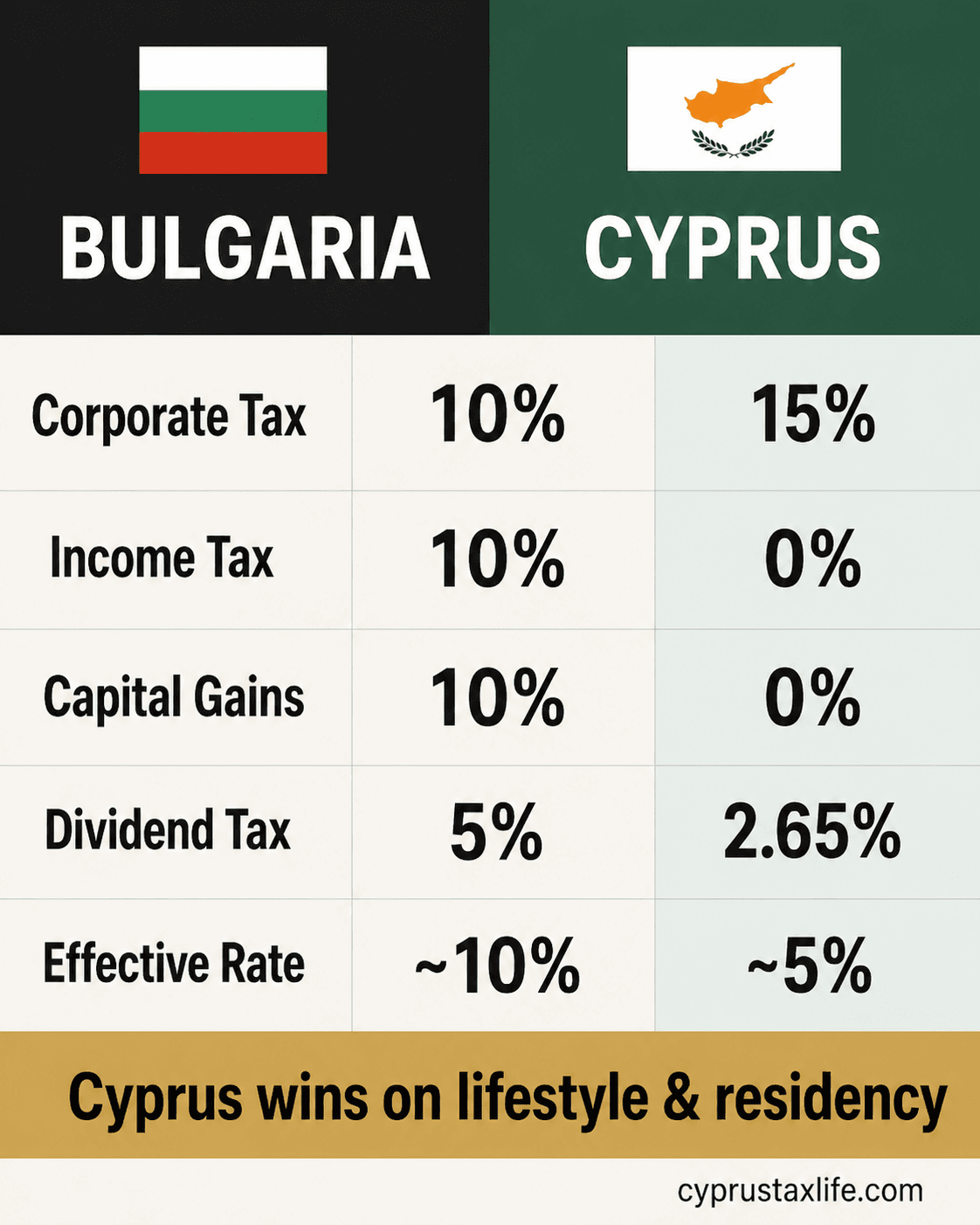
Tax Burden in Bulgaria
Bulgaria has one of the lowest flat tax rates in the EU: 10% on corporate income and 10% on personal income. This makes it one of the most competitive tax environments in the bloc. Dividends paid to shareholders face an additional 5% withholding tax.
For an entrepreneur through a Bulgarian EOOD (single-member Ltd): 10% corporate tax on EUR 100,000 leaves EUR 90,000. Dividend tax of 5% on EUR 90,000 = EUR 4,500. Total tax: EUR 14,500, an effective rate of 14.5%.
Social security contributions are lower than most EU countries but still meaningful. Employees pay approximately 13.78% (pension, health, other) and employers pay approximately 18.92%. Self-employed individuals pay contributions based on a declared income base. Monthly social security payments are mandatory even if the company has no profit.
Bulgaria's economic limitations include: lower banking standards than Western European norms (though EU-regulated), occasional issues with rule of law and corruption (improvement in recent years), lower quality of public infrastructure, and a much colder climate than Cyprus. Sofia, the capital, experiences temperatures as low as -10°C in winter.
**Bulgaria and Schengen:** Bulgaria joined Schengen for air and sea borders in March 2024. Land borders joined in January 2025. This is genuinely relevant for frequent travellers to Europe: from Sofia's airport you now pass through without passport control to the Schengen zone. Cyprus, by contrast, remains outside Schengen. For entrepreneurs who travel frequently within Europe, this is a practical advantage of Bulgaria over Cyprus.
Why Cyprus is Better for Entrepreneurs
Bulgaria's lower headline corporate tax rate (10% vs Cyprus's 15%) often surprises people: on the surface, Bulgaria looks cheaper. But the combined total effective rate tells a different story: 14.5% in Bulgaria versus approximately 5% in Cyprus via the Non-Dom structure. That is a gap of nearly 10 percentage points.
**Why Cyprus wins on total tax despite the higher corporate rate:**
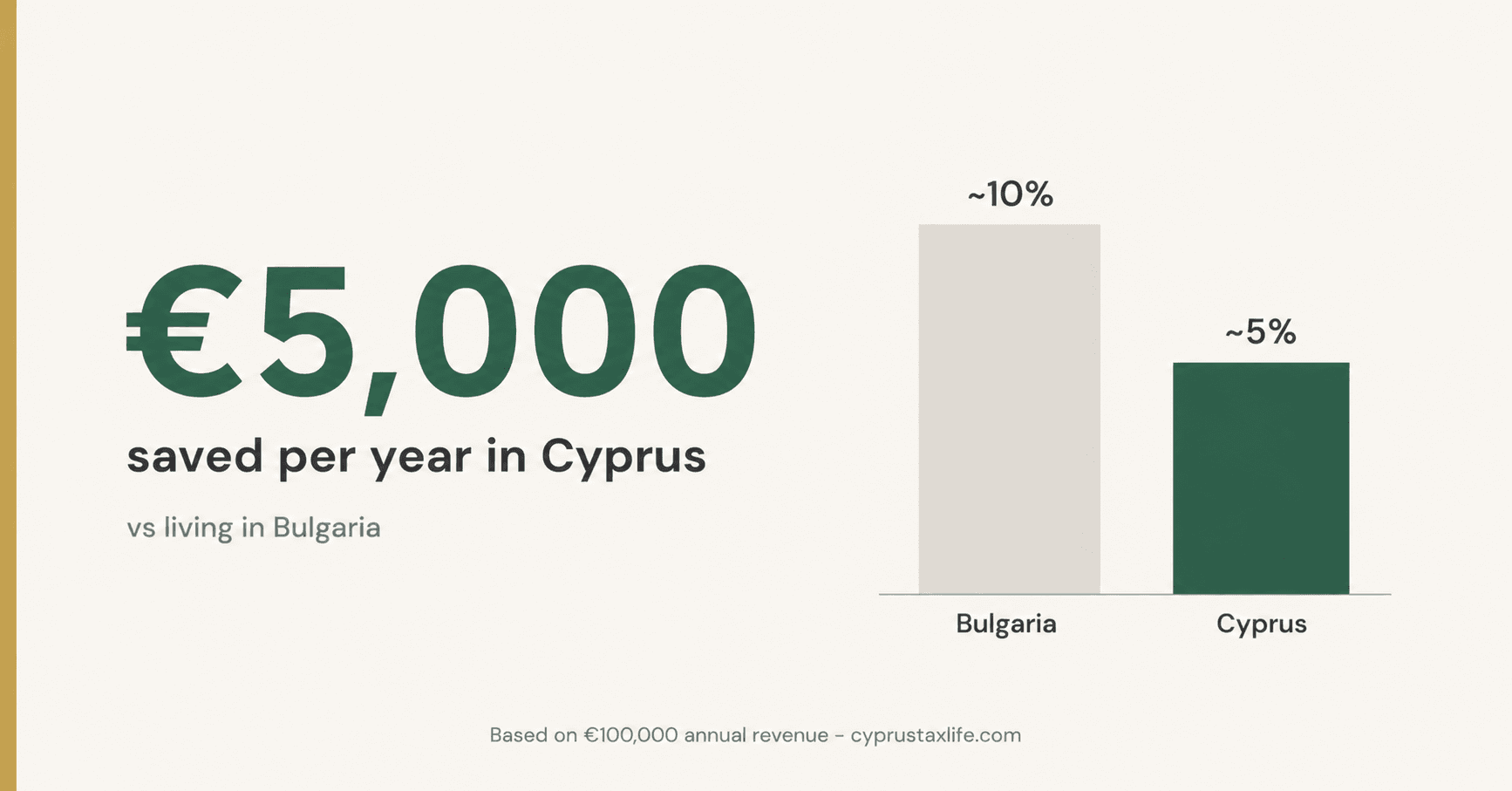
Bulgaria taxes dividends at 5% on top of 10% corporate tax. Cyprus taxes dividends at 0% income tax under Non-Dom, with only a 2.65% GHS healthcare contribution. For EUR 100,000 of revenue: Bulgaria yields EUR 14,500 in total tax; Cyprus yields approximately EUR 5,000. Annual saving: EUR 9,500, scaling linearly with revenue.
**Where Cyprus's structural advantages go further:**
1. **IP Box regime:** Cyprus has an IP Box that taxes qualifying intellectual property income at an effective rate of about 3%. Bulgaria has no equivalent IP Box. For any business with software, patents, or other IP, Cyprus can be dramatically more efficient.
2. **Participation exemption:** Cyprus exempts dividends received from subsidiary companies (in most cases) from corporate tax entirely. Bulgaria has no equivalent regime.
3. **Tax treaty network:** Cyprus has 65+ double tax treaties including with the USA, China, and India. Bulgaria has approximately 60 treaties, but notably lacks a treaty with the USA. For US-connected businesses, Cyprus is materially better.
4. **Banking and international business reputation:** Cyprus banks (Bank of Cyprus, Hellenic Bank) are well-regarded by EU and international counterparties. Bulgarian banking has improved significantly since EU accession, but some Western European and US banks still apply enhanced due diligence to Bulgarian entities.
5. **Language:** Cyprus conducts all business in English - it is the working language of finance, law, and business. In Bulgaria, Bulgarian is required for most official processes. For non-Bulgarian-speaking entrepreneurs, the operational friction in Bulgaria is real.
6. **Common law legal system:** Cyprus operates under English common law, directly familiar to businesses from the UK, Ireland, and internationally. Bulgaria uses civil law.
The practical question: is a ~9-10 percentage point tax difference worth relocating from Bulgaria to Cyprus? For businesses generating EUR 100,000+ annually, yes. For EUR 200,000+ of revenue, the annual saving exceeds EUR 19,000 and the case is compelling. For very small businesses (under EUR 50,000 revenue), the savings may not justify the relocation cost.
Tax Calculation: EUR 100,000
🇧🇬 Bulgaria
🇨🇾 Cyprus (Non-Dom)
Annual savings moving to Cyprus
EUR 9,500
EUR 47,500 over 5 years
Double Tax Treaty: Bulgaria - Cyprus
Bulgaria and Cyprus have a double tax treaty in force. Key provisions: dividends 5-10%, interest 7%, royalties 10%. Both are EU members, so EU directives reduce these rates to 0% for qualifying corporate transactions (parent-subsidiary directive). The treaty follows standard OECD principles.
A key treaty difference that is often overlooked: Cyprus has a tax treaty with the United States; Bulgaria does not. For entrepreneurs who receive income from US clients, own US-listed shares, or have US business connections, Cyprus provides treaty protection from US withholding taxes that Bulgaria cannot offer. This is a significant structural advantage of Cyprus over Bulgaria for internationally-oriented businesses.
Bulgaria's treaty network of approximately 60 treaties covers most major European economies. Cyprus's 65+ cover a broader range including many emerging markets in Asia and Africa.
Exit Tax and Emigration from Bulgaria
Bulgaria does not impose an exit tax on individuals emigrating. The main considerations when leaving Bulgaria are: deregistering from Bulgarian social security (NOI), filing your final personal income tax return (Form 1 to the NRA - National Revenue Agency), and handling any outstanding VAT or corporate tax obligations. Bulgarian company shares can be sold without capital gains tax concerns in most cases if held over 12 months. The process is administratively lighter than leaving Germany, France, or Spain.
Timing consideration: if you have been operating an EOOD with retained earnings, consider timing any dividend distributions before the company is wound down, as distributions after deregistration can create complications.
Cost of Living: Bulgaria vs Cyprus
Bulgaria, particularly Sofia, is one of the cheapest countries in the EU. Rent for a 2-bedroom apartment in Sofia: EUR 400-700. Food and dining are extremely affordable: restaurant meal for two EUR 15-25. Plovdiv and Varna are similarly affordable. However, Cyprus, while more expensive than Bulgaria (Larnaca EUR 550-750, Limassol EUR 650-900), offers dramatically better quality of life for international entrepreneurs: Mediterranean climate, beaches, English-speaking environment, and an established international business community.
Monthly cost-of-living comparison: - Sofia: approximately EUR 900-1,400 (very affordable) - Larnaca: approximately EUR 1,300-1,900
The difference is approximately EUR 300-600/month (EUR 3,600-7,200/year) in favor of Bulgaria. Against this: the annual tax saving in Cyprus on EUR 100,000 of revenue is EUR 9,500. Net financial benefit of Cyprus: EUR 2,300-5,900 annually on EUR 100,000 of revenue, growing proportionally with income. On EUR 200,000, the net benefit is EUR 12,000+/year even after accounting for higher living costs.
For lifestyle quality, most international entrepreneurs, particularly those from Western Europe, strongly prefer Cyprus: year-round warmth, beach access, and the established expat infrastructure (international schools, English-speaking lawyers and accountants, EU-standard healthcare through the GHS).
Practical Steps to Relocate
Establish a Cyprus Ltd company (5-7 working days, EUR 1,100-1,800 all-in)
Apply for Cyprus tax residency (60-day or 183-day rule)
Register as Non-Dom at the Cyprus Tax Department
Obtain your Yellow Slip (EU citizen registration)
Open a Cyprus bank account
Deregister from Bulgarian tax residency (submit notification to NRA - National Revenue Agency)
File your final Bulgarian personal tax return (Form 1 to NRA)
Address Bulgarian social insurance (NOI) deregistration
Handle Bulgarian company (EOOD) closure or transfer if applicable
Set up Cyprus payroll structure and GHS healthcare contributions
Frequently Asked Questions
Bulgaria has 10% corporate tax. Why does Cyprus win?+
Is Bulgaria cheaper than Cyprus to live in?+
Which country has better tax for crypto, Cyprus or Bulgaria?+
Can I live in Bulgaria and have a Cyprus company?+
Which country has better banking for expats?+
Is Bulgaria in the Schengen area now?+
Does Cyprus have an IP Box that Bulgaria lacks?+
What is the process to move from Bulgaria to Cyprus?+
Sources and References
Tax data: PwC Worldwide Tax Summaries, KPMG Tax Guides (2025/2026), Big Four country guides, government tax authority publications. Effective rates are approximations for entrepreneur structures (company + low salary + dividends). Consult a qualified tax advisor before making decisions.
Free, no commitment
Moving to Cyprus or opening a company?
Tell us your situation and we'll connect you with our specialist expat advisory in Cyprus: Non-Dom tax, company setup and residency, done for you. Free consultation, no commitment.
Related Articles
Germany's exit tax (§6 AStG) taxes unrealised gains on shares >1% when you emigrate. Moving to Cyprus (EU): you can defer payment indefinitely. Full breakdown for German founders and investors.
 Miriam Alonso
- Tax Planning
- Relocation
Canada's departure tax treats you as having sold your worldwide assets the day you stop being a tax resident. What is caught, what is exempt, how to defer it, and what the cost-base reset means for where you go next.
![Countries With No Property Tax [2026]: The Real Cost](https://cdn.sanity.io/images/glqahhks/production/6f7ea0efceed8a692ad7c3785efa8baaf4d1e208-1679x937.jpg?w=700&q=75&auto=format)
Compare countries with no property tax and the stamp duty they charge instead. See the 10-year holding cost that makes Cayman pricier than Portugal.
Miriam Alonso