Cyprus vs UK 2026: Tax, Brexit and Why Entrepreneurs Are Leaving
UK entrepreneurs pay 25% corporation tax plus up to 39.35% dividend tax = 40-45% effective. Cyprus Non-Dom: ~5%. Full comparison including Brexit EU-access angle, 0% UK-Cyprus treaty WHT and Temporary Non-Residence rules.
Last updated: 2026-06-01
Effective tax rate comparison
~40-45%
United Kingdom
~5%
Cyprus Non-Dom
Which Is Better For You?
Remote worker / freelancer
Cyprus wins decisively. UK Ltd owners pay 25% corp tax + up to 39.35% on dividends = 40-45% effective rate. Cyprus Non-Dom: ~5%. On EUR 100,000 of revenue that is ~EUR 35,000-40,000 extra per year in the UK. Plus: Cyprus gives you EU single market access post-Brexit that a UK Ltd no longer has.
Holding company / IP owner
Cyprus wins. Cyprus provides full EU access (parent-subsidiary directive, VAT OSS, freedom of establishment) that UK companies lost post-Brexit. For any business with EU clients or EU subsidiaries, Cyprus is operationally and fiscally superior. CGT on shares: 24% in UK vs 0% in Cyprus.
Retiree / passive investor
Cyprus wins for most. UK IHT at 40% above GBP 325k is a major long-term burden Cyprus has no equivalent of. For pension income: UK state pension is taxable in the UK; foreign pensions received in Cyprus as Non-Dom are exempt from Cyprus income tax. Careful exit planning from the UK Statutory Residence Test is needed.
Crypto investor
Cyprus wins. UK taxes crypto gains at 18-24% CGT. Cyprus introduced 8% flat for professional crypto traders (2026) or 0% for individual investors on non-Cyprus assets. UK also has complex pooling and matching rules. Cyprus is simpler and cheaper.
Tax Comparison: United Kingdom vs Cyprus
| 🇬🇧 United Kingdom | 🇨🇾 Cyprus (Non-Dom) | |
|---|---|---|
| Corporate tax | 25% | 15% |
| Income tax | Up to 45% (+ 2% NIC) | 0% (dividends) |
| Capital gains tax | 24% (gains on shares) | 0% (no Cyprus property) |
| Dividend tax | 8.75% / 33.75% / 39.35% (by band) | 0% income tax + 2.65% GHS |
| Wealth tax | None (but IHT 40% above GBP 325k) | None |
| Social contributions | 8% employee NIC (+ 13.8% employer) | ~4% on salary (capped) |
| Effective rate (entrepreneur) | ~40-45% | ~5% |
| VAT | 20% | 19% |
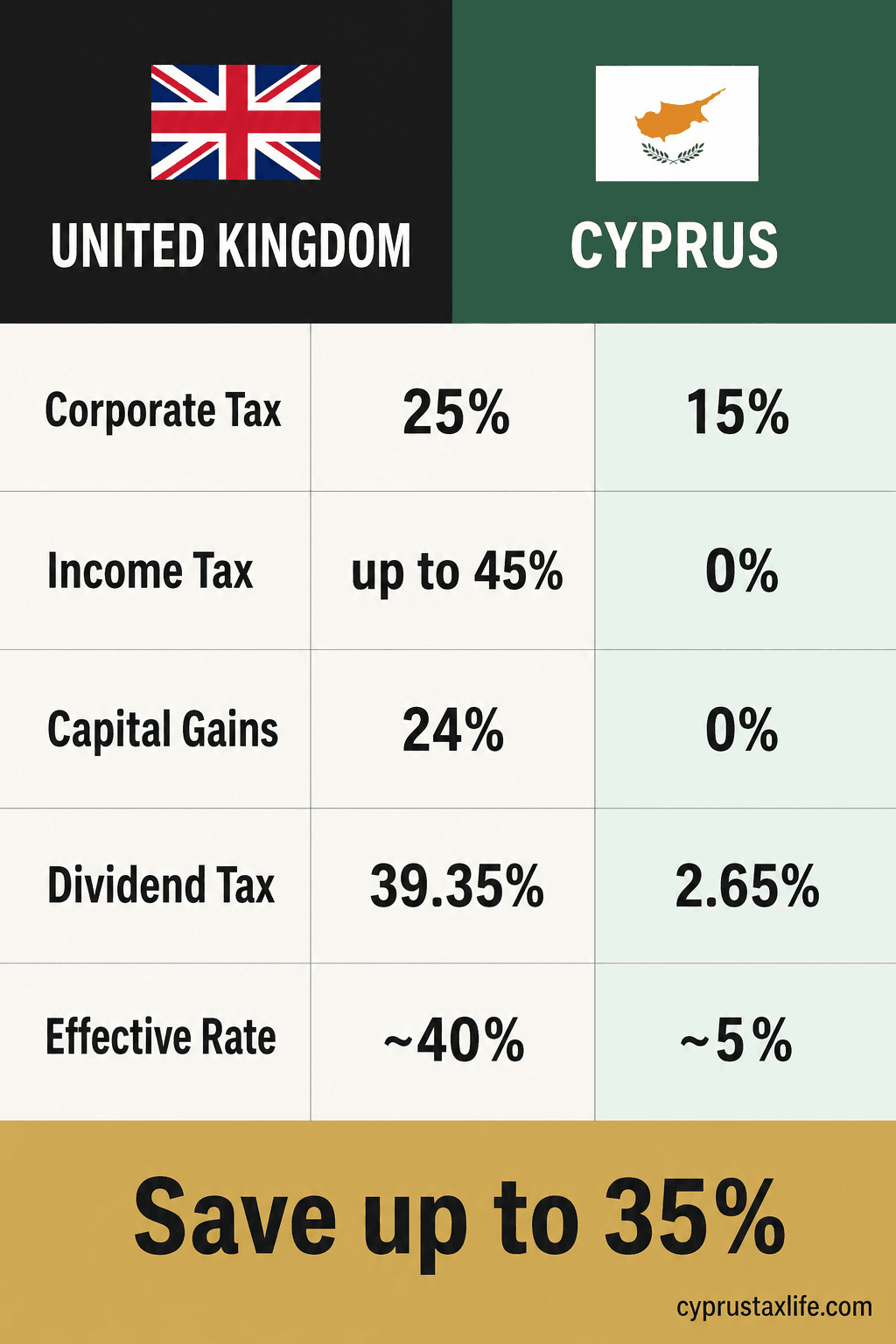
Tax Burden in United Kingdom
The United Kingdom has one of the highest effective tax burdens for owner-managed businesses in Europe. Following the corporation tax rise to 25% in April 2023 (for profits above GBP 250,000), UK entrepreneurs running a limited company face a double layer of taxation that significantly erodes returns.
Corporate profits are taxed at 25% (the small profits rate of 19% applies only below GBP 50,000, with a marginal relief taper between GBP 50,000 and GBP 250,000). When distributing profits as dividends, shareholders pay an additional 8.75% (basic rate), 33.75% (higher rate, income over GBP 50,270), or 39.35% (additional rate, income over GBP 125,140). The dividend allowance was cut to just GBP 500 from April 2024.
For a director earning GBP 100,000 through salary, income tax reaches 40-45% plus National Insurance. Even with the optimized structure (minimum salary + dividends), the combined effective rate on GBP 100,000 of company profit easily reaches 40-45%. The removal of the higher personal allowance above GBP 100,000 (60% effective marginal rate between GBP 100,000 and GBP 125,140) makes the UK particularly punishing for mid-level earners.
Inheritance tax at 40% on estates above GBP 325,000 (GBP 500,000 with a residential property nil-rate band) adds further long-term burden. Capital gains tax on shares and investments was raised to 18%/24% from October 2024. The UK tax system has become progressively less competitive since 2021.
Why Cyprus is Better for Entrepreneurs
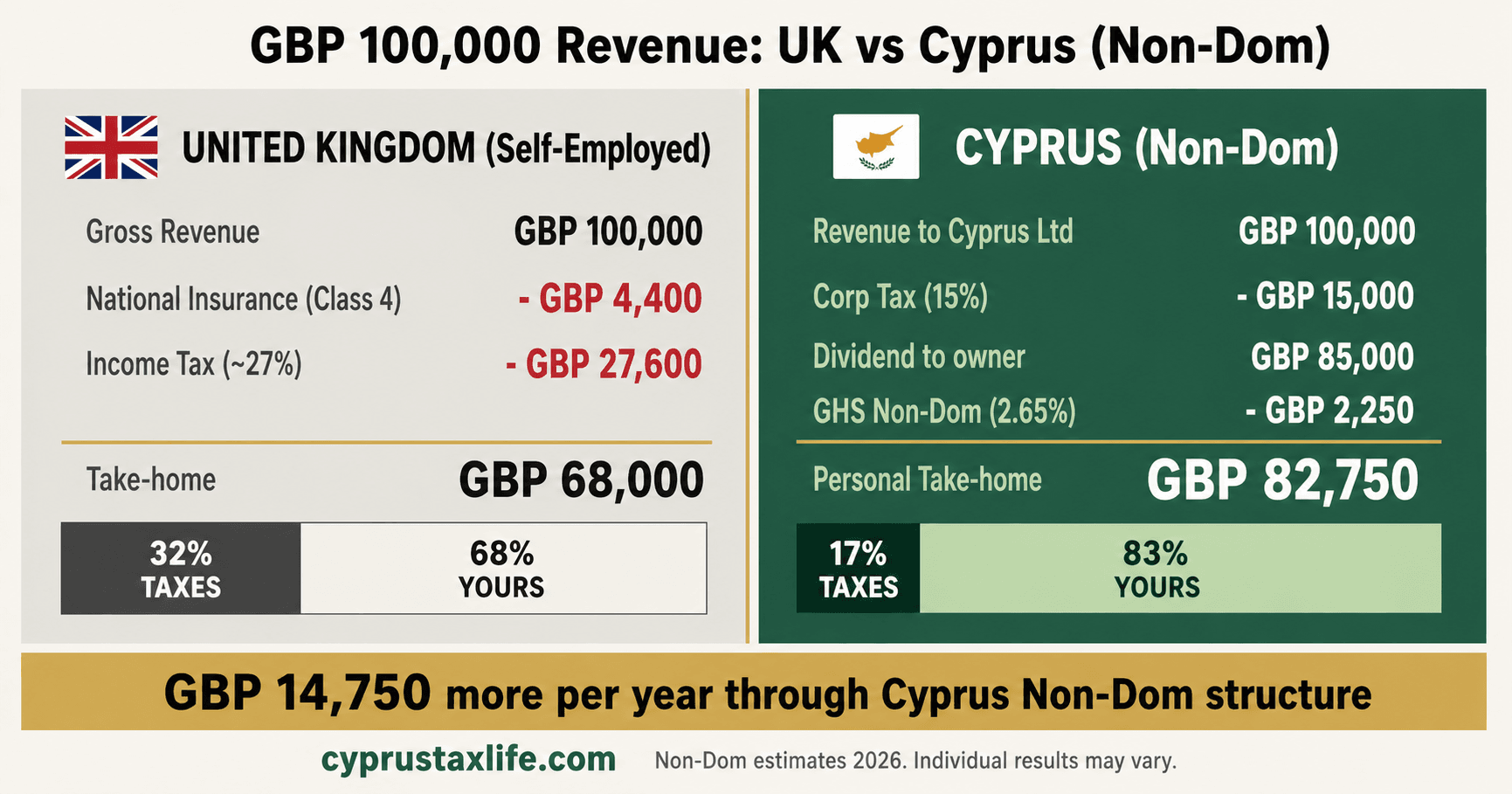
Cyprus under the Non-Dom regime offers a dramatically simpler and more efficient structure for UK entrepreneurs. The corporate tax rate is a flat 15% with no surcharges and no small/large company distinction. Dividends paid from a Cyprus Ltd to a Non-Dom shareholder are completely exempt from income tax, with only the 2.65% GHS healthcare contribution applying.
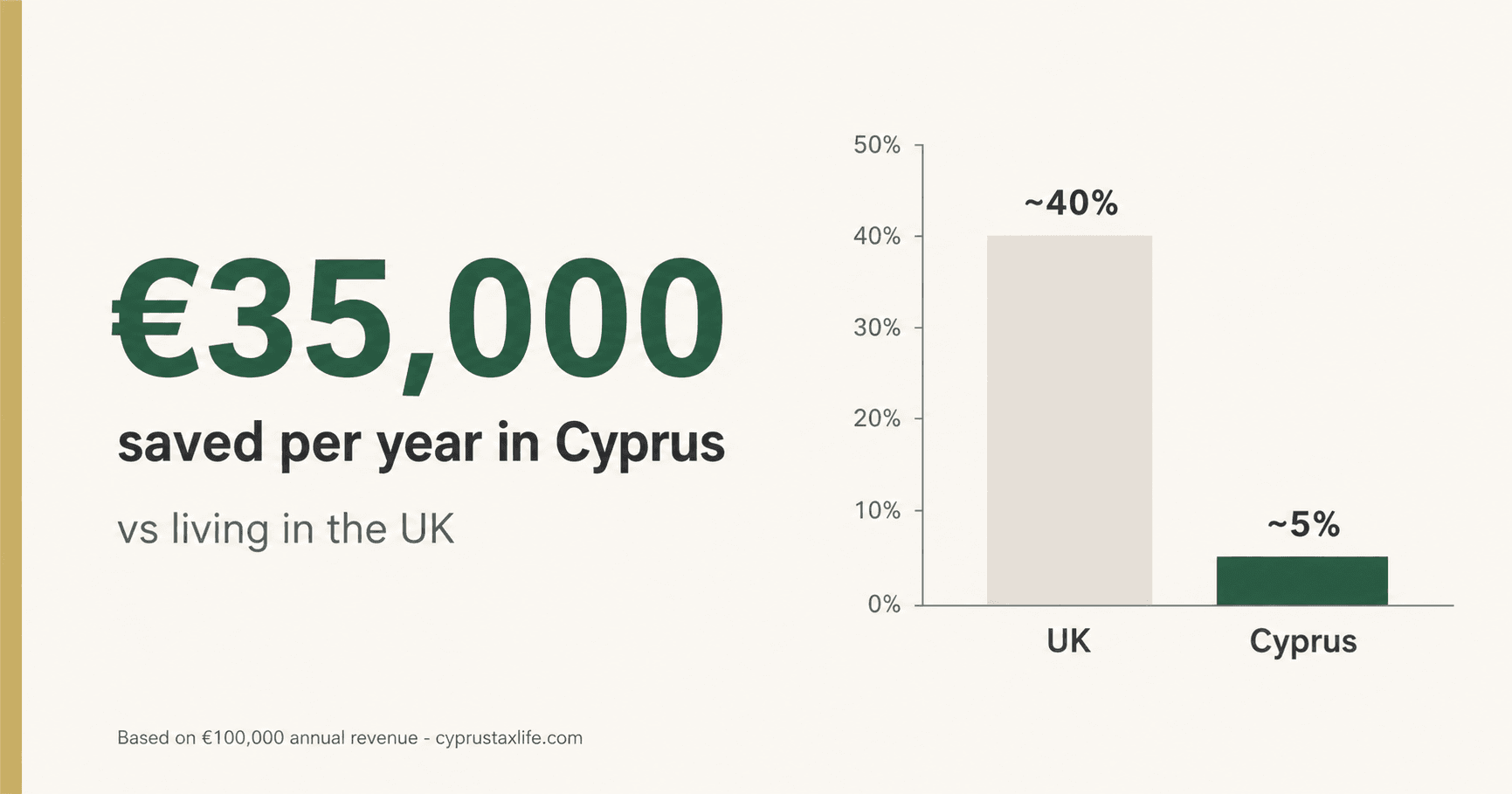
On EUR 100,000 of revenue, the effective rate through a Cyprus Ltd under Non-Dom is approximately 5%. Compare this to 40-45% in the UK, and the annual saving for an entrepreneur billing EUR 100,000 is approximately EUR 35,000-40,000.
Cyprus is a full EU member state, which is particularly relevant for UK entrepreneurs post-Brexit. A Cyprus Ltd maintains full access to the EU single market, can invoice EU clients without complication, and benefits from EU directives. UK companies, by contrast, have lost passporting rights and face increased friction with EU clients since Brexit.
The 60-day rule makes Cyprus tax residency accessible for internationally mobile professionals. As an EU citizen (if you hold Irish, German, or other EU citizenship) or through the company structure, Cyprus provides a compliant and legitimate tax base. British nationals (non-EU) need to meet standard immigration requirements but Cyprus offers various visa routes.
Tax Calculation: EUR 100,000
🇬🇧 United Kingdom
🇨🇾 Cyprus (Non-Dom)
Annual savings moving to Cyprus
EUR 35,000
EUR 175,000 over 5 years
Double Tax Treaty: United Kingdom - Cyprus
The UK and Cyprus have had a comprehensive double tax treaty since 1974, recently updated. Key provisions include: 0% withholding on dividends (where the beneficial owner holds at least 10% of capital), 0% on interest, and 0% on royalties. The treaty contains tie-breaker rules based on permanent home, center of vital interests, habitual abode, and nationality. For UK entrepreneurs, the treaty provides protection against double taxation during the transition period. Cyprus-source income is generally exempt from UK tax once Cyprus residency is properly established. British nationals planning to relocate should ensure they spend fewer than 16 days in the UK per tax year (if formerly non-UK resident) or meet the relevant UK Statutory Residence Test conditions.
Exit Tax and Emigration from United Kingdom
The UK does not have a formal exit tax in the same way as Germany or France. However, entrepreneurs need to carefully manage the UK Statutory Residence Test (SRT). Spending 16 or more days in the UK (if you previously had stronger ties) can result in UK tax residency being maintained despite a formal move abroad. The UK also has a Temporary Non-Residence rule: if you are non-UK resident for fewer than 5 complete tax years and return, certain income and gains during the non-residence period can be taxed in the UK upon return. For this reason, commitment to at least 5 years outside the UK is advisable. Company shares may trigger capital gains consideration if the company has UK assets. Professional advice on the SRT and emigration timing is essential.
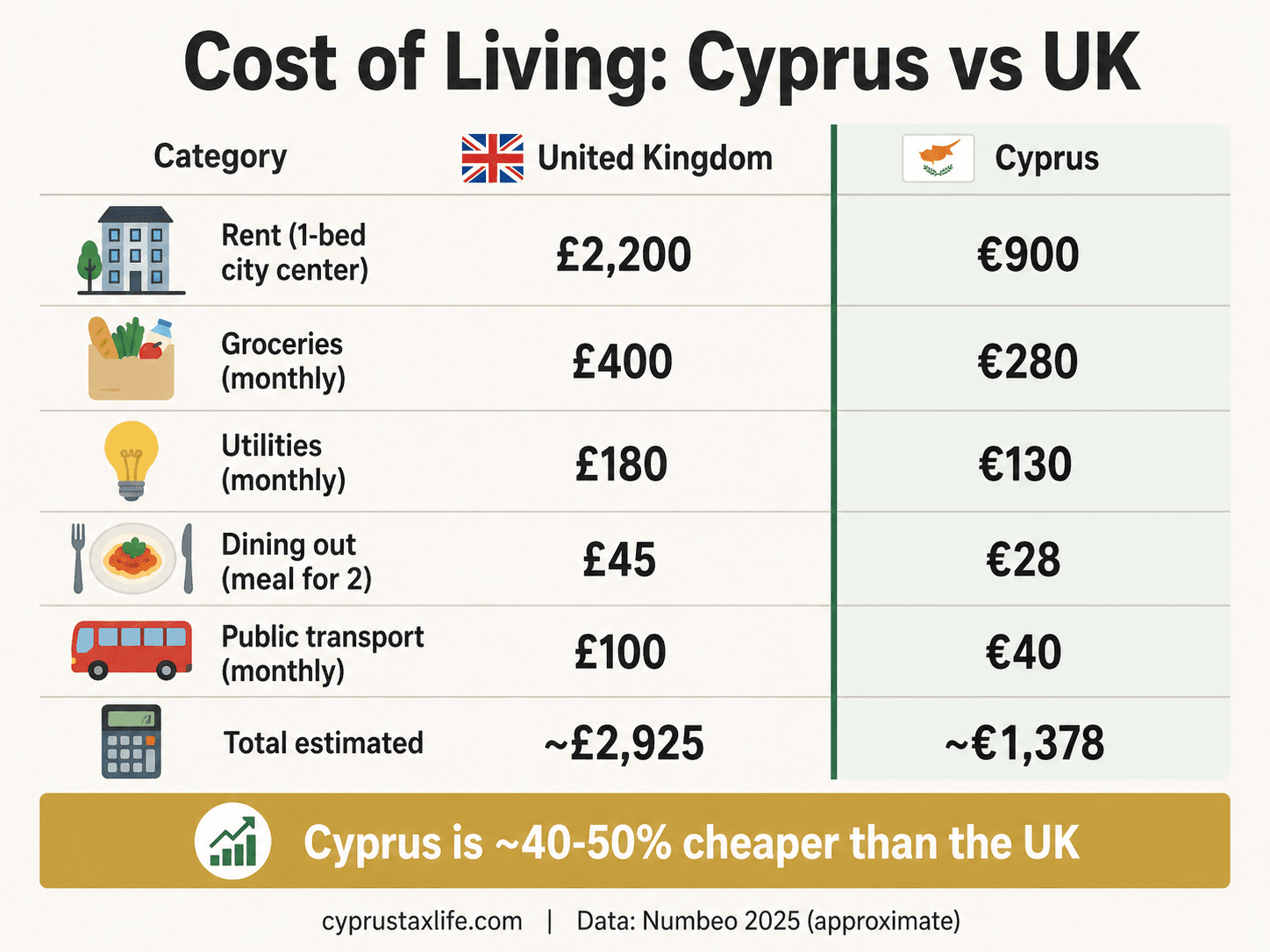
Cost of Living: United Kingdom vs Cyprus
Cyprus is substantially cheaper than the UK, particularly compared to London and the South East. A 2-bedroom apartment in Larnaca costs EUR 550-750 per month, compared to GBP 1,800-2,500 in London or GBP 900-1,400 in other major UK cities. Groceries are approximately 30-40% cheaper in Cyprus. Dining out costs roughly half UK prices: a quality restaurant meal for two runs EUR 30-45 in Cyprus vs GBP 60-100 in London. Healthcare through the GHS system (2.65% contribution) replaces NI contributions for healthcare. Car insurance, fuel, and utilities are cheaper. A single professional can live comfortably in Cyprus on EUR 1,500-2,000 per month versus GBP 2,500-4,000 in London.
Practical Steps to Relocate
Review your UK Statutory Residence Test position and determine your planned exit date
Establish a Cyprus Ltd company (5-7 working days, EUR 1,100-1,800 all-in)
Apply for Cyprus tax residency (60-day rule if EU citizen, or full 183-day rule)
Register as Non-Dom at the Cyprus Tax Department
Obtain your registration certificate (Yellow Slip equivalent for non-EU nationals)
Open a Cyprus bank account
File your UK P85 form (leaving the UK) with HMRC
Submit your final UK self-assessment tax return
Ensure you comply with the Temporary Non-Residence rules if applicable
Set up PAYE/payroll structure in Cyprus (low salary + dividends)
Consider whether to retain your UK Ltd or dissolve it
Frequently Asked Questions
Will HMRC challenge my move to Cyprus?+
Can I keep my UK Ltd company after moving to Cyprus?+
How does the Temporary Non-Residence rule work?+
Is there a UK exit tax on shares?+
Do I need EU citizenship to use the Cyprus 60-day rule?+
Does Cyprus have a double tax treaty with the UK?+
Sources and References
Tax data: PwC Worldwide Tax Summaries, KPMG Tax Guides (2025/2026), Big Four country guides, government tax authority publications. Effective rates are approximations for entrepreneur structures (company + low salary + dividends). Consult a qualified tax advisor before making decisions.
Free, no commitment
Moving to Cyprus or opening a company?
Tell us your situation and we'll connect you with our specialist expat advisory in Cyprus: Non-Dom tax, company setup and residency, done for you. Free consultation, no commitment.
Related Articles
Germany's exit tax (§6 AStG) taxes unrealised gains on shares >1% when you emigrate. Moving to Cyprus (EU): you can defer payment indefinitely. Full breakdown for German founders and investors.
 Miriam Alonso
- Tax Planning
- Relocation
Canada's departure tax treats you as having sold your worldwide assets the day you stop being a tax resident. What is caught, what is exempt, how to defer it, and what the cost-base reset means for where you go next.
![Countries With No Property Tax [2026]: The Real Cost](https://cdn.sanity.io/images/glqahhks/production/6f7ea0efceed8a692ad7c3785efa8baaf4d1e208-1679x937.jpg?w=700&q=75&auto=format)
Compare countries with no property tax and the stamp duty they charge instead. See the 10-year holding cost that makes Cayman pricier than Portugal.
Miriam Alonso