Cyprus vs Spain 2026: Tax Comparison Including Beckham Law vs Non-Dom
Spain: 25% corp + 28% dividend + wealth tax = 40-48% effective. Cyprus Non-Dom: ~5%. Beckham Law at 24% is still 5x Cyprus. EUR 38,000 saved per year. Full 2026 comparison including exit tax and Hacienda compliance.
Last updated: 2026-06-01
Effective tax rate comparison
~40-48%
Spain
~5%
Cyprus Non-Dom
Which Is Better For You?
Remote worker / freelancer
Cyprus wins by a large margin. Spain: 25% corp + up to 28% dividends + potential wealth tax = 40-48% effective. Cyprus: ~5%. Even the Beckham Law (24% flat for 6 years) is still 5x more expensive than Cyprus Non-Dom (~5%). For any entrepreneur, Cyprus is the rational choice.
Holding company / IP owner
Cyprus wins. Spain has aggressive CFC rules and high total tax on distributions. Cyprus has IP Box (about 3%), participation exemption, and 65+ treaties. No Spanish wealth tax (Patrimonio) for Cyprus residents on non-Spanish assets.
Retiree / passive investor
Cyprus wins for investment income. Spain's wealth tax (Patrimonio) in most regions charges 0.2-3.5% on net wealth above EUR 700k. Cyprus has zero wealth tax. For dividend income: 19-28% in Spain vs 0% income tax in Cyprus (only 2.65% GHS). The savings compound year after year.
Crypto investor
Cyprus wins. Spain taxes crypto as capital gains at 19-28% (savings income scale). Cyprus: 8% flat for professional traders (2026), 0% for individual investors. Cyprus is clearly better.
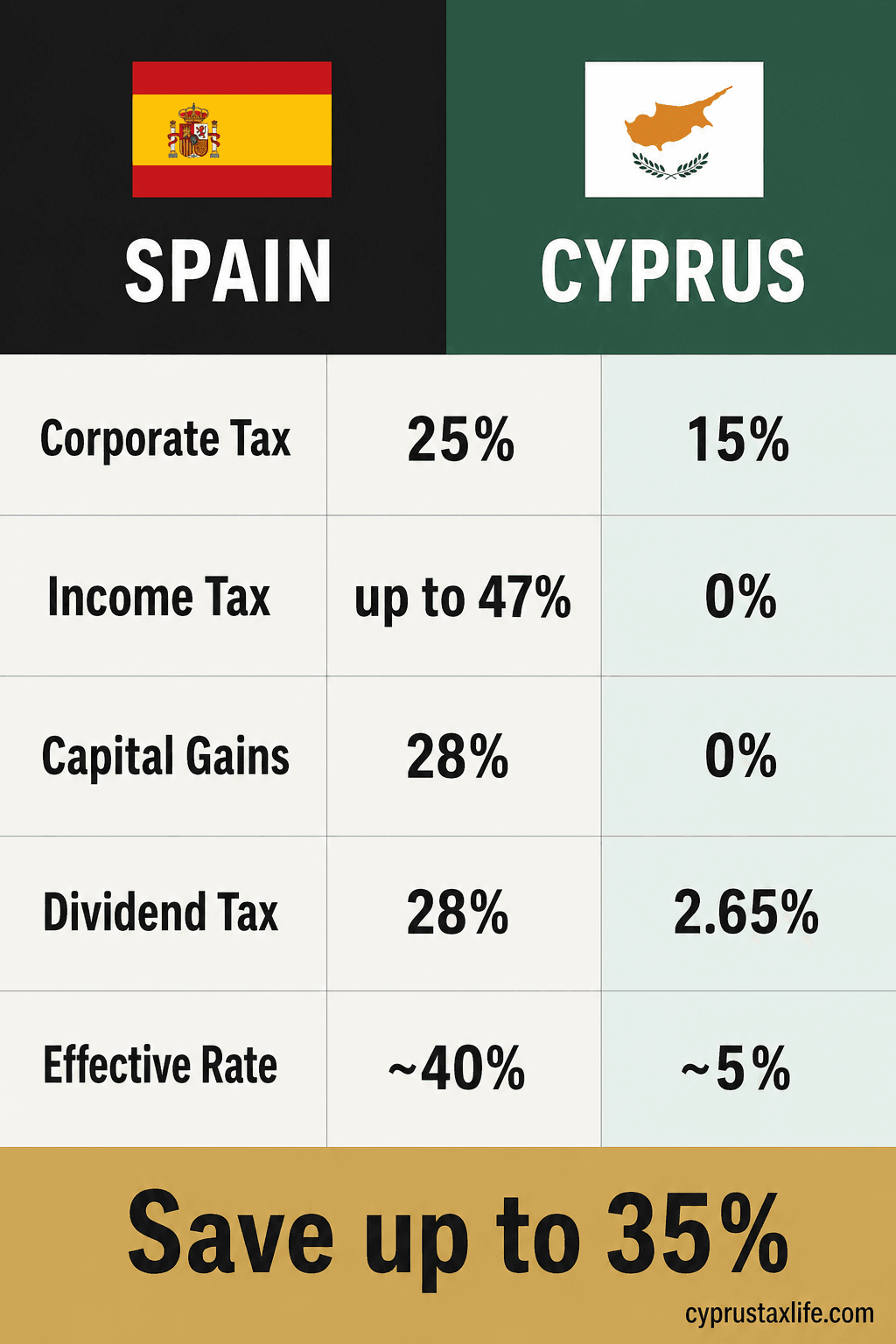
Tax Comparison: Spain vs Cyprus
| 🇪🇸 Spain | 🇨🇾 Cyprus (Non-Dom) | |
|---|---|---|
| Corporate tax | 25% | 15% |
| Income tax | Up to 47% (+ regional surcharge) | 0% (dividends) |
| Capital gains tax | 19-28% (on savings income) | 0% (no Cyprus property) |
| Dividend tax | 19-28% (on savings income) | 0% income tax + 2.65% GHS |
| Wealth tax | 0.2-3.5% (varies by region) | None |
| Social contributions | ~6.35% employee + ~29.9% employer | ~4% on salary (capped) |
| Effective rate (entrepreneur) | ~40-48% | ~5% |
| VAT | 21% | 19% |
Tax Burden in Spain
Spain has one of the most complex and burdensome tax systems in Europe, particularly for entrepreneurs and high earners. The IRPF (personal income tax) is progressive from 19% to 47% at the national level, with regions like Catalonia and Valencia adding surcharges that push the marginal rate to 54% or higher.
For entrepreneurs operating through a Sociedad Limitada (SL), the corporate tax rate is 25% (15% in the first two years of activity). When distributing profits as dividends, shareholders pay an additional 19-28% on the savings income scale: 19% up to EUR 6,000, 21% from EUR 6,000 to EUR 50,000, 23% from EUR 50,000 to EUR 200,000, 27% from EUR 200,000 to EUR 300,000, and 28% above that.
Spain also imposes a wealth tax (Impuesto sobre el Patrimonio) in most regions, ranging from 0.2% to 3.5% on net wealth above the exemption threshold (EUR 700,000 nationally, though Madrid exempts residents). This adds a recurring annual burden on accumulated assets.
Social security contributions are very high: employees pay approximately 6.35% and employers 29.9% of gross salary. Autónomos (self-employed) pay monthly contributions on a declared income base, which can range from EUR 230 to over EUR 500 per month depending on declared income. The Beckham Law (special expat regime) offers a flat 24% rate for the first 6 years, but this applies only to salaried employment and has specific conditions.
Why Cyprus is Better for Entrepreneurs
For Spanish entrepreneurs, the contrast with Cyprus is dramatic. The total effective rate in Spain often reaches 40-48% for owner-managed businesses, while Cyprus Non-Dom achieves approximately 5%.
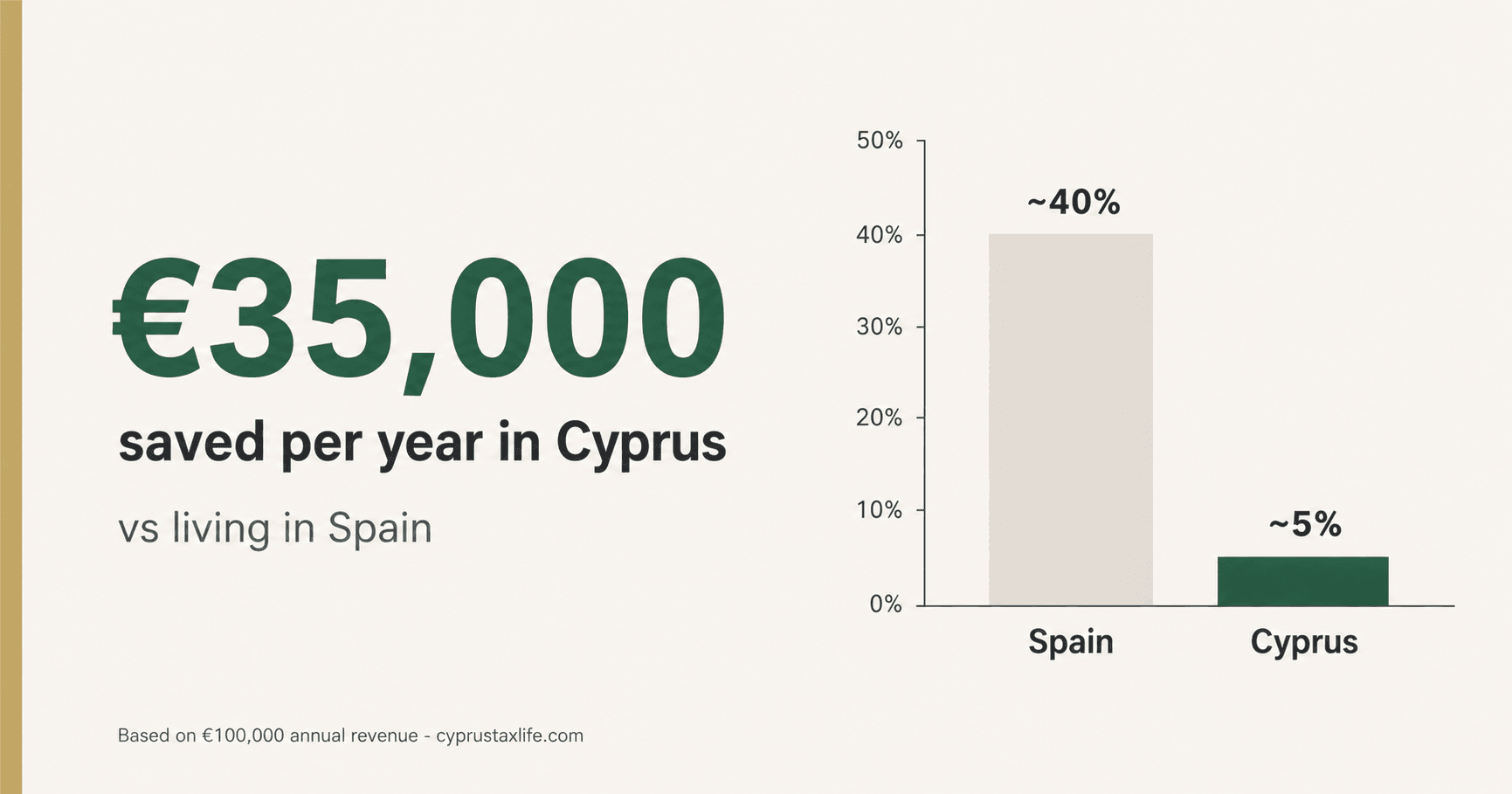
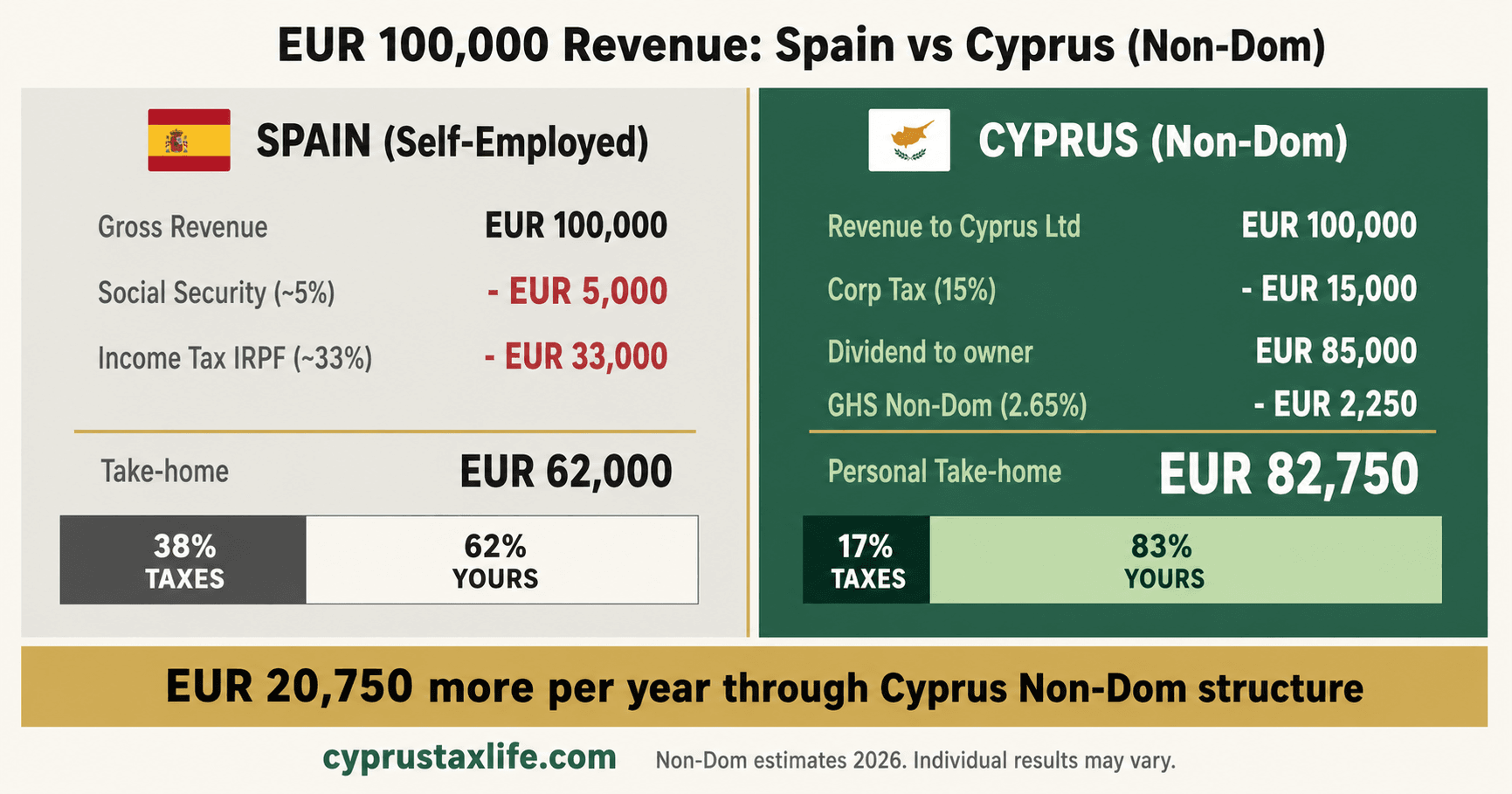
With a Cyprus Ltd, corporate tax is 15% flat. Under Non-Dom status, dividends are exempt from income tax (only 2.65% GHS). No wealth tax, no succession tax, no gift tax. On EUR 100,000 of revenue, the total effective rate is approximately 5%, saving EUR 35,000-43,000 annually compared to Spain.
Cyprus is a full EU member, meaning Spanish clients can be invoiced without complications using the reverse charge VAT mechanism for B2B services. The double tax treaty between Spain and Cyprus provides protection during the transition period. Cyprus has a large and growing Spanish-speaking community, particularly in Limassol and Larnaca.
The Beckham Law, while attractive at 24%, is still significantly higher than Cyprus Non-Dom's ~5%, has a 6-year time limit, applies mainly to salaried income, and requires an employment or director contract in Spain. Cyprus Non-Dom has no time limit (beyond the 17-of-20-years non-residency requirement) and applies to all dividends.
Tax Calculation: EUR 100,000
🇪🇸 Spain
🇨🇾 Cyprus (Non-Dom)
Annual savings moving to Cyprus
EUR 38,000
EUR 190,000 over 5 years
Double Tax Treaty: Spain - Cyprus
Spain and Cyprus have a double tax treaty. Spanish residence generally applies for the whole calendar year. Domestic tests include time spent in Spain, the main centre of economic interests, and a rebuttable presumption involving a spouse and dependent minor children in Spain. If both countries consider you resident, assess the treaty's residence tie-breaker. Neither a Cyprus tax residence certificate nor Modelo 030 alone determines Spanish non-residence. Check the treaty treatment of each income type separately.
Exit Tax and Emigration from Spain
Article 95 bis LIRPF can tax positive unrealised gains on shares when Spanish tax-resident status is lost. You must have been an IRPF taxpayer for at least 10 of the 15 tax periods before the last IRPF period. The holding thresholds are combined share market value above EUR 4 million, or ownership above 25% in an entity with that holding valued above EUR 1 million. In the second case, only that holding is covered. The thresholds measure market value, not unrealised gains.
For moves to the EU or a qualifying EEA state with effective tax-information exchange, an optional special regime has communication requirements. Filing can be triggered in the 10 tax years following the last IRPF period by a sale or other lifetime transfer, loss of EU/EEA residence, or failure to meet the required communications. This is not an automatic, indefinite deferral or a blanket annual-reporting rule. Temporary-move deferral and relief on returning to Spain have separate conditions; returning within 5 years does not universally cancel the charge.
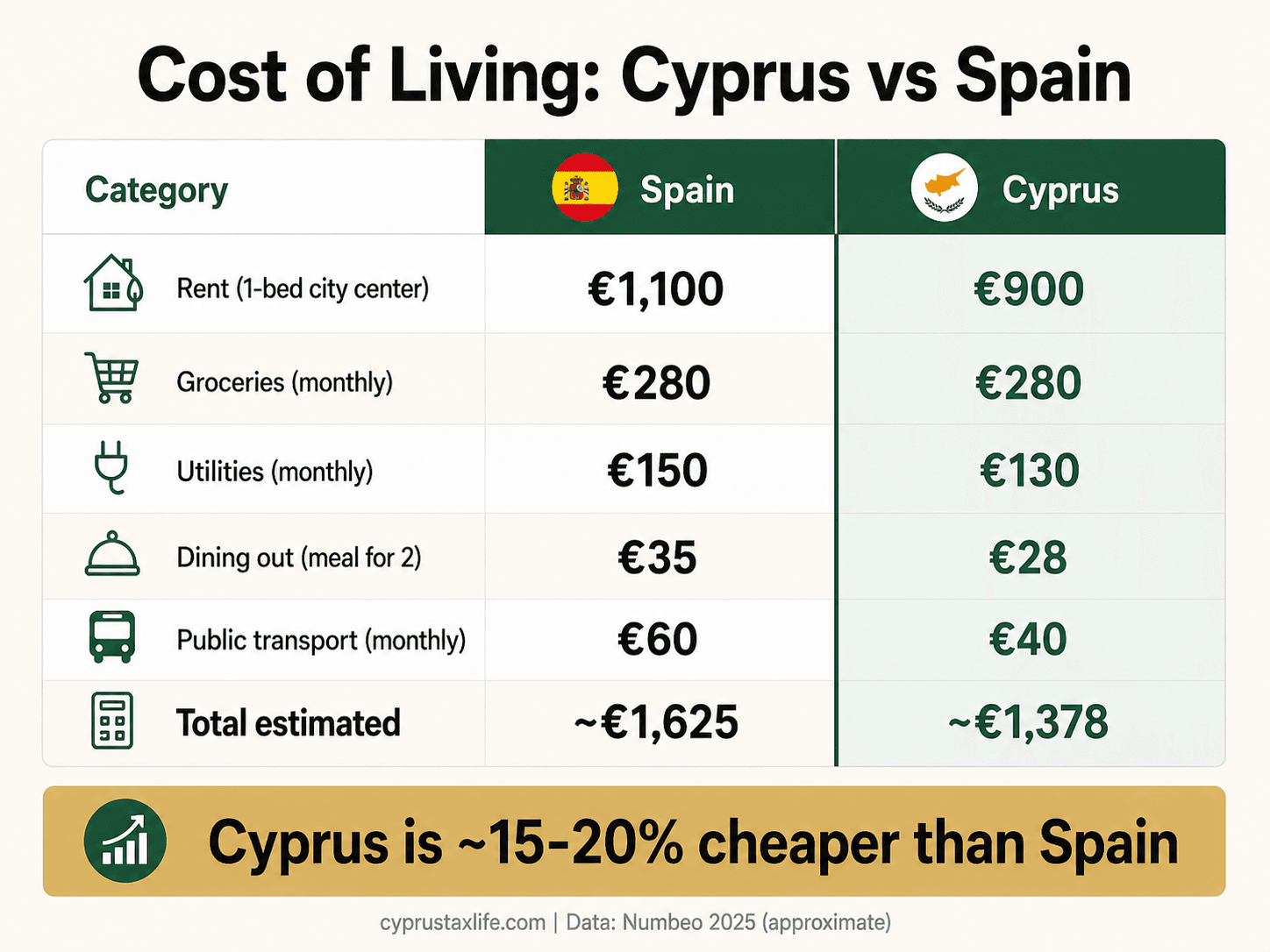
Cost of Living: Spain vs Cyprus
Cyprus offers a comparable or slightly lower cost of living compared to major Spanish cities. Barcelona and Madrid are more expensive than Limassol or Larnaca in housing, dining, and services. Smaller Spanish cities (Valencia, Seville, Malaga) are comparable to Cypriot cities. Rent for a 2-bedroom apartment: Larnaca EUR 550-750, Limassol EUR 650-900, Barcelona EUR 1,200-1,800, Madrid EUR 1,100-1,600. Groceries are 15-25% cheaper in Cyprus. Mediterranean cuisine and lifestyle are similar. The biggest difference is climate: both countries are Mediterranean, though Cyprus offers more consistent heat. Spain has better public transport infrastructure but Cyprus has simpler bureaucracy for business setup.
Practical Steps to Relocate
Assess full-calendar-year Spanish residence and any treaty tie-breaker
Establish a Cyprus Ltd company (5-7 working days, EUR 1,100-1,800 all-in)
Apply for Cyprus tax residency
Register as Non-Dom at the Cyprus Tax Department
Obtain your Yellow Slip (EU citizen registration certificate)
Open a Cyprus bank account
Update Hacienda census details through the appropriate procedure; Modelo 030 is not a tax return or a residence determination
File the applicable IRPF or non-resident returns and review both Article 95 bis market-value tests and any EU/EEA option
If your activity or contribution liability actually ends, confirm the relevant autónomo and RETA procedures separately with your adviser or TGSS
Confirm applicable social-security coverage rather than assuming the move ends Spanish contributions
Transfer healthcare to the Cyprus GHS system
Frequently Asked Questions
Can Hacienda challenge my move to Cyprus?+
What about the Beckham Law vs Cyprus Non-Dom?+
Do I owe Spain wealth tax if I move to Cyprus?+
How does VAT work for my Cyprus company with Spanish clients?+
Is there a Spanish-speaking community in Cyprus?+
How long does it take to set up everything in Cyprus?+
Sources and References
Tax data: PwC Worldwide Tax Summaries, KPMG Tax Guides (2025/2026), Big Four country guides, government tax authority publications. Effective rates are approximations for entrepreneur structures (company + low salary + dividends). Consult a qualified tax advisor before making decisions.
Free, no commitment
Moving to Cyprus or opening a company?
Tell us your situation and we will introduce you to our expat advisory firm in Cyprus. The introduction is free; it does not include the 30-minute video call or the firm's later work.
Related Articles
Germany's exit tax (§6 AStG) taxes unrealised gains on shares >1% when you emigrate. Moving to Cyprus (EU): you can defer payment indefinitely. Full breakdown for German founders and investors.
 Miriam Alonso
- Tax Planning
- Relocation
Canada's departure tax treats you as having sold your worldwide assets the day you stop being a tax resident. What is caught, what is exempt, how to defer it, and what the cost-base reset means for where you go next.
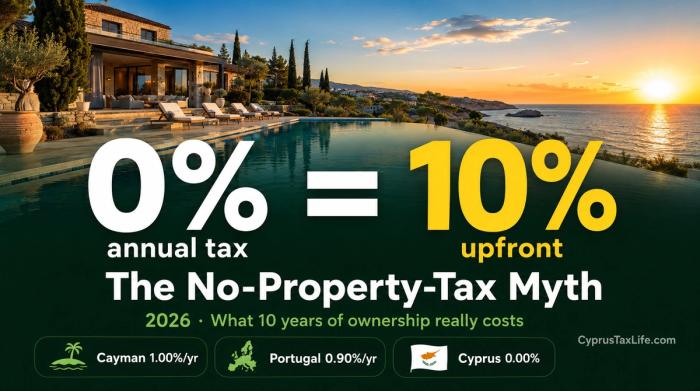
Compare countries with no property tax and the stamp duty they charge instead. See the 10-year holding cost that makes Cayman pricier than Portugal.
Miriam Alonso