Moving from Portugal to Cyprus
Quick Answer
Moving from Portugal to Cyprus with Non-Dom status reduces your effective tax rate from ~35-48% to approximately 5%. Cyprus applies 0% Special Defence Contribution on foreign dividends, a flat 15% corporate tax, and offers tax residency with just 60 days of physical presence per year under the 60-day rule. A double tax treaty between Portugal and Cyprus prevents double taxation during the transition.
Last updated: 2026-05-29

Why Portugal Professionals Consider Cyprus
Portugal was for several years the destination of choice for digital nomads and entrepreneurs attracted by the Non-Habitual Resident (NHR) regime, which offered a 20% flat tax on Portuguese-source income from "high value-added activities" and a 10-year exemption on most foreign-source income. The NHR regime attracted thousands of remote workers and entrepreneurs to Lisbon, Porto, and the Algarve.
However, the NHR regime was closed to new applicants from January 2024. The replacement regime, IFICI (Incentivo Fiscal a Investigacao Cientifica e Inovacao), is far more restrictive and applies only to researchers, tax residents returning after 5+ years abroad, specific qualifying workers, and individuals in certain approved categories. Most entrepreneurs and digital nomads no longer qualify.
Without the NHR, Portugal reverts to its standard IRS rates, which reach 48% plus solidarity surcharges of 2.5-5% for higher incomes. The employer social security contribution (TSU) of 23.75% makes hiring employees or paying oneself as a salaried director expensive. The IRC (corporate income tax) at 21% plus municipal surtax compares unfavorably with Cyprus's 15% flat rate.
For entrepreneurs who were in Portugal under the NHR regime and whose 10-year window is ending, Cyprus is often the natural next step. The two countries are both EU members with Mediterranean climates, but Cyprus offers a more straightforward and potentially more favorable tax structure for business income under the Non-Dom regime.
Portugal Tax Burden at a Glance
| Tax type | 🇵🇹 Portugal |
|---|---|
| Income tax | Up to 48% IRS + solidarity surcharge (2.5-5%) |
| Corporate tax | 21% IRC + municipal surtax (up to 1.5%) |
| Capital gains tax | 28% (for movable assets) |
| Dividend tax | 28% (withheld at source) |
| Social contributions | 11% employee + 23.75% employer (TSU) |
| Effective rate | ~35-48% |
Tax Comparison: Portugal vs Cyprus
For an entrepreneur post-NHR (or who never qualified for NHR):
On EUR 100,000 of business revenue: Portugal (Lda + dividends, without NHR): IRC at 21% + surtax ~1.5% = approximately EUR 22,500. Remaining EUR 77,500 as dividends at 28% = EUR 21,700. Total approximately EUR 44,200 (44.2% effective).
Cyprus (Ltd + Non-Dom): Corporate tax at 15% = EUR 15,000. Low salary plus dividends at 0% income tax + 2.65% GHS. Total approximately EUR 5,000 (5% effective).
Annual savings: approximately EUR 39,000.
For NHR holders who qualified for the 20% flat tax on Portuguese-source income from qualifying activities, the comparison is more nuanced. However, as the 10-year NHR window expires, the full Portuguese rates kick in. Many former NHR holders move to Cyprus at that point.
It is worth noting that Lisbon rents have increased dramatically since 2019, significantly eroding the cost-of-living advantage Portugal once held. Monthly rents in central Lisbon now rival those of some Northern European capitals, making Cyprus competitive on cost of living as well as taxes.
Interactive Tax Calculator
Portugal
Effective rate
42%
Est. tax: €42,000
Cyprus (Non-Dom)
Effective rate
5%
Est. tax: €5,000
Annual savings by moving to Cyprus
€37,000
Estimates based on effective rates. Consult a tax advisor for your specific situation.
Cyprus Non-Dom: ~5% effective tax
The alternative most entrepreneurs do not know about
- ✓15% corporate tax (flat, no surcharges)
- ✓0% dividend income tax (Non-Dom)
- ✓2.65% GHS on all income
- ✓No wealth tax, no inheritance tax
- ✓60-day rule for flexible tax residency
- ✓Full EU membership and treaty network
Double Tax Treaty: Portugal - Cyprus
Portugal and Cyprus have a double tax treaty in force. Key provisions: dividends 10% (5% if the beneficial owner holds at least 25% of the capital), interest 10%, royalties 10%. Portugal has an exit tax (mais-valias de saida) applicable to certain unrealized capital gains when individuals with substantial holdings depart. For moves to other EU member states, payment can be deferred. The Autoridade Tributaria (AT) has increased its anti-avoidance activity in recent years. Genuine substance in Cyprus is essential for entrepreneurs moving there.
Leaving Portugal: Exit Process
Portugal's exit process includes an important exit tax consideration:
Exit tax (mais-valias de saida): Portugal imposes an exit tax on unrealized capital gains for individuals who have been Portuguese residents and hold shares in companies above certain thresholds when they depart. For EU moves, the tax is deferred until actual disposal of the assets. Annual reporting to the AT is required during the deferral period.
NHR final considerations: If you are on the NHR regime, understand the implications of departure before your 10-year window ends. Leaving early does not trigger clawback, but it ends the benefits.
Deregistration from Servicos de Financas: Notify the AT (Autoridade Tributaria) and update your tax address. This can be done through the Portal das Financas online.
Final IRS return: File a final Portuguese income tax return (declaracao modelo 3) for the year of departure, covering income earned up to the departure date.
NIF (tax identification number): Your NIF number remains active and is needed for any ongoing Portuguese obligations (e.g., property income from Portuguese real estate).
Social security: Notify the Seguranca Social of your departure and cessation of activity in Portugal. Accrued pension rights are preserved under EU coordination rules.
Portugal's NHR is Over: Why Cyprus Is the Natural Next Step
The Non-Habitual Resident (NHR) regime was Portugal's golden offer for a decade: a 20% flat tax on Portuguese-source qualifying income and a 10-year exemption on most foreign-source income. From 2014 to 2023, it attracted tens of thousands of digital nomads, remote workers, entrepreneurs, and retirees to Lisbon, Porto, the Algarve, and the Azores. Portugal became Europe's most talked-about tax relocation destination for location-independent professionals.
All of that changed on 1 January 2024. The Portuguese government officially closed the NHR regime to new applicants. Individuals who registered as NHR before 31 December 2023 may continue their 10-year benefit period. But anyone who missed the deadline - or whose 10-year window is now approaching expiry - faces the full Portuguese standard tax rates: IRS progressive up to 48% plus solidarity surcharges of 2.5-5%, employer TSU of 23.75%, and IRC corporate tax at 21%.
The replacement regime, IFICI (Incentivo Fiscal à Investigação Científica e Inovação), is far more restrictive. It targets researchers, qualified employees returning to Portugal after at least 5 years abroad, and workers in specific sectors (technology, science, innovation). It does not apply to general digital nomads, independent entrepreneurs, or freelancers who do not fall into specific qualifying categories. For the typical entrepreneur or remote worker who benefited from NHR, IFICI provides no benefit.
This creates a very specific and time-sensitive situation for thousands of people currently in Portugal. If your NHR period is expiring in 2024, 2025, 2026, or 2027, you face a stark choice: stay in Portugal under standard rates (45-55% effective) or plan your next move now. Cyprus has emerged as the most logical destination for this cohort.
The reasons are structural. Cyprus is also an EU member state, so there is no disruption to EU freedom of movement. Both countries have Mediterranean climates - though Cyprus is warmer and drier. Both have growing international communities. The fiscal comparison is unambiguous: Cyprus Non-Dom delivers approximately 5% effective rate on business income, with no time limit and no activity restrictions. Unlike NHR's 20% rate with a 10-year clock, Cyprus Non-Dom is renewable for as long as you maintain non-domicile status (typically up to 17 years of residency). You claim it with form T.D. 38 and questionnaire T.D. 38QA at the Tax Department. There is no approved-activity list. If you earn through a Cyprus Ltd and distribute dividends as a Non-Dom, you pay 15% corporate tax plus 2.65% GHS on dividends - and nothing more.
The practical transition from Portugal to Cyprus is also simpler than many expect. The cost of living in Lisbon and Porto has risen sharply since 2019, narrowing what was once a dramatic advantage over other EU cities. Limassol's rental market, while tighter than 5 years ago, remains meaningfully cheaper than Lisbon for equivalent-quality apartments. Larnaca is comparable to Portugal's secondary cities in price but with significantly lower taxes. Direct flights connect Lisbon and Porto to Larnaca year-round (typically via a hub, approximately 5-6 hours total). Several Portuguese-speaking advisors and communities operate in Limassol.
For those currently in Portugal under NHR with years remaining, there is no obligation to leave before the 10-year period ends. The NHR benefits continue until they expire. The decision is whether to begin planning the Cyprus move in advance so that company structures, residency registration, and tax filings align smoothly with the NHR expiry date - rather than scrambling to establish Cyprus residency at the last moment.
Cost of Living: Portugal vs Cyprus
Portugal has become significantly more expensive in recent years, particularly in Lisbon and Porto:
Housing: Lisbon EUR 1,200-2,200 rent vs Larnaca EUR 550-750 (savings: 55-70%). Porto EUR 900-1,500. Algarve EUR 900-1,500 seasonal. Groceries: Portugal EUR 250-350 vs Cyprus EUR 250-350 (comparable) Dining out: Portugal EUR 200-300 vs Cyprus EUR 150-200 (Portugal is slightly more expensive now) Transport: Portugal EUR 80-120 vs Cyprus EUR 100-150 (comparable) Utilities: Portugal EUR 120-180 vs Cyprus EUR 100-150 (comparable)
Total monthly: Portugal EUR 2,400-3,200 vs Cyprus EUR 1,400-1,900
The cost of living gap has narrowed as Lisbon and Porto have gentrified, but Cyprus still offers meaningful savings especially on housing. For families, the reduced cost of schooling and general living expenses in Cyprus adds up significantly. Both countries offer excellent Mediterranean climates, though Cyprus enjoys more sunshine hours annually.
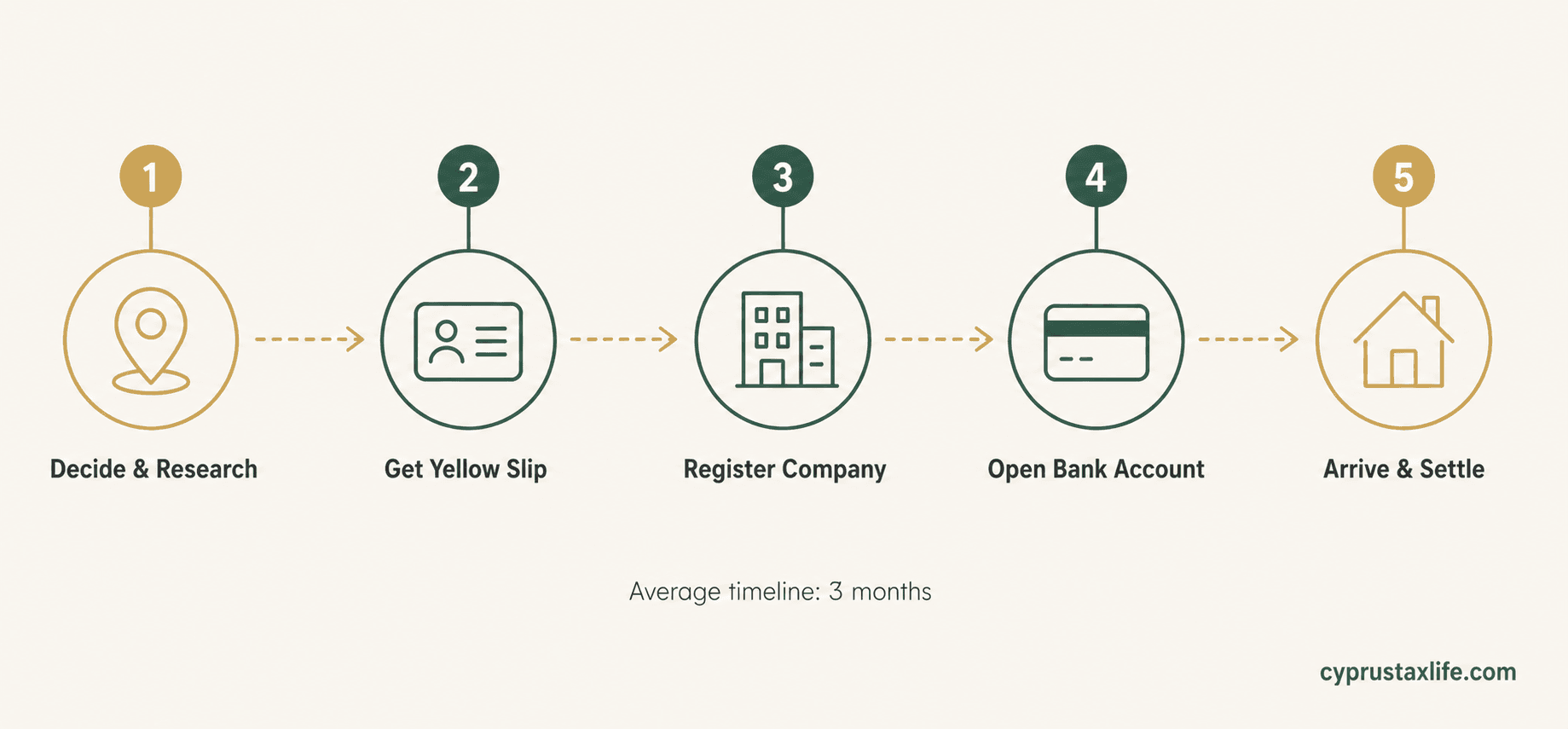
Step-by-Step Relocation Checklist
Understand your NHR status and any implications of early departure if applicable
Consult a Portuguese tax advisor about exit tax exposure on substantial holdings
Research Cyprus cities, particularly Limassol and Larnaca
Set up a Cyprus Ltd company (approximately EUR 2,100)
Find accommodation in Cyprus and sign a rental contract
Notify the AT (Autoridade Tributaria) of your departure through Portal das Financas
Notify the Seguranca Social of your change of residency
File your final Portuguese IRS return for the departure year
Apply for Cyprus tax residency (60-day or 183-day rule)
Register for Non-Dom status at the Cyprus Tax Department
Obtain your Yellow Slip (EU citizen registration)
Open a Cyprus bank account
Register for GHS healthcare
Set up payroll structure in Cyprus (low salary + dividends)
Frequently Asked Questions
Is Cyprus better than Portugal for entrepreneurs after NHR ended?+
What is the IFICI regime that replaced NHR?+
Does Portugal have an exit tax?+
Can I keep my Portuguese NHR status if I have years remaining?+
Is there a Portuguese community in Cyprus?+
Sources and References
- PwC Worldwide Tax Summaries — Cyprus
- KPMG Cyprus — Tax and Advisory
- EY Cyprus — Tax Services
- Cyprus Ministry of Finance (mof.gov.cy)
Effective rates are approximations for entrepreneur structures (company + low salary + dividends). Consult a qualified tax advisor before making decisions.
Free, no commitment
Moving to Cyprus or opening a company?
Tell us your situation and we'll connect you with our specialist expat advisory in Cyprus: Non-Dom tax, company setup and residency, done for you. Free consultation, no commitment.
Related Articles
Germany's exit tax (§6 AStG) taxes unrealised gains on shares >1% when you emigrate. Moving to Cyprus (EU): you can defer payment indefinitely. Full breakdown for German founders and investors.
 Miriam Alonso
- Tax Planning
- Relocation
Canada's departure tax treats you as having sold your worldwide assets the day you stop being a tax resident. What is caught, what is exempt, how to defer it, and what the cost-base reset means for where you go next.
![Countries With No Property Tax [2026]: The Real Cost](https://cdn.sanity.io/images/glqahhks/production/6f7ea0efceed8a692ad7c3785efa8baaf4d1e208-1679x937.jpg?w=700&q=75&auto=format)
Compare countries with no property tax and the stamp duty they charge instead. See the 10-year holding cost that makes Cayman pricier than Portugal.
Miriam Alonso