Quick Answer
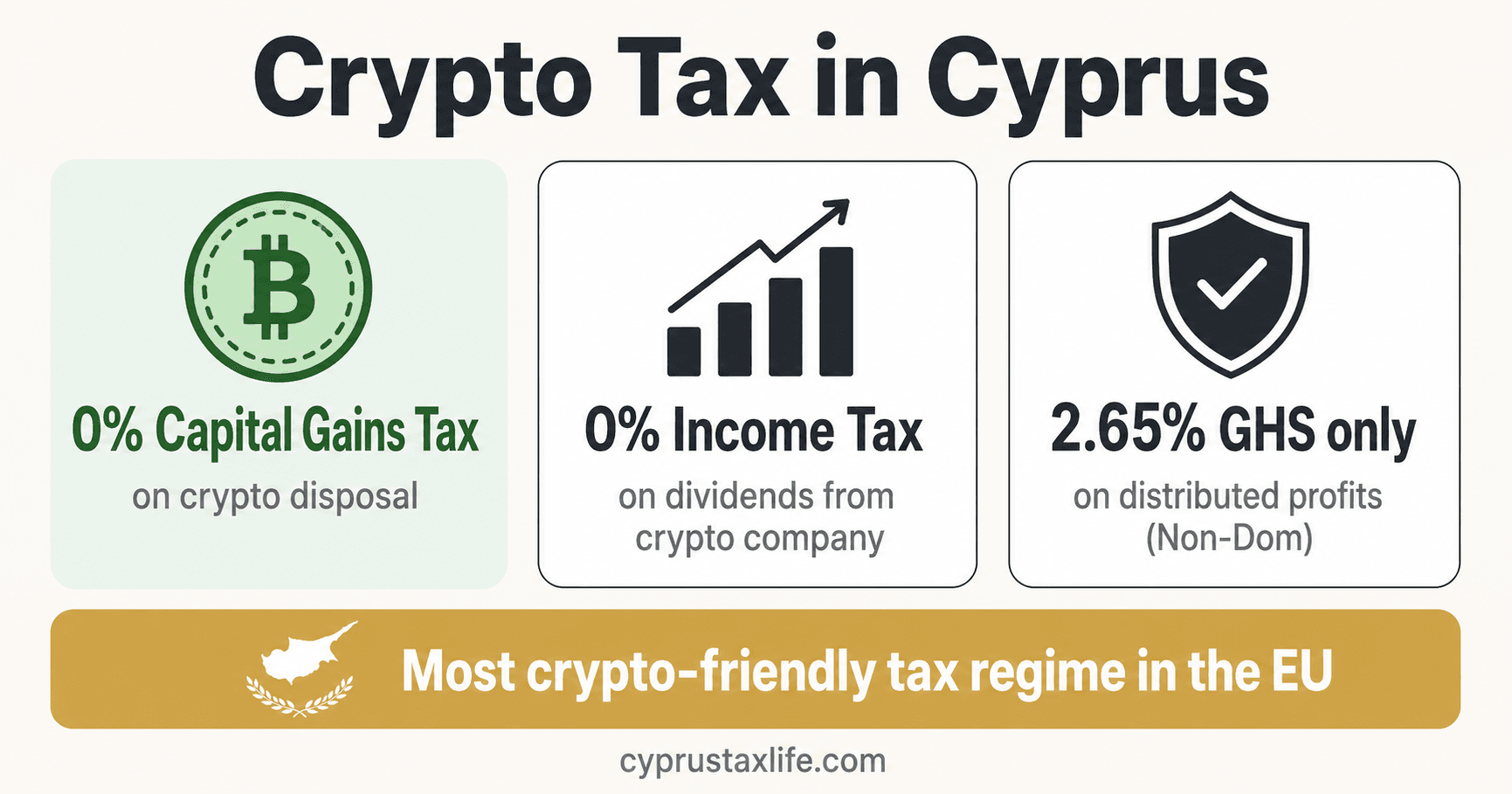
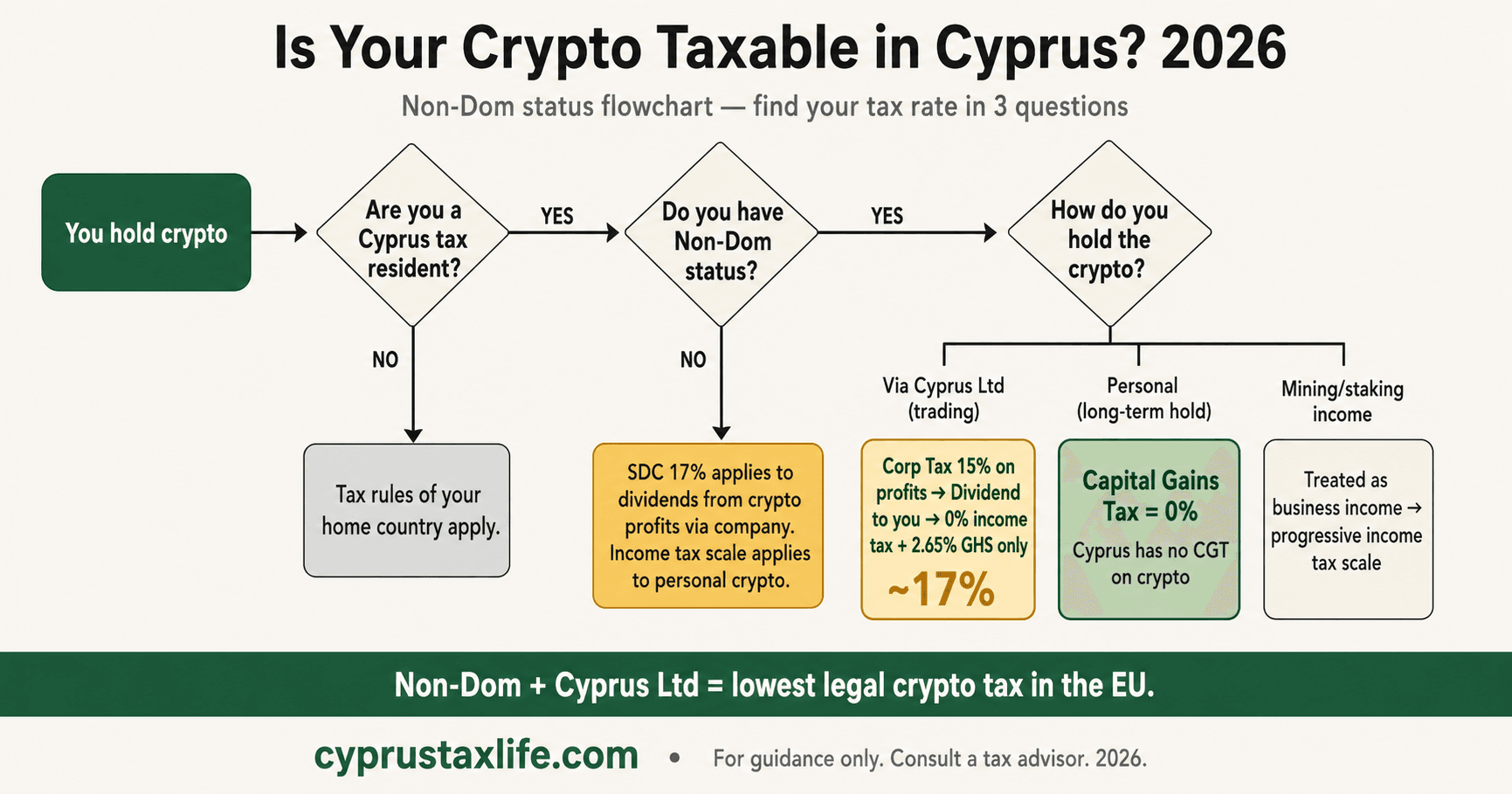
Cyprus treats cryptocurrency trading profits as capital gains, which are exempt from CGT when not derived from immovable property in Cyprus. This means most crypto trading profits are tax-free for Cyprus residents. Professional traders may be subject to income tax. Non-Dom residents are also exempt from the 17% SDC on crypto dividends.
Crypto Tax in Cyprus: The Complete 2026 Guide
Cyprus introduced a flat 8% tax on cryptocurrency gains effective January 1, 2026. Here is what it means for residents, non-dom holders, and investors.
Last updated:
Crypto Tax in Europe: Country Comparison 2026
The 8% flat rate introduced in Cyprus for 2026 makes it one of the lowest crypto tax jurisdictions in the EU. Here is how Cyprus compares to the main European countries for crypto investors.
| Country | Crypto Tax Rate | Structure | Holding Period Benefit | Notes |
|---|---|---|---|---|
| Cyprus | 8% flat | Flat rate on gains (Article 20E, 2026) | None required | New 2026 reform. Non-Dom: 8% still applies (not exempt). |
| Germany | 0% or 26.375% | Free if held 1+ year; 26.375% (Abgeltungsteuer) if under 1 year | Yes, 1 year minimum | Mining/staking taxed as income. Long-term HODLing completely tax-free. |
| Portugal | 28% | Flat rate on gains held under 1 year; 0% if held 1+ year | Yes, 1 year minimum | Professional traders may be taxed as business income at higher rates. |
| Spain | 19-26% | Progressive: 19% up to EUR 6K, 21% 6-50K, 23% 50-200K, 26% above | None | DAC8 reporting mandatory since Jan 2026. |
| France | 30% | Flat tax (Prélèvement Forfaitaire Unique) on gains | None | Professional trading treated as BIC income at higher rates. |
| Italy | 26% | Flat rate on gains above EUR 2,000/year threshold | None | EUR 2,000 annual exemption applies. |
| Netherlands | 0% CGT, but wealth tax | No capital gains tax on crypto; box 3 wealth tax 1.2-1.7%/yr on total assets | N/A | Crypto held in portfolio subject to notional return wealth tax annually. |
| United Kingdom | 10-20% | CGT: 10% basic rate, 20% higher rate. Annual exempt amount EUR ~3,000 | None | Post April 2024: exempt amount reduced to GBP 3,000. HMRC enforcement active. |
| Switzerland | 0% for private investors | 0% CGT if not a professional trader. Wealth tax applies. | N/A | Professional traders taxed as income (up to 41.5%). Private investors pay 0%. |
| Malta | 0% or 35% | 0% on long-term capital gains; trading profits taxed up to 35% | Case by case | MFSA regulates crypto. Casual gains generally 0%, frequent trading treated as income. |
Source: PwC Worldwide Tax Summaries 2026, OECD CARF framework, national tax authority guidance. Rates current as of January 2026. Always verify with a local tax adviser before making residency or investment decisions based on tax rates.
Crypto Tax in Cyprus for German Residents: Key Differences
Germany taxes cryptocurrency gains under Section 23 EStG (Einkommensteuergesetz) as "private disposal transactions" (private Veräußerungsgeschäfte). The rules differ significantly from Cyprus and create important planning opportunities.
Germany vs Cyprus: The Core Trade-Off
Germany has a 12-month holding rule: if you hold a cryptocurrency for more than one year before selling, the gain is 100% tax-free. For long-term holders of a single asset this can be better than Cyprus's 8% flat rate. However, Germany taxes short-term gains at your full marginal income tax rate, up to 45%, plus 5.5% Solidaritätszuschlag (solidarity surcharge) and church tax where applicable. For active traders or frequent disposals, this creates a combined rate that can reach over 47%.
| Scenario | Germany | Cyprus (Non-Dom) |
|---|---|---|
| Holding > 12 months (BTC, ETH) | 0% | 8% |
| Short-term trading (< 12 months) | Up to 45% income tax + 5.5% SolZ | 8% flat |
| Staking rewards, holding extended? | 10-year rule under some BMF guidance | 8% on disposal |
| DeFi / liquidity provision | Unclear, case-by-case | 8% on disposal |
| NFT sales | Section 23 EStG likely applies | 8% flat |
Staking and the 10-Year Rule
Germany's Federal Ministry of Finance (BMF) has issued guidance interpreting staking income under Section 22 EStG (other income). Crucially, some interpretations extend the holding period from 1 year to 10 years for staked tokens that generate "economic advantages." This interpretation, where it applies, means staking rewards cannot be sold tax-free after 1 year. Cyprus does not have a holding-period rule at all: the 8% rate applies on disposal regardless of when you acquired the asset.
German Exit Tax and Crypto: Important Clarification
The German exit tax (Wegzugsbesteuerung, §6 AStG) does not apply to cryptocurrency. Section 6 AStG only covers equity participations of 1% or more in a corporation. Crypto assets are not corporate participations. This means German residents moving to Cyprus have no German exit tax obligation on their crypto portfolio, regardless of portfolio size. For shares in a GmbH, UG, or AG, theGermany exit tax (Wegzugsbesteuerung) applies separately.
Germany-Cyprus Double Tax Treaty and Crypto
The Germany-Cyprus Double Tax Treaty (1977, amended) does not specifically address cryptocurrency, most bilateral tax treaties predate crypto assets and do not mention them explicitly. In practice, once you are a Cyprus tax resident, Cyprus has the right to tax your capital gains under its domestic law (8% flat rate). Germany does not retain source-state taxing rights over crypto once you have broken German tax residency. The treaty is therefore not the relevant mechanism, German tax residency status is. You must properly cease German tax residency to avoid continued German taxation.
To cease German tax residency, you must deregister from the Einwohnermeldeamt, close or transfer your habitual residence (gewöhnlicher Aufenthalt), and not maintain a permanent dwelling in Germany available to you. An active German business address or home can keep you tied to German taxation. For the full Cyprus tax residency requirements, see Cyprus tax residency.
Taxable vs Exempt Crypto Activities in Cyprus (2026)
Not all crypto activity is taxable under the 2026 Cyprus framework. Understanding which events trigger the 8% flat rate, and which do not, is essential for tax planning.
Taxable events (8% flat rate applies):
- Selling cryptocurrency for fiat currency (e.g., BTC to EUR, USDT to USD)
- Exchanging one cryptocurrency for another (e.g., BTC to ETH), each swap is a disposal
- Spending cryptocurrency on goods or services (e.g., paying with BTC)
- Donating cryptocurrency to non-qualifying organisations (gifts to individuals may vary)
- NFT sales where the NFT is classified as a crypto-asset under Article 20E
- Staking rewards received and subsequently disposed of
- Mining proceeds sold (proceeds from mining sales, not the receipt of mined coins itself)
Non-taxable events (no Cyprus tax triggered):
- Simply holding (HODLing) cryptocurrency, there is no wealth tax or annual charge on holdings
- Transferring crypto between your own wallets (same owner, different addresses)
- Receiving crypto as a gift (the recipient does not pay tax at receipt; tax applies on later disposal)
- Receiving staking or mining rewards (no tax at receipt; tax applies when those coins are later sold)
- Losses: crypto losses can be offset against crypto gains in the same tax year under Article 20E
Important: Cyprus capital gains tax on shares (0% CGT) does NOT apply to crypto-assets from 2026 onwards. Crypto disposals are now classified separately under Article 20E of the Income Tax Law, at 8% flat. Shares in companies that hold crypto assets are still treated as shares (0% CGT applies to the shares themselves).
How to Report Crypto Gains on the Cyprus Tax Return (IR1)
Crypto-asset disposal gains are reported on the Cyprus personal income tax return (Form IR1), filed annually via the Taxisnet portal. The 2026 reform introduced a dedicated section for crypto-asset disposals. Here is the step-by-step process for Cyprus tax residents.
Step 1, Calculate your gains for the tax year
For each disposal event (sale, exchange, spend), calculate: Sale proceeds minus Cost basis (what you originally paid) = Gain or Loss. Use the FIFO (first-in, first-out) method by default, or LIFO if consistent. Keep a transaction log with dates, amounts, exchange rates at the time of each transaction.
Step 2, Aggregate total annual gains
Add all gains together. Offset losses against gains within the same tax year. Carry-forward of losses to future years is not permitted under the current 2026 rules. Net gain is the taxable amount.
Step 3, Complete the IR1 crypto section
Log into Taxisnet (taxisnet.mof.gov.cy). Open the current tax year IR1 form. Navigate to the crypto-assets section (Article 20E). Enter total disposal proceeds, total cost basis, and net gain. The system calculates the 8% tax automatically.
Step 4, Pay by the deadline
The personal income tax deadline for salaried individuals is 31 July of the following year. Self-assessment taxpayers: 31 March of the following year plus an extension to 30 September if filing electronically. Provisional tax payments may apply if estimated tax liability exceeds EUR 300. Interest of 1.75% per annum applies on late payments.
DAC8: Automatic reporting by exchanges
From 1 January 2026, all EU-regulated crypto exchanges are required to report user transaction data directly to the Cyprus Tax Department under the EU DAC8 directive. This means the Tax Department already has data on many transactions before you file. Consistent, complete reporting is essential, discrepancies between what exchanges report and what appears on your IR1 trigger automatic audits.
How to Relocate to Cyprus to Reduce Crypto Tax
Cyprus is one of the few EU member states where crypto investors can legally reduce their tax rate to 8% flat — well below Germany (up to 45%), France (30%), or Spain (up to 28%). The move is straightforward in legal terms but requires careful timing to avoid paying tax in both countries.
Step 1: Establish Cyprus Tax Residency
You become a Cyprus tax resident under one of two rules. The 183-day rule is the default: spend more than 183 days in Cyprus in a calendar year. The 60-day rule is an alternative for those who cannot spend 183 days: stay at least 60 days, maintain a home in Cyprus, operate a business or be employed here, and do not be tax resident in any other country.
Step 2: Deregister from Your Home Country
Tax residency in your home country does not end automatically. German residents must deregister from the Einwohnermeldeamt, close or remove permanent dwelling access, and ensure they spend fewer than 183 days in Germany. French and Spanish residents face similar requirements. Your home country may challenge the departure if you retain a home, family, or business ties there — document the relocation thoroughly.
Step 3: Sell Crypto After You Are a Cyprus Resident
The critical rule for reducing crypto tax by relocating: you must be a Cyprus tax resident at the time of the disposal. Gains realised before your residency start date are taxable in your country of origin. If you sell crypto on January 15 but only establish Cyprus residency on March 1, that gain belongs to your prior tax year under your home country's rules. Plan disposals for after the residency switch.
Exit Tax: Does Germany Tax You When You Leave?
Germany's exit tax (§ 6 AStG) applies to corporate equity participations of at least 1% — it does not apply to personal crypto holdings. Your Bitcoin, Ethereum, or altcoin portfolio is free from German exit tax on departure. This is a frequently misunderstood point: crypto is not captured by the German exit tax regime, so German investors can legally relocate to Cyprus and sell their crypto at 8% without triggering an additional exit charge.
Is Cyprus a Crypto Tax Haven?
Cyprus is not a zero-tax crypto jurisdiction — the 2026 reform introduced an 8% flat rate. However, at 8% it remains one of the lowest effective crypto tax rates in the EU. Compared to Germany (0% after 1 year but up to 47% before), France (30% flat PFU), Spain (19-28%), and Portugal (28%), Cyprus offers a genuinely competitive rate for active traders and short-term holders. Non-Dom residents also avoid SDC on dividends, making the overall tax package attractive for crypto entrepreneurs distributing profits through a company structure.
Crypto Gains That Are Tax-Free in Cyprus
Within the 2026 framework, certain gains remain exempt from the 8% rate. Unrealised gains — increases in the value of crypto you still hold — are not taxable until disposal. Tokens classified as securities (equity tokens, certain DeFi governance tokens with rights comparable to shares) may fall under the existing CGT exemption on securities rather than the 8% rate, though this requires professional classification. Long-term holding does not reduce the rate in Cyprus (unlike Germany's 1-year rule), but it does defer the tax event.
Key Facts 2026
| CGT on crypto trading (individuals) | 0% (no specific crypto CGT legislation) |
| CGT under Non-Dom | 0% on all capital disposals including crypto |
| Corporate crypto income | 15% corporate tax (standard rate) |
| Staking rewards | No specific law - likely income if regular/professional |
| Mining income | Business income - subject to corporate or income tax |
| NFT sales | Generally 0% CGT (treated as securities disposal) |
| VAT on crypto exchanges and transactions | 0% (exempt as financial service) |
| VASP registration | Required for businesses offering crypto services in Cyprus |
Free, no commitment
Moving to Cyprus or opening a company?
Tell us your situation and we'll connect you with our specialist expat advisory in Cyprus: Non-Dom tax, company setup and residency, done for you. Free consultation, no commitment.
Frequently Asked Questions
What is the crypto tax rate in Cyprus in 2026?
Was crypto taxed in Cyprus before 2026?
Does Non-Dom status exempt me from crypto tax in Cyprus?
Is swapping one cryptocurrency for another taxable in Cyprus?
Can I offset crypto losses against other income in Cyprus?
How do I report my cryptocurrency gains in Cyprus?
Is crypto mining income taxed the same way in Cyprus?
Is simply holding cryptocurrency taxable in Cyprus?
I am a German resident moving to Cyprus. When can I sell my crypto in Cyprus instead of Germany?
Once you have validly broken German tax residency and become a Cyprus tax resident, Cyprus taxes your crypto disposals at 8% flat. The key date is when you cease to be a German tax resident, not when you register in Cyprus. Practically: deregister from the Einwohnermeldeamt, end your German dwelling availability, and establish Cyprus tax residency in the same calendar year. Crypto sold after your Cyprus residency start date is taxed in Cyprus only. Note: German exit tax (§6 AStG) does not apply to crypto, only to corporate equity participations of 1% or more. Your crypto portfolio is therefore free from German exit tax on departure.
Is Cyprus a crypto tax haven?
How do I relocate to Cyprus to reduce crypto tax legally?
I have crypto held for more than 1 year in Germany. Is it better to sell in Germany at 0% or move to Cyprus first?
Which crypto gains are tax-free in Cyprus?
What is the crypto tax rate in Cyprus for German residents who relocate?
Sources
Cyprus Tax Department - Income Tax Law Amendment 2026 (Article 20E). Cyprus Bar Association guidance on crypto-asset taxation. Updated: April 2026.
Calculate your exact liability with our Cyprus Crypto Tax Calculator. Enter your cost basis and sale proceeds to see the 8% flat rate tax, net proceeds, and a breakdown of which disposal events are and are not taxable.
Free, no commitment
Moving to Cyprus or opening a company?
Tell us your situation and we'll connect you with our specialist expat advisory in Cyprus: Non-Dom tax, company setup and residency, done for you. Free consultation, no commitment.
Related resources
Crypto tax guide for traders
8% flat rate vs 0% CGT: which applies to your trading activity
0% CGT on crypto assets
How Cyprus capital gains exemption applies to crypto holdings
Non-Dom + crypto dividends
Non-Dom status exempts you from SDC on crypto company dividends
Cyprus vs Germany crypto tax
Germany taxes crypto at up to 45%. Cyprus charges 0% or 8%
Free newsletter
What do you want to hear about?
No spam. Unsubscribe any time.