Germany Exit Tax 2026: How to Defer the Wegzugsteuer

Germany taxes its residents at up to 47.5% on high incomes. For entrepreneurs and GmbH shareholders who decide to leave, there is a further complication: the Wegzugsteuer, an exit tax that can generate a substantial bill simply for the act of emigrating.
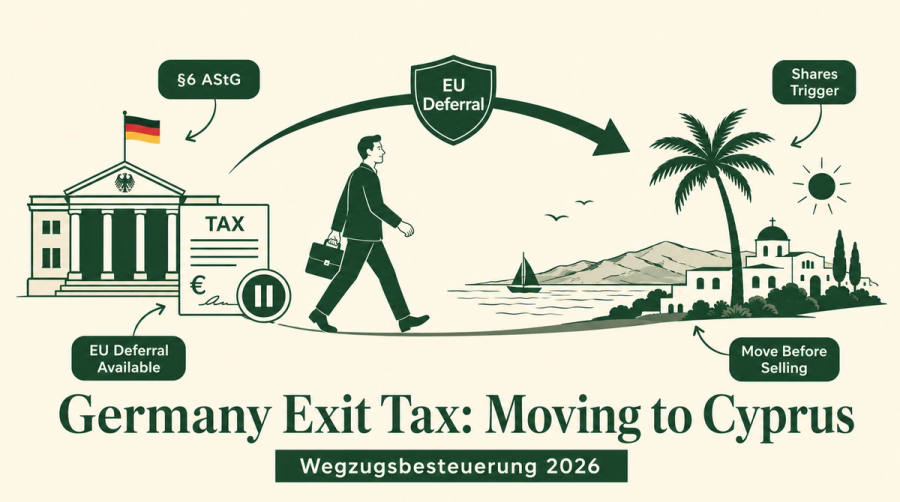
Introduced in its current form in 2006 and significantly reformed in 2022, the Wegzugsteuer is one of the more complex exit taxes in Europe. But for those moving within the EU, including to Cyprus, the 2022 reform introduced a meaningful relief: 7 annual interest-freeinstalments instead of immediate full payment.
According to the German Ministry of Finance (BMF), the Wegzugsbesteuerung was significantly reformed in 2022 to align with EU freedom of movement rules. PwC Tax Facts Germany 2026 confirms the effective rate on GmbH share gains at 26.375% (after the Teileinkünfteverfahren partial exemption).
What Is the Wegzugsteuer?
The Wegzugsteuer is Germany's exit tax on corporate shareholdings. It is governed by Section 6 of the Außensteuergesetz (AStG), the Foreign Tax Act. When a qualifying German tax resident leaves Germany, the shares they hold in corporations are treated as if sold atmarket value on the date of departure, triggering tax on the unrealised gain.
It is not a wealth tax or a charge on your assets per se. It is an income tax on a deemed sale. Germany is asserting its right to tax the appreciation that occurred while you were a German resident.
Two conditions must both be met for the Wegzugsteuer to apply.
Who Does the Wegzugsteuer Apply To?
The Wegzugsteuer applies when you meet both of the following conditions at the time you leave Germany:
- Residency: you have been a German tax resident for at least 10 of the last 12 years prior to emigration
- Shareholding: you hold, or have held within the past 5 years, a stake of 1% or more in any corporation (domestic or foreign)
The shareholding threshold of 1% is deliberately low. It covers GmbH shares (the most common structure for German entrepreneurs), AG shares, and stakes in foreign companies. Even if you sold most of your shares and retained a 1.1% stake, you are in scope.
If you have only been resident in Germany for 8 years, you fall below the 10-year threshold and the Wegzugsteuer does not apply, even if you hold 50% of a GmbH. Similarly, if your stake is 0.9%, the standard Wegzugsteuer rules do not apply (though other provisions of the AStG may).
What Is NOT Covered
The Wegzugsteuer applies specifically to corporate shareholdings. It does not apply to:
- Personal bank accounts, savings, or investment portfolios (ETFs, bonds, listed shares below 1%)
- Real estate, subject to separate German non-resident tax rules
- Business assets held as a sole trader (different provisions apply)
- Pension rights, covered by separate DTA and pension rules
How Is the Exit Tax Calculated?
The gain is the difference between the market value of your shares on the day you leave and your original acquisition cost. This sounds simple but is often contentious: Germany uses the going-concern value (Verkehrswert) of the company, which can be significantly higher than book value.
Germany applies the Teileinkünfteverfahren (partial income method) to shareholdings held by individuals: 60% of the gain is taxable. The taxable 60% is then subject to Germany's progressive income tax rates, up to 45% plus 5.5% solidarity surcharge, giving a maximum marginal rate of 47.5% on the taxable portion.
Effective rate on the full gain: 60% × 47.5% = 28.5% maximum. In practice, for large gains where the top bracket applies throughout, expect around 28% on the total unrealised gain.
Example: You hold 25% of a GmbH with a fair market value of EUR 2,000,000. Your acquisition cost was EUR 100,000. Unrealised gain: EUR 1,900,000. Taxable portion (60%): EUR 1,140,000. Exit tax at ~47.5%: approximately EUR 541,500. Effective exit tax on the full gain: ~28.5%.
The 2022 Reform: 7 Instalments for EU/EEA Moves
Before the 2022 reform, moving within the EU still required either paying the Wegzugsteuer upfront or providing security (a bank guarantee). The European Court of Justice ruled this incompatible with EU freedom of movement, leading to the 2022 reform.
From 21 December 2022 onward, moving to another EU or EEA country allows you to pay the Wegzugsteuer in 7 equal annual instalments, interest-free. No bank guarantee is required. The instalments begin in the year following your departure.
- 7 equal annual instalments, starting the year after you leave Germany
- Interest-free, no penalty for spreading the payment
- No security or bank guarantee required
- You must notify the Finanzamt of your intent to use the instalment option when you file your departure return
If you sell the shares before all instalments are paid, the remaining balance becomes immediately due. If the company value falls after your departure, you can apply to have the assessed gain reduced, but this requires evidence of the lower value.
Cyprus is an EU member. Moving from Germany to Cyprus qualifies for the 7-instalment relief. You will not face an immediate large payment, instead you manage the liability over 7 years while building your new life in Cyprus.
Moving Outside the EU: Immediate Full Payment
If your destination is outside the EU and EEA, for example Switzerland, UAE, or the United States, the 7-instalment option does not apply. The full Wegzugsteuer assessment is due immediately, or you must provide adequate security to the Finanzamt.
In practice, securing a bank guarantee for several hundred thousand euros is expensive and bureaucratically complex. Most people in this situation simply pay. This is why non-EU moves for German GmbH shareholders are significantly more expensive than EU moves.
Practical Steps Before Leaving Germany
The Wegzugsteuer requires careful advance planning. Rushed departures without proper preparation are one of the most common sources of expensive mistakes.
- Engage a German Steuerberater (tax adviser) specialising in international tax at least 6 months before your planned departure
- Obtain a professional valuation (Unternehmensbewertung) of your GmbH, this is the basis for the exit tax calculation and you want it defensible
- Check whether any restructuring before departure (e.g. converting a GmbH to a UG, or transferring to a holding) reduces the taxable gain, this requires careful advice as anti-avoidance rules apply
- File a Wegzugsmeldung (emigration notification) with your local Finanzamt and request the 7-instalment option in writing
- Complete your Abmeldung at your local Einwohnermeldeamt (resident registration office)
- File your final German income tax return (Einkommensteuererklärung) as a partial-year resident
- Obtain a tax residency certificate from Cyprus as soon as you establish residency there
Germany and Cyprus: The Key Interaction
Once you are a Cyprus Non-Dom resident, Cyprus charges 0% income tax on dividends and 2.65% GHS on dividend income. Cyprus also has 0% capital gains tax on the sale of shares in companies not owning Cyprus real estate.
The interaction with the Wegzugsteuer is important. The deferred German exit tax is assessed on the gain that existed at the time you left Germany. Any further appreciation in your GmbH after you become a Cyprus tax resident is entirely outside German reach, Cyprus would apply its 0% CGT when you eventually sell.
There is a further planning point: if you sell the shares of your GmbH before you complete the 7-year instalment plan, the remaining Wegzugsteuer balance becomes immediately due to Germany. If you sell after the 7 instalments are complete, you have settled your German liability and Cyprus takes 0% on the sale proceeds. Time your exit accordingly.
Germany and Cyprus have a double tax treaty. It covers dividends (5% withholding if 10%+ shareholder, 15% otherwise), interest, and capital gains. See our Germany-Cyprus tax treaty guide for the full details.
Wegzugsteuer vs Other European Exit Taxes
| — | Germany | Netherlands | France | Spain |
|---|---|---|---|---|
| Shareholding threshold | 1% (held in last 5 years) | 5% | Securities > EUR 800k | EUR 4M gain or 25% stake |
| Residency requirement | 10 of last 12 years | Any duration | 6+ years in last 10 | 10+ years |
| Effective rate (approx) | ~28.5% (partial income method) | 24.5% / 33% (box 2) | 30% | 19-28% |
| EU deferral | 7 instalments (interest-free) | Unlimited deferral | 2-year deferral | Unlimited (EU) |
| Non-EU treatment | Immediate full payment | Immediate or security | Immediate | Immediate |
France operates a different mechanism: the exit tax under Art. 167 bis CGI (31.4% rate) applies automatic sursis d'imposition for EU residents, with true cancellation of the liability after 2 years (portfolio under €2.57M) or 5 years (above). Unlike the German instalment system, France's exit tax can disappear entirely. See the France exit tax 2026 guide for full mechanics and how Cyprus qualifies for automatic deferral.
Does the Wegzugsteuer apply if I have a 0.5% stake?
The 1% threshold is a hard floor. If your total shareholding in a single company is below 1%, the Wegzugsteuer does not apply to those shares. However, stakes held by closely connected persons (spouse, minor children) may be aggregated in certain circumstances, check with your adviser if you have family members who also hold shares.
What if I move to Switzerland instead of Cyprus?
Switzerland is not in the EU or EEA. The 7-instalment relief does not apply. You would face immediate assessment of the full Wegzugsteuer, or need to provide security. Switzerland is considerably more expensive for German GmbH shareholders than an EU destination like Cyprus, purely due to the exit tax treatment.
Can I transfer my GmbH shares to a holding company before leaving to reduce the exit tax?
Pre-departure restructuring is heavily scrutinised. The AStG has anti-avoidance provisions specifically targeting transfers designed to reduce or defer exit tax. Any restructuring should be completed well in advance (typically 3+ years before departure) and with professional advice. Last-minute transfers at below-market value are treated as deemed disposals at market value.
What if my company value falls after I leave Germany?
If the value of your shares decreases after you leave, you can apply to the Finanzamt to have the Wegzugsteuer assessment reduced to reflect the lower value. You will need to provide evidence (e.g. a new valuation, a lower sale price). This reduction is available for the portion of the 7-year instalment period that is still outstanding.
Does the Wegzugsteuer apply to shares in a foreign company?
Section 6 AStG applies to shareholdings in any corporation, not just German companies. If you hold 2% of a US tech startup or 5% of a UK Ltd while being a German tax resident for 10+ years, those shares are in scope. The deemed disposal applies at fair market value on the date you leave Germany.
How does Cyprus treat the gain after I arrive?
Cyprus imposes 0% capital gains tax on the sale of shares in companies that do not own Cyprus real estate. When you eventually sell your GmbH shares after establishing Cyprus residency, Cyprus takes nothing on the sale proceeds. Germany will collect the remaining instalment payments on the pre-departure gain, but future appreciation is entirely Cyprus-territory, tax free.
Sources: Außensteuergesetz (AStG) Section 6; BMF circular on Wegzugsteuer 2023; ECJ ruling Hughes de Lasteyrie du Saillant (C-9/02); German Income Tax Act (EStG); PwC Germany Tax Guide 2026; Harneys Cyprus Non-Dom Overview 2026; Germany-Cyprus Double Tax Treaty.
Need personalized advice? Book a consultation with an expat tax specialist.
Germany is not alone. Canada's departure tax works on the same deemed-disposal principle but bites harder in one respect: it catches your entire non-registered portfolio, not only shareholdings above a threshold. If you hold assets in both countries, read them together.
Auf Deutsch: Diese Seite gibt es auch als ausführliche deutsche Fassung — Wegzugsbesteuerung nach § 6 AStG mit Rechenbeispiel, Ratenzahlung, Rückkehrregelung und dem, was sich mit dem ATAD-Umsetzungsgesetz geändert hat.
This guide is for informational purposes only and does not constitute tax or legal advice. German exit tax rules involve significant complexity and individual circumstances vary widely. Consult a qualified Steuerberater with international tax expertise before making any relocation decision.
![Cyprus Ltd vs Irish Ltd: Company Tax Compared [2026]](https://cdn.sanity.io/images/glqahhks/production/84e3d82538a859345d8d2447e8e097c5777fb238-1679x937.png?w=700&q=75&auto=format)
![Cyprus vs Malta Company Formation [2026]](https://cdn.sanity.io/images/glqahhks/production/97db89d0ce729a9e931d09bc1522631faa6c3474-1679x937.png?w=700&q=75&auto=format)