Cyprus-Germany Double Tax Treaty 2026
Last updated: 2026-03-30
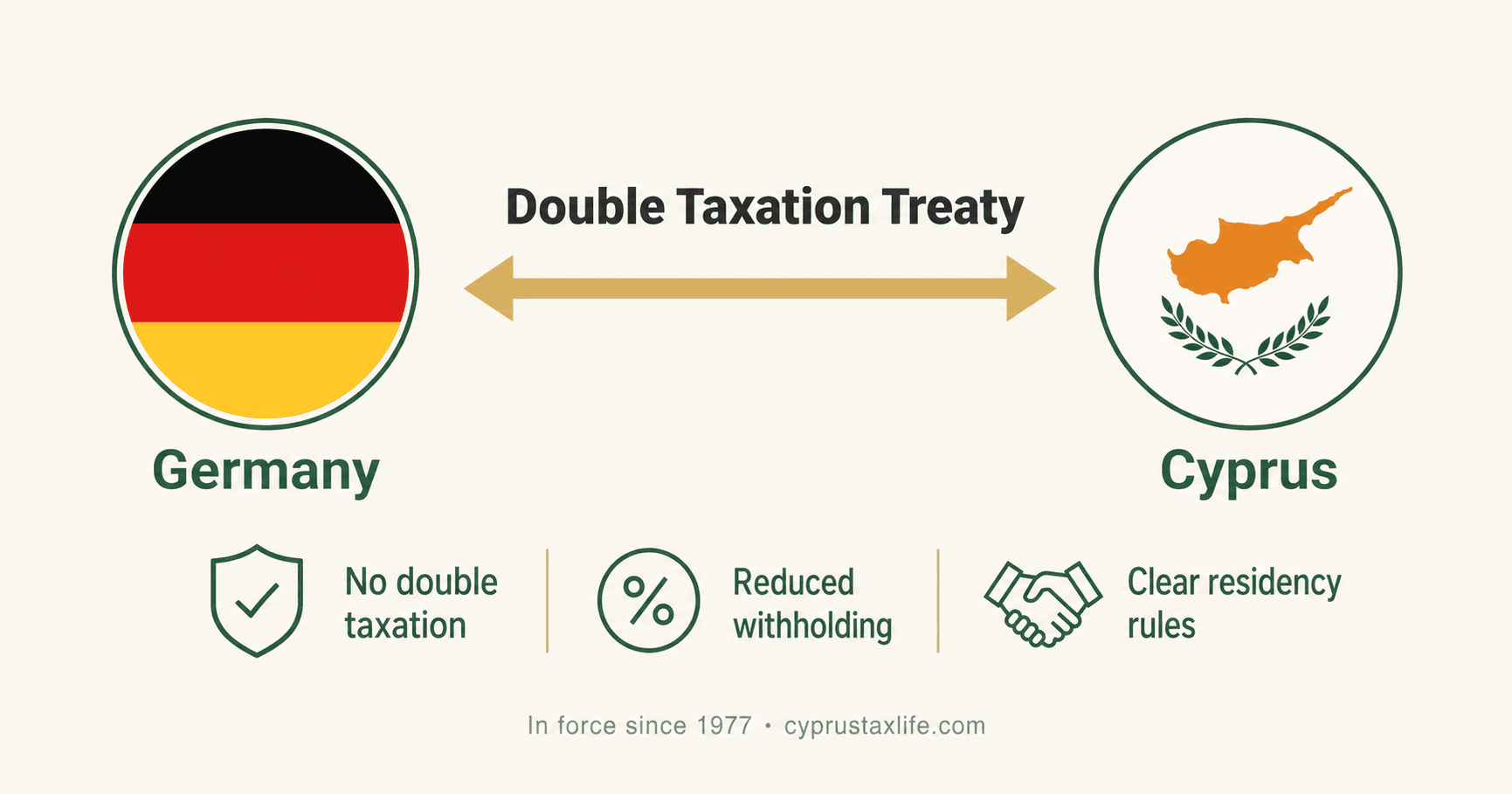
Treaty Information
Signed
1974 (revised 2011)
In force since
1977
Model
OECD Model
Overview
The Cyprus-Germany Double Taxation Agreement was originally signed in 1974 and revised by protocol in 2011. It follows the OECD Model Tax Convention and provides comprehensive rules for the allocation of taxing rights between the two countries.
This treaty is particularly relevant for German entrepreneurs relocating to Cyprus, German companies investing in Cyprus, and Cyprus companies serving German clients. Germany is one of the largest sources of foreign investment and professional migration to Cyprus.
The treaty covers income tax and corporate tax in both countries, trade tax (Gewerbesteuer) in Germany, and the special contribution for defense in Cyprus. It includes modern provisions on exchange of information and mutual assistance.
Germany has strict anti-avoidance legislation (AStG) that can override treaty benefits in certain circumstances. The exit tax (Wegzugsbesteuerung) under Section 6 AStG and CFC rules (Hinzurechnungsbesteuerung) are key considerations for German entrepreneurs moving to Cyprus.
What the Cyprus-Germany Tax Treaty Means for Expats Moving to Cyprus
Moving from Germany to Cyprus is one of the most tax-efficient relocations available to EU citizens — but the treaty mechanics matter. Once you establish genuine tax residency in Cyprus, Germany can only tax income that originates there: rental income from German properties, German statutory pension (gesetzliche Rente), and employment income earned while physically working in Germany. Everything else — your dividends, capital gains on shares, private pension income, and freelance income invoiced from Cyprus — shifts to Cyprus's favorable rules.
The key numbers: Germany taxes employment and business income at up to 45% (plus 5.5% solidarity surcharge). Cyprus Non-Dom gives you an effective rate of approximately 5% on dividends from your Cyprus or German company. If you hold a GmbH, dividends are subject to 5-15% German withholding (Kapitalertragsteuer) before reaching Cyprus — where they are then exempt from income tax, with only 2.65% GHS to pay.
There are two major Germany-specific hurdles every relocating German must plan around: the exit tax (Wegzugsbesteuerung) on GmbH/AG shares, and the question of how to break German tax residency cleanly.
| Income source | Where taxed | Effective rate |
|---|---|---|
| German GmbH dividends (10%+ stake) | Germany 5% WHT + Cyprus 2.65% GHS | ~7.7% |
| German GmbH dividends (minority stake) | Germany 15% WHT + Cyprus 2.65% GHS | ~17.7% |
| Capital gains on GmbH shares (after exit tax settled) | Cyprus only — 0% (Cyprus exempts securities gains) | 0% |
| German rental income | Germany only (exemption method) | German rate applies |
| Private pension (betriebliche Altersvorsorge) | Cyprus only | 5% flat on amounts above €5,000 |
| German statutory pension (gesetzliche Rente) | Both countries (credit method in Cyprus) | German rate minus Cyprus credit |
| Freelance/consulting from Cyprus (non-German source) | Cyprus only | 15% CIT if via company, then 2.65% GHS on dividends |
Bottom line
For a German entrepreneur running a business through a Cyprus Ltd after relocating: the effective rate on profits taken as dividends is approximately 5% (15% corporate tax + 2.65% GHS on distributions). Compare this to Germany's combined rate of 45% income tax + 5.5% solidarity surcharge + trade tax — often exceeding 50%. The treaty does not eliminate German withholding on dividends from German companies, but it caps it at 5-15%, still dramatically below what you would pay as a German resident.
Withholding Tax Rates
| Income type | Withholding rate |
|---|---|
| Dividends | 5% (10%+ holding) / 15% (other) |
| Interest | 0% |
| Royalties | 0% |
Withholding Details
Dividends (Article 10): - 5% withholding if the beneficial owner is a company holding directly at least 10% of the capital - 15% in all other cases - EU Parent-Subsidiary Directive can reduce this to 0% for qualifying EU parent-subsidiary relationships (minimum 10% holding for 2 years) - For Non-Dom Cyprus residents: German dividends are subject to German withholding at treaty rates, then exempt from Cyprus income tax (only 2.65% GHS)
Interest (Article 11): - 0% withholding on interest payments - German banks and borrowers can pay interest to Cyprus residents without deduction - This is favorable for Cyprus holding companies lending to German subsidiaries
Royalties (Article 12): - 0% withholding on royalties - The EU Interest & Royalties Directive also applies (eliminating withholding between associated EU companies) - Relevant for licensing arrangements between Cyprus IP companies and German operating entities
Employment income (Article 15): Taxable in the country where the work is performed. Exception: short-term assignments under 183 days in a 12-month period, paid by a non-resident employer, with costs not borne by a PE.
Permanent Establishment Rules
The PE definition follows standard OECD guidelines. For Cyprus companies operating in Germany, the key risk areas are:
Fixed place of business PE: Having an office, warehouse, or other fixed premises in Germany from which business is conducted.
Service PE: Providing services in Germany for more than 183 days within any 12-month period (cumulative days, not consecutive).
Agent PE: Having a person in Germany who habitually concludes contracts on behalf of the Cyprus company.
Construction PE: A building site or installation project lasting more than 12 months.
For Cyprus-based consultants serving German clients: traveling to Germany for client meetings and short-term engagements is generally fine. However, working regularly from a German coworking space or client office over extended periods could create a PE. Keep careful records of days spent in Germany.
Germany's domestic tax law is aggressive in identifying PEs. The German tax authorities (Finanzamt) may investigate arrangements where a Cyprus company is closely connected to German operations. Having genuine substance in Cyprus (office, employees, management decisions made in Cyprus) is essential.
Tie-Breaker Rules
The tie-breaker rules follow the standard OECD sequence:
1. Permanent home available 2. Centre of vital interests 3. Habitual abode 4. Nationality 5. Mutual agreement
For German entrepreneurs relocating to Cyprus, the critical steps are:
- Deregister from Germany (Abmeldung) at the Einwohnermeldeamt - Do not maintain a home available for your use in Germany (Wohnung) - Transfer your center of vital interests to Cyprus (family, main business, social connections) - Keep records of days spent in each country
Germany's domestic rules add complexity. The concept of "extended limited tax liability" (erweiterte beschrankte Steuerpflicht) under Section 2 AStG can apply for 10 years after emigration if you move to a low-tax country. However, Cyprus with its 15% corporate tax rate is generally not considered a low-tax jurisdiction for this purpose (the threshold is below 25%).
Caution: Germany may still apply the exit tax on shares regardless of the tie-breaker result. The exit tax is a German domestic provision that operates independently of treaty residency.
Pension Provisions
Pensions (Article 18): - Private pensions and annuities: Taxable only in the state of residence (Cyprus) - Government pensions (Beamtenpensionen): Taxable in the paying state (Germany), unless the recipient is a Cyprus national - German statutory pension (gesetzliche Rente): Generally taxable in both states, with credit in Cyprus for German tax paid
German Riester and Rurup pensions: The treaty does not specifically address these modern German pension products. Their treatment depends on general provisions. Tax advisors generally recommend clarifying the treatment before moving.
For a German professional who retires to Cyprus: private pension income (betriebliche Altersvorsorge, private Rentenversicherung) is taxable only in Cyprus at the special 5% flat rate on amounts above EUR 5,000. This is dramatically lower than German rates (up to 45%). The German statutory pension may be taxed in both countries with a credit mechanism.
Lump sum withdrawals from German pension plans may trigger German taxation depending on the plan type. Plan the timing of any withdrawals relative to your move.
Capital Gains
Capital gains (Article 13): - Immovable property: Taxable in the situs country - Shares deriving 50%+ value from immovable property: Taxable in the situs country - Other shares and assets: Taxable only in the state of residence
Exit tax interaction: Germany's exit tax under Section 6 AStG applies when a shareholder with 1%+ stake emigrates. The tax is levied on unrealized gains at the date of departure. For EU moves (including to Cyprus), the tax can be deferred in 7 equal annual installments without interest. This operates as a German domestic provision regardless of the treaty.
After establishing Cyprus residency: subsequent gains on shares (not related to the exit tax assessment) are taxable only in Cyprus. Since Cyprus does not tax gains on securities, they are effectively tax-free.
Example: A German founder with GmbH shares worth EUR 1,000,000 (cost basis EUR 100,000) moves to Cyprus. Germany assesses exit tax on EUR 900,000 gain at 26.375% = approximately EUR 237,375, deferred over 7 years. Any additional gain after the move date is taxable only in Cyprus (tax-free).
Practical Implications
For German entrepreneurs relocating to Cyprus:
1. Exit tax planning: If you hold 1%+ of a GmbH, plan for the exit tax. Consider restructuring, partial sales, or gift/inheritance planning before emigrating. The 7-year deferral is interest-free.
2. GmbH management: If your GmbH continues operating, ensure management is not conducted from Cyprus (unless you want to transfer the GmbH's tax residency). Appoint a German-resident managing director (Geschaftsfuhrer) if needed.
3. Trade tax (Gewerbesteuer): Only applies to businesses with a German PE. Your Cyprus company without a German PE is not subject to trade tax.
4. CFC rules (Hinzurechnungsbesteuerung): German CFC rules under Sections 7-14 AStG can attribute passive income of a Cyprus company to a German shareholder. Once you are no longer German tax resident, these rules do not apply. Ensure clean exit from German residency.
5. Social security: Under EU coordination rules (Regulation 883/2004), you pay social insurance only in the country where you work. Accrued German pension rights are preserved. The A1 certificate may be relevant during transition periods.
6. German bank accounts: You can maintain them. Update your tax residency information (Steueridentifikationsnummer). German banks will report your accounts to Cyprus under CRS.
Frequently Asked Questions
Is Cyprus considered a low-tax country by Germany?+
How does the German exit tax work when moving to Cyprus?+
Can I receive German dividends tax-free in Cyprus?+
What about my German statutory pension?+
Do I still file German tax returns after moving?+
Can my Cyprus company serve German clients?+
Sources and References
Treaty text: Cyprus Ministry of Finance, Germany tax authority publications, IBFD Tax Research Platform, PwC Worldwide Tax Summaries. Treaty provisions are summarized for general guidance. Consult a qualified tax advisor for your specific situation. Last verified: 2026-03-30.
Related Articles
Germany's exit tax (§6 AStG) taxes unrealised gains on shares >1% when you emigrate. Moving to Cyprus (EU): you can defer payment indefinitely. Full breakdown for German founders and investors.
 Miriam Alonso
- Tax Planning
- Relocation
Canada's departure tax treats you as having sold your worldwide assets the day you stop being a tax resident. What is caught, what is exempt, how to defer it, and what the cost-base reset means for where you go next.
![Countries With No Property Tax [2026]: The Real Cost](https://cdn.sanity.io/images/glqahhks/production/6f7ea0efceed8a692ad7c3785efa8baaf4d1e208-1679x937.jpg?w=700&q=75&auto=format)
Compare countries with no property tax and the stamp duty they charge instead. See the 10-year holding cost that makes Cayman pricier than Portugal.
Miriam AlonsoFree, no commitment
Moving to Cyprus or opening a company?
Tell us your situation and we'll connect you with our specialist expat advisory in Cyprus: Non-Dom tax, company setup and residency, done for you. Free consultation, no commitment.