Moving from Germany to Cyprus: 9-Step Tax Checklist

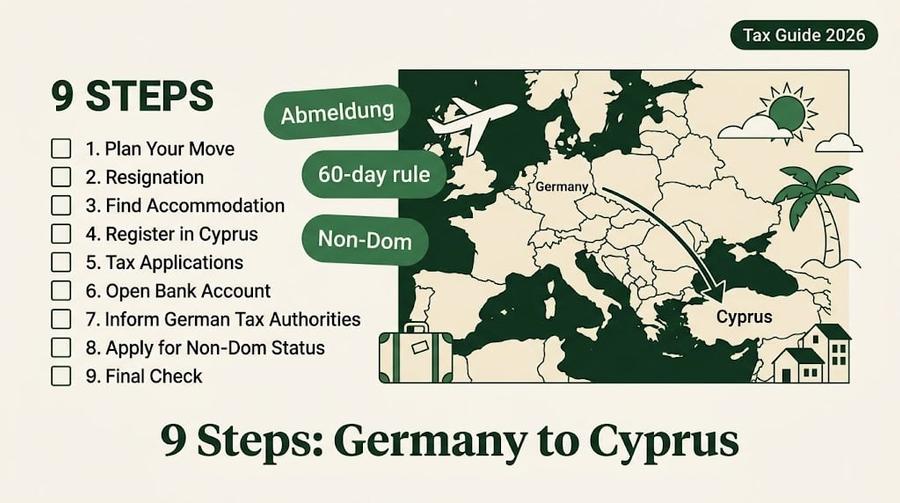
Moving from Germany to Cyprus involves more than packing and booking flights. Germany has specific exit obligations - from Wegzugsteuer to Abmeldung - and Cyprus has specific entry requirements for establishing tax residency. This 9-step checklist covers both sides of the move in the correct sequence.
For a broader overview of the Germany-to-Cyprus relocation, see /moving-from/germany. This post focuses on the tax and administrative steps.
Source: PwC Cyprus Tax Facts 2026. Rates current as of January 2026.
German Exit Obligations Before You Leave
1. Calculate Your German Exit Tax Liability (Wegzugsteuer)
Germany imposes exit tax on unrealised gains in company shares when you leave. The tax applies to the deemed disposal of those shares at your departure date.
German exit tax (Wegzugsteuer under section 6 AStG) applies to individuals who have been German tax residents for at least 7 of the last 12 years and hold shares worth at least 1% in a corporation. The unrealised gain is taxed as if the shares were sold on the day of departure.
Key steps to complete BEFORE leaving Germany:
- File Abmeldung (deregistration) at your local Einwohnermeldeamt, required by law within 2 weeks of moving
- Submit tax deregistration to your Finanzamt, notify them of your new foreign address
- Get a tax clearance or final assessment if you have outstanding obligations
- Evaluate exit tax exposure (§6 AStG), if you hold ≥1% of a company worth ≥€1 to €500k market value, consult a tax advisor first
- Close or transfer German bank accounts, note that many banks allow non-residents to keep accounts
- Arrange health insurance bridge coverage, cancel German Krankenkasse and arrange GESY registration in Cyprus
- Notify pension provider (Deutsche Rentenversicherung) of address change
First 30 days in Cyprus:
- Register at Civil Registry (MEU1 yellow slip) for EU citizens
- Obtain Cyprus TIC (Tax ID) via TaxisNet
- Open Cyprus bank account
- Register for GESY (healthcare system)
- If company director: register with Social Insurance (MLSI)
The rules changed significantly in 2022. Temporary absence rules and payment-by-instalments provisions exist. A German tax advisor should assess your specific situation before you move.
2. File a German Partial-Year Tax Return
You remain German tax resident for the portion of the year you lived in Germany. A partial-year return covering January through your departure date is required.
German tax residency ends on the day you permanently leave Germany and no longer have a place of abode (Wohnsitz) or habitual residence (gewohnlicher Aufenthalt) there. Your final German return covers income earned during that period.
Timing matters: if you leave Germany in December, you owe tax on almost a full year of German-source income. Leaving in January or February of the new year can significantly reduce the partial-year tax exposure.
3. Deregister Your German Address (Abmeldung)
Formally deregistering from your German municipality (Abmeldung) is both a legal obligation and important evidence that your German tax residency has ended.
Abmeldung is done at the local Einwohnermeldeamt (residents' registration office). You receive an Abmeldebestatigung (deregistration certificate), which you should keep as proof of your departure date.
Deregistration alone does not automatically end German tax liability - you must also have no Wohnsitz or gewohnlicher Aufenthalt in Germany. If you keep a home available in Germany, the German tax authority may still claim you as a resident.
Cyprus Entry and Residency Steps
4. Establish Your Cyprus Address Before Year-End
To avoid a gap year with no tax residency, your Cyprus rental contract or property deed must be in place in the same calendar year you leave Germany.
A gap year - where you are tax resident in neither Germany nor Cyprus - creates complications. Both countries may make claims, and double tax treaty tie-breaker rules become relevant.
Practical approach: sign a Cyprus rental contract before or on the same day you deregister in Germany. The lease should run for the full calendar year.
Yellow Slip and residency: /learn/yellow-slip
5. Meet the 60-Day Rule Requirements
If you will not be spending 183+ days in Cyprus in your first year, you must meet all 5 conditions of the 60-day rule to become Cyprus tax resident.
The 60-day rule requires: at least 60 days in Cyprus, not more than 183 in any single other country, no tax residency elsewhere, a permanent Cyprus address, and a Cyprus business or directorship.
Many Germans transitioning to Cyprus split their first year between multiple countries. The 60-day rule is designed for this situation - but all 5 conditions must be met simultaneously.
60-day rule explained: /learn/60-day-rule
6. Open a Cyprus Bank Account
A Cyprus bank account is required for the Yellow Slip process and for operating your Cyprus company. Allow 4-12 weeks for a corporate account.
Personal accounts at Hellenic Bank or Bank of Cyprus are easier to open than corporate accounts. For companies, banks require full KYC documentation including business description, source of funds, and director identification.
As a bridge, Revolut Business or Wise Business can be operational within days and is widely accepted for business purposes in Cyprus while the bank account is being set up.
Registration, Banking, and Status Applications
7. Apply for the Yellow Slip (MEU1)
The Yellow Slip is your official EU resident registration certificate in Cyprus. Apply at your district civil registry office.
Required documents: valid EU passport or ID, proof of Cyprus address (rental contract), proof of financial means, MEU1 application form, and two passport photos. Health insurance is not a mandatory requirement.
Processing takes 1-3 months depending on the office. You can live and work in Cyprus while waiting.
Yellow Slip documents: /learn/yellow-slip
8. Apply for Non-Dom Status in Your First Tax Year
Non-Dom status must be actively applied for - it is not granted automatically. Apply as soon as you establish Cyprus tax residency to ensure SDC exemption applies from day one.
Submit a tax registration application (TD2001) to the Cyprus Tax Department and declare your non-domicile status. Provide evidence that you were not domiciled in Cyprus at birth and have not been resident for 17 of the last 20 years.
Missing the application in your first year can result in SDC being technically owed on dividend income received during that year. Apply promptly.
Non-Dom guide: /learn/non-dom
9. Register for GHS/GESY Health Coverage
All Cyprus residents must register for the General Health System (GESY/GHS). This gives access to state healthcare and covers the 2.65% GHS contribution requirement.
Registration is through the Health Insurance Organisation (HIO). Employed individuals are registered by their employer. Self-employed and company directors register directly.
GHS contributions are 2.65% on employment income and dividends (capped at EUR 180,000 annual insurable income). The system provides access to public GPs, specialists, hospitals, and emergency care.
GHS explained: /learn/ghs-cyprus
The 9 Steps: Sequence and Timing
| Step | When | Key Action |
|---|---|---|
| 1. Exit tax calculation | Before departure | German tax advisor assessment |
| 2. Partial-year return | Year of departure | File by deadline in Germany |
| 3. Abmeldung | Day of departure | Get Abmeldebestatigung certificate |
| 4. Cyprus address | Same year as departure | Sign lease before year-end |
| 5. 60-day rule | First Cyprus year | Meet all 5 conditions |
| 6. Bank account | Month 1-2 | Personal first, corporate later |
| 7. Yellow Slip | Month 1-3 | Civil registry office appointment |
| 8. Non-Dom application | First Cyprus tax year | Submit TD2001 promptly |
| 9. GESY registration | Month 1 | Health Insurance Organisation |
Frequently Asked Questions
Does Germany charge exit tax when moving to Cyprus?
Potentially yes. German exit tax (Wegzugsteuer) applies if you have been a German tax resident for at least 7 of the last 12 years and hold at least 1% in a corporation. The unrealised gain on those shares is taxed on departure. A German tax advisor should assess your specific situation before you move.
Can I keep a home in Germany and still become Cyprus tax resident?
Keeping a home available for your use in Germany is a significant risk factor. German tax authorities may argue you retain a Wohnsitz in Germany, making you German tax resident regardless of your Cyprus ties. The Cyprus-Germany double tax treaty tie-breaker rules would then determine which country has primary taxing rights.
What is the correct sequence for moving from Germany to Cyprus?
Generally: (1) calculate exit tax, (2) set up Cyprus address, (3) file Abmeldung, (4) move, (5) meet 60-day rule conditions, (6) apply for Yellow Slip, (7) apply for Non-Dom in same tax year.
How long does the Yellow Slip take for Germans moving to Cyprus?
As EU citizens, Germans have immediate right to reside and work in Cyprus. The Yellow Slip (MEU1) is a registration document. Processing takes 1-3 months depending on the civil registry office.
Is the Cyprus-Germany double tax treaty relevant for people relocating?
Yes. The treaty governs which country taxes different income types during the year of departure and beyond. It includes tie-breaker rules for individuals who may be considered resident in both countries simultaneously during the transition year.
Sources: PwC Cyprus Tax Facts 2026, Cyprus Tax Department.
Does Germany charge exit tax when moving to Cyprus?
How long does the Yellow Slip take for Germans moving to Cyprus?
What is the correct sequence for moving from Germany to Cyprus?
Can I keep a home in Germany and still become Cyprus tax resident?
Is the Cyprus-Germany double tax treaty relevant for people relocating?
Do I need to file a German tax return after leaving?
Which Cyprus city is best for Germans relocating?
Need personalized advice? Book a consultation with an expat tax specialist.
Sources: PwC Cyprus Tax Facts 2026, Cyprus Tax Department.
Planning your move from Germany to Cyprus? Speak with a specialist
Use the Cyprus Salary Calculator to compare net income under Cyprus income tax (0% up to EUR 22,000, max 35%) versus Germany's top rates (up to 45%). For a full structure comparison, the Company vs Self-Employed Calculator models self-employment, Cyprus Ltd with salary, and Non-Dom dividends.
![Cyprus Ltd vs Irish Ltd: Company Tax Compared [2026]](https://cdn.sanity.io/images/glqahhks/production/84e3d82538a859345d8d2447e8e097c5777fb238-1679x937.png?w=700&q=75&auto=format)
![Cyprus vs Malta Company Formation [2026]](https://cdn.sanity.io/images/glqahhks/production/97db89d0ce729a9e931d09bc1522631faa6c3474-1679x937.png?w=700&q=75&auto=format)