Moving from Germany to Cyprus
Quick Answer
Moving from Germany to Cyprus with Non-Dom status reduces your effective tax rate from ~42-48% to approximately 5%. Cyprus applies 0% Special Defence Contribution on foreign dividends, a flat 15% corporate tax, and offers tax residency with just 60 days of physical presence per year under the 60-day rule. A double tax treaty between Germany and Cyprus prevents double taxation during the transition.
Last updated: 2026-05-29

Why Germany Professionals Consider Cyprus
Germany presents a multilayered tax burden that is particularly costly for entrepreneurs and company owners. The income tax system reaches 45% at the top marginal rate, plus a 5.5% Solidaritatszuschlag (solidarity surcharge) for higher earners, bringing the effective top rate to approximately 47.5% on earned income.
For GmbH (Gesellschaft mit beschrankter Haftung) owners, the corporate tax picture is similarly complex. The base corporate tax (Korperschaftsteuer, KSt) is 15%, but the Gewerbesteuer (trade tax) adds approximately 14-17% depending on the municipality, resulting in a combined effective corporate tax rate of approximately 29-32%.
When profits are distributed as dividends, the Abgeltungsteuer (final withholding tax) of 26.375% (25% + 5.5% solidarity surcharge) applies. The result: on EUR 1 of pre-tax profit, approximately EUR 0.47-0.52 remains after corporate tax and dividend tax.
The GmbH also involves complex accounting requirements, mandatory audits above certain thresholds, and a demanding compliance calendar. The combination of high rates, high complexity, and high living costs in Munich, Frankfurt, or Hamburg drives many German entrepreneurs to explore alternatives. Cyprus, within the EU, with its straightforward 15% corporate tax and Non-Dom structure, is increasingly the destination of choice.
Germany Tax Burden at a Glance
| Tax type | 🇩🇪 Germany |
|---|---|
| Income tax | Up to 45% + 5.5% Solidaritatszuschlag |
| Corporate tax | ~30% (15% KSt + ~15% Gewerbesteuer) |
| Capital gains tax | 26.375% Abgeltungsteuer |
| Dividend tax | 26.375% Abgeltungsteuer |
| Social contributions | ~20% employee + ~20% employer (capped) |
| Effective rate | ~42-48% |
Tax Comparison: Germany vs Cyprus
The German-to-Cyprus comparison for a GmbH owner is compelling:
On EUR 100,000 of business revenue: Germany (GmbH + dividends): Corporate tax ~30% = EUR 30,000. Remaining EUR 70,000 as dividends at 26.375% = EUR 18,463. Total tax approximately EUR 48,463 (48.5% effective).
Cyprus (Ltd + Non-Dom): Corporate tax at 15% = EUR 15,000. Low salary plus dividends at 0% income tax + 2.65% GHS. Total tax approximately EUR 5,000 (5% effective).
Annual savings: approximately EUR 43,000.
The savings also extend to capital gains on business sales. In Germany, a GmbH sale is subject to the Teileinkuenfteverfahren (partial income method), where 60% of the gain is taxable at the personal rate (up to 47.5%), resulting in an effective rate of approximately 28.5%. In Cyprus, capital gains on shares are not subject to personal income tax. A company sale of EUR 1,000,000 in Cyprus results in zero personal tax, while the same transaction in Germany generates approximately EUR 285,000 in personal tax.
Interactive Tax Calculator
Germany
Effective rate
45%
Est. tax: €45,000
Cyprus (Non-Dom)
Effective rate
5%
Est. tax: €5,000
Annual savings by moving to Cyprus
€40,000
Estimates based on effective rates. Consult a tax advisor for your specific situation.
Cyprus Non-Dom: ~5% effective tax
The alternative most entrepreneurs do not know about
- ✓15% corporate tax (flat, no surcharges)
- ✓0% dividend income tax (Non-Dom)
- ✓2.65% GHS on all income
- ✓No wealth tax, no inheritance tax
- ✓60-day rule for flexible tax residency
- ✓Full EU membership and treaty network
Double Tax Treaty: Germany - Cyprus
Germany and Cyprus have a double tax treaty in force. Key provisions: dividends 5% (if the beneficial owner holds at least 10% of capital) or 15% otherwise, interest 0%, royalties 5%. Germany has robust anti-avoidance legislation under the Aussensteuergesetz (AStG), which includes CFC rules (Hinzurechnungsbesteuerung) and exit tax provisions. The German exit tax (Wegzugsteuer) under section 6 AStG applies to unrealized gains on shares in corporations for individuals who have been German tax residents for at least 10 of the last 12 years. For EU moves, the exit tax can be paid in installments over 7 years without interest. Professional German tax advice before departure is strongly recommended.
Leaving Germany: Exit Process
Germany's exit process is thorough and has significant tax implications:
Wegzugsteuer (exit tax): If you have been a German tax resident for at least 10 of the last 12 years and hold shares in a corporation with a value above EUR 500,000, Germany will assess an exit tax on unrealized capital gains under section 6 AStG. For moves within the EU, payment can be spread over 7 annual installments. Annual reporting to the Finanzamt is required.
Deregistration: You must deregister (Abmeldung) from the Einwohnermeldeamt (residents' registration office) of your current city at least one week before departure. This is a legal requirement in Germany.
Final tax return: File a final German income tax return (Einkommensteuererklarung) covering the year of departure.
GmbH considerations: Your German GmbH can be maintained, but if management and control are exercised from Cyprus, the GmbH may be considered to have its place of effective management in Cyprus, which changes its corporate tax status. Consult a German tax advisor to structure this correctly.
Social insurance: Your statutory health insurance (gesetzliche Krankenversicherung) ends upon leaving Germany. You transition to the Cyprus GHS system. Your German Rentenversicherung (pension) credits are preserved under EU coordination rules.
Wegzugsteuer: Germany's Exit Tax on GmbH Shares Explained
The Wegzugsteuer under section 6 AStG (Außensteuergesetz) is one of the most important tax considerations for any German entrepreneur or GmbH owner planning to relocate to Cyprus. It applies when you have been a German tax resident for at least 10 of the last 12 years and hold shares in a domestic or foreign corporation - including your GmbH, a foreign LLC, or any other corporate structure - with a total fair market value above EUR 500,000. Germany treats your departure as a deemed disposal: the unrealized capital gain (difference between fair market value on your departure date and your original acquisition cost) is taxed as if you had sold the shares.
For moves within the European Union - which includes Cyprus - section 6(5) AStG grants a right to pay the assessed Wegzugsteuer in seven equal annual installments without interest. You do not pay the full tax bill upfront on the day you leave. However, the deferral conditions are strict: you must remain a resident of an EU or EEA member state throughout the installment period, you must not sell or transfer the shares during the installment period (unless the full deferred tax becomes immediately due), and you must submit an annual declaration to your Finanzamt confirming the conditions are still met.
A numerical example makes this concrete. A German entrepreneur owns a GmbH with a current fair market value of EUR 800,000. The shares were originally acquired for EUR 50,000. The unrealized gain is EUR 750,000. Assuming the Teileinkünfteverfahren (partial income method) applies - where 60% of the gain is subject to personal income tax at rates up to 47.5% - the assessed Wegzugsteuer is approximately 60% × EUR 750,000 × 47.5% = EUR 213,750. Paid in seven installments: approximately EUR 30,536 per year. This is a real cash obligation that must be planned for.
The critical point: the Wegzugsteuer is assessed on departure, not on sale. Even if you never sell the GmbH, you owe Germany the installment payments. If you subsequently sell the GmbH while living in Cyprus, the sale price generates a separate taxable event under the Germany-Cyprus double tax treaty. The treaty generally allocates capital gains on shares to the state of residence (Cyprus). But the pre-departure accrued gain - which has already been assessed under Wegzugsteuer - remains a German obligation. The interaction between the deferred Wegzugsteuer installments and any actual sale gain requires detailed professional analysis to avoid paying tax twice on the same appreciation.
Entrepreneurs with GmbH values below EUR 500,000 or who have been German residents for fewer than 10 of the last 12 years do not trigger the Wegzugsteuer. For those who do trigger it, the planning window before departure - restructuring shareholdings, valuing the company professionally, deciding on installment timing - is one of the most important steps in the entire relocation process.
Krankenversicherung Transition: From GKV to Cyprus GHS
One of the most practical concerns for Germans moving to Cyprus is the transition from the German statutory health insurance system (gesetzliche Krankenversicherung, GKV) to the Cyprus General Health System (GHS, also known as GESY). This transition is smoother than many Germans expect, but requires active steps.
The GKV covers approximately 90% of Germans through statutory insurance funds (Krankenkassen) such as TK, AOK, Barmer, or DAK. Premiums are calculated as a percentage of gross income (approximately 14.6% shared equally between employee and employer, plus a fund-specific additional contribution averaging 1.7%). For self-employed individuals who contribute voluntarily to GKV, the full contribution is their own responsibility and can reach EUR 800-900/month for higher earners.
When you deregister from Germany (Abmeldung) and establish residence in Cyprus as an EU citizen, your GKV membership automatically ends. There is no penalty for leaving, and your accrued GKV history does not transfer monetarily - but it does not generate a liability either. You simply stop being a member. Some GKV funds will issue a coverage certificate (Versicherungsbescheinigung) for the period you were insured, which may be useful for establishing your insurance history if you ever return.
The Cyprus GHS was fully launched in 2020 and covers all residents, including EU citizens who take up residence. Contributions are 2.65% of employment income, 2.65% on pension income, and 2.65% on dividend and investment income - with a personal annual cap of approximately EUR 4,770. This is dramatically lower than GKV costs, particularly for higher earners. In return, GHS covers GP visits (with a EUR 1 copay), specialist referrals (EUR 6), hospital stays, diagnostic tests, prescriptions, and mental health consultations.
The practical difference German expats notice most is the speed of private specialists. Many opt to use GHS for basic care and hold a supplementary private health insurance for faster specialist access or private hospital rooms. Private health insurance in Cyprus for a healthy adult in their 30s-40s costs approximately EUR 100-250/month depending on coverage level - still far less than GKV for self-employed individuals.
For medications, the GHS formulary covers most common drugs at low copayments (EUR 1-3 per item). Specialist medications not on the formulary may need private purchase. German-trained doctors practice in Cyprus, and many specialists completed training at German or Austrian universities. English is the working language of the medical system.
Your German statutory pension (Rentenversicherung) is completely separate from healthcare. See the section below for how German pension contributions are handled after you move.
Rentenversicherung and Anmeldung in Cyprus: What German Expats Need to Know
Two practical questions arise for almost every German moving to Cyprus: what happens to their German pension contributions, and how does the Cypriot registration system work compared to the German Anmeldung.
On Rentenversicherung: Germany's state pension system (Deutsche Rentenversicherung) operates on a points-based system where each year of contributions earns Entgeltpunkte (earnings points) that translate into monthly pension payments at retirement age. When you move to Cyprus and cease German employment or self-employment, you stop accumulating new points. But all points earned during your German working years are preserved in full. The Deutsche Rentenversicherung will pay your pension at German statutory retirement age regardless of where you live - it can be deposited to a Cyprus bank account or any SEPA-zone bank. Under EU coordination rules (EC Regulation 883/2004), your years of residence and contributions in Germany and Cyprus are taken into account when calculating minimum pension qualifying periods for both countries' systems.
If you are self-employed as a GmbH director in Cyprus and pay yourself a salary, you will contribute to the Cyprus Social Insurance Fund. Cyprus social insurance contributions are capped at a much lower income ceiling than the German Beitragsbemessungsgrenze (BBG), and the rates are 8.8% employee + 8.8% employer on income up to EUR 68,904/year (2026). The administrative process is straightforward and is handled by your Cyprus company payroll.
One important decision: if you have fewer than 5 years of German Rentenversicherung contributions (the Wartezeit minimum to qualify for a pension), it may be worth making voluntary contributions (freiwillige Beiträge) to reach the minimum qualifying period. The contribution rate for voluntary insurers is currently 18.6% of the declared contribution base (minimum EUR 100.07/month). This is a personal financial decision that a cross-border pension advisor can help structure.
On Anmeldung in Cyprus: Germans are very accustomed to the Anmeldung (residential registration) system where your address must be registered with the Einwohnermeldeamt within 14 days of moving. Cyprus has a different but functionally similar system. EU citizens who plan to stay more than 3 months in Cyprus must register with the Migration Department. The registration document you receive is commonly called the "Yellow Slip" (MEU1 certificate) and is equivalent to a formal residence registration. To obtain it, you need your EU passport or national ID, proof of accommodation (rental contract or property deed), proof of employment or sufficient financial means, and health insurance (GHS registration or private coverage). The Yellow Slip is valid indefinitely and serves as your primary residency document for opening bank accounts, registering for tax residency, and other administrative purposes.
For Germans accustomed to the reliability and digitization of German administrative services, Cyprus can feel less systematic - processes take longer, documentation requirements vary by officer, and in-person visits are often required for initial registrations. Building in 2-4 weeks for administrative processing time is realistic.
Cost of Living: Germany vs Cyprus
Germany's major cities are among the most expensive in Europe:
Housing: Munich EUR 1,500-2,500 rent vs Larnaca EUR 550-750 (savings: 60-70%). Berlin EUR 1,100-1,800. Frankfurt EUR 1,300-2,100. Groceries: Germany EUR 350-450 vs Cyprus EUR 250-350 (savings: 25-35%) Dining out: Germany EUR 250-350 vs Cyprus EUR 150-200 (savings: 40%) Transport: Germany EUR 100-150 vs Cyprus EUR 100-150 (comparable) Utilities: Germany EUR 200-280 vs Cyprus EUR 100-150 (significantly less heating needed)
Total monthly: Germany EUR 2,800-3,800 vs Cyprus EUR 1,400-1,900
Germany's notoriously expensive car registration and ongoing vehicle costs are absent in Cyprus. The climate shift from German winters (with limited daylight from November to February) to the Mediterranean is a significant quality-of-life improvement that many German expats cite alongside the tax savings.
Step-by-Step Relocation Checklist
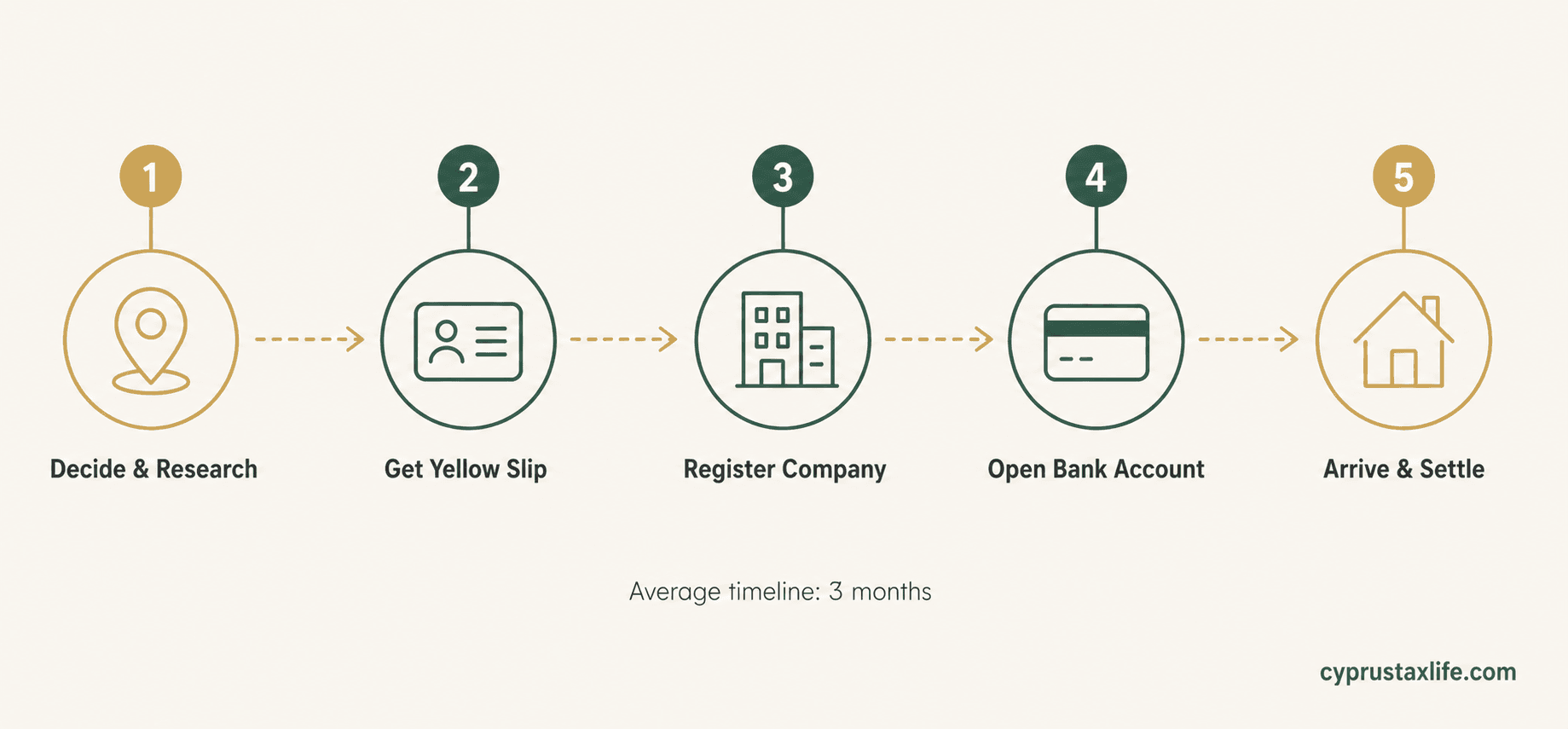
Consult a German tax advisor regarding Wegzugsteuer exposure before departure
Research and choose your Cyprus city
Set up a Cyprus Ltd company (EUR 1,100-1,800 all-in)
Find accommodation in Cyprus and sign a rental contract
Register your departure with the Einwohnermeldeamt (Abmeldung)
Notify the Finanzamt of your change of residence and new tax address
File your final German income tax return (Einkommensteuererklarung)
Address any GmbH management and control implications with your advisor
Apply for Cyprus tax residency (60-day or 183-day rule)
Register for Non-Dom status at the Cyprus Tax Department
Obtain your Yellow Slip (EU citizen registration)
Open a Cyprus bank account
Register for GHS healthcare
Set up payroll structure in Cyprus (low salary + dividends)
If exit tax applies, set up annual reporting arrangements with the Finanzamt
Frequently Asked Questions
What is the German exit tax (Wegzugsteuer) and does it apply to me?+
Can I keep my German GmbH after moving to Cyprus?+
How does the German solidarity surcharge (Solidaritatszuschlag) work?+
What happens to my German pension (Rentenversicherung)?+
How much can I save by moving from Germany to Cyprus?+
What happens to my German Krankenversicherung (GKV) when I move to Cyprus?+
Are my German Rentenversicherung pension points preserved after moving?+
Do I need a formal Abmeldung before leaving Germany?+
Sources and References
- PwC Worldwide Tax Summaries: Cyprus
- KPMG Cyprus: Tax and Advisory
- EY Cyprus: Tax Services
- Cyprus Ministry of Finance (mof.gov.cy)
Effective rates are approximations for entrepreneur structures (company + low salary + dividends). Consult a qualified tax advisor before making decisions.
Free, no commitment
Moving to Cyprus or opening a company?
Tell us your situation and we'll connect you with our specialist expat advisory in Cyprus: Non-Dom tax, company setup and residency, done for you. Free consultation, no commitment.
Related Articles
Germany's exit tax (§6 AStG) taxes unrealised gains on shares >1% when you emigrate. Moving to Cyprus (EU): you can defer payment indefinitely. Full breakdown for German founders and investors.
 Miriam Alonso
- Tax Planning
- Relocation
Canada's departure tax treats you as having sold your worldwide assets the day you stop being a tax resident. What is caught, what is exempt, how to defer it, and what the cost-base reset means for where you go next.
![Countries With No Property Tax [2026]: The Real Cost](https://cdn.sanity.io/images/glqahhks/production/6f7ea0efceed8a692ad7c3785efa8baaf4d1e208-1679x937.jpg?w=700&q=75&auto=format)
Compare countries with no property tax and the stamp duty they charge instead. See the 10-year holding cost that makes Cayman pricier than Portugal.
Miriam Alonso