Quick Answer
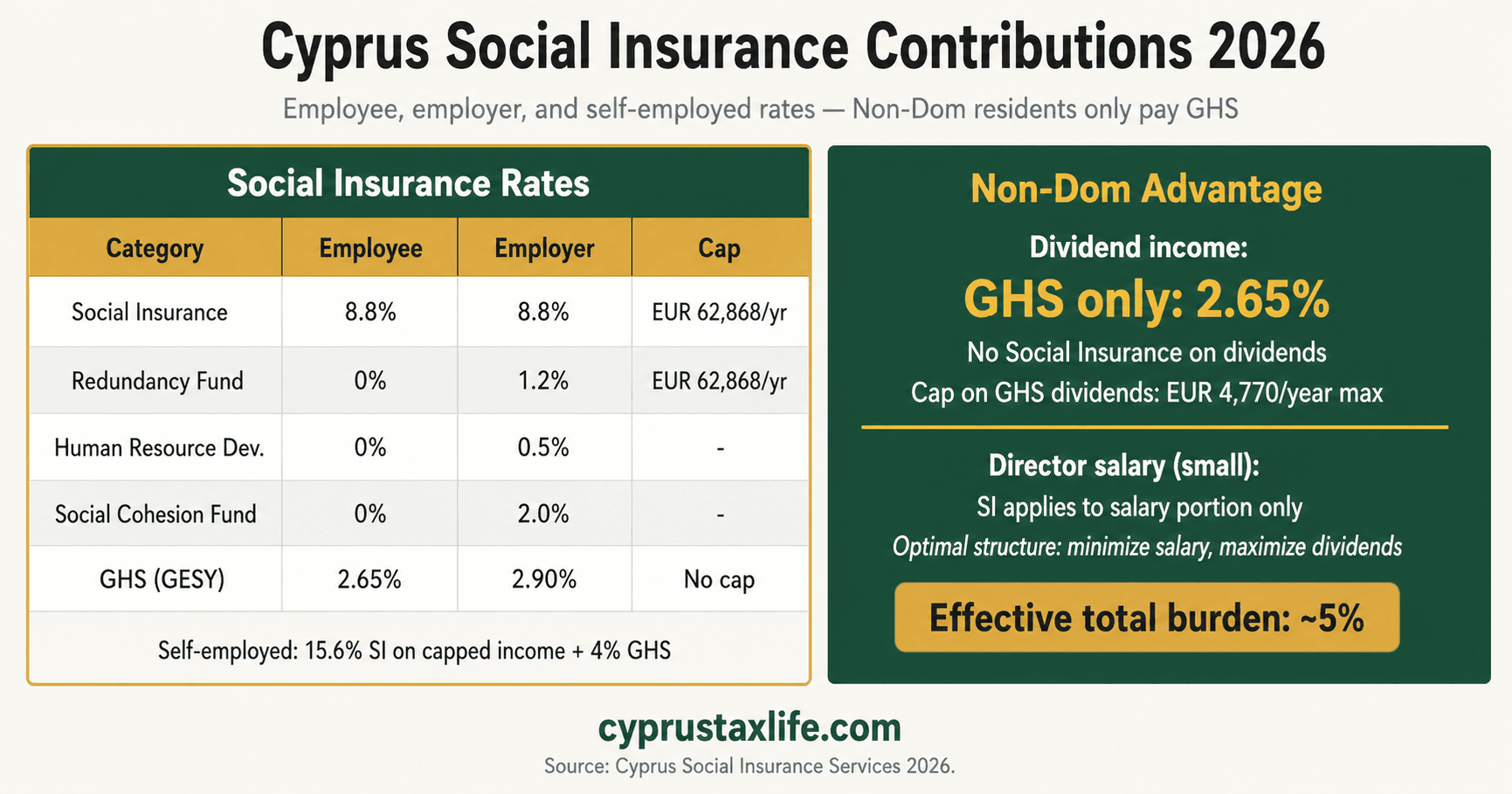
Cyprus social insurance contributions for employees are 8.8% of gross salary paid by the employee and 8.8% paid by the employer. Self-employed individuals pay 16.6% of their insurable income. Directors of Cyprus companies who extract only dividends are not subject to social insurance on dividend income - a significant advantage over salary-based extraction.
Social Insurance in Cyprus: 2026 Rates and Guide
Cyprus social insurance contributions are among the lowest in the EU. Employees pay 8.8%, employers 8.8%, and self-employed 16.6% on insurable earnings.
Last updated:
Social Insurance Portability: What Happens to Your Contributions When You Leave Cyprus
One of the most common questions from expats considering Cyprus is whether their social insurance contributions will be wasted if they eventually move on. The answer depends on your nationality and destination country, but in most cases, your contributions are protected.
EU/EEA Citizens: Full Portability Under Regulation (EC) 883/2004
If you are a citizen of an EU or EEA country, Regulation (EC) 883/2004 guarantees complete portability of your social insurance contributions across all member states. The key principle is totalisation: contribution periods accumulated in Cyprus are added to those from other EU countries when calculating your pension entitlement.
For example, a worker who contributed for 10 years in Germany and 7 years in Cyprus will have 17 years recognised for pension purposes. Each country pays its proportional share, Germany pays based on 10/17 of the pension and Cyprus pays based on 7/17. No contributions are lost when you leave.
This totalisation applies to all social insurance branches: old-age pension, invalidity, survivors' benefits, sickness, and unemployment. Moving within the EU means your entire contribution history travels with you.
Non-EU Nationals: Bilateral Social Security Agreements
Cyprus has signed bilateral social security agreements that provide portability for nationals of several non-EU countries. Countries covered by these agreements include:
- United Kingdom
- Canada
- Australia
- Syria
- Egypt
For nationals of these countries, contribution periods in Cyprus and the partner country are totalised in the same way as within the EU. Your Cypriot contributions count toward the minimum qualifying periods in the partner country and vice versa.
For nationals of countries without a bilateral agreement, the situation is different. Your contributions in Cyprus accrue toward a Cypriot pension only, they do not transfer to your home country. However, they are not entirely lost: provided you meet the minimum contribution threshold, you will receive a Cypriot pension at retirement age regardless of where you live at that time.
Minimum Contribution Period for a Cypriot Pension
To qualify for a Cypriot old-age pension, you must have accumulated at least 3 years of contributions (156 insurable weeks). The standard retirement age is 65. If you leave Cyprus before reaching this threshold and your country has no totalisation agreement with Cyprus, those contributions will not generate a pension entitlement, though they do count toward sickness benefits and unemployment insurance during your time in Cyprus.
If you are approaching 3 years of contributions before leaving, it is worth making voluntary contributions to cross the threshold and secure the pension entitlement.
How to Claim Portability When You Leave Cyprus
When departing Cyprus, request your contribution history statement from the Social Insurance Services (Υπηρεσίες Κοινωνικών Ασφαλίσεων). This document records all insurable weeks accumulated under your Social Insurance Number (SIN).
For EU/EEA destinations: Your Cypriot contribution history is automatically recognised by the social security institutions of all other EU member states. Present your statement when registering with the social security authority in your new country of residence.
For countries with a bilateral agreement: Contact the social security institution in your destination country and provide your Cypriot contribution history. They will coordinate with Cyprus to apply totalisation.
For all other destinations: Keep your contribution history for future reference. At retirement age (65), you can apply for a Cypriot pension from abroad if you have accumulated the minimum 156 insurable weeks.
UK Pensioners Moving to Cyprus: NI Contributions
For individuals who paid UK National Insurance (NI) contributions and are now living in Cyprus, there is good news on two fronts. First, under the post-Brexit bilateral agreement between the UK and Cyprus, your NI contribution years count toward the UK State Pension even while you reside in Cyprus. Second, you can continue making voluntary Class 2 or Class 3 NI contributions from Cyprus to fill gaps and reach the full 35-year qualifying period for the maximum UK State Pension.
The UK State Pension is payable to overseas residents, including those in Cyprus, without reduction. This makes Cyprus particularly attractive for UK nationals planning early retirement: Cyprus's low taxes apply to your income, and your UK State Pension rights remain intact.
Sources: Social Insurance Services Cyprus; Regulation (EC) 883/2004 on coordination of social security systems; HIO Cyprus 2026.
Key Facts 2026
| Employee SI contribution | 8.8% of insurable earnings |
| Employer SI contribution | 8.8% of insurable earnings |
| Self-employed SI contribution | 16.6% |
| Insurable earnings ceiling (2026) | EUR 68,904/year (EUR 1,325/week) |
| GHS employee contribution (separate) | 2.65% |
| GHS employer contribution (separate) | 2.90% |
| GHS self-employed contribution | 4.00% |
| Director (no employment contract) | SI at 16.6% as self-employed |
Free, no commitment
Moving to Cyprus or opening a company?
Tell us your situation and we'll connect you with our specialist expat advisory in Cyprus: Non-Dom tax, company setup and residency, done for you. Free consultation, no commitment.
Frequently Asked Questions
What is the social insurance rate for employees in Cyprus?
What is the social insurance rate for self-employed in Cyprus?
What is the GHS contribution and is it separate from social insurance?
Do I pay social insurance if I work remotely from Cyprus for a foreign employer?
Can I receive a Cyprus pension if I worked in multiple EU countries?
How do I register for social insurance in Cyprus as self-employed?
Is there a cap on social insurance contributions in Cyprus?
Does Non-Dom status reduce my social insurance contributions in Cyprus?
Can I make voluntary social insurance contributions after leaving Cyprus?
How much is the maternity benefit in Cyprus and who qualifies?
I work remotely from Cyprus for a foreign employer, do I pay Cyprus social insurance?
Need a Cyprus accountant?
We connect you for free with a vetted, English-speaking accountant who handles VAT, accounts and payroll for expats and Cyprus Ltds.
Related Guides
Sources
Cyprus Social Insurance Services. General Health System (GHS/GESY) Law 2001. Insurable earnings ceiling updated 2026. Updated: April 2026.
How Social Insurance Contributions Are Calculated: Salary vs Self-Employment
For employees, social insurance contributions are calculated on gross insurable earnings, the total salary before any deductions. The employee contributes 8.8% and the employer matches that with another 8.8%, bringing the combined contribution to 17.6% of gross salary. There is an annual cap on insurable earnings: for 2026 this is EUR 62,868 (EUR 5,239 per month), meaning contributions are not owed on any earnings above this threshold. A salaried employee earning EUR 50,000 per year pays EUR 4,400 in SI contributions; one earning EUR 80,000 per year still pays only EUR 5,532 (capped). Employers are required to register their employees with the Social Insurance Services within the first day of employment.
Self-employed individuals follow a different calculation method. The contribution rate is 16.6% (versus the combined 17.6% for employed persons, because there is no employer to share the burden), applied to 80% of the self-employed person's annual net profit. This 80% rule is a statutory assumption about what counts as insurable earnings, it is not optional. For example, if your net self-employment profit is EUR 40,000, your insurable earnings are EUR 32,000 and your annual SI contribution is EUR 5,312. The same EUR 62,868 cap applies to the 80%-adjusted figure, not the raw profit. Self-employed persons must file a declaration of insurable earnings annually and make contributions quarterly.
Freelancers and company directors who are also shareholders occupy a specific position: if you hold more than 50% of the shares of a Cyprus company and you are also its director providing services, the Social Insurance Services typically classify you as self-employed for SI purposes, even if the company pays you a salary. This classification matters because the self-employed rate (16.6%) is paid entirely by you rather than being split with an employer. If you are a minority shareholder and salaried director, the standard employee/employer split applies. When in doubt, request a formal classification letter from the Social Insurance Services before filing your first contribution return.
Pension Rights: How Cyprus SI Contributions Build Your Future Entitlement
The Cyprus social insurance system provides a two-tier state pension. The first tier is a flat-rate basic pension (the 'Basic Pension') paid to all insured persons who meet the minimum contribution threshold. The second tier is an earnings-related supplementary pension that scales with your accumulated insurance points (called 'units' in the Cypriot system). Each year of contributions at average insurable earnings credits you with a set number of units; higher or lower earnings credit proportionally more or fewer units. The current full basic pension requires 780 weeks (15 years) of contributions, and the supplementary pension is calculated on the total units accumulated over your entire insured career.
The statutory retirement age in Cyprus is 65 for both men and women (phased in from 63 for women, now fully aligned). Early retirement is possible from age 63 with a minimum of 780 contribution weeks, but the pension amount is permanently reduced by approximately 0.5% for each month taken before age 65. For a digital nomad or expat who spends, say, 10 years in Cyprus before relocating, those 10 years of contributions still generate a proportional Cypriot pension entitlement. Under EU Regulation 883/2004, Cyprus will pay its share of the pension to you wherever you retire in the EU/EEA, and the periods contributed elsewhere in the EU count toward meeting Cyprus's minimum eligibility threshold.
Contribution records are maintained individually at the Social Insurance Services and are accessible online via Ariadni (the Cyprus government portal) or in person at any district office. It is strongly advisable for any new arrival to request a 'Statement of Insurance Record' (Form SI 200) within their first year to confirm that their employer's contributions are actually being posted to their account. Discrepancies, for example an employer who registered late or paid contributions without specifying the employee's Social Insurance Number, are far easier to correct while you still have access to payslips and employment contracts.
Unemployment, Sick Pay, and Maternity Benefits: What SI Actually Pays Out
Unemployment benefit in Cyprus is paid for a maximum of 156 days (approximately 5 months) per unemployment spell. To qualify you must have at least 26 weeks of contributions in the two contribution years immediately before unemployment, and you must register as unemployed with the District Labour Office within 3 days of losing your job. The benefit amount is 60% of your weekly insurable earnings (based on your earnings in the reference period), subject to a minimum floor and a maximum ceiling that is updated annually. For 2026, the maximum weekly unemployment benefit is approximately EUR 450. Importantly, self-employed persons do not qualify for unemployment benefit, it is available only to employees whose employment ended involuntarily.
Sickness benefit is payable from the 4th day of incapacity (the first 3 days are a waiting period at your own expense, unless your employer's contract covers them). The rate is 60% of your weekly insurable earnings for the first 156 days of sickness, dropping to 75% from day 157 onwards if the illness continues. A medical certificate from a registered doctor (ideally your GESY personal doctor) is required from day one. The maximum duration is 156 weeks for any single continuous illness. Workers with a serious chronic or terminal condition may transition to the disability pension if they exhaust sickness benefit entitlement.
Maternity benefit is one of the most generous elements of the Cyprus SI system. It is paid for 18 weeks (not 14 as was previously the case, extended in 2023), at the rate of 72% of weekly insurable earnings, and requires a minimum of 26 weeks of contributions in the two years before the expected birth. Paternity leave benefit was introduced in Cyprus in 2022: two weeks paid at 72% of insurable earnings, available to the father within 16 weeks of the child's birth. Adoption benefit mirrors maternity benefit. All these benefits are paid directly by the Social Insurance Services, not by the employer, the employer is not legally required to top them up, though many do. Self-employed mothers also qualify for maternity benefit provided they meet the contribution threshold.
Social Insurance for Foreign Workers, Non-Dom Residents, and Remote Workers
Cyprus social insurance is territorial: if you are working in Cyprus, whether as an employee, self-employed person, or company director, you are subject to Cyprus SI regardless of your nationality, tax residency status, or Non-Dom designation. Non-Dom status is a purely income tax and SDC concept; it has no effect whatsoever on your social insurance obligations. A Non-Dom resident who owns a Cyprus company and draws a director's salary pays the same 8.8% employee SI contribution as any Cypriot citizen. This is one of the most common misunderstandings among new arrivals: the 'low-tax Non-Dom' setup does not mean low social insurance.
Remote workers employed by a foreign company while living in Cyprus face a more nuanced situation. Under EU Regulation 883/2004, an employee is generally insured in the country where they physically work. If you are a tax resident of Cyprus and your employer is based in, say, Germany, the default rule is that you should be registered for social insurance in Cyprus, not in Germany. The employer may need to register in Cyprus to make contributions, or you may need to pay as self-employed if the employer cannot or will not register. However, the A1 certificate (Certificate of Applicable Legislation) can be used to maintain insurance in another EU country for a posted worker or multi-state worker. If you hold a valid A1 certificate from your home country, Cyprus SI does not apply for the duration of that certificate (normally up to 24 months).
Third-country nationals (non-EU citizens) who hold a Cyprus work permit or a Category F/'60-day rule' residency are subject to Cyprus SI from the first day of covered employment. Their contributions accumulate exactly like a Cypriot citizen's and are portable to countries with which Cyprus has a bilateral social security agreement (currently: UK, Canada, Australia, Egypt, Syria, and a small number of others). If your home country has no such agreement with Cyprus, your contributions still count toward the Cypriot pension and any Cyprus-based benefits, but they cannot be combined with your home country's record for portability purposes. Third-country nationals leaving Cyprus before reaching the 780-week minimum can either leave contributions on account (to be claimed when they eventually retire) or, in some treaty cases, request a lump-sum refund.
Voluntary contributions after leaving Cyprus are permitted under Article 40 of the Social Insurance Law. A person who was insured in Cyprus and ceases to be covered (because they left Cyprus or retired from employment) may continue making voluntary contributions to maintain continuity of their insurance record. The voluntary contribution rate is 14.6% of declared insurable earnings, paid entirely by the contributor. This is particularly useful for individuals who are a few years short of the 780-week pension eligibility threshold and want to 'top up' remotely. Applications must be submitted to the Social Insurance Services within 6 months of ceasing compulsory insurance.
Disability Pension and Long-Term Incapacity Benefits
Cyprus SI provides a disability pension for insured persons who are assessed as having a permanent incapacity of at least 66.7% that prevents them from engaging in any gainful employment. The assessment is carried out by a Medical Board appointed by the Social Insurance Services. To qualify, you must have at least 156 weeks of contributions paid before the onset of the disability, with a minimum of 26 weeks in the two years immediately preceding the incapacity. The pension amount is calculated in the same way as the old-age pension, basic pension plus supplementary units, but is paid from the date of incapacity rather than from retirement age.
A partial disability pension (for assessed incapacity between 40% and 66.6%) is also available at a reduced rate proportional to the degree of incapacity. Recipients of the disability pension who recover and return to work have their pension suspended but can resume it if the condition recurs. Importantly, disability pension recipients under retirement age continue to accrue pension units, the period on disability pension is treated as a period of insurance for pension-building purposes, so your eventual old-age pension is not penalized for years spent on disability benefit.
In addition to the contributory disability pension, Cyprus operates a means-tested Guaranteed Minimum Income (Elachisto Enguiimeno Eisodima, EEE) safety net for residents whose total income falls below the poverty threshold, regardless of contribution history. This is a separate social welfare payment and not part of the SI system, but it is worth noting for long-term expat residents who may have gaps in their contribution record. EEE eligibility requires legal residence in Cyprus for at least 5 of the last 10 years and is administered by the Social Welfare Services, not the Social Insurance Services.
Free, no commitment
Moving to Cyprus or opening a company?
Tell us your situation and we'll connect you with our specialist expat advisory in Cyprus: Non-Dom tax, company setup and residency, done for you. Free consultation, no commitment.
Related resources
SI for freelancers
Freelancer and contractor full tax picture: SI + GHS + income tax in Cyprus
GHS contributions guide
GHS rates, cap at €180k insurable income, and how it stacks with SI
Income tax brackets
How salary and SI interact with income tax thresholds in Cyprus
SI for property investors
When rental income triggers SI and GHS obligations in Cyprus
Free newsletter
What do you want to hear about?
No spam. Unsubscribe any time.