Cyprus-UK Double Tax Treaty 2026
Last updated: 2026-03-30
Treaty Information
Signed
2018
In force since
2019
Model
OECD Model (updated)
Overview
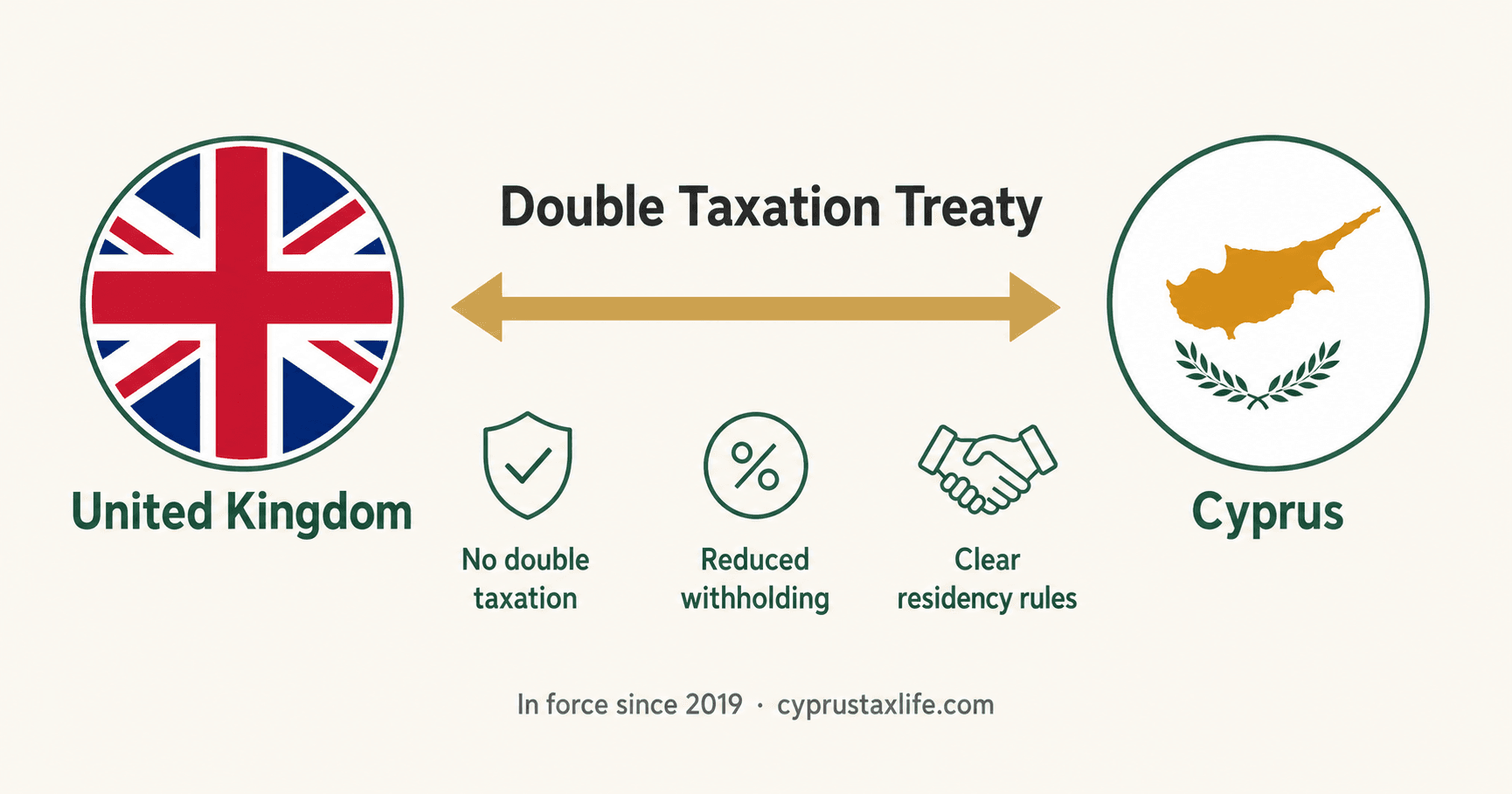
The Cyprus-UK Double Taxation Agreement (DTA) was signed in 2018, replacing the previous 1974 treaty. It follows the OECD Model Tax Convention with some bilateral modifications. The new treaty is more modern and includes provisions on anti-abuse, exchange of information, and digital economy considerations.
This treaty is particularly important for British entrepreneurs who have relocated to Cyprus (post-Brexit) and for Cyprus companies with UK clients, shareholders, or operations. Since the UK is no longer in the EU, the treaty governs tax treatment where EU directives (such as the Parent-Subsidiary Directive) no longer apply.
Key features of the 2018 treaty: elimination of withholding tax on interest and royalties, reduced dividend withholding for substantial holdings, comprehensive tie-breaker rules, and mutual agreement procedures for dispute resolution.
The treaty applies to income tax, corporation tax, and capital gains tax in the UK, and to income tax, corporate income tax, special contribution for defense, and capital gains tax in Cyprus.
Withholding Tax Rates
| Income type | Withholding rate |
|---|---|
| Dividends | 0% (10%+ holding) / 15% (other) |
| Interest | 0% |
| Royalties | 0% |
Withholding Details
Dividends (Article 10): - 0% withholding if the beneficial owner is a company holding directly at least 10% of the voting power of the paying company - 15% withholding in all other cases - For Non-Dom Cyprus residents receiving UK dividends: the UK withholds at treaty rates, and Cyprus exempts dividends from income tax under Non-Dom (only 2.65% GHS applies)
Interest (Article 11): - 0% withholding on all interest payments between the two countries - This is a significant improvement over many treaties and means UK bank interest, bond interest, or loan interest paid to Cyprus residents faces no UK withholding
Royalties (Article 12): - 0% withholding on royalties - Covers payments for the use of copyrights, patents, trademarks, designs, models, plans, formulas, and software - Particularly relevant for tech companies and IP-intensive businesses
Other income: Employment income is generally taxable in the country where the work is performed, with exceptions for short-term assignments (183-day rule within any 12-month period).
Permanent Establishment Rules
The treaty defines a permanent establishment (PE) as a fixed place of business through which the business of an enterprise is wholly or partly carried on. This includes offices, branches, factories, workshops, and places of management.
A PE is specifically deemed to exist if: - A building site or construction project lasts more than 12 months - Services are provided for more than 183 days in any 12-month period - An agent habitually concludes contracts on behalf of the enterprise
A PE does not include: - Storage facilities used solely for delivery - Purchasing offices - Preparatory or auxiliary activities
For Cyprus-based entrepreneurs serving UK clients: visiting the UK for client meetings, conferences, or short-term engagements does not create a PE as long as you do not have a fixed place of business in the UK and do not habitually conclude contracts there. However, working from a UK office regularly could create a PE.
Post-Brexit consideration: since the UK is no longer in the EU, Cyprus companies cannot rely on EU freedom of services for extended UK operations. The PE provisions of this treaty become the primary framework for determining tax exposure in the UK.
Tie-Breaker Rules
If an individual is considered a tax resident of both Cyprus and the UK, the treaty provides tie-breaker rules (Article 4) to determine residency for treaty purposes:
1. Permanent home: The individual is deemed resident in the country where they have a permanent home available. If they have a permanent home in both countries, proceed to the next test.
2. Centre of vital interests: Where their personal and economic relations are closer (family, social connections, work, business activities, property).
3. Habitual abode: Where they spend more time.
4. Nationality: If still tied, nationality determines residency.
5. Mutual agreement: If none of the above resolves the issue, the competent authorities settle the matter by mutual agreement.
For entrepreneurs relocating from the UK to Cyprus: to clearly establish Cyprus tax residency, you should maintain your permanent home in Cyprus (not keep a UK property available for your use), have your center of vital interests in Cyprus (family, main business, social life), and spend more days in Cyprus than in the UK. Properly deregistering from the UK (notifying HMRC of departure) is essential.
The UK's Statutory Residence Test (SRT) is the domestic UK test for determining tax residency. Meeting the SRT criteria for non-residence, combined with establishing Cyprus residency under the 60-day or 183-day rule, provides the strongest position.
Pension Provisions
Pensions and annuities (Article 17): - Government pensions (civil service): Taxable only in the paying state (UK), unless the recipient is a national of Cyprus and not a UK national - Private pensions: Taxable only in the state of residence (Cyprus) - Social security pensions (UK State Pension): Taxable only in the state of residence (Cyprus)
This means that a UK citizen who retires to Cyprus and receives a UK private pension or State Pension pays tax on it only in Cyprus. Under Cyprus income tax rules, pension income is taxed at a special flat rate of 5% on amounts above EUR 5,000, or at normal progressive rates if preferred. This is typically much more favorable than UK income tax rates.
Lump sum pension payments: The tax treatment of lump sums (such as tax-free 25% pension commencement lump sums under UK rules) depends on the specific circumstances and should be planned with a cross-border tax advisor.
UK ISAs and investment accounts: These are not specifically addressed by the treaty and their tax treatment in Cyprus depends on the type of income they generate (dividends, interest, capital gains).
Capital Gains
Capital gains (Article 13): - Gains from immovable property: Taxable in the country where the property is located (situs principle) - Gains from shares deriving more than 50% of their value from immovable property: Taxable in the country where the property is located - Gains from other shares and movable property: Taxable only in the state of residence of the seller
This is very favorable for Cyprus residents. If you sell shares in a company (that does not derive its value primarily from immovable property), the gain is taxable only in Cyprus. Since Cyprus does not tax capital gains on the sale of securities (only gains on Cyprus immovable property are taxed), the gain is effectively tax-free.
Example: A Cyprus resident sells their UK company for GBP 500,000 profit. Under the treaty, the UK cannot tax this gain (it is taxable only in Cyprus). In Cyprus, the gain is exempt from capital gains tax since it relates to shares, not immovable property. Result: zero tax on the exit.
Important: This only works if you are genuinely a Cyprus tax resident and have properly severed UK tax residency. If the UK considers you still UK tax resident under the SRT, they retain the right to tax your worldwide gains.
Practical Implications
For UK entrepreneurs relocating to Cyprus:
1. Corporate structure: If you have a UK Ltd, consider whether to maintain it or transition to a Cyprus Ltd. A Cyprus company serving UK clients is straightforward under the treaty. VAT on services follows the place-of-supply rules (B2B services taxed where the customer is established).
2. UK property: If you retain UK property, rental income remains taxable in the UK. You may also remain within the UK's CGT scope on UK property. Selling UK property before relocating can simplify your tax position.
3. UK bank accounts and investments: You can maintain UK bank accounts. Interest is received gross (0% withholding under the treaty). Report this interest on your Cyprus tax return.
4. Directors of UK companies: If you remain a director of a UK company while resident in Cyprus, your director's fees are taxable in the UK (as they relate to duties performed in the UK if that is where board meetings occur). Consider conducting board meetings virtually from Cyprus.
5. National Insurance: Under the UK-Cyprus social security agreement, you generally pay social insurance only in the country where you work. If self-employed in Cyprus, you pay Cyprus social insurance only. Accrued UK NI contributions count toward your UK State Pension entitlement.
6. HMRC notification: Notify HMRC of your departure using form P85 (if employed) or including departure information in your Self Assessment return (if self-employed). This triggers their processes for adjusting your tax code and records.
Frequently Asked Questions
Does the UK withhold tax on dividends paid to Cyprus?+
Can I keep my UK Ltd after moving to Cyprus?+
How is my UK State Pension taxed in Cyprus?+
Is capital gains on selling my UK company tax-free?+
Do I need to file UK tax returns after moving to Cyprus?+
How does post-Brexit affect the Cyprus-UK tax treaty?+
Sources and References
Treaty text: Cyprus Ministry of Finance, United Kingdom tax authority publications, IBFD Tax Research Platform, PwC Worldwide Tax Summaries. Treaty provisions are summarized for general guidance. Consult a qualified tax advisor for your specific situation. Last verified: 2026-03-30.
Related Articles
Germany's exit tax (§6 AStG) taxes unrealised gains on shares >1% when you emigrate. Moving to Cyprus (EU): you can defer payment indefinitely. Full breakdown for German founders and investors.
 Miriam Alonso
- Tax Planning
- Relocation
Canada's departure tax treats you as having sold your worldwide assets the day you stop being a tax resident. What is caught, what is exempt, how to defer it, and what the cost-base reset means for where you go next.
![Countries With No Property Tax [2026]: The Real Cost](https://cdn.sanity.io/images/glqahhks/production/6f7ea0efceed8a692ad7c3785efa8baaf4d1e208-1679x937.jpg?w=700&q=75&auto=format)
Compare countries with no property tax and the stamp duty they charge instead. See the 10-year holding cost that makes Cayman pricier than Portugal.
Miriam AlonsoFree, no commitment
Moving to Cyprus or opening a company?
Tell us your situation and we'll connect you with our specialist expat advisory in Cyprus: Non-Dom tax, company setup and residency, done for you. Free consultation, no commitment.