Cyprus-France Double Tax Treaty 2026
Last updated: 2026-03-30
Treaty Information
Signed
1981
In force since
1983
Model
OECD Model
Overview
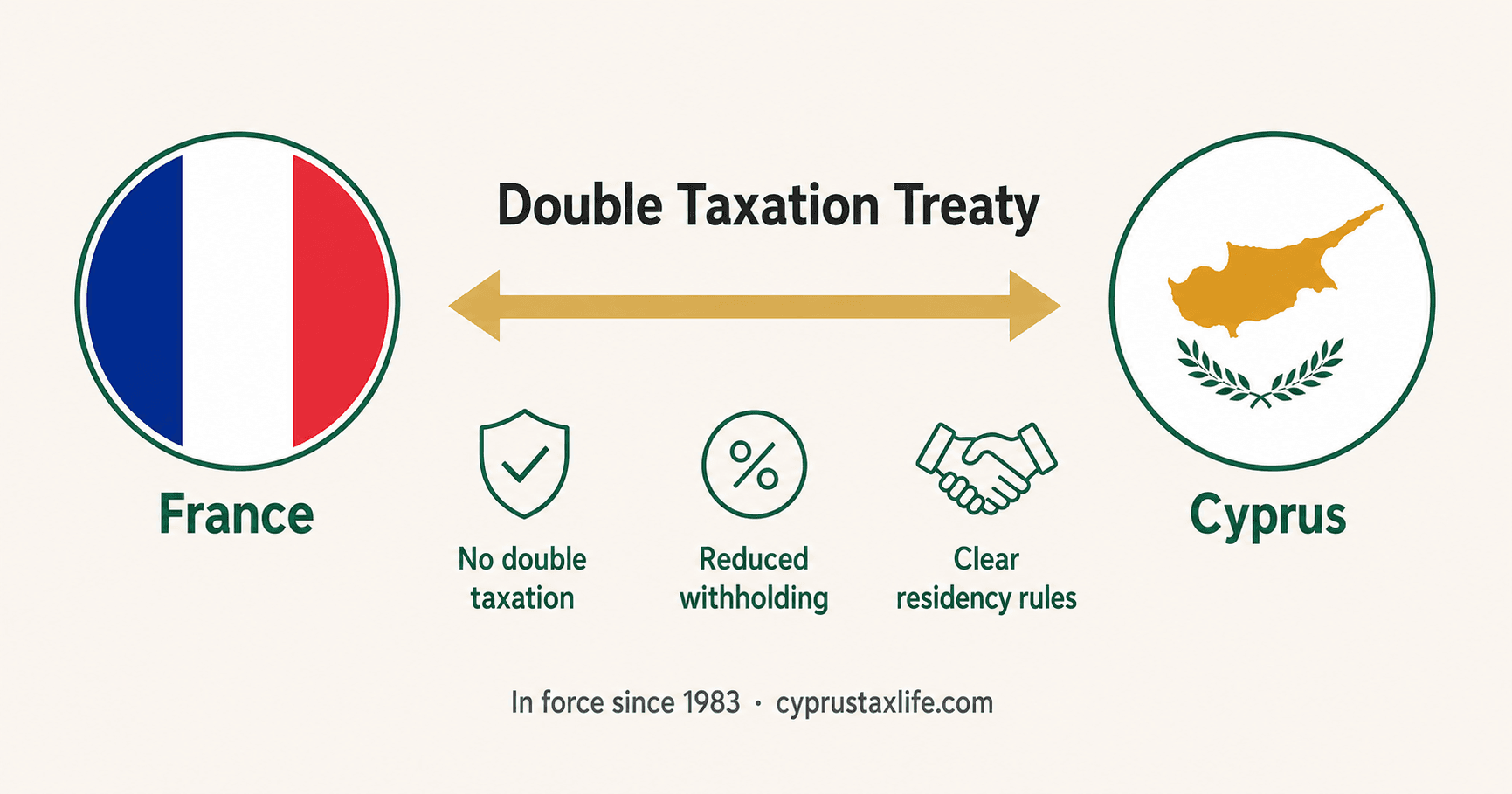
The Cyprus-France Double Taxation Agreement was signed in 1981 and has been in force since 1983. While older than some other Cyprus treaties, it provides a comprehensive framework for avoiding double taxation between the two countries.
This treaty is relevant for French entrepreneurs relocating to Cyprus, French companies with Cyprus operations, and Cyprus companies serving French clients. France is one of the highest-taxed countries in Europe, making the treaty particularly valuable for tax planning.
The treaty covers income tax (impot sur le revenu), corporate tax (impot sur les societes), and social charges in France, and income tax, corporate tax, and special contribution for defense in Cyprus.
France has aggressive anti-avoidance rules (Article 209 B CGI for CFC, Article 238 A for artificial arrangements) that may challenge certain structures. However, once genuinely resident in Cyprus, these rules generally do not apply to your personal situation.
The EU Parent-Subsidiary Directive and Interest & Royalties Directive can provide more favorable treatment (0% withholding) for qualifying corporate relationships, supplementing the treaty rates.
What the Cyprus-France Tax Treaty Means for Expats Moving to Cyprus
France taxes its top earners at a marginal rate that can exceed 55% when you include the income tax (45% top bracket), CSG/CRDS social contributions (9.7%), and prélèvements sociaux on investment income (17.2%). Cyprus Non-Dom offers an effective rate of approximately 5% on dividends, and 0% on capital gains from share sales. The savings for an entrepreneur or business owner making the move can be transformative.
The key feature of the Cyprus-France treaty that makes it expat-friendly is the exemption method: for most categories of income (capital gains on shares, business income from a Cyprus company, dividends from non-French sources), France exempts that income entirely once you are a Cyprus tax resident. It does not just give a credit — it steps aside.
Two France-specific issues require planning before you leave. First, the exit tax (Article 167 bis CGI): if you've been a French tax resident for at least 6 of the last 10 years and hold qualifying shareholdings, France assesses tax on unrealized gains at departure — but automatically defers it for EU moves. Second, CSG/CRDS: these social levies (17.2%) on French-source investment income may not apply once you're covered by Cyprus social security, based on EU case law (de Ruyter ruling) — but France continues to apply them on French real estate income.
| Income source | Where taxed | Effective rate |
|---|---|---|
| Capital gains on French company shares | Cyprus only (treaty exemption method) | 0% — Cyprus does not tax securities gains |
| French company dividends (10%+ stake) | France 10% WHT + Cyprus 2.65% GHS | ~12.7% |
| French company dividends (minority) | France 15% WHT + Cyprus 2.65% GHS | ~17.7% |
| Income from Cyprus company (non-French source) | Cyprus only | ~5% effective (Non-Dom) |
| French rental income | France only (source country rule) | French non-resident rate + potential prélèvements sociaux |
| French private pension (assurance vie, PER) | Cyprus only | 5% flat on amounts above €5,000 |
| French state pension (retraite de base) | Cyprus only (state of residence) | 5% flat on amounts above €5,000 |
Bottom line
The Cyprus-France treaty's exemption method means France largely steps back once you're genuinely resident in Cyprus. Your business income from a Cyprus company, your share sale proceeds, and your non-French dividends are all taxed only in Cyprus. French-source income (rentals, French company dividends) still has French withholding — but at treaty-capped rates far below what you'd pay as a French resident. The biggest planning opportunity: selling your French company shares after relocating, where the gain is taxable only in Cyprus (0% on securities).
Withholding Tax Rates
| Income type | Withholding rate |
|---|---|
| Dividends | 10% (10%+ holding) / 15% (other) |
| Interest | 0% (most) / 10% (certain) |
| Royalties | 0% (most) / 5% (certain) |
Withholding Details
Dividends (Article 10): - 10% withholding if the beneficial owner is a company holding at least 10% of capital - 15% in all other cases - EU Parent-Subsidiary Directive reduces this to 0% for qualifying EU parent-subsidiary relationships (minimum 10% holding for 2 years) - French domestic WHT on dividends to non-residents is 12.8% or 25% depending on circumstances; the treaty caps this at 10-15%
Interest (Article 11): - 0% on most interest payments (bank interest, corporate loans) - 10% on certain interest (connected to profit-sharing arrangements) - EU Interest & Royalties Directive can reduce to 0% for associated EU companies
Royalties (Article 12): - 0% on most royalties (patents, copyrights, software) - 5% on royalties for the use of industrial, commercial, or scientific equipment - EU Interest & Royalties Directive applies (0% for associated EU companies)
The treaty rates are less favorable than some newer Cyprus treaties (e.g., 0% on all categories with the UK). However, the EU directives effectively provide 0% withholding for most corporate structures.
Permanent Establishment Rules
The PE definition follows the OECD model. For Cyprus companies operating in France:
Fixed PE: An office, branch, or factory in France. Even a shared desk used regularly may qualify.
Service PE: France applies the 183-day rule for services. If personnel of a Cyprus company provide services in France for more than 183 days in any 12-month period, a PE may be deemed to exist.
Agent PE: A dependent agent in France who habitually exercises authority to conclude contracts on behalf of the Cyprus company.
French tax authorities are particularly vigilant about PEs. The Direction Generale des Finances Publiques (DGFiP) actively investigates arrangements where companies are registered in other EU countries but have significant French operations.
For Cyprus-based consultants with French clients: limit your physical presence in France, ensure contracts are signed in Cyprus, and keep evidence that management decisions are made from Cyprus. France has been known to argue PE status aggressively.
Tie-Breaker Rules
Standard OECD sequence applies: 1. Permanent home 2. Centre of vital interests 3. Habitual abode 4. Nationality 5. Mutual agreement
France has specific domestic rules (Article 4 B CGI) for determining tax residence: - Foyer (family home) in France - Lieu de sejour principal (principal place of stay) - Activite professionnelle principale (main professional activity) - Centre des interets economiques (center of economic interests)
Meeting any ONE of these criteria makes you a French tax resident under domestic law. The treaty tie-breaker then resolves conflicts between French and Cypriot claims.
For French entrepreneurs moving to Cyprus: move your entire family, do not keep a home available in France, transfer your main business activity to Cyprus, and move your bank accounts and investments. France is particularly aggressive about claiming residents who maintain significant French ties.
The French exit tax (Article 167 bis CGI) operates independently of treaty residency. It applies based on French domestic law at the time of departure.
Pension Provisions
Pensions (Article 18): - Government pensions: Taxable in the paying state (France), unless the recipient has Cyprus nationality - Private pensions: Taxable only in the state of residence (Cyprus) - Social security pensions (retraite de base): Generally taxable in the state of residence
For French retirees in Cyprus: private pension income (assurance vie, PER, retraite complementaire) is taxable only in Cyprus at the favorable 5% flat rate above EUR 5,000. The French state pension (retraite de base) is generally taxable only in Cyprus under the treaty.
Important: CSG/CRDS (social charges) on French-source income may still be claimed by France on certain types of income. The European Court of Justice has ruled that CSG/CRDS cannot be levied on investment income of EU residents covered by the social security system of another member state. This is evolving jurisprudence.
French life insurance (assurance vie): Withdrawals may be subject to French taxation depending on the product structure. Plan the timing of any withdrawals relative to your move.
Capital Gains
Capital gains (Article 13): - Immovable property: Taxable in the situs country - Shares deriving 75%+ value from immovable property: Taxable in the situs country (note: the threshold is 75%, higher than the 50% in more modern treaties) - Other shares: Taxable only in the state of residence
French exit tax (Article 167 bis CGI): Applies when departing France if you have been a French tax resident for at least 6 of the last 10 years. Targets holdings exceeding EUR 800,000 in value or representing 50% or more of a company's profits.
For EU moves: the capital gains portion is automatically deferred (sursis automatique). The social charges portion (17.2% CSG/CRDS) may be due immediately, though this is contested in courts.
The exit tax is forgiven after: - 2 years if the holding is below EUR 2.57 million - 5 years if the holding exceeds EUR 2.57 million
After establishing Cyprus residency: gains on share sales are taxable only in Cyprus. Cyprus does not tax gains on securities. Combined with the exit tax being forgiven after the holding period, this can result in zero effective tax on business exits.
Practical Implications
For French entrepreneurs relocating to Cyprus:
1. Exit tax preparation: Assess your holdings before departing. Gather valuations for all shareholdings. Consider selling or restructuring before the move if it reduces the exit tax base.
2. SAS/SARL winding down: If you have a French company, decide whether to keep it (with a French-resident manager), liquidate it, or transfer operations to a Cyprus Ltd. Liquidation may trigger additional French taxation on reserves.
3. CSG/CRDS planning: Once resident in Cyprus and covered by Cyprus social security, you should not be subject to CSG/CRDS on investment income. Claim refunds for any incorrectly levied charges (based on de Ruyter ECJ ruling).
4. French property: If you retain French property, rental income remains taxable in France. French prelevement sociaux (17.2%) on real estate income may no longer apply to EU residents under evolving jurisprudence.
5. Bank account maintenance: You can keep French bank accounts. Under EU/SEPA, they function normally from Cyprus. Banks must update your tax residency status. Automatic exchange of information (CRS) applies.
6. Notification requirements: Inform the Service des impots des particuliers of your departure. File a final French return (declaration de revenus) for the year of departure. Include your new Cyprus address and TIN.
Frequently Asked Questions
Is the French exit tax avoidable?+
Do I still pay CSG/CRDS after moving to Cyprus?+
How are French dividends taxed when living in Cyprus?+
Can I maintain my assurance vie from Cyprus?+
Will France challenge my move to Cyprus?+
How does the Cyprus-France treaty compare to newer treaties?+
Sources and References
Treaty text: Cyprus Ministry of Finance, France tax authority publications, IBFD Tax Research Platform, PwC Worldwide Tax Summaries. Treaty provisions are summarized for general guidance. Consult a qualified tax advisor for your specific situation. Last verified: 2026-03-30.
Related Articles
Germany's exit tax (§6 AStG) taxes unrealised gains on shares >1% when you emigrate. Moving to Cyprus (EU): you can defer payment indefinitely. Full breakdown for German founders and investors.
 Miriam Alonso
- Tax Planning
- Relocation
Canada's departure tax treats you as having sold your worldwide assets the day you stop being a tax resident. What is caught, what is exempt, how to defer it, and what the cost-base reset means for where you go next.
![Countries With No Property Tax [2026]: The Real Cost](https://cdn.sanity.io/images/glqahhks/production/6f7ea0efceed8a692ad7c3785efa8baaf4d1e208-1679x937.jpg?w=700&q=75&auto=format)
Compare countries with no property tax and the stamp duty they charge instead. See the 10-year holding cost that makes Cayman pricier than Portugal.
Miriam AlonsoFree, no commitment
Moving to Cyprus or opening a company?
Tell us your situation and we'll connect you with our specialist expat advisory in Cyprus: Non-Dom tax, company setup and residency, done for you. Free consultation, no commitment.