Cyprus-Spain Double Tax Treaty 2026
Last updated: 2026-03-30
Treaty Information
Signed
2013
In force since
2014
Model
OECD Model
Overview
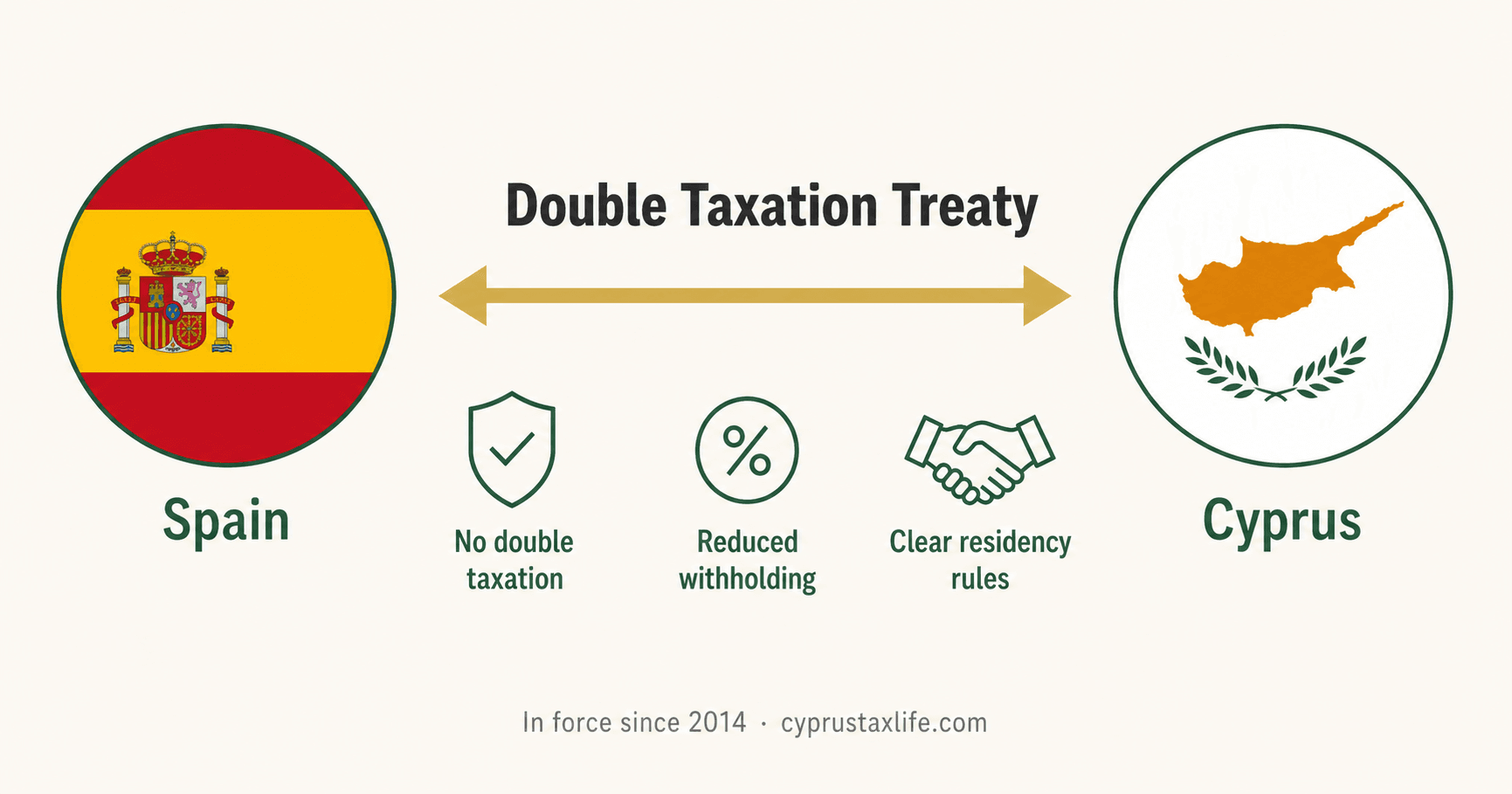
The Cyprus-Spain Double Taxation Agreement was signed in 2013, making it one of the more modern Cyprus treaties. It follows the OECD Model Tax Convention and includes anti-abuse provisions and exchange of information clauses.
This treaty is highly relevant given the significant number of Spanish entrepreneurs and autonomos relocating to Cyprus. Spain's high tax rates (IRPF up to 47%, autonomo social security, and wealth tax in some regions) make Cyprus's Non-Dom regime particularly attractive.
The treaty provides favorable withholding rates: 0% on dividends from substantial holdings, 0% on interest, and 0% on royalties. These rates, combined with the EU Parent-Subsidiary and Interest & Royalties Directives, provide a comprehensive framework for tax-efficient cross-border structures.
Spain's exit tax (Modelo 720 reporting and capital gains on deemed disposal) and the Beckham Law (special expat tax regime) are important considerations for Spanish entrepreneurs planning a move.
What the Cyprus-Spain Tax Treaty Means for Expats Moving to Cyprus
Spain's top IRPF rate reaches 47% (plus up to 3% in regional surcharges in some comunidades autonomas). Autónomos pay social security contributions on top — often 25-30% of net profit for the first years under the new quota system. If you operate through a Sociedad Limitada, you still face IRPF on dividends at 19-26%, plus solidarity wealth surcharges in regions like Cataluña.
The Cyprus-Spain treaty is one of the most expat-friendly in Cyprus's network. It was signed in 2013 — modern and clean. The headline benefit: 0% withholding on dividends if you hold 10%+ of a Spanish company. This means dividends from your Spanish SL flow to Cyprus with no Spanish deduction at source, then face only 2.65% GHS in Cyprus under Non-Dom.
Two things Spanish expats consistently get wrong: (1) assuming the exit tax applies to them — it only kicks in above €4 million in shares or 25%+ of a company worth over €1 million, so most autónomos and SL owners are below the threshold; (2) forgetting that Spanish public pensions (pensión contributiva) remain taxable only in Cyprus once you're resident there — not in Spain.
| Income source | Where taxed | Effective rate |
|---|---|---|
| Spanish SL dividends (10%+ stake, held 1+ year) | Spain 0% WHT + Cyprus 2.65% GHS | ~2.65% |
| Spanish SL dividends (minority stake) | Spain 15% WHT + Cyprus 2.65% GHS | ~17.7% |
| Capital gains on Spanish company shares | Cyprus only (treaty: residence state) | 0% — Cyprus does not tax securities gains |
| Spanish rental income | Spain only (19% for EU non-residents) | 19% |
| Income from Cyprus company (non-Spanish source) | Cyprus only | ~5% effective (Non-Dom) |
| Spanish public pension (pensión contributiva) | Cyprus only (state of residence) | 5% flat on amounts above €5,000 |
| Spanish civil servant pension (funcionario) | Spain only (government pension rule) | Spanish non-resident rate |
Bottom line
The 2013 Cyprus-Spain treaty is one of the cleanest setups for expats. For a Spanish entrepreneur who holds their SL outright (10%+), dividends flow to Cyprus at 0% Spanish withholding and face only 2.65% GHS — a total effective rate under 3%. Capital gains on selling the SL are taxable only in Cyprus (0%). The main residual Spanish taxation concerns are: rental income from Spanish property (19% non-resident rate) and government pensions for funcionarios. Everything else shifts to Cyprus's far more favorable rules.
Withholding Tax Rates
| Income type | Withholding rate |
|---|---|
| Dividends | 0% (10%+ holding) / 15% (other) |
| Interest | 0% |
| Royalties | 0% |
Withholding Details
Dividends (Article 10): - 0% withholding if the beneficial owner is a company holding directly at least 10% of capital and the holding has been maintained for at least 1 year - 15% in all other cases - EU Parent-Subsidiary Directive also provides 0% for qualifying holdings - Spanish domestic WHT on dividends is 19%; the treaty reduces this significantly
Interest (Article 11): - 0% on all interest payments - This covers bank interest, bond interest, corporate loans, and inter-company financing - Very favorable for Cyprus holding structures with Spanish subsidiaries
Royalties (Article 12): - 0% on all royalties - Covers patents, copyrights, software, trademarks, and know-how - Favorable for IP licensing arrangements
The 2013 treaty's 0% rate on dividends from substantial holdings is one of the best in Cyprus's treaty network, making it ideal for Spanish entrepreneurs who maintain a Spanish company while resident in Cyprus.
Permanent Establishment Rules
Standard OECD PE definition applies. Spain uses the concept of "establecimiento permanente" in its domestic tax law (Ley del Impuesto sobre la Renta de no Residentes).
Spain-specific PE risks: - Working from a Spanish coworking space or client office regularly - Having inventory or goods stored in Spain for delivery - Providing services in Spain for more than 183 days in 12 months
For Cyprus-based entrepreneurs with Spanish clients: Spain is generally reasonable about PE determinations compared to France. Short-term client visits and project-based work in Spain do not typically create a PE. However, having a regular Spanish office or employee does.
Online businesses: Selling digital services or products to Spanish customers from Cyprus does not create a PE. The business operates from Cyprus. Only physical presence or dependent agents in Spain could create PE exposure.
Tie-Breaker Rules
The treaty tie-breaker follows OECD sequence. Spain's domestic residence rules (Article 9 LIRPF) consider you resident if you: - Spend 183+ days in Spain in a calendar year - Have the nucleus or base of economic activities in Spain - Have a spouse (not legally separated) and minor children resident in Spain (rebuttable presumption)
For Spanish entrepreneurs moving to Cyprus: - Deregister from the padron (municipal register) and from the Agencia Tributaria - File Modelo 030 (census declaration) notifying change of residence - Move your family (spouse and children) to avoid the family presumption - Ensure you spend fewer than 183 days in Spain
Spain applies the "treaty override" doctrine cautiously. If you are clearly a Cyprus resident under the treaty tie-breaker, Spain generally respects this. However, Spain may still tax you on Spanish-source income.
Modelo 720: Spain requires residents to declare overseas assets exceeding EUR 50,000 (bank accounts, securities, real estate). Penalties for non-compliance were ruled disproportionate by the ECJ but Spain has introduced new reporting rules. Once you are a non-resident, Modelo 720 no longer applies.
Pension Provisions
Pensions (Article 17): - Government pensions: Taxable in Spain, unless the recipient has Cyprus nationality and is not also a Spanish national - Private pensions: Taxable only in the state of residence (Cyprus) - Spanish public pension (pension contributiva): Generally taxable only in the state of residence under the treaty
For Spanish professionals retiring to Cyprus: private pension income (planes de pensiones, seguros de jubilacion) is taxable only in Cyprus at 5% flat rate above EUR 5,000. The Spanish public pension is generally taxable only in Cyprus.
Spanish RETA contributions (autonomo social security): Accrued pension rights are preserved under EU coordination rules. You can claim your Spanish pension from Cyprus when you reach retirement age.
Warning: Spain may attempt to tax pension income based on the source principle in certain interpretations. Maintain clear evidence of Cyprus tax residency and the treaty provisions.
Capital Gains
Capital gains (Article 13): - Immovable property: Taxable in the situs country (Spain taxes non-resident gains on Spanish property at 19%) - Shares deriving 50%+ value from immovable property: Taxable in the situs country - Other shares and assets: Taxable only in the state of residence
Spanish exit tax: Spain introduced an exit tax in 2015 (Article 95 bis LIRPF) applicable to individuals who have been Spanish tax residents for at least 10 of the last 15 years and hold shares worth more than EUR 4 million (or 25% of any company worth more than EUR 1 million). For moves within the EU, the tax is deferred until actual disposal of the shares (within 10 years).
Most Spanish entrepreneurs (autonomos, small company owners) are below the EUR 4 million threshold and are not affected by the exit tax. For those above the threshold, the 10-year deferral with EU moves provides planning time.
After establishing Cyprus residency: gains on share sales are taxable only in Cyprus. Cyprus does not tax gains on securities. Spanish property gains remain taxable in Spain at 19% for non-residents.
Practical Implications
For Spanish autonomos and entrepreneurs moving to Cyprus:
1. Deregistration: File Modelo 030 with the Agencia Tributaria, deregister from the padron municipal, and deregister as autonomo from the Seguridad Social (RETA).
2. Last Spanish tax return: File your final IRPF return for the year of departure. Spanish income up to the departure date is taxable.
3. Spanish SL: If you have a Sociedad Limitada, decide whether to maintain it (with a Spanish-resident administrator), liquidate it, or transfer operations to a Cyprus Ltd. Maintaining the SL with a non-resident administrator is possible but has governance implications.
4. Autonomo cessation: Cancel your RETA registration. You stop paying autonomo contributions from the month after cessation. Your accrued Spanish pension rights are preserved.
5. Modelo 720: Once you are a non-resident, you are no longer required to file Modelo 720 (overseas asset declaration). Ensure your final year's declaration is complete.
6. Spanish bank accounts: You can maintain them. Notify the bank of your new tax residency. Spanish banks report under CRS to Cyprus tax authorities. Non-resident accounts may have different fee structures.
7. Spanish property: If you retain Spanish property, rental income is taxable in Spain at 19% (non-resident flat rate for EU residents). Capital gains on disposal are also taxable at 19% in Spain.
Frequently Asked Questions
Is there a Spanish exit tax when moving to Cyprus?+
Can I stop paying autonomo after moving to Cyprus?+
How does the Beckham Law compare to Cyprus Non-Dom?+
Do I need to file Modelo 720 after moving?+
Can my Cyprus company invoice Spanish clients?+
What happens to my Spanish public pension?+
Sources and References
Treaty text: Cyprus Ministry of Finance, Spain tax authority publications, IBFD Tax Research Platform, PwC Worldwide Tax Summaries. Treaty provisions are summarized for general guidance. Consult a qualified tax advisor for your specific situation. Last verified: 2026-03-30.
Related Articles
Germany's exit tax (§6 AStG) taxes unrealised gains on shares >1% when you emigrate. Moving to Cyprus (EU): you can defer payment indefinitely. Full breakdown for German founders and investors.
 Miriam Alonso
- Tax Planning
- Relocation
Canada's departure tax treats you as having sold your worldwide assets the day you stop being a tax resident. What is caught, what is exempt, how to defer it, and what the cost-base reset means for where you go next.
![Countries With No Property Tax [2026]: The Real Cost](https://cdn.sanity.io/images/glqahhks/production/6f7ea0efceed8a692ad7c3785efa8baaf4d1e208-1679x937.jpg?w=700&q=75&auto=format)
Compare countries with no property tax and the stamp duty they charge instead. See the 10-year holding cost that makes Cayman pricier than Portugal.
Miriam AlonsoFree, no commitment
Moving to Cyprus or opening a company?
Tell us your situation and we'll connect you with our specialist expat advisory in Cyprus: Non-Dom tax, company setup and residency, done for you. Free consultation, no commitment.