Cyprus-USA Double Tax Treaty 2026
Last updated: 2026-03-30
Treaty Information
Signed
1984
In force since
1985
Model
US Model (with modifications)
Overview
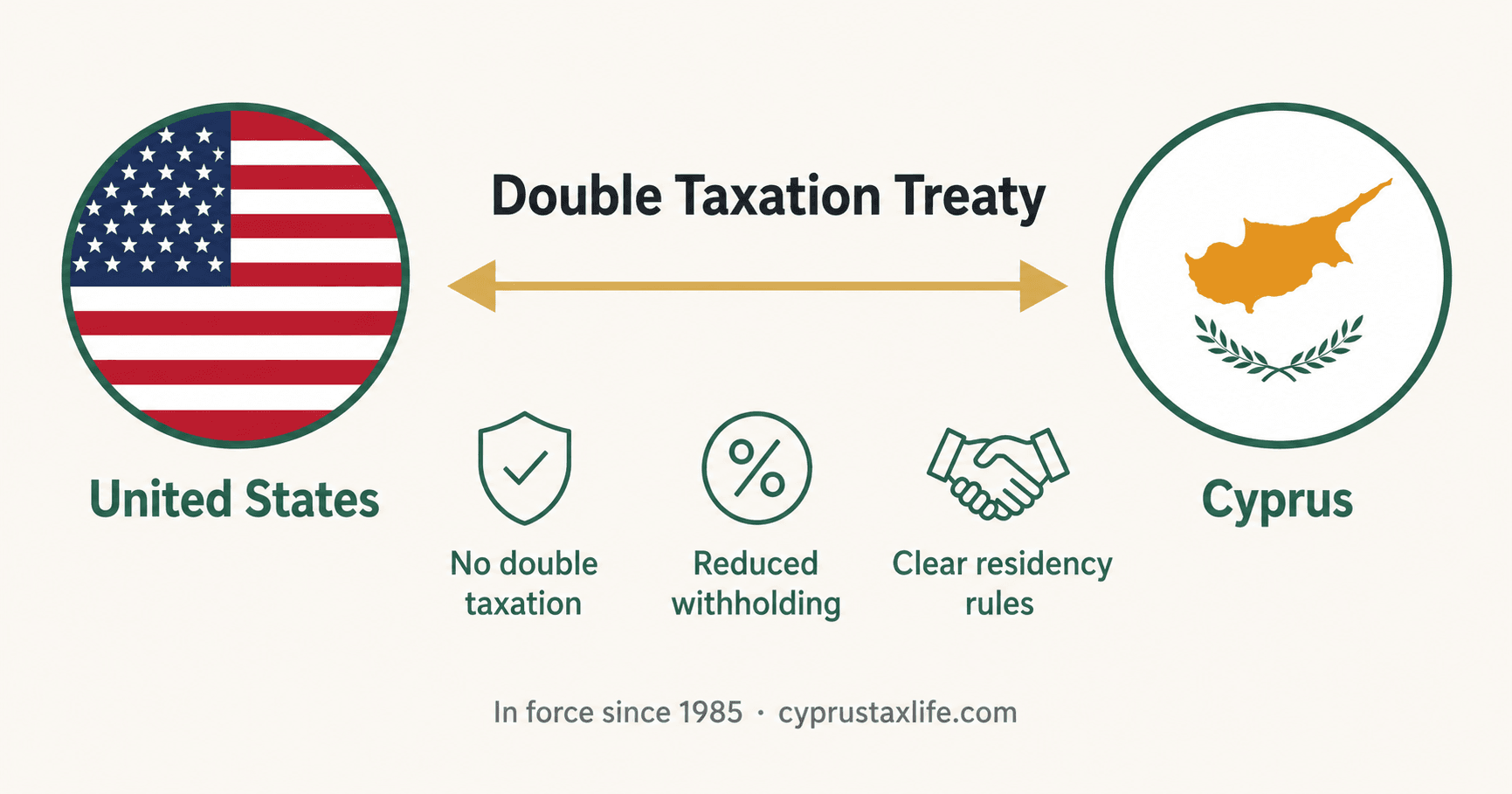
The Cyprus-USA Double Taxation Agreement was signed in 1984 and follows the US Model Tax Convention rather than the OECD Model. This is an important distinction because US treaties contain a "saving clause" (Article 25) that preserves the right of the United States to tax its citizens and residents on worldwide income regardless of treaty provisions.
This means that for American citizens living in Cyprus, the treaty does not exempt them from US taxation. Instead, it provides mechanisms (primarily the Foreign Tax Credit) to avoid double taxation. The treaty works differently for US citizens than for citizens of other countries.
For non-US citizens (Cypriots, EU nationals) conducting business with or in the United States, the treaty provides standard protections against double taxation through reduced withholding rates and PE rules.
FATCA (Foreign Account Tax Compliance Act) adds a layer of compliance for Americans abroad and for non-US financial institutions (including Cyprus banks) that hold accounts for US persons. FATCA operates independently of the treaty.
Withholding Tax Rates
| Income type | Withholding rate |
|---|---|
| Dividends | 5% (10%+ voting stock) / 15% (other) |
| Interest | 0% (most) / 10% (certain) |
| Royalties | 0% |
Withholding Details
Dividends (Article 10): - 5% withholding if the beneficial owner is a company holding at least 10% of voting stock - 15% in all other cases - The saving clause means US citizens in Cyprus still face US taxation on dividends (with a Foreign Tax Credit for Cyprus taxes paid) - Cyprus does not tax dividends for Non-Dom residents (0% income tax, 2.65% GHS)
Interest (Article 11): - 0% on most interest (bank deposits, government securities, arm's length corporate loans) - 10% on certain interest (connected with profit-sharing arrangements, excess interest) - US domestic rules may impose 30% withholding; the treaty reduces this
Royalties (Article 12): - 0% on most royalties (copyrights, patents, know-how) - 10% on royalties for the use of industrial, commercial, or scientific equipment - Relevant for software licensing and IP arrangements
For Americans in Cyprus: the key mechanism is the Foreign Tax Credit (Form 1116). Any Cyprus tax paid can be credited against US tax on the same income, preventing true double taxation.
Permanent Establishment Rules
The PE definition in the US-Cyprus treaty follows the US model, which is generally stricter than the OECD model:
Fixed place PE: Standard definition (office, branch, etc.) Service PE: The treaty does not contain a services PE provision (unlike newer OECD treaties). Services are generally taxable only where they are performed.
Insurance PE: The treaty includes specific provisions for insurance companies.
Construction PE: 12-month threshold (standard).
For Cyprus companies with US clients: providing services remotely from Cyprus to US clients does not create a US PE. Physical presence in the US (regular office, employees) would create a PE.
For Americans in Cyprus: the saving clause means that even without a PE, the US retains the right to tax its citizens on worldwide income. The PE rules are more relevant for Cyprus companies operating in the US.
US withholding on payments to Cyprus: Payments from US companies to Cyprus companies (dividends, interest, royalties, service fees) may be subject to US withholding unless reduced by the treaty. The W-8BEN-E form claims treaty benefits.
Tie-Breaker Rules
The treaty contains tie-breaker rules (Article 4), but the saving clause significantly modifies their effect for US citizens:
Standard tie-breaker sequence: 1. Permanent home 2. Centre of vital interests 3. Habitual abode 4. Nationality/citizenship 5. Mutual agreement
For US citizens: Even if the tie-breaker determines you are a Cyprus resident for treaty purposes, the saving clause preserves US taxing rights on your worldwide income. The tie-breaker is relevant primarily for determining which country has primary taxing rights (and which provides credits).
For non-US nationals: The tie-breaker works normally. If you are a Cyprus resident under the tie-breaker, the US can only tax US-source income.
Practical implication: An American living in Cyprus is simultaneously a US taxpayer (by citizenship) and a Cyprus taxpayer (by residence). The treaty prevents double taxation through credits, but does not eliminate the US filing obligation. This is unique to US citizens and a fundamental difference from any other nationality.
Pension Provisions
Pensions (Article 19): - US Social Security: Taxable only in the US under the saving clause. However, Cyprus may also tax it as worldwide income. Double taxation is avoided through credits. - US private pensions (401(k), IRA, Roth IRA): Generally taxable in the US upon distribution. The treaty allocation rules may give Cyprus the right to tax as well, with credits to avoid double taxation. - Government pensions: Taxable in the paying state (US for US government pensions).
US-Cyprus totalization agreement: Coordinates social security coverage between the two countries. Generally, you pay into only one system. If self-employed in Cyprus, you pay Cyprus social insurance (not US SECA).
Roth IRA special consideration: Roth IRA distributions may be tax-free in the US but could be taxable in Cyprus as foreign income. The tax treatment of Roth IRAs in non-US jurisdictions is complex and varies. Consult a cross-border tax advisor.
401(k) and IRA rollovers: Moving to Cyprus does not change the US tax treatment of these accounts. Distributions are taxed by the US under normal rules. Early withdrawal penalties (10% before age 59.5) still apply.
Capital Gains
Capital gains (Article 14): - Immovable property: Taxable in the situs country - Personal property forming part of a PE: Taxable in the PE country - Shares and other assets: Taxable in the state of residence
Saving clause impact: For US citizens in Cyprus, the US retains the right to tax capital gains on worldwide assets. Cyprus does not tax gains on securities. So a US citizen in Cyprus who sells shares pays US capital gains tax (0-20% + 3.8% NIIT) but no Cyprus tax. The result is better than paying both US and Cyprus tax, but not tax-free.
For non-US nationals in Cyprus: selling US stocks while Cyprus-resident means gains are taxable only in Cyprus (under the treaty). Cyprus does not tax gains on securities. Result: effectively tax-free. But FIRPTA rules may apply to gains on US real property interests.
PFIC (Passive Foreign Investment Company) rules: If a US citizen owns shares in a Cyprus company that qualifies as a PFIC, punitive US tax rules apply. Most active businesses are not PFICs, but investment holding companies may be. Proper structuring is essential.
Practical Implications
For Americans relocating to Cyprus:
1. Continued US filing obligation: File Form 1040 annually reporting worldwide income. File FBAR (FinCEN Form 114) for foreign accounts exceeding USD 10,000 aggregate. File FATCA Form 8938 for foreign financial assets exceeding USD 200,000 (USD 400,000 joint, higher thresholds for foreign residents).
2. Foreign Earned Income Exclusion (FEIE): Exclude up to approximately USD 130,000 of foreign earned income using Form 2555. Requires bona fide residence or physical presence (330 days in 12 months). Does not apply to self-employment tax or passive income.
3. Foreign Tax Credit (FTC): Credit Cyprus taxes paid against US tax on the same income. File Form 1116. The credit is limited to the US tax attributable to foreign-source income.
4. Self-employment tax: The US-Cyprus totalization agreement exempts you from US SECA (self-employment tax) if you pay into the Cyprus social insurance system. File Form 8854 equivalent or obtain a certificate of coverage.
5. State tax cessation: Properly sever ties with your US state. Some states (California, New York) may continue to claim you as a resident if ties remain. Update driver's license, voter registration, mailing address.
6. Banking: FATCA requires Cyprus banks to report US-person accounts to the IRS. Disclose your US citizenship when opening accounts. Some banks may hesitate; Bank of Cyprus and Hellenic Bank generally accept US persons.
7. Investment accounts: Be cautious with PFIC rules. Investing in non-US mutual funds from Cyprus may trigger PFIC taxation. US-domiciled ETFs and mutual funds are generally safer from a US tax perspective.
Frequently Asked Questions
Do Americans still pay US taxes when living in Cyprus?+
What is the saving clause in the US-Cyprus treaty?+
How does FATCA affect Americans in Cyprus?+
Can I use the FEIE and Cyprus Non-Dom together?+
What about PFIC rules for my Cyprus company?+
Is the US-Cyprus totalization agreement helpful?+
Sources and References
Treaty text: Cyprus Ministry of Finance, United States tax authority publications, IBFD Tax Research Platform, PwC Worldwide Tax Summaries. Treaty provisions are summarized for general guidance. Consult a qualified tax advisor for your specific situation. Last verified: 2026-03-30.
Related Articles
Germany's exit tax (§6 AStG) taxes unrealised gains on shares >1% when you emigrate. Moving to Cyprus (EU): you can defer payment indefinitely. Full breakdown for German founders and investors.
 Miriam Alonso
- Tax Planning
- Relocation
Canada's departure tax treats you as having sold your worldwide assets the day you stop being a tax resident. What is caught, what is exempt, how to defer it, and what the cost-base reset means for where you go next.
![Countries With No Property Tax [2026]: The Real Cost](https://cdn.sanity.io/images/glqahhks/production/6f7ea0efceed8a692ad7c3785efa8baaf4d1e208-1679x937.jpg?w=700&q=75&auto=format)
Compare countries with no property tax and the stamp duty they charge instead. See the 10-year holding cost that makes Cayman pricier than Portugal.
Miriam AlonsoFree, no commitment
Moving to Cyprus or opening a company?
Tell us your situation and we'll connect you with our specialist expat advisory in Cyprus: Non-Dom tax, company setup and residency, done for you. Free consultation, no commitment.