Cyprus-Poland Double Tax Treaty 2026
Last updated: 2026-04-26
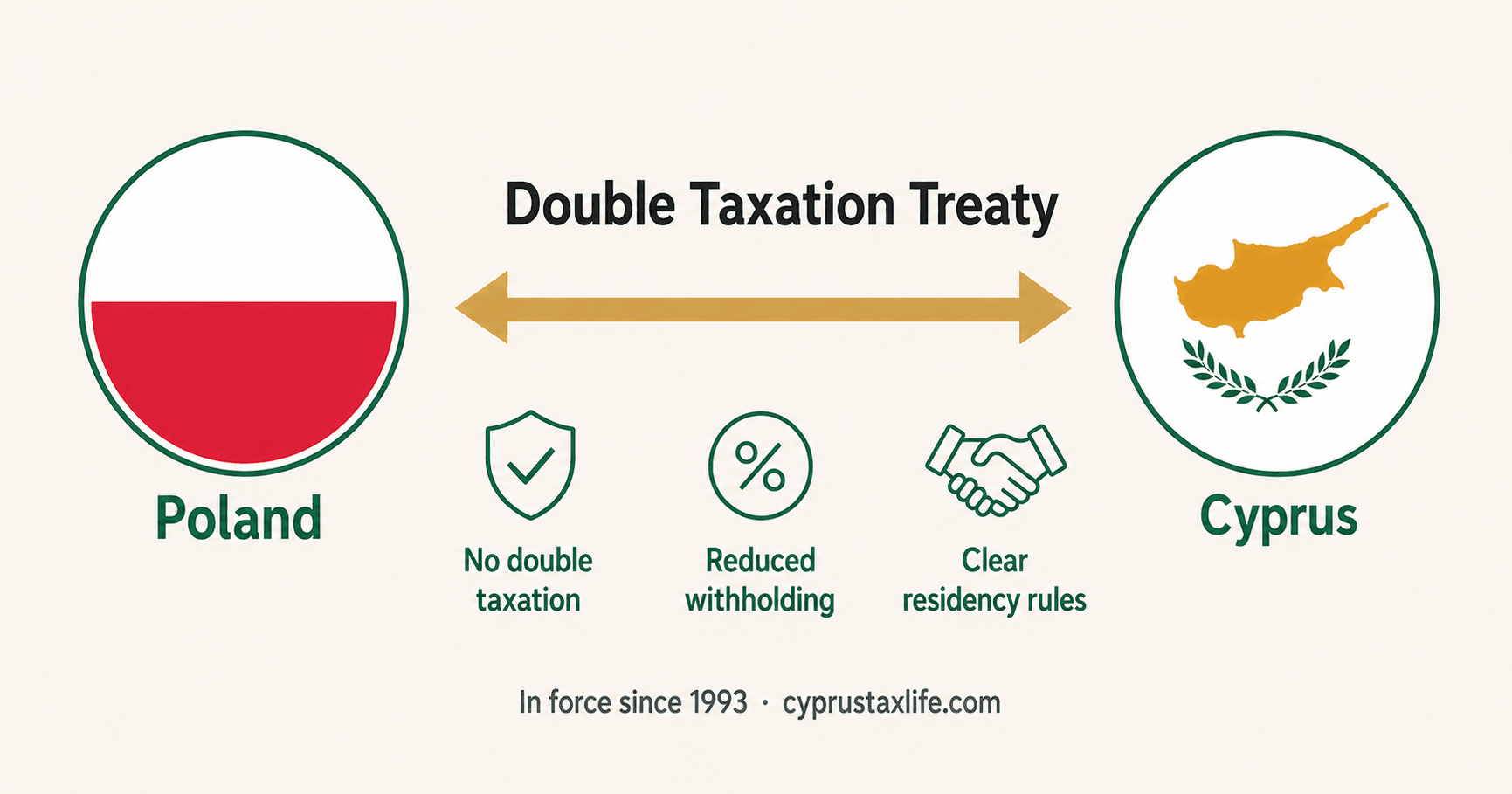
Treaty Information
Signed
1992
In force since
1993
Model
OECD Model
Overview
The Cyprus-Poland Double Taxation Agreement was signed in 1992 and has been in force since 1993. It follows the OECD Model Tax Convention and provides comprehensive rules for avoiding double taxation between the two countries.
This treaty is increasingly relevant as Poland's growing tech and startup scene (particularly Warsaw) produces a significant number of entrepreneurs and professionals exploring international tax planning. Poland's top PIT rate reaches 32%, and the solidarity surcharge of 4% applies to annual income exceeding PLN 1,000,000. Combined with ZUS (Zaklad Ubezpieczen Spolecznych) social security contributions, the effective burden on Polish self-employed and business owners can be substantial.
The treaty covers Polish income tax (podatek dochodowy od osob fizycznych - PIT) and corporate income tax (CIT), as well as Cyprus income tax, corporate income tax, and special contribution for defense.
Poland introduced ATAD-compliant exit tax provisions that affect individuals and companies relocating abroad. Additionally, Poland's "estonski CIT" (Estonian-model CIT) allows companies to defer corporate tax until profit distribution, creating interesting pre-relocation planning opportunities. EU directives (Parent-Subsidiary Directive, Interest and Royalties Directive) apply to qualifying corporate structures and can provide rates more favorable than the treaty withholding rates for dividends, interest, and royalties.
Withholding Tax Rates
| Income type | Withholding rate |
|---|---|
| Dividends | 0% (10%+ holding, 2yr) / 5% (other) |
| Interest | 5% |
| Royalties | 5% |
Withholding Details
Dividends (Article 10): - 0% withholding if the beneficial owner is a company holding directly at least 10% of the paying company's capital for a continuous period of at least 2 years - 5% in all other cases - EU Parent-Subsidiary Directive additionally applies to qualifying EU corporate structures (0% for 10%+ holding for 2 years), often providing the same result as the favorable treaty rate - For Non-Dom Cyprus residents receiving Polish dividends personally: Poland withholds at 5% or 19% (domestic rate), treaty caps at 5%. In Cyprus, dividends are exempt from income tax under Non-Dom (only 2.65% GHS applies)
Interest (Article 11): - 5% withholding on interest payments - EU Interest and Royalties Directive can reduce this to 0% for associated EU companies meeting the ownership threshold - The 5% rate is less favorable than the 0% in the UK or Spain treaties. For corporate structures, rely on the EU directive instead - Inter-company loan arrangements between Cyprus holding companies and Polish subsidiaries benefit from the EU directive
Royalties (Article 12): - 5% withholding on royalties - EU Interest and Royalties Directive reduces this to 0% for associated EU companies - Relevant for IP licensing between Cyprus companies and Polish operating entities - The 5% treaty rate applies to individuals and non-qualifying corporate structures
Polish domestic withholding tax (podatek u zrodla - WHT) on dividends and royalties to non-residents is 19% and 20% respectively. The treaty and EU directives provide significant relief.
Permanent Establishment Rules
The PE definition follows standard OECD guidelines. Poland applies the concept of "zaklad" (permanent establishment) under its domestic law (ustawa CIT/PIT) consistent with the treaty.
Key PE risk areas for Cyprus companies operating in Poland:
Fixed place PE: Having an office, branch, or warehouse in Poland from which business is conducted.
Service PE: Providing services in Poland for more than 183 days within any 12-month period, even without a fixed location.
Agent PE: Having a dependent agent in Poland (pracownik, wspolpracownik) who habitually exercises authority to conclude contracts on behalf of the Cyprus company.
The Polish B2B structure is widespread: Polish professionals operating through their own single-person Sp. z o.o. (limited liability company) or as sole proprietors. When such a person relocates to Cyprus, their Cyprus company may serve Polish clients without creating a PE, provided the person is genuinely resident in Cyprus and does not conduct the Polish work from Polish soil.
The Polish tax authority (Krajowa Administracja Skarbowa - KAS) has become increasingly sophisticated in analyzing international structures. Substance in Cyprus - genuine office, management decisions taken in Cyprus, local employees or directors - is important for defending the absence of a Polish PE.
Tie-Breaker Rules
Standard OECD tie-breaker sequence applies: 1. Permanent home available 2. Centre of vital interests 3. Habitual abode 4. Nationality 5. Mutual agreement
Poland's domestic residency rules (Article 3 PIT Act) consider a person Polish tax resident if they have their centre of personal or economic interests (centrum interesow osobistych lub gospodarczych - osrodek interesow zyciowych) in Poland, or spend more than 183 days in Poland in a tax year.
For Polish entrepreneurs relocating to Cyprus: - Obtain and register a Cyprus address as your primary residence - Update your Polish PESEL registration to reflect departure (wymeldowanie) - Ensure your family joins you in Cyprus to move the centre of vital interests - Keep careful records of days spent in Poland (business visits are fine; avoid exceeding 183 days) - Consider closing or restructuring Polish bank accounts and investment portfolios
Poland does not have a comprehensive exit tax on individual emigration equivalent to Germany's AStG, but ATAD-compliant provisions (introduced 2019) apply to companies and to individuals transferring assets to a foreign jurisdiction. For individuals moving personal assets (shares in a Polish company), the exit provisions can apply if certain value thresholds are met. Consult a Polish tax advisor before relocation if you hold significant stakes in Polish companies.
Pension Provisions
Pensions (Article 18): - Government pensions (state employment): Taxable in the paying state (Poland), unless the recipient is a Cyprus national and not a Polish national - Private pensions: Taxable only in the state of residence (Cyprus) - Polish ZUS pension (emerytura): Generally taxable in the state of residence under the treaty
For Polish professionals relocating to Cyprus: private pension savings (PPK - Pracownicze Plany Kapitalowe, PPE - Pracownicze Programy Emerytalne, IKE/IKZE individual retirement accounts) are generally taxable only in Cyprus upon distribution. Cyprus taxes pension income at a special flat rate of 5% on amounts above EUR 5,000, far below Polish rates.
ZUS contributions and the annual ceiling: ZUS social security contributions in Poland have a ceiling (rocznie wychodzic z ZUS) - contributions for pension (emerytalna) and disability (rentowa) apply only up to approximately 260,000 PLN of annual income. Relocation to Cyprus removes the ongoing ZUS obligation (you pay Cyprus social insurance instead under EU coordination rules), though accrued Polish pension rights are preserved.
Entrepreneurs registered as B2B in Poland (JDG - jednoosobowa dzialalnosc gospodarcza or Sp. z o.o.) who relocate cease ZUS obligations from the date they transfer social security coverage to Cyprus. The A1 certificate from Cyprus Social Insurance Services documents this transition.
Capital Gains
Capital gains (Article 13): - Immovable property: Taxable in the situs country (Poland for Polish property) - Shares deriving 50%+ value from immovable property: Taxable in the situs country - Other shares and securities: Taxable only in the state of residence
Exit provisions for companies: Poland's ATAD exit tax (Article 24f-24h CIT Act, Article 30da PIT Act) applies when assets or tax residency are transferred abroad. Companies face a 19% exit tax on unrealized gains. For EU/EEA moves, payment can be spread over 5 years.
For individuals: The Polish exit tax on individuals (Article 30da PIT Act, introduced 2019) applies when total asset value subject to exit exceeds PLN 4,000,000. The tax rate is 19% (for assets with determined cost) or 3% (for assets without determined cost). For EU/EEA moves, the tax can be deferred until actual realization.
After establishing Cyprus residency: gains on share and securities sales are taxable only in Cyprus. Cyprus does not tax gains on the disposal of securities. Polish property gains remain taxable in Poland at 19% for non-residents.
Estonski CIT interaction: Companies using the Estonian-model CIT deferral should plan their relocation timing carefully, as undistributed profits become subject to different rules upon exit from the Polish CIT system.
Practical Implications
For Polish entrepreneurs and B2B professionals relocating to Cyprus:
1. Deregistration steps: Close or suspend the Polish JDG (business registration) at CEIDG, deregister from ZUS, update PESEL address records, notify the Polish tax office (Urzad Skarbowy) via NIP-7 of change of residence.
2. Sp. z o.o. transition: If you operate via a Polish Sp. z o.o., decide whether to keep it (with a Polish-resident board member / prokurent), liquidate it, or transfer operations to a Cyprus Ltd. Maintaining the Sp. z o.o. for Polish clients while operating personally from Cyprus is a common structure.
3. ZUS cessation: Deregister from ZUS (wyrejestrowanie ZWUA) when you establish social insurance coverage in Cyprus. Accrued Polish pension (emerytura ZUS) rights are preserved under EU Regulation 883/2004 and can be claimed at Polish retirement age.
4. Last Polish PIT return: File your final PIT-36 or PIT-38 for the year of departure. Polish-source income (employment, dividends from Polish companies, property rental) up to the departure date is taxable in Poland.
5. Polish bank accounts: You can maintain Polish accounts. Banks will update your CRS tax residency information. Polish banks report accounts to Cyprus under the automatic exchange of information framework.
6. VAT: If registered for VAT (podatnik VAT) in Poland, you may need to deregister or restructure depending on whether you continue providing services in Poland. B2B services to Polish clients from a Cyprus company use the reverse charge mechanism (no Polish VAT on the invoice).
Frequently Asked Questions
What is the withholding tax on dividends from Poland to Cyprus?+
Do I need to pay ZUS social contributions after moving to Cyprus?+
How does Poland's exit tax affect my relocation?+
Can I keep my Polish Sp. z o.o. after moving to Cyprus?+
What is the effective tax rate for a Cyprus company owned by a Polish person?+
Is the Polish estonski CIT compatible with moving to Cyprus?+
Sources and References
Treaty text: Cyprus Ministry of Finance, Poland tax authority publications, IBFD Tax Research Platform, PwC Worldwide Tax Summaries. Treaty provisions are summarized for general guidance. Consult a qualified tax advisor for your specific situation. Last verified: 2026-04-26.
Related Articles
Germany's exit tax (§6 AStG) taxes unrealised gains on shares >1% when you emigrate. Moving to Cyprus (EU): you can defer payment indefinitely. Full breakdown for German founders and investors.
 Miriam Alonso
- Tax Planning
- Relocation
Canada's departure tax treats you as having sold your worldwide assets the day you stop being a tax resident. What is caught, what is exempt, how to defer it, and what the cost-base reset means for where you go next.
![Countries With No Property Tax [2026]: The Real Cost](https://cdn.sanity.io/images/glqahhks/production/6f7ea0efceed8a692ad7c3785efa8baaf4d1e208-1679x937.jpg?w=700&q=75&auto=format)
Compare countries with no property tax and the stamp duty they charge instead. See the 10-year holding cost that makes Cayman pricier than Portugal.
Miriam AlonsoFree, no commitment
Moving to Cyprus or opening a company?
Tell us your situation and we'll connect you with our specialist expat advisory in Cyprus: Non-Dom tax, company setup and residency, done for you. Free consultation, no commitment.