Spain Exit Tax 2026: How the Plusvalia Really Works

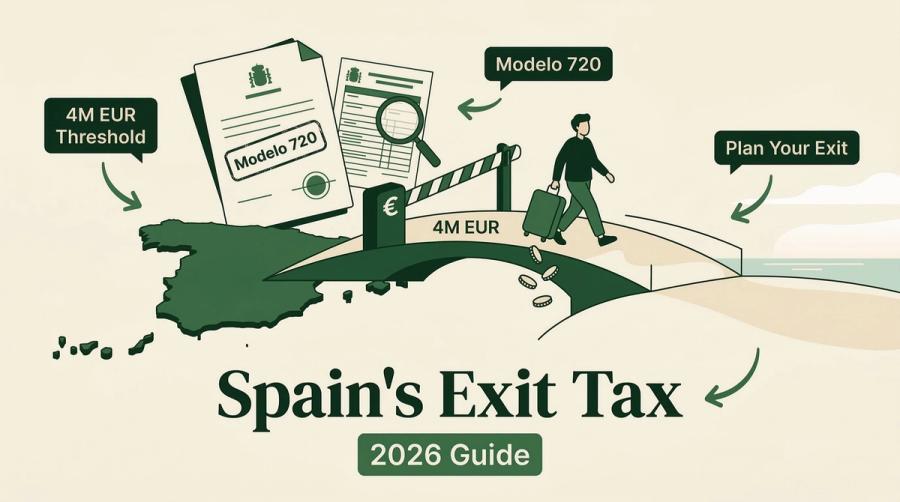
Spain's exit tax (impuesto de salida) applies to residents with unrealized gains above EUR 4,000,000 in shares or 25%+ shareholdings when they cease Spanish tax residency. If you move to another EU country, you may defer the tax. Moving outside the EU typically triggers immediate payment.
Spain does have an exit tax, defined in Article 95 bis of the IRPF law. But it has very specific thresholds that only apply to people holding significant shareholdings. If you are a freelancer, autonomo, or small business owner thinking about moving abroad from Spain, this guide will help you understand exactly what applies to you and what does not.
This is the complete 2026 guide to exit tax Spain rules, including who is affected, how the thresholds work, the EU deferral mechanism, Modelo 720 obligations, anti-avoidance rules, and the practical steps to leave Spain properly.
Source: PwC Cyprus Tax Facts 2026. Spain exit tax thresholds verified January 2026.
Spain's exit tax threshold 4,000,000 EUR The vast majority of freelancers, autonomos, and small business owners are NOT affected
What Is Spain's Exit Tax?
Spain's exit tax (impuesto de salida) applies to individuals relocating abroad and holding significant shareholdings. Regulated by Article 95 bis of the Ley del IRPF (Ley 35/2006), it targets capital gains tax avoidance on large shareholdings when moving internationally.
The mechanism is simple: when you cease to be a Spanish tax resident, the law treats certain shares and participations as if you had sold them at market value on the day of your departure. Any unrealized gain is subject to savings tax (base del ahorro) at progressive rates from 19% to 28%.
However, this is not a general wealth tax on leaving Spain. It applies only to specific shareholdings that exceed very high thresholds.
WHO IS ACTUALLY AFFECTED?
Who Is Actually Affected by the Exit Tax?
Two cumulative requirements trigger the exit tax: you must meet both the residency condition AND at least one shareholding threshold.
Residency requirement
- You have been a Spanish tax resident for at least 10 of the last 15 tax years before your departure
Shareholding thresholds (at least one must apply)
- You hold shares or participations in any entity with a total market value of 4,000,000 EUR or more
- You hold shares or participations in an entity where you own at least 25% and the market value exceeds 1,000,000 EUR
| Condition | Threshold | Details |
|---|---|---|
| Shares in any entity | EUR 4,000,000+ | Market value of all shares held, regardless of ownership % |
| Shares in entity where you own 25%+ | EUR 1,000,000+ | Market value exceeds 1M EUR and you hold at least 25% |
| Both conditions require | 10 of last 15 years | Must have been Spanish tax resident for at least 10 of 15 years |
Freelancers & small business owners Not affected Shares below 4M EUR threshold Large shareholders & investors 19-28% Tax on unrealized capital gains at departure
Let that sink in. If you are a freelancer billing 50,000 EUR per year, or an autonomo with a small SL, or a remote worker with savings in index funds, the exit tax has nothing to do with you. It targets large shareholders, significant investors, and founders of companies valued in the millions.
HOW THE EXIT TAX WORKS
How the Exit Tax Works: Deemed Disposal
Spain applies exit tax by deeming you sold qualifying shares on your last day of tax residency. You pay tax on the unrealized gain, calculated as the difference between market value at departure and your original acquisition cost.
Progressive tax rates on the gain
| Unrealized gain | Tax rate | Tax owed |
|---|---|---|
| First EUR 6,000 | 19% | EUR 1,140 |
| EUR 6,001 - 50,000 | 21% | EUR 9,240 |
| EUR 50,001 - 200,000 | 23% | EUR 34,500 |
| EUR 200,001 - 300,000 | 27% | EUR 27,000 |
| Over EUR 300,000 | 28% | Varies |
The tax is declared in your final Spanish IRPF return for the year of departure. It is important to note that this is a tax on paper gains. You have not actually sold anything, but Spain taxes you as if you had.
Moving to the EU or EEA? You Can Defer the Payment
You can defer Cyprus exit tax if you move to another EU or EEA member state. The deferral applies when you relocate your tax residency within the European Union or European Economic Area. This exception allows you to postpone payment rather than settle immediately upon departure. The deferral must be formally requested and is governed by formal procedures and standards set by the Cyprus tax authorities. This option significantly eases the tax burden for EU/EEA relocations compared to moves outside Europe.
- No upfront payment required at the time of departure
- The tax is only triggered if you actually sell the shares later, or if you subsequently move to a non-EU/EEA country
- The deferral must be explicitly requested in your final Spanish tax return
EU/EEA Deferral - Key Benefit If you move from Spain to another EU or EEA country (including Cyprus), you can defer the exit tax payment indefinitely . You do not need to pay upfront. You must request the deferral explicitly when filing your final Spanish tax return. The tax is only triggered if you later sell the shares or move to a non-EU/EEA country.
Since Cyprus is a full EU member state, this deferral is available to anyone moving from Spain to Cyprus. Combined with the Non-Dom tax regime and the 60-day residency rule, Cyprus offers a particularly clean exit path from Spain for entrepreneurs and investors.
Modelo 720: What Happens When You Leave?
When you leave Spain, you must file Modelo 720 for the year of departure if you held foreign assets exceeding 50,000 EUR in any category during your tax residency. The declaration covers foreign bank accounts, securities, and real estate. Your obligation ends when you lose Spanish tax residency, though you may need to file a final return depending on your departure date.
The critical point: the Modelo 720 is an obligation for Spanish tax residents only. Once you cease to be a tax resident of Spain, you are no longer required to file it.
Modelo 720 - After You Leave The Modelo 720 (declaration of overseas assets) is an obligation for Spanish tax residents only . Once you cease to be a Spanish tax resident, you no longer need to file it. However, make sure you have filed the 720 for all years in which you were resident. The penalties for non-filing have been reduced after the EU Court of Justice ruling (C-788/19), but it is still advisable to be fully compliant before leaving.
Before leaving, ensure you have filed the 720 for every year you were required to. The EU Court of Justice ruled in January 2022 (Case C-788/19) that Spain's original penalty regime for the 720 was disproportionate and contrary to EU law. Penalties have since been reduced, but compliance remains important.
The 4-Year Anti-Avoidance Rule: Tax Havens
Spain can treat you as a tax resident for 4 years after you move to a classified tax haven, even though you've left the country. This anti-avoidance rule applies to territories officially designated as tax havens (paraísos fiscales). During these 4 years, Spanish tax obligations on worldwide income may continue.
During those 4 years, you would still be required to:
- File Spanish tax returns on worldwide income
- Pay Spanish taxes as if you had not left
- Comply with all resident reporting obligations, including the Modelo 720
Cyprus is NOT on Spain's tax haven list. As a full EU member state, Cyprus is not classified as a paraíso fiscal. The 4-year anti-avoidance rule does not apply when moving from Spain to Cyprus. See how Cyprus compares to Spain in detail.
Centro de Intereses Vitales: What Triggers an Inspection
Hacienda may challenge your non-resident status if your centro de intereses vitales (center of vital interests) remains in Spain, even after filing Modelo 030 and moving abroad. This is the primary trigger for tax residency inspections. The tax authority examines family ties, employment, property ownership, economic interests, and social connections to determine whether your actual center of vital interests stayed in Spain despite your physical relocation.
Hacienda looks at factors such as:
- Where your spouse and minor children live (this is the strongest indicator)
- Where you own property, especially your primary residence
- Where your bank accounts are located
- Where your main source of income originates
- Where you maintain social and professional ties
The most important factor is family. If your spouse or partner and children remain in Spain while you move abroad, Hacienda has strong grounds to argue that your center of vital interests is still in Spain, regardless of where you actually live.
Planning your move from Spain to Cyprus? We specialize in helping entrepreneurs and remote workers relocate to Cyprus. Get connected with trusted local advisors. Get in touch
LEAVING SPAIN PROPERLY
Practical Steps to Leave Spain Properly
Rewrite this section to lead with the direct answer:
Leaving Spain requires formal notification to Hacienda, not just physical relocation. Follow these essential steps: notify the tax authorities of your departure, cancel your residency status, update your address with relevant institutions, and obtain a certificate confirming your non-resident status. Complete this process before leaving to avoid ongoing tax obligations and penalties. Proper documentation protects you from being taxed as a Spanish resident on worldwide income after departure.
1. File the Modelo 030
This is the official notification to the Agencia Tributaria that your tax domicile has changed. You must indicate your new country of residence and provide the date of change. This is a critical step that many people overlook.
Modelo 030 - Essential Step Filing the Modelo 030 (change of tax domicile) is the official way to notify Hacienda that you are no longer a Spanish tax resident. Do not skip this step. Without it, Spain may continue to consider you a tax resident and expect you to file and pay taxes on your worldwide income.
2. Complete your baja censal (if autonomo)
If you are registered as an autonomo, you must formally deregister (baja censal) with Hacienda and with the Social Security system (TGSS). This stops your monthly autonomo contributions and IRPF obligations.
3. File your final IRPF return
You must file an IRPF return for the tax year in which you leave. The return covers income from January 1 until the date you ceased to be a Spanish tax resident. If exit tax applies, this is where it is declared (and where you request the EU deferral if applicable).
4. Obtain a tax residency certificate from your new country
This is your strongest proof that you have genuinely relocated. In Cyprus, the tax residency certificate is issued by the Tax Department once you meet the requirements of the 183-day or 60-day rule. Apply as soon as you qualify.
5. Ensure all Modelo 720 filings are complete
Before leaving, verify that you have filed the Modelo 720 for every year you were required to. It is much easier to resolve compliance issues while you are still in Spain than to deal with them from abroad.
6. Keep records of everything
Maintain copies of your Modelo 030, baja censal, final IRPF return, rental contracts in your new country, flight records, and your new tax residency certificate. If Hacienda ever questions your departure, these documents are your defense.
Why Cyprus Is a Clean Exit from Spain
Cyprus satisfies all Spanish tax residency requirements for a legitimate, tax-efficient relocation. The island meets Spain's substantial presence test (183+ days annually), maintains separate economic interests through its own business environment, and offers competitive personal income tax rates (0% on foreign-sourced income for Non-Doms). Unlike other jurisdictions, Cyprus provides EU residency stability, a familiar legal framework for Spanish nationals, and no exit taxes on relocation. The Non-Dom regime eliminates Spanish worldwide income taxation without triggering Spain's departure tax, making it the cleanest exit route for high-net-worth individuals leaving the Spanish tax system.
- EU member state: exit tax deferral available, no 4-year anti-avoidance rule
- Not a tax haven: not on Spain's paraísos fiscales list
- Double Taxation Agreement: Spain and Cyprus have a DTA that prevents double taxation on the same income
- Non-Dom status: dividends taxed at just 2.65% for up to 17 years. See the full Non-Dom guide.
- Corporate tax at 15%: vs 25% in Spain. Learn about company formation in Cyprus.
- 60-day rule: tax residency with just 60 days of presence per year, ideal for digital nomads and remote workers
- Comprehensive guide: see our complete moving from Spain to Cyprus guide and Cyprus taxes overview.
For a detailed comparison of tax rates, cost of living, and lifestyle factors, see Cyprus vs Spain.
Related reading: what taxes you still owe Spain after leaving, and the best low-tax countries to relocate to.
Sources and References
- Agencia Tributaria - Modelo 030 (change of tax domicile)
- Ley 35/2006 del IRPF - Article 95 bis (exit tax provisions)
- BOE - Royal Decree 1080/1991 (tax haven list)
- EU Court of Justice - Case C-788/19 (Modelo 720 ruling, January 2022)
- PwC Spain - Tax Residency and Exit Tax Guidance
- KPMG - Spain Individual Tax Guide 2025/2026
Helpful Resources Tax Setup Checklist → Book a Consultation → View All Services →
This article is for informational purposes only and does not constitute tax, legal, or financial advice. Tax laws change frequently and individual circumstances vary. Always consult a qualified tax advisor before making decisions about your tax residency or international relocation.
Recent Changes to Spain's Exit Tax: What Changed in 2023-2024
Spain's exit tax underwent two major changes in 2023-2024 affecting anyone planning to leave Spain in 2025 or 2026.
First, the 2023 Finance Law expanded the scope of qualifying assets. Previously, the exit tax focused primarily on shares and equity participations. The updated rules now more explicitly capture certain rights derived from insurance contracts with an investment component, and closed-ended funds with limited liquidity windows. If you hold private equity funds or certain structured products, these may now fall within the scope.
Second, the enforcement capacity has increased. The Spanish Tax Agency (AEAT) has signed more automatic exchange of information agreements and now receives banking and brokerage data from Cyprus, Malta, Liechtenstein, and several other jurisdictions where Spanish emigrants typically structure assets. The era of 'they will not find out' is over.
How Spain Calculates the Exit Tax: Step-by-Step
Spain's exit tax is calculated on unrealised gains by treating your departure as a deemed disposal at market value. The exact calculation method follows these steps:
- Determine fair market value of each qualifying asset on the date you cease Spanish tax residency
- Subtract your acquisition cost (including eligible expenses and commissions paid at purchase)
- The difference is the deemed capital gain
- Apply the Spanish savings tax rates: 19% on the first EUR 6,000; 21% on EUR 6,000 to EUR 50,000; 23% on EUR 50,000 to EUR 200,000; 27% on EUR 200,000 to EUR 300,000; 28% above EUR 300,000
Example: You bought shares in a Spanish company for EUR 50,000 ten years ago. On the day you leave Spain, they are worth EUR 250,000. The unrealised gain is EUR 200,000. The exit tax liability would be approximately: 19% x EUR 6,000 = EUR 1,140; 21% x EUR 44,000 = EUR 9,240; 23% x EUR 150,000 = EUR 34,500. Total: approximately EUR 44,880.
This is money you owe Spain even though you have not sold anything and have not received a single euro.
Exit Tax Deferral: The EU/EEA Exception Explained
Spain must defer exit tax collection if you move to an EU or EEA country, including Cyprus, under EU freedom of movement principles confirmed by the EU Court of Justice and codified in Spanish law.
The deferral works as follows: you declare the exit tax liability on your final Spanish tax return (filing as a partial-year resident), but you do not pay. Payment is triggered only when one of these events occurs:
- You actually sell the qualifying assets
- You move to a non-EU, non-EEA country
- Ten years pass from the date you left Spain (the statute of limitations for the deferral)
For most people relocating to Cyprus, this means the exit tax sits dormant. If you eventually sell the shares years later from Cyprus, Spain may still claim its portion of the gain up to the value that existed when you left. The Cyprus-Spain double tax treaty determines how the final split is calculated, and this is complex territory that requires a tax adviser in both countries.
| Destination | Exit Tax Treatment | Payment Due |
|---|---|---|
| EU country (e.g., Cyprus, Germany) | Automatic deferral until asset sale or move to non-EU | Deferred |
| EEA country (Norway, Iceland, Liechtenstein) | Automatic deferral with periodic reporting | Deferred |
| UK (post-Brexit) | Immediate payment or guarantee required | On departure or guarantee |
| USA, UAE, rest of world | Immediate payment required | On departure |
| Spain to Spain (never leaves) | No exit tax triggered | N/A |
What Documentation Spain Requires When You Leave
You must prepare specific documentation before leaving Spain to avoid Tax Agency inquiries later. Required documents include:
- Empadronamiento cancellation: deregister from your municipal register (padrón municipal)
- Certificate of fiscal residency from your new country: AEAT will request this within 12 months of your departure
- Final Spanish personal income tax return (IRPF) as a partial-year resident for the year you leave
- Modelo 030: notify AEAT of your change of address and tax residence outside Spain
- Modelo 720 final filing: report all foreign assets above EUR 50,000 if applicable for the last year of Spanish residency
- Asset valuation reports: for qualifying assets subject to exit tax, get professional valuations dated on or before your departure date
- Property evidence: if you own Spanish property, it stays in Spain and remains subject to Spanish non-resident taxes even after you leave
Keep all of this for a minimum of ten years. AEAT has aggressive audit timelines and the exit tax clock does not start until they acknowledge your departure.
The Spain-Cyprus Double Tax Treaty: What Covers What
Spain and Cyprus have a double taxation agreement (DTA) in force that allocates primary taxing rights between the two countries for residents moving between them. Key provisions for Spanish emigres to Cyprus include: business income is taxed where the business is managed; employment income follows residency; investment income (dividends, interest) is taxed in the resident country with limited source-country withholding; and capital gains on immovable property are taxed in the country where the property is located. The treaty prevents double taxation through credit mechanisms and provides relief for foreign tax paid.
- Employment income: taxed where the work is physically performed
- Business profits: taxed in the country where the business has its permanent establishment
- Dividends: source country can tax up to 10%; residence country taxes the rest
- Capital gains on shares: generally taxed only in the country of residence, not source country, unless the shares are substantially backed by real estate
- Capital gains on real estate: Spain retains taxing rights on Spanish property regardless of where you live
The treaty does not resolve every situation. In particular, the 'exit tax' gain is contested territory: Spain argues it arose when you lived there, Cyprus argues you are now a Cypriot resident. In practice, a bilateral tax adviser is essential for anyone with significant unrealised gains.
Read the Spain-Cyprus DTA text: Spain-Cyprus Double Tax Agreement (AEAT).
Exit Tax Planning: Timing and Asset Management Before Leaving
Proactive planning 12-24 months before departure significantly reduces your exit tax liability. Key decisions about timing and asset management must be made before you leave, not after.
Crystallize Losses Before Departure
If you have assets with unrealised losses alongside assets with unrealised gains, consider selling loss-making assets while you are still a Spanish tax resident. These losses offset gains in the same tax year and reduce your total exit tax base. An asset with a EUR 100,000 unrealised loss that you sell before leaving reduces your taxable gain by EUR 100,000.
Step-Up Strategies for Non-Qualifying Assets
Not all assets are subject to Spain's exit tax. The thresholds (EUR 4 million total portfolio or 25% ownership stake in a single company worth EUR 1 million+) mean that smaller portfolios often escape entirely. If your portfolio is near but below the threshold, verify carefully whether each asset qualifies. Personal bank accounts, bonds, real estate (taxed differently), and certain investment funds may have different treatment.
When to Book Legal Advice
Engage a dual-qualified adviser (Spanish tax + Cyprus tax) at least 18 months before your planned departure date. The reason for this lead time: restructuring investments, setting up your Cyprus company, obtaining banking in Cyprus, and preparing the documentation all take time. Rushing these steps in the final months creates errors that are expensive to fix.
A good Spanish tax lawyer will also advise you on whether your situation actually triggers the exit tax. Many people assume they are affected when they are not, due to misunderstanding the EUR 4 million threshold or the 25% ownership rule. Others assume they are not affected when they are. Get the analysis done properly.
After Leaving: Ongoing Spanish Obligations
Even after establishing Cypriot fiscal residency and ceasing to be a Spanish tax resident, several obligations to Spain continue:
- If you own Spanish property: annual non-resident property tax (imputed income or actual rental income), payable on Modelo 210
- If you deferred exit tax by moving to an EU country: periodic updates to AEAT may be required if requested, and immediate payment is triggered by asset disposal
- If you have Spanish pension entitlements: these remain subject to Spanish/Cyprus treaty rules
- If you receive dividends from Spanish companies: 10% withholding tax under the Spain-Cyprus DTA (you reclaim excess above your final liability in Cyprus)
None of these obligations are complicated if you are aware of them. The problems arise when former residents are unaware and receive demand notices years later with accumulated interest and surcharges.
Spain's Agencia Tributaria non-resident tax guide: AEAT Non-Residents Tax Guide.
The exit tax from Spain is manageable with the right preparation. Hundreds of Spanish professionals relocate to Cyprus each year having dealt with these obligations correctly. The process is documented, the rules are clear, and advisers who have guided many clients through it exist in both countries.
What is the exit tax in Spain?
Do I need to pay exit tax when moving from Spain to Cyprus?
What steps do I follow to stop being a Spanish tax resident?
Can Spain challenge my new tax residency in Cyprus?
Which taxes do I save by moving from Spain to Cyprus?
Is there a double tax treaty between Spain and Cyprus?
Is Spain's exit tax new or long-established?
Spain's exit tax (impuesto de salida) applies when a Spanish tax resident relocates abroad and holds shares or interests with unrealised capital gains above EUR 4 million, or above EUR 1 million if the taxpayer holds 25%+ of a company. The tax is calculated as if the assets were sold on the day of departure, at capital gains rates of 19-28%.
Does Spain's exit tax apply to everyone who leaves?
The exit tax only applies to individuals who have been Spanish tax residents for at least 10 of the last 15 years before departure, and who hold qualifying assets (shares, participations) with unrealised gains above the thresholds. Most expats moving to Cyprus will not meet these thresholds.
Can I defer Spain's exit tax when moving to Cyprus?
If you move to another EU/EEA country, you can request deferred payment of the exit tax, payable only when you actually sell the assets or leave the EU. Since Cyprus is an EU member, moving from Spain to Cyprus allows you to defer any exit tax liability. You must notify the Spanish tax authority (AEAT) and file the relevant form.
How does Cyprus compare to Spain for dividend taxation?
In Spain, dividends are taxed at 19-28% personal income tax. In Cyprus, a Non-Dom resident pays only 2.65% GHS on dividends (capped at EUR 4,770/year) with zero SDC and zero income tax. For a business owner distributing EUR 100,000 in dividends, Spain charges EUR 19,000-28,000 while Cyprus charges EUR 2,650.
Are there steps to stop being a Spanish tax resident when moving to Cyprus?
You must file Form 030 (census) with AEAT to deregister as a Spanish tax resident and provide your new Cyprus address. You also need to file your final Spanish income tax return for the partial year. Spain may challenge your residency change if you maintain significant ties in Spain (family, property, business), so documenting your Cyprus residency thoroughly is important.
Related Guides
Cyprus Tax Residency: How to Qualify
Cyprus Capital Gains Tax: 0% on Shares
If you are ready to act on this information, Book a consultation with our Cyprus tax specialists.
Spain Exit Tax and the Cyprus Option: A Practical Roadmap
Spain's exit tax forces many entrepreneurs and investors to choose their next jurisdiction, with Cyprus emerging as a leading option due to tax efficiency and business environment. Successfully relocating requires coordinated planning across residency, tax registration, and asset management steps.
First: trigger the exit correctly. Leave Spain before June 30 to avoid the 183-day trap in your departure year. File your final Spanish IRPF return for the partial year. If you hold any assets that cross the exit tax thresholds, declare them and arrange payment or deferral as appropriate.
Second: establish Cyprus tax residency. Under the 60-day rule you need to spend at least 60 days in Cyprus per year, maintain a permanent residence (rent or own), have some business activity or employment in Cyprus, and not be tax resident anywhere else. Under the standard 183-day rule you just need 183+ days in Cyprus and no residency elsewhere.
Third: apply for Cyprus Non-Dom status. This is separate from tax residency and applies to domicile (where you were born or have your center of life). Most foreigners moving to Cyprus qualify for Non-Dom automatically, which means 0% on dividends and interest for up to 17 years.
| Step | Action | Timing |
|---|---|---|
| 1 | Submit baja censal (model 030) and baja padron | Before June 30 of departure year |
| 2 | File final IRPF for partial year | By June 30 of following year |
| 3 | Declare exit tax assets (if above threshold) | With final IRPF or separately |
| 4 | Establish Cyprus address and MEU1 registration | Within 3 months of arriving |
| 5 | Apply for Cyprus tax residency certificate | After meeting 60/183 day requirement |
| 6 | Open Cyprus bank account and document economic activity | As early as possible |
What Happens to Your Spanish Assets After You Leave?
**What Happens to Your Spanish Assets After You Leave?**
Spain continues taxing Spanish-source income even after you leave, through the Non-Resident Income Tax (IRNR). Rental income from Spanish property requires quarterly tax filings in Spain. Capital gains from selling Spanish property remain taxable in Spain regardless of your residency status.
The Cyprus-Spain Double Tax Treaty (DTT) governs how income is taxed when you are a Cyprus resident with Spanish-source income. Under the treaty, Spain retains the right to tax rental income from Spanish property (Article 6) and gains from selling Spanish real estate (Article 13). Cyprus, as your residence country, will typically exempt that income or give a credit for tax paid in Spain.
Interest and dividends from Spanish companies paid to a Cyprus resident are subject to a withholding tax in Spain under the treaty, at reduced rates: 5-15% on dividends and 0-10% on interest, depending on the specifics. Your Cyprus tax return will then account for these as foreign income.
Deferral Options for the Exit Tax: When They Apply
Spain permits deferral of exit tax payment until asset sale or disposal if you relocate to another EU or EEA country. Deferral is unavailable when moving to third countries such as the UAE or Georgia.
For Cyprus specifically, since Cyprus is an EU member, you qualify for the deferral. This means you do not need to come up with cash to pay an exit tax on unrealized gains when you leave, as long as you notify the Spanish tax authority and maintain records. You pay when you actually realize the gains.
Important: the deferral requires filing the Model 113 declaration and maintaining communication with the AEAT (Spanish tax authority) about changes in your situation. If you sell the assets while a Cyprus resident, the gain is taxable in Spain under the exit tax (deferred portion) even though you are no longer a Spanish resident.
Official AEAT guidance on exit tax (Impuesto de Salida)
OECD Model Tax Convention commentary on exit taxes
![Cyprus Ltd vs Irish Ltd: Company Tax Compared [2026]](https://cdn.sanity.io/images/glqahhks/production/84e3d82538a859345d8d2447e8e097c5777fb238-1679x937.png?w=700&q=75&auto=format)
![Cyprus vs Malta Company Formation [2026]](https://cdn.sanity.io/images/glqahhks/production/97db89d0ce729a9e931d09bc1522631faa6c3474-1679x937.png?w=700&q=75&auto=format)