Golden Visa Europe 2026: Which Programs Are Left

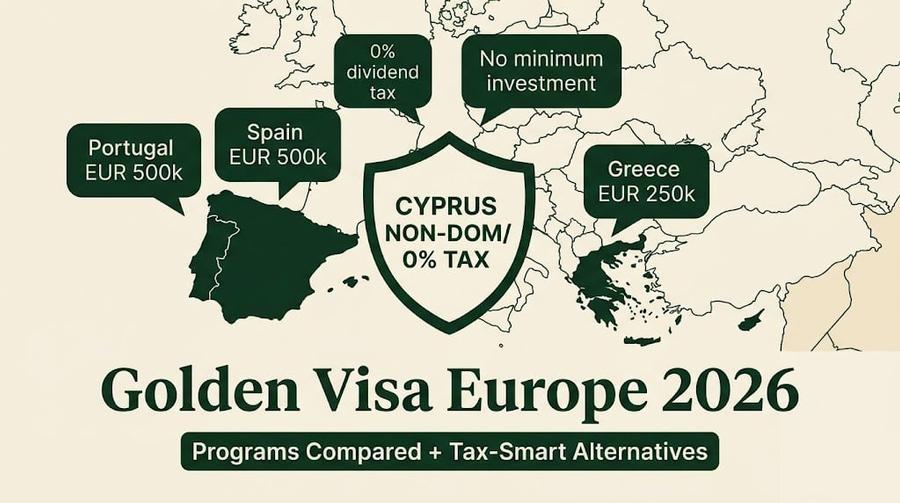
The search for a golden visa in Europe is almost always driven by two goals: securing the legal right to live and work inside the European Union, and reducing the tax burden on business income, dividends, or capital gains. Residency programs marketed as golden visas address the first goal directly. The second goal, however, is where most programs fall short, because a residence permit and a favourable tax residency are two very different things.
This guide compares every active golden visa program in Europe in 2026, breaks down their real tax implications, and explains why Cyprus Non-Dom status - which requires no minimum investment - is frequently the more tax-efficient alternative for entrepreneurs, investors, and remote workers establishing tax residency in Cyprus.
What Is a Golden Visa?
Source: PwC Cyprus Tax Facts 2026. Cyprus tax rates verified as of January 2026.
A golden visa is a residence permit granted by a country in exchange for a qualifying investment, typically in real estate, government bonds, or local businesses. The investor and their immediate family gain the right to live, work, and travel freely within the issuing country, with visa-free movement throughout the Schengen Area in EU countries.
Golden visas should not be confused with citizenship by investment programs, which grant a passport directly. Most European golden visa programs offer residency first, with a potential path to citizenship only after several years of meeting specific requirements. The two are separate legal instruments with different costs, timelines, and obligations.
In practical terms, a golden visa in an EU country typically provides: legal residence, Schengen travel access, the right to bring dependants, and in some programs a route to EU citizenship after five to ten years. What it does not automatically provide is a lower tax rate on income, dividends, or capital gains.
Active Golden Visa Programs in Europe 2026
Greece, Portugal, Italy and Malta run the investment residency programs still open to new applicants in Europe in 2026. The sector has contracted sharply: Cyprus terminated its own program in 2021, Ireland closed in 2023, and Spain shut its golden visa on 3 April 2025. What remains is smaller, more expensive, and vetted far more strictly than a decade ago.
Greece Golden Visa
Greece runs the most popular investment residency program in Europe, largely because it still offers the lowest entry point of any EU country. It remains active in 2026, but the thresholds were raised twice, first in August 2023 and again in September 2024, and the cheapest tier now comes with conditions attached. For full detail on how Greece compares to Cyprus, see the Cyprus vs Greece comparison.
Minimum investment: EUR 800,000 in the Athens and Thessaloniki metropolitan areas, Mykonos, Santorini and any island with more than 3,100 residents; EUR 400,000 everywhere else in Greece; EUR 250,000 only for property converted from commercial use, or for a listed building restored for residential use.
Qualifying investments: real estate purchase, shares in Greek companies, government bonds, qualifying investment funds, or - new for 2026 - an investment of at least EUR 250,000 in a certified Greek startup, with the number of permits granted scaling with the size of the investment.
- Residence permit: 5-year permit, renewable indefinitely provided the investment is maintained
- Path to citizenship: possible after 7 years of actual residence and meeting language and integration requirements
- Schengen access: yes, as a full Schengen member state
Tax implications: holding a Greek golden visa does not in itself create any tax obligation. If the investor becomes a Greek tax resident (spending 183 or more days per year in Greece), they are subject to Greek income tax rates of up to 44% for high earners, and a 5% withholding tax on dividends. Greece does have a special regime for foreign high-net-worth individuals - a lump-sum annual tax of EUR 100,000 on foreign-source income - but this is a separate application from the golden visa and applies only to those who choose to become Greek tax residents.
Best suited for: investors who want to live in Greece, or those who simply need a Schengen residence permit without intending to change their tax residency.
Portugal Golden Visa
Portugal's golden visa underwent a major change in October 2023. The previously popular route of buying residential real estate in Lisbon, Porto, or coastal areas no longer qualifies in most cases. This significantly changed the program's appeal. For a side-by-side tax comparison, see Cyprus Non-Dom vs Portugal NHR and the full Cyprus vs Portugal page.
- Qualifying investments as of 2026: EUR 500,000 in venture capital or investment funds, EUR 500,000 in scientific research, EUR 500,000 in real estate in designated low-density interior areas only, or creation of at least 10 jobs
- Residence permit: 2-year initial permit, renewable. Applicant must spend a minimum of 7 days per year in Portugal in the first period, and 14 days in subsequent periods
- Path to citizenship: possible after 5 years, subject to language test and absence of criminal record
- Tax implications: Portugal's Non-Habitual Resident (NHR) regime ended for new applicants in January 2024. The replacement scheme, IFICI, is limited to researchers, academics, and specific high-value professions. The combination of golden visa plus NHR that made Portugal attractive for entrepreneurs no longer exists for new applicants in 2026
Best suited for: investors who want a Portuguese passport at the end of a 5-year horizon and are less concerned with near-term tax optimization.
Spain Golden Visa (Closed April 2025)
Spain's golden visa no longer exists. Organic Law 1/2025, published in the Official State Gazette on 3 January 2025, repealed the investor residence permit created by Law 14/2013, with effect from 3 April 2025. The stated reason was housing affordability: the government argued that residency-linked property investment was pushing prices beyond reach in Madrid, Barcelona and the coastal provinces. For tax rate detail, see the Cyprus vs Spain comparison.
What it required until April 2025: EUR 500,000 in Spanish real estate with no mortgage component counting toward the threshold, EUR 1,000,000 in shares of Spanish companies or investment funds, or EUR 2,000,000 in Spanish government bonds. The property route was the one the government singled out for abolition.
If you already hold one: permits granted before 3 April 2025, and applications filed before that date, remain valid and renewable under the old rules. Existing holders keep their path to permanent residence after five years and citizenship after ten. There is no grace period for new applicants and no replacement scheme.
What replaced it: nothing equivalent. Non-EU nationals who want Spanish residency now use the non-lucrative visa (passive income, no work permitted), the digital nomad visa for remote employees and freelancers, or an ordinary work or entrepreneur permit. None of these is an investment route, and none carries a preferential tax regime.
Tax position: Spain never attached a special tax regime to the investor visa. A Spanish tax resident pays income tax of up to 47% on ordinary income and 19-28% on dividends and capital gains. The Beckham Law offers a flat 24% rate, but it applies only to impatriates taking salaried employment in Spain and never covered most investor-visa holders.
Where that leaves investors: those who were considering Spain for the combination of EU residency and lifestyle now have to choose between a program in another country or a route that carries no investment component at all. Neither the old visa nor its replacements ever offered a tax advantage, which is why Spain rarely made sense as an optimization play in the first place.
Italy Investor Visa
- Minimum investment options: EUR 500,000 in Italian companies or innovative startups of significant economic interest; EUR 250,000 in certified innovative startups; EUR 1,000,000 in charitable foundations or organisations; EUR 2,000,000 in Italian government bonds
- Residence permit: 2-year initial permit, renewable for 3-year periods
- Path to citizenship: 10 years of legal residence
- Tax implications: Italy has the Nuovi Residenti (New Residents) regime, which allows qualifying individuals to pay a flat annual substitute tax of EUR 100,000 on all foreign-source income, regardless of the actual amount earned abroad. This is a separate application from the investor visa but can be combined with it. Italy also offers a 50% reduction on taxable income for new residents in specific employment categories
The Italy investor visa combined with the Nuovi Residenti regime can be attractive for high-net-worth individuals whose income comes predominantly from outside Italy. The flat EUR 100,000 annual tax is straightforward if foreign income significantly exceeds EUR 500,000 per year, but it becomes expensive for those with lower foreign income.
Best suited for: high-net-worth individuals with substantial foreign-source income who want EU residence and can justify the EUR 100,000 annual tax.
Malta Permanent Residency Programme
Malta's program is technically not a golden visa but a permanent residency by investment scheme. It is worth including because Malta is an EU member with a Non-Dom tax system, making it one of the few EU countries where residency and tax optimization can be genuinely combined.
- Contribution: EUR 98,000 (South Malta or Gozo) or EUR 300,000 (other areas), plus a property purchase of at least EUR 300,000 or rental of at least EUR 10,000 per year
- Outcome: permanent residency (not temporary), renewable every 5 years
- Tax implications: Malta operates a Non-Dom system where non-domiciled residents pay tax only on income remitted to Malta. A minimum annual tax of EUR 5,000 applies. For investors with significant foreign income that is not remitted to Malta, the effective tax rate can be very low
- Path to citizenship: Malta has a separate citizenship by naturalisation program with higher investment requirements
Best suited for: those who want EU permanent residency with a Non-Dom tax structure, and who have capital to invest in Malta property. The total upfront cost is higher than Cyprus Non-Dom but lower than most other golden visa programs.
Countries That Ended Their Golden Visa
Spain, Bulgaria, Cyprus and Ireland have all closed investment residency or citizenship routes under EU Commission pressure over money laundering and sanctions evasion. Cyprus terminated its citizenship-by-investment program in 2021, Bulgaria in 2022, Ireland closed the Immigrant Investor Programme in 2023, and Spain repealed its golden visa in April 2025. Malta ended its citizenship-by-investment scheme but kept the MPRP residency program described above, which is why it appears in both lists.
- Cyprus: cancelled in October 2021 following a journalistic investigation ('passport gate') that revealed passports had been issued to individuals with criminal records. The program was suspended and formally terminated. Cyprus has not reinstated it.
- United Kingdom: the Tier 1 Investor visa was suspended in February 2022 and subsequently abolished.
- Ireland: the Immigrant Investor Programme was closed in February 2023.
- Netherlands: no formal golden visa ever existed. The startup visa for investors was tightened significantly in 2023.
The EU has also signalled intent to restrict or harmonise golden visa programs across member states, particularly those that allow visa holders to remain in the issuing country for minimal time while holding other tax residencies. The direction of regulation is toward stricter substance requirements.
The Tax Problem With Golden Visas
A residence permit and tax residency are legally distinct, so a golden visa does not by itself determine your tax obligation. Tax residency depends on spending 183 or more days per year in a country, plus factors like family ties, economic centre and habitual abode. Holding a Greek or Portuguese golden visa will not, on its own, change where you pay tax. See also: Non-Dom status in other countries for how different jurisdictions approach this.
In practice, many golden visa holders do not become tax residents of the issuing country. They hold the permit for Schengen travel access or as a long-term contingency, while maintaining their existing tax residency elsewhere. This is legally permissible in most cases, but it means the golden visa delivers no tax benefit whatsoever.
When a golden visa holder does choose to relocate and become a tax resident, the consequences depend on the country:
- Greece: income tax up to 44%, dividend tax 5%, capital gains tax 15% (for securities)
- Portugal (post-NHR): standard rates apply, income tax up to 48%, capital gains on shares at 28%
Spain (no longer available): income tax up to 47%, dividend tax 19-28%, capital gains 19-28%
- Italy: standard rates are high, but the Nuovi Residenti lump-sum regime can cap the cost at EUR 100,000 per year for foreign-source income
- Malta: the Non-Dom system with EUR 5,000 minimum annual tax is genuinely favourable, but comes with higher entry costs
The conclusion is clear: for most of the countries still running these programs, the visa itself provides no tax advantage. The investor has to analyse separately whether becoming a full tax resident there is beneficial, and for Greece and Portugal the answer for high-income entrepreneurs and investors is typically no. For comparison, the 60-day rule in Cyprus allows tax residency with minimal physical presence requirements.
Cyprus Non-Dom: The Alternative Built for Tax Optimization
Cyprus Non-Dom status is a tax residency classification, not an immigration tool, and it requires no minimum investment. It applies to dividends, capital gains and interest income, and unlike the cancelled citizenship program it targets income optimization rather than immigration.
To qualify for Non-Dom status in Cyprus, an individual must first become a Cyprus tax resident. There are two routes:
- 183-day rule: spending 183 or more days per year in Cyprus. This is the standard route and creates unambiguous tax residency.
- 60-day rule: available under the Cyprus 60-day tax residency rule for individuals who are not tax resident in any other country and spend at least 60 days in Cyprus. This suits digital entrepreneurs and investors who travel frequently.
Once Cyprus tax resident, the Non-Dom status provides the following benefits for up to 17 years:
- Dividends: 0% income tax. Only 2.65% GHS (health contribution) applies, for an effective rate of approximately 5% when combined with corporate tax.
- Capital gains: 0% (except on Cyprus real estate)
- Interest income: 0% income tax
- Corporate tax: 15% - the lowest effective rate of any EU member state with a territorial economy of this scale
- Non-Dom period: 17 years from the date of first tax registration in Cyprus
Cyprus is a full EU member state. Non-Dom residents have access to EU banking, EU regulatory frameworks, Schengen travel, and the credibility of an EU address for business contracts. For those structuring European holding companies, see also: best country for a holding company in Europe.
Golden Visa vs Cyprus Non-Dom: Side-by-Side Comparison
| Criteria | Greece | Portugal | Italy | Cyprus Non-Dom |
|---|---|---|---|---|
| Minimum investment | EUR 250k-800k | EUR 500k (funds) | EUR 250k (startups) | None required |
| Annual stay required | None (hold visa) | 7 days (year 1) | None (hold visa) | 60 days (or 183) |
| Path to EU citizenship | Yes (7 years) | Yes (5 years) | Yes (10 years) | No direct path |
| Dividend tax rate | 5% (if tax resident) | 19-28% (standard) | 26% (if tax resident) | 0% income (+ 2.65% GHS) |
| Corporate tax rate | 22% | 21% | 24% (IRES) | 15% |
| Capital gains tax | 15% (if tax resident) | 28% (if tax resident) | 26% (if tax resident) | 0% |
| Upfront cost | EUR 250k+ | EUR 500k+ | EUR 250k+ | Relocation costs only |
| Duration | 5 yrs (renewable) | 2 yrs (renewable) | 2 yrs (renewable) | 17 years (Non-Dom) |
Who Should Choose What?
**Who Should Choose What?**
Your choice between a golden visa and Cyprus Non-Dom depends entirely on your primary goal.
Choose the **golden visa** if you need EU residency, travel freedom across the EU/Schengen zone, or long-term settlement rights. It requires significant investment (real estate or business) but grants permanent residence.
Choose **Cyprus Non-Dom** if you want tax efficiency on foreign-sourced income while maintaining flexibility. It offers an effective ~5% tax rate on dividends and capital gains from abroad, requires Cyprus tax residency, and is ideal for mobile professionals or investors with international income streams.
Both can overlap, but prioritize based on whether residency rights or tax optimization matters more to your circumstances.
A golden visa makes sense when:
- The primary goal is obtaining EU residence rights or a path to EU citizenship
- The investor wants to physically live in the golden visa country and benefits from its lifestyle, healthcare, or education
- Capital is available and the investment threshold is not a barrier
- The investor does not have an immediate tax optimization goal or already operates in a tax-efficient structure
Cyprus Non-Dom makes sense when:
- The primary goal is reducing effective tax on dividends, capital gains, or interest income
- The investor can spend at least 60 days per year in Cyprus (or 183 days for the standard route)
- An EU address, EU banking, and Schengen access satisfy the residency requirements - without needing a specific national passport
- No large capital sum is available or the investor prefers not to lock capital into a qualifying investment
- The investor operates a Cyprus Ltd company or can restructure to do so - allowing corporate income to be taxed at 15% before distribution
Frequently Asked Questions
Can I combine a golden visa with Cyprus Non-Dom?
Can I hold a Greek golden visa and be a Cyprus tax resident for Non-Dom purposes?
You must be a Cyprus tax resident to claim Non-Dom status, regardless of holding a golden visa elsewhere. Spending 60+ days in Cyprus while not tax resident anywhere else can establish Cyprus tax residency, but combining a Greek golden visa with Cyprus tax residency risks dual residency and exposure to tax in both countries. Professional advice is essential before pursuing this arrangement.
Which European golden visa is cheapest in 2026?
Greece offers the lowest real estate entry point at EUR 250,000, but only for property converted from commercial use or a restored listed building. Ordinary property costs EUR 400,000 outside the main cities and EUR 800,000 in Athens, Thessaloniki and the popular islands. Malta MPRP starts with a government contribution of EUR 98,000 but adds a property purchase or rental on top. Cyprus Non-Dom has no minimum investment at all: the cost is legal and accounting fees to establish tax residency, typically EUR 2,000 to EUR 5,000.
Does Portugal's golden visa still include property investment?
No. As of October 2023, residential real estate in most Portuguese areas no longer qualifies for the golden visa. The main investment route in 2026 is EUR 500,000 in qualifying venture capital or investment funds. Real estate in low-density interior areas still qualifies, but coastal and urban real estate does not.
Is Cyprus Non-Dom the same as a golden visa?
No. A golden visa is an immigration residence permit granted in exchange for a qualifying investment. Cyprus Non-Dom is a tax classification applied to individuals who become Cyprus tax residents but are not domiciled in Cyprus. Non-Dom does not require any minimum investment - only the establishment of tax residency through either the 60-day or 183-day rule. The two are different instruments serving different purposes.
Do golden visas in Europe provide tax benefits?
Generally no. A golden visa provides a residence permit but not special tax treatment. If the visa holder becomes a full tax resident of the issuing country (typically requiring 183 or more days per year), they pay that country's standard tax rates, which are often high. The exceptions are Malta, where a Non-Dom flat-tax system applies, and Italy, where the Nuovi Residenti lump-sum regime can be combined with the investor visa - but both require separate applications and have their own costs.
Is Cyprus still an EU member state despite cancelling its golden visa?
Yes. Cyprus cancelled its golden visa program in October 2021 under pressure from the European Commission but remains a full EU member state. Cyprus residents have access to Schengen travel, EU banking systems, EU legal frameworks, and the EU single market. The cancellation of the investment passport program has no impact on the validity of Cyprus Non-Dom status or the benefits of Cyprus tax residency.
Sources: PwC Cyprus Tax Facts 2026, Cyprus Tax Department.
What is a golden visa?
Does Cyprus offer a golden visa?
How does Cyprus permanent residency compare to EU golden visa programs?
Is the Portugal Golden Visa still available?
What are the tax benefits of Cyprus residency?
How long does Cyprus permanent residency take?
Need personalized advice? Book a consultation with an expat tax specialist.
![Cyprus Ltd vs Irish Ltd: Company Tax Compared [2026]](https://cdn.sanity.io/images/glqahhks/production/84e3d82538a859345d8d2447e8e097c5777fb238-1679x937.png?w=700&q=75&auto=format)
![Cyprus vs Malta Company Formation [2026]](https://cdn.sanity.io/images/glqahhks/production/97db89d0ce729a9e931d09bc1522631faa6c3474-1679x937.png?w=700&q=75&auto=format)