Schengen 90-Day Rule for Cyprus Residents

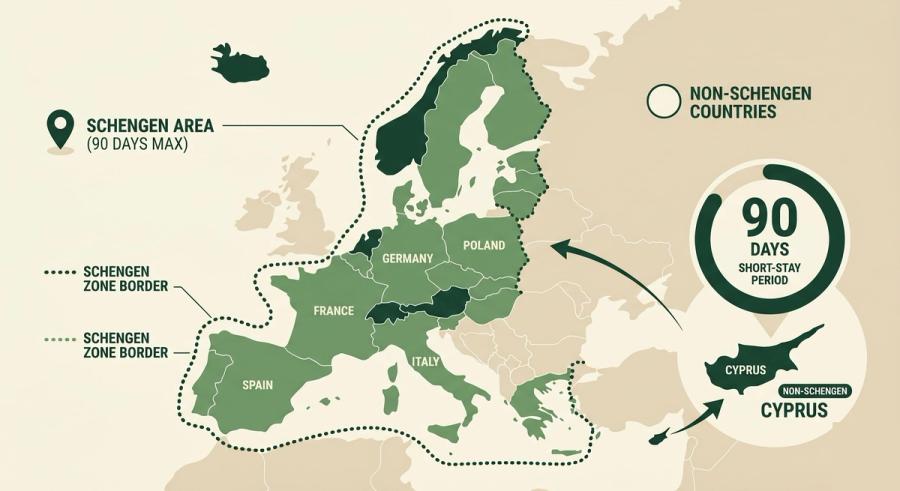
If you live in Cyprus and hold a non-EU passport, the Schengen 90-day rule is one of the most important travel regulations you need to understand. Getting it wrong can result in an entry ban, a fine, or complications with your residency.
This guide explains exactly what the Schengen 90/180-day rule means for people who are tax residents in Cyprus - including how it interacts with the Cyprus 60-day tax residency rule, how to count your days correctly, and what changes when Cyprus eventually joins the Schengen Area.
What Is the Schengen 90/180-Day Rule?
Non-EU nationals can stay in the Schengen Area for a maximum of 90 days within any 180-day period without a long-stay visa. The 180-day window is a rolling period, meaning it recalculates continuously based on when you exit the zone. Once you exceed 90 days of presence, you must leave and cannot re-enter until 90 days have passed since your first entry date. Extensions are not permitted, and violations result in entry bans.
Source: PwC Cyprus Tax Facts 2026. Rates current as of January 2026.
- You can spend a maximum of 90 days in any 180-day period in the Schengen Zone.
- The 180-day period is a rolling window - it is not a calendar half-year. Each day you want to enter, you count back 180 days from that day and check how many Schengen days you have already used.
- If you have used 90 days in the past 180 days, you must wait until enough days have 'rolled off' the window before you can enter again.
- Overstaying triggers penalties: entry bans, fines, and in some cases, impact on future visa applications.
The Schengen Area includes 29 countries: all EU member states except Cyprus, Bulgaria, Romania, and Ireland, plus non-EU countries Norway, Iceland, Switzerland, and Liechtenstein. Croatia joined Schengen in January 2023.
Is Cyprus Part of the Schengen Area?
Cyprus is not part of the Schengen Area, despite being an EU member since 2004. As of 2026, Cyprus remains one of four EU countries outside Schengen, alongside Bulgaria, Romania, and Ireland.
The practical implication: days you spend in Cyprus do not count toward your 90-day Schengen limit. Cyprus has its own entry rules, separate from the Schengen framework.
Cyprus is expected to join Schengen - the accession process advanced in 2024-2025 - but no confirmed date exists for full integration as of this writing. More on this below.
The Key Difference: Schengen 90-Day Rule vs. Cyprus 60-Day Tax Rule
Most expats confuse these two separate rules with different purposes. The Schengen 90-day rule controls EU border crossings; the Cyprus 60-day tax rule determines Non-Dom residence status. Exceeding Schengen limits risks entry bans. Exceeding Cyprus limits triggers full tax residency on worldwide income. You can stay 90 days in the Schengen zone but only 60 days in Cyprus to maintain Non-Dom status. Plan movements carefully: days outside Cyprus don't reset the 60-day counter within a tax year.
| Rule | Schengen 90/180 | Cyprus 60-day fiscal |
|---|---|---|
| Purpose | Controls entry to Schengen countries for non-EU nationals | Determines tax residency in Cyprus |
| Who applies it | Schengen member states (border control) | Cyprus Tax Department |
| Days counted | Days spent in any Schengen country | Days spent in Cyprus |
| Minimum/maximum | Maximum 90 days per 180-day period | Minimum 60 days in Cyprus per year |
| Consequence of breach | Entry ban, fines | Loss of Cyprus tax residency status |
| Relationship | Independent - not connected | Independent - not connected |
The Cyprus 60-day rule is a path to Cyprus tax residency: if you spend at least 60 days in Cyprus per calendar year, do not spend more than 183 days in any other country, and have a business or employment connection to Cyprus, you can qualify as a Cyprus tax resident under the alternative residency rule. This has nothing to do with Schengen.
The Schengen 90-day rule controls how many days you, as a non-EU passport holder, can spend travelling in France, Spain, Germany, Italy, Portugal and other Schengen countries. These are entirely parallel systems run by different authorities.
How Many Days Can a Cyprus Tax Resident Spend in the EU?
A Cyprus tax resident holding a non-EU passport can spend up to 90 days in the EU during any 180-day rolling period. This limit applies to non-EU citizens regardless of Cyprus residency status. After 90 days, you must leave the EU for at least 90 days before re-entering. Cyprus tax residency does not exempt you from Schengen travel rules.
- Cyprus: unlimited - you are a legal resident, no day limit applies.
- Schengen countries: 90 days in every 180-day rolling window.
- Non-Schengen EU countries (Ireland, Bulgaria, Romania): separate rules per country, generally 90 days for most passport holders.
- UK: 6 months per visit for most nationalities (separate system post-Brexit).
Your time in Cyprus is entirely separate from your Schengen day count. A month in Larnaca followed by a month in Barcelona uses 0 Schengen days (for Cyprus) and 31 Schengen days (for Spain). This is the key advantage of Cyprus-as-base for non-EU expats: you get full freedom of movement within Cyprus plus 90 Schengen days per period on top.
Practical Examples for Non-EU Expats Based in Cyprus
Example 1: The American digital nomad
# US Expat Becoming Cyprus Tax Resident: Year 1 Scenarios
**Tax residency established:** 60 days in Cyprus from January 2026 makes you tax resident for the full year.
**Scenario 1: Employment income**
EUR 60,000 salary from Cyprus employer. Tax: EUR 8,500 (15% corporate withholding). Non-Dom relief doesn't apply to Cyprus-source employment.
**Scenario 2: US rental income**
USD 24,000 from US property. Cyprus taxes worldwide income. Estimated tax: EUR 3,000-3,600 (15% rate). File US tax return separately; use foreign tax credit to avoid double taxation.
**Scenario 3: Investment dividends**
EUR 20,000 from EU-listed companies. Cyprus applies 17% dividend withholding tax at source. Non-Dom status may
- January-February: In Larnaca (Cyprus) - 60 days.
- March: Barcelona and Madrid - 31 days. (31 Schengen days used out of 90.)
- April: Back in Cyprus - 30 days.
- May: Amsterdam and Paris - 31 days. (62 Schengen days used, 28 remaining.)
- June-September: Cyprus - 122 days. Schengen days start rolling off from January.
- October: Lisbon - 21 days. By October 1, the March days (used 184+ days ago) have cleared. Counter resets partially.
Result: maintains Cyprus tax residency (well over 60 days in Cyprus), stays within Schengen limits, and travels freely across Europe.
Example 2: The UK passport holder (post-Brexit)
UK nationals are now treated as third-country nationals for Schengen purposes. A British person resident in Cyprus faces the same 90/180 limit as any non-EU traveller. The practical planning is identical to Example 1.
Important: UK passport holders should check the specific Schengen days calculator before booking extended trips to southern Europe. Post-2021, several UK citizens have been turned away at Schengen borders after overstaying.
Example 3: Managing a 6-month European trip
Some Cyprus residents want to spend significant time in continental Europe. With 90 Schengen days per 180-day period, a practical approach:
- Month 1: Cyprus (non-Schengen - no days used)
- Month 2: Greece or France (30 Schengen days)
- Month 3: Cyprus (no days used - 'recharge' period)
- Month 4: Spain or Portugal (30 Schengen days)
- Month 5: Cyprus (no days used)
- Month 6: Italy (30 Schengen days = 90 total, at the limit)
By alternating Cyprus months with Schengen months, you can travel extensively in Europe while keeping Cyprus as your home base without overstaying.
How to Count Your Schengen Days: The Rolling 180-Day Window
# How to Count Your Schengen Days: The Rolling 180-Day Window
The 180-day period is calculated backwards from each day you want to enter, not in fixed calendar blocks like January-June or July-December.
On any given day, authorities count back 180 days to see how many days you've spent in the Schengen area during that window. If you've used 90 days, you cannot enter. If you've used 89 days, you have one day remaining.
This rolling calculation means your eligibility changes daily as old travel dates drop out of the 180-day window and new days are added.
- Today is April 27, 2026. You want to enter France.
- Count back 180 days: that is October 29, 2025.
- Count every Schengen day you have spent between October 29, 2025 and today.
- If that total is 90 or more, you cannot enter.
The European Commission provides a free Schengen Short-Stay Calculator at the official Schengen visa portal. Use it before booking any Schengen trip. Enter your entry and exit dates for each Schengen visit and it calculates whether you are within the limit.
Common Mistakes Cyprus Expats Make with Schengen Days
- Counting days spent in Cyprus toward your Schengen visa allowance is the most common mistake Cyprus expats make. Cyprus is not part of the Schengen Area, so days in Larnaca, Limassol, or anywhere else on the island do not count against your 90-day Schengen limit. You can spend unlimited time in Cyprus without affecting your Schengen entitlement in other European countries.
- Using calendar half-years instead of rolling 180 days: The rule is rolling. July 1 to December 31 is not a valid calculation window - each entry date triggers its own 180-day backward count.
- Forgetting brief transits: A layover where you clear border control in a Schengen airport counts as a Schengen day. Air-side transits without border clearance do not count.
- Assuming EU residency rights: Having a Cyprus residency card (Yellow Slip) does not give non-EU nationals unlimited Schengen access. The 90-day limit still applies.
- Confusing Schengen overstay with Cyprus residency: Overstaying Schengen does not automatically affect your Cyprus residency status - they are managed by different authorities. However, a Schengen entry ban can complicate practical logistics for Cyprus residents who need to travel through Schengen airports.
What Changes When Cyprus Joins Schengen?
Cyprus joining Schengen will count days spent there toward the 90-day limit for non-EU nationals. This means time in Cyprus will be included in the total days permitted within any 180-day period across all Schengen countries. Border controls between Cyprus and other Schengen member states will be eliminated, allowing visa-free movement. Non-EU visitors will need to meet standard Schengen entry requirements and may be subject to the ETIAS (European Travel Information and Authorisation System) once implemented.
This is a significant change for non-EU passport holders currently using Cyprus as a base:
- Time in Cyprus will reduce the Schengen day budget available for European travel.
- Cyprus residents with non-EU passports may need to apply for long-stay (D) visas to any Schengen country they want to spend extended time in - rather than relying on the 90-day rule.
- The Cyprus long-stay residence permit (for non-EU nationals) would provide legal residence rights, and holders could potentially apply for Schengen residence in other EU countries under different rules.
Until Cyprus joins Schengen, the current favorable position - unlimited time in Cyprus plus 90 Schengen days - remains. Non-EU expats considering Cyprus should factor this transition into their long-term planning.
Cyprus, Schengen, and Tax Residency: The Full Picture
For digital nomads and remote workers claiming Cyprus tax residency, Schengen freedom of movement and tax residency rules interact in ways that directly affect your obligations.
- To maintain Cyprus tax residency under the 60-day rule: spend at least 60 days in Cyprus per calendar year, with no more than 183 days in any single other country, and have a local business or employment tie.
- To stay within Schengen limits: track every Schengen day using the rolling 180-day window. Cyprus time does not count.
- The two rules are independent and compatible: you can satisfy both simultaneously with good calendar planning.
For most Cyprus tax residents with non-EU passports, the practical constraint is not the Schengen limit (90 days is substantial for periodic European travel) but the requirement to spend enough time in Cyprus to maintain the tax residency status that makes the entire structure worthwhile.
Does time in Cyprus count toward Schengen days?
Can I spend 3 months in Spain if I live in Cyprus?
Does a Cyprus Yellow Slip (residence permit) give me unlimited Schengen access?
What is the Cyprus 60-day rule and how does it differ from the Schengen rule?
What happens if I overstay the Schengen 90-day limit while based in Cyprus?
Is there a tool to check my Schengen days?
When will Cyprus join Schengen and what changes for residents?
Are the Schengen 90-day rule apply to EU passport holders living in Cyprus?
Sources: PwC Cyprus Tax Facts 2026, Cyprus Tax Department.
Need personalized advice? Book a consultation with an expat tax specialist.
Sources: PwC Cyprus Tax Facts 2026, Cyprus Tax Department.
Related guides: Cyprus 60-day tax rule - permanent residency routes - Non-Dom status guide - Cyprus company tax calculator
For more on establishing Cyprus tax residency and the 60-day rule, see our complete guide to Cyprus tax residency. For the company structure and Non-Dom dividend tax, see the Cyprus company formation guide.
![Cyprus Ltd vs Irish Ltd: Company Tax Compared [2026]](https://cdn.sanity.io/images/glqahhks/production/84e3d82538a859345d8d2447e8e097c5777fb238-1679x937.png?w=700&q=75&auto=format)
![Cyprus vs Malta Company Formation [2026]](https://cdn.sanity.io/images/glqahhks/production/97db89d0ce729a9e931d09bc1522631faa6c3474-1679x937.png?w=700&q=75&auto=format)