Cyprus 60-Day Rule: Practical Checklist & Common Mistakes (2026)

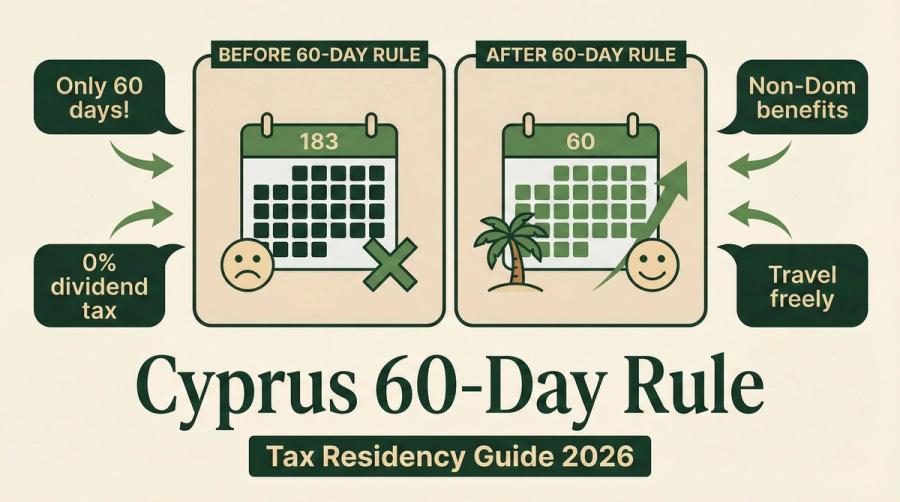
The Cyprus 60 day rule is one of the most flexible tax residency frameworks in the EU. Most countries require spending at least 183 days per year to establish tax residency. For entrepreneurs, remote workers, and frequent travelers, that can feel like a prison sentence. The Cyprus 60 day rule offers an alternative that exists nowhere else in the EU: full tax residency with just 60 days of physical presence per year.
While the 183 days tax rule in Europe is the universal standard, Cyprus introduced its 60 day rule in 2017 specifically for internationally mobile professionals who need a tax base without being tied to one location. Combined with Non-Dom status, it makes taxes in Cyprus one of the most flexible and tax-efficient residency options in Europe.
Minimum days per year for Cyprus tax residency 60 vs 183 days required in virtually every other country
This guide covers the 5 exact requirements, day-counting rules, how it compares to the standard 183-day threshold, required documentation, and the most common mistakes to avoid.
What Is the Cyprus 60 Day Rule?
The Cyprus 60 day rule allows individuals to qualify as tax residents by spending just 60 days per year in Cyprus, rather than the standard 183-day physical presence test. This alternative path requires meeting specific Cyprus tax residency requirements beyond the time threshold alone.
The rule was introduced through an amendment to the Cyprus Income Tax Law (Section 2) in 2017. Its purpose was clear: attract entrepreneurs, investors, and digital professionals who operate across multiple countries and cannot (or do not want to) spend half the year in one place.
60-Day Rule 60 days With 5 conditions: business ties, permanent home, not resident elsewhere Standard Rule 183 days No additional conditions, just physical presence
Same benefits, fewer days
Both the 60-day rule and the 183-day rule grant the exact same tax residency status. There is no difference in rights, obligations, or access to Non-Dom benefits. The only difference is the physical presence requirement.
What Are the 5 Requirements for the 60-Day Rule?
Five conditions must be met simultaneously during the tax year (January 1 to December 31) for the 60-day rule to apply; missing even one disqualifies you. The rule requires: 60+ days physical presence in Cyprus, no tax residency in another country, no more than 90 days in any other single country, employment or business activity in Cyprus, and a permanent home available in Cyprus. All five must hold together - partial compliance doesn't count.
1. Spend at least 60 days in Cyprus
The minimum physical presence threshold. The 60 days do not need to be consecutive. They can be spread across the year in any pattern: weekends, monthly visits, or longer stays.
2. Do not spend 183 or more days in any other single country
This prevents dual tax residency conflicts. If 183 or more days are spent in another country, that country will likely claim tax residency first, and this provision cannot override it. The days are counted per country, not combined.
Travel strategy Splitting time across multiple countries works perfectly. For example: 90 days in Cyprus, 80 days in Spain, 60 days in Portugal, and the rest elsewhere. As long as no single country reaches 183, the condition is met.
3. Do not be a tax resident of any other country
Beyond just the day count, there must be no active tax residency in another jurisdiction. This means properly deregistering from previous tax residencies (e.g., filing a "baja censal" in Spain, or notifying HMRC in the UK) before relying on the 60-day rule.
4. Have a business connection to Cyprus
At least one of the following must be in place:
- Be a director of a company registered in Cyprus
- Be an employee of a Cyprus-registered company
- Be a partner in a Cyprus-registered partnership
Remote work for foreign clients is fully compatible with this requirement, as long as the work is channeled through a Cyprus entity. For example, a freelance developer invoicing clients worldwide through a Cyprus Ltd company satisfies this condition.
Most common setup
The typical path is forming a Cyprus Ltd company and appointing yourself as director. This satisfies the business connection requirement and also creates the optimal structure for the low salary + dividends strategy (see the Non-Dom guide for details on the 2.65% dividend rate).
5. Maintain a permanent home in Cyprus
A residential property must be available for use throughout the year. This can be:
- Owned property (apartment, house, or studio)
- Rented property with a lease covering the full tax year
The rental contract must be in the applicant's name (not a company name). A short-term Airbnb or hotel does not qualify. The property does not need to be occupied the entire year, but it must be permanently available.
| Requirement | What it means | How to meet it |
|---|---|---|
| 60+ days in Cyprus | Physical presence, any pattern | Track flights, keep boarding passes |
| Less than 183 days elsewhere | Per single country, not combined | Spread time across multiple countries |
| Not tax resident elsewhere | No active tax residency abroad | Formally deregister from previous country |
| Business connection | Director, employee, or partner in Cyprus entity | Form a Cyprus Ltd, appoint as director |
| Permanent home | Property available year-round | Annual lease in your name |
DAY COUNTING
How Are Days Counted for the 60-Day Rule?
Days are counted as calendar days of physical presence in Cyprus, regardless of time spent each day. You must be physically present in Cyprus for at least 60 days in the relevant tax year. Partial days count as full days if you're present at any point during that calendar day. Days don't need to be consecutive. The Tax Department strictly enforces this rule, and miscounting is a common reason for failed residency claims.
What counts as a day in Cyprus:
- The day of arrival counts as a day in Cyprus
- The day of departure counts as a day outside Cyprus
- Arrival and departure on the same day counts as one day in Cyprus
- Transit through Cyprus (without clearing immigration) does not count
Tracking advice Keep a simple spreadsheet with dates, flight numbers, and countries visited. Save all boarding passes and flight confirmations. The Tax Department can request proof of physical presence at any time, and passport stamps alone are not always sufficient (especially within the Schengen area where stamps are rare).
The tax year in Cyprus runs from January 1 to December 31. There is no prorating for the first year. If arriving mid-year, the full 60 days must still be spent in Cyprus before December 31 of that year to qualify.
First year planning
Arriving in January or February gives maximum flexibility to accumulate 60 days. Arriving in September or later makes it very tight. Many advisors recommend securing a rental contract and company registration before the start of the tax year to avoid complications.
For a complete step-by-step timeline, see the moving to Cyprus guide.
60-Day Rule vs 183-Day Standard: Which One to Use?
Cyprus tax residency requires either 60 consecutive days in Cyprus or 183 days in any 12-month period. Both paths grant identical tax residency status and rights. Choose the 60-day route if you can commit to continuous presence; use the 183-day standard if your time in Cyprus is fragmented across the year.
Want to know if this applies to you? Every situation is different. Get personalized guidance on your Cyprus tax setup. Get Personalized Advice
| Feature | 60-Day Rule | 183-Day Rule |
|---|---|---|
| Minimum days in Cyprus | 60 | 183 |
| Business connection needed | Yes | No |
| Permanent home needed | Yes | No |
| Restriction on days elsewhere | Less than 183 in any one country | None |
| Non-Dom eligible | Yes | Yes |
| Best for | Frequent travellers | Full-time residents |
For most entrepreneurs and remote workers with a Cyprus company, this residency option is the optimal choice. It provides full tax residency while preserving the freedom to travel, visit clients, or live part of the year in other countries.
The 183-day rule is simpler (no conditions beyond physical presence) and works better for retirees, families settling in Cyprus, or anyone who plans to live in Cyprus most of the year anyway.
How Does Cyprus Compare to the 183-Day Rule in Other Countries?
Cyprus offers a 60-day alternative to the standard 183-day tax residency rule used throughout Europe, giving non-domiciled individuals full tax residency rights with significantly shorter physical presence requirements. Most European countries require 183 days of presence annually to establish tax residency, but Cyprus' Non-Dom regime allows qualification at just 60 days, combined with no previous Cyprus tax residency for five years and no significant Cyprus income sources. This makes Cyprus exceptionally competitive for high-net-worth individuals seeking tax-efficient residency without lengthy annual commitments.
| Country | Days for tax residency | Alternative rule |
|---|---|---|
| Cyprus | 60 days | 60-day rule (with 5 conditions) |
| Portugal | 183 days | Habitual residence test |
| Spain | 183 days | Center of vital interests |
| Germany | 183 days | Habitual abode (6+ months) |
| France | 183 days | Primary home or economic center |
| UK | 183 days | Statutory Residence Test (complex) |
| Italy | 183 days | Registered residence or domicile |
| Malta | 183 days | No reduced-day alternative (2026) |
No other EU member state offers a reduced-day tax residency path comparable to the Cyprus 60-day rule. This is a structural advantage that remains unique in the European tax landscape.
How Do the 60-Day Rule and Non-Dom Work Together?
The 60-day rule combined with Non-Dom status allows tax residency with just 60 days per year in Cyprus and a 2.65% effective tax rate on dividend income through the General Healthcare System (GHS) contribution.Non-Dom (non-domiciled) status. Together, they allow tax residency with just 60 days per year and a 2.65% effective tax rate on dividend income.
The combination works as follows:
- This residency provision establishes Cyprus tax residency (the legal foundation)
- Non-Dom status exempts from Special Defence Contribution on dividends (0% instead of 5%), interest (0% instead of 30%), and foreign rental income (0% instead of 3%)
- The only remaining cost on dividends is the 2.65% GHS (General Healthcare System) contribution, capped at 4,770 EUR per year
Effective dividend tax rate with 60-Day Rule + Non-Dom 2.65% Full tax residency status with just 60 days per year in Cyprus
For company owners, the optimal structure is a Cyprus Ltd with a low salary (first 22,000 EUR is tax-free) and profits distributed as dividends at 2.65%. See the Non-Dom guide for detailed savings calculations.
What Documentation Do You Need for the 60-Day Rule?
For the 60-day rule, you don't need a formal application; status is determined by facts and declared during annual tax filing. Keep these documents available: proof of physical presence (travel records, entry/exit stamps), accommodation evidence (rental agreements, utility bills), employment or business documentation, bank statements showing financial activity, and any communication with tax authorities. Retain records for at least six years to support your residency claim if audited.
- Rental contract or property deed in the applicant's name (covering the full tax year)
- Company registration certificate (Cyprus Ltd)
- Director appointment letter or employment contract
- Yellow Slip (MEU1 or MEU3 immigration certificate for EU citizens)
- Travel log with dates, countries visited, and flight references
- Boarding passes, flight confirmations, or airline booking records
- Proof of deregistration from previous tax residency (e.g., baja censal from Spain, P85 from UK)
- Utility bills or bank statements showing activity at the Cyprus address
Keep records for 6 years
The Cyprus Tax Department can audit tax returns going back 6 years. All documentation related to the 60-day rule should be preserved for at least this period. Digital copies are acceptable, but original documents should be kept where possible.
What Mistakes Should You Avoid with the 60-Day Rule?
- You must formally notify your previous country of departure - simply leaving is insufficient. Most countries require written deregistration to end tax residency. Without it, two jurisdictions may claim you as a resident simultaneously, triggering double taxation and compliance complications.
- Spending 183+ days in another country by accident. Extended summer holidays, family visits, or business trips can push the day count in another country past 183 without realizing it. Track every day, every country.
- Rental contract not in the applicant's own name. A lease under a company name, a partner's name, or an informal arrangement does not satisfy the "permanent home" requirement. The contract must be in the individual's name.
- No Cyprus business connection before relying on the rule. The company or employment must be in place before the end of the tax year. Incorporating a Cyprus company in November and claiming 60-day residency for the same year is technically possible but may draw scrutiny.
- Relying on passport stamps for proof. Within the Schengen area and the EU, passport stamps are rare or non-existent. Flight records, boarding passes, and bank transaction locations are much more reliable evidence.
Prevention is simple
A basic spreadsheet tracking country, arrival date, and departure date for every trip eliminates most of these risks. Update it after every flight.
For a broader overview of the full Cyprus tax system, including income tax bands, corporate tax, and VAT, see the complete Cyprus tax guide.
The information in this article reflects rules and regulations as of early 2026. Legislation changes regularly. It is strongly recommended to consult with a qualified advisor before making any decisions. This content is for informational purposes only and does not constitute legal or tax advice.
Beyond taxes, expats should review the Cyprus GHS healthcare guide.
Once you qualify, you will need to apply for the Yellow Slip, check current MEU1 processing times.
Practical next steps include opening a bank account in Cyprus.
Sources & References
Official 2025-2026 legislation governs all tax rules and residency requirements cited in this article:
- 60-day rule requirements and conditions: PwC Cyprus Individual, ResidencePwC Cyprus Individual, Residence
- Cyprus Income Tax Law (Section 2, 60-day amendment): KPMG Cyprus Tax Residency & Non-Dom RulesKPMG Cyprus Tax Residency & Non-Dom Rules
- GHS contribution rates (2.65% on dividends and interest): GESY Official WebsiteGESY Official Website
- Double Taxation Agreements network (65+ countries): PwC Cyprus Individual, Foreign Tax ReliefPwC Cyprus Individual, Foreign Tax Relief
For a detailed analysis of how the 60-day rule interacts with US LLC structures and other cross-border setups, Global Solo has published a comprehensive guide covering the structural comparison with other EU residency pathways, year-one costs, and practical considerations for internationally mobile entrepreneurs.
- Cyprus 2026 tax reform measures (15% corporate rate): EY Global Tax AlertEY Global Tax Alert
Helpful Resources Tax Setup Checklist → Book a Consultation → View All Services →
📖 Read the complete 60-Day Rule guide , eligibility checklist, required documents, and common mistakes to avoid.
Tax Benefits Once You Qualify Under the 60-Day Rule
Qualifying under the Cyprus 60-Day Rule establishes you as a Cypriot tax resident and unlocks significant tax benefits on foreign-sourced income. Resident status exempts foreign dividends, interest, capital gains, and rental income from Cyprus taxation when not remitted locally. You remain subject to Cyprus tax only on income sourced within Cyprus. This makes the 60-Day Rule particularly valuable for high-net-worth individuals with substantial overseas investments seeking to minimize their overall tax burden while maintaining legal residency.
As a Cyprus tax resident (60-day basis or 183-day basis), you are eligible to apply for Non-Domiciled status in Cyprus. This is a separate election that runs for up to 17 consecutive years, and it provides complete exemption from Cyprus Special Defence Contribution (SDC) on dividends and interest, regardless of amount or source.
| Income Type | Cyprus Tax Resident (Domiciled) | Cyprus Tax Resident (Non-Dom) |
|---|---|---|
| Salary / employment income | Progressive 0-35% | Progressive 0-35% |
| Dividends received | 5% SDC (2026 reform) | 0% SDC + 2.65% GHS |
| Interest income | 5% SDC (2026 reform) | 0% SDC + 2.65% GHS |
| Rental income | 3% SDC + income tax | Only income tax (no SDC) |
| Capital gains (shares) | 0% | 0% |
| Capital gains (crypto) | 8% flat rate (2026) | 8% flat rate (2026) |
| Inheritance | 0% | 0% |
| Pension income (foreign) | 5% flat rate (optional) | 5% flat rate (same) |
The 60-Day Rule is particularly valuable for entrepreneurs and investors because it allows you to establish tax residency without spending 183 days per year in Cyprus. This matters for people who travel frequently or split time between multiple countries.
The Day Count Rules: What Counts and What Does Not
**The Day Count Rules: What Counts and What Does Not**
Cyprus tax authorities count days of physical presence, not nights. The rules are strict and specific:
- A day in Cyprus = any day on which you are physically present in Cyprus at any point during that day
- A day of departure = counted as a day OUTSIDE Cyprus
- A day of arrival = counted as a day IN Cyprus
- Transit days: if you transit through Cyprus airport without leaving the airport, this does NOT count as a day in Cyprus
This means how you structure your travel can affect your count. If you fly from London to Cyprus and leave the same day, that is one day in Cyprus. If you arrive on a Monday and depart on a Thursday, that is three days in Cyprus (Monday, Tuesday, Wednesday -- Thursday is a departure day and counts as outside).
For the 60-day minimum, this means you need to carefully count actual presence days. Many people think they have met the minimum but have miscounted because they did not account for the departure-day rule.
Practical Calendar Management for the 60-Day Rule
# Practical Calendar Management for the 60-Day Rule
Track your physical presence using a simple calendar system - either digital or paper-based. Record entry and exit dates in Cyprus, noting the specific day you arrive and depart. For frequent travelers, use color coding: green for days in Cyprus, red for days abroad, yellow for travel days crossing midnight. Set monthly reminders on the 20th to calculate cumulative days and project whether you'll exceed 60 days by year-end. Keep boarding passes, hotel receipts, and entry stamps as supporting documentation. If you're borderline, avoid unnecessary Cyprus visits in December. Consider consulting a tax advisor if your pattern is irregular or involves yacht/aircraft use.
Month 1 (January): Arrive in Cyprus January 2 (1 day). Leave January 10, return January 15, leave January 22 (15 days total). Running total: 16 days.
Month 2 (February): Arrive February 3, leave February 18 (14 days). Running total: 30 days.
Month 3 (March): Two visits totalling 15 days. Running total: 45 days.
Month 4 (April): One visit, 16 days. Total: 61 days. Minimum satisfied.
This pattern works, but it requires deliberate tracking. A simple spreadsheet recording entry and exit dates is sufficient, but you must be prepared to produce it if audited. Cyprus tax authorities can access immigration records and cross-reference your claimed days.
60-Day Rule and the Substance Test: What Inspectors Look For
Cyprus tax inspectors apply a substance test beyond day counting for the 60-Day Rule. You must demonstrate genuine ties to Cyprus, not just physical presence. Key substance indicators they evaluate include: accommodation ownership or lease, employment or business operations in Cyprus, family residence in Cyprus, bank accounts and financial activity, professional memberships, and enrollment in local institutions. Inspectors cross-reference arrival and departure records with accommodation access, utility usage, and banking patterns. A compliant 60-day visitor must show continuous connection to Cyprus beyond the statutory minimum.
- Permanent address: do you have a home in Cyprus? Renting qualifies; owning is stronger evidence
- Business registration: is your company or business registered in Cyprus?
- Bank accounts: do you maintain an active Cyprus bank account?
- Social security: are you registered with the Social Insurance Services in Cyprus?
- Healthcare: are you registered with the General Healthcare System (GESY)?
- Utility bills: are utilities at your Cyprus address in your name?
- Family ties: does your family also reside in Cyprus?
None of these is individually mandatory, but inspectors look for a coherent picture. Someone who claims 60 days in Cyprus but has no bank account, no local bills, and no business registration will face scrutiny.
What Happens If You Fail the 60-Day Conditions in a Tax Year
**What Happens If You Fail the 60-Day Conditions in a Tax Year**
Non-residency for that tax year results if you fail all five 60-day conditions. You may still qualify as a Cyprus tax resident under the 183-day rule if total days spent in Cyprus meet that threshold instead. The 60-day rule is evaluated annually, so failure in one year does not affect subsequent years.
Failing qualification has consequences: if you were relying on Cyprus tax residency to avoid being a tax resident in a higher-tax country, you may become a tax resident of that other country by default for the year you failed. This can trigger unexpected tax liabilities in countries you thought you had left.
The risk is highest for people who stop traveling to Cyprus mid-year due to personal or health circumstances. A gap year means you may need to file as a tax resident in your previous country.
This is why maintaining a buffer above 60 days is recommended. Aiming for 75-80 days provides protection against miscounts, last-minute travel changes, and ambiguous edge cases.
Official Cyprus Tax Department guidance on tax residency: Cyprus Tax Residency Rules (Tax Department).
Cyprus income tax law (full text): Income Tax Law Cyprus (Law 118(I)/2002).
Moving to Cyprus and Applying the 60-Day Rule: A Practical Timeline
You must spend fewer than 60 days in Cyprus during your first year to qualify for Non-Dom status. Here is how the first year typically plays out if you plan to use the 60-Day Rule.
January-March: Scout trip. Spend 2-3 weeks in Cyprus visiting neighborhoods, meeting estate agents, understanding the cost of living firsthand. This does not trigger tax residency yet.
April: Formal move. Sign a lease agreement in Cyprus (minimum 1 year is ideal for residency documentation purposes). Register with the civil registry (Yellow Slip / MEU1 form for EU citizens). This is your first day of official presence.
April-June: First extended stay. Spend 4-6 weeks in Cyprus. Register with the Tax Department (TIC number). Register social insurance. Open a bank account. Start accumulating documented presence days. Running total by June: approximately 35-45 days.
July-August: Second stay, potentially with international travel mixed in. Another 3-4 weeks in Cyprus brings the total to 55-65 days. The 60-day minimum is reached by late August at the latest.
September-December: Continue as a Cyprus tax resident for the remainder of the year. Apply for Non-Dom status once confirmed as a tax resident. Apply for the Certificate of Fiscal Residency from the Tax Department.
Year-end: Submit tax return as a Cyprus tax resident. The 60-Day Rule is confirmed for the full calendar year.
This timeline shows that establishing Cyprus tax residency under the 60-Day Rule does not require you to give up your entire year. You can spend significant time in other countries, traveling, or working internationally, while still qualifying as a Cypriot tax resident.
The Yellow Slip: Cyprus's Civil Registration Document
The Yellow Slip proves you are registered as a Cyprus resident and is essential for Non-Dom status and Certificate of Fiscal Residency applications. Officially called the Certificate of Registration (Alien Registration Certificate or MEU1 form for EU citizens), it differs from tax residency but serves as required evidence for these tax benefits.
EU citizens obtain the Yellow Slip from the District Administration Office or the Civil Registry and Migration Department. Required documents: valid EU passport or ID card, proof of Cyprus address (lease agreement, utility bill), proof of sufficient resources (bank statement) or employment/business in Cyprus. Cost: approximately EUR 10-20. Processing time: same day or up to a few days.
Non-EU citizens follow a different process and may need a Category F visa or other permit before being able to register as residents.
The Yellow Slip is the document you present to banks, schools, healthcare providers, and government offices to prove your Cyprus residency. It is the foundation of your life in Cyprus and should be one of the first administrative tasks you complete after arriving.
Cyprus Civil Registry and Migration Department: Civil Registry and Migration Department.
Related Guides
Cyprus Tax Residency: Full Guide
Cyprus Personal Income Tax 2026
Ready to take the next step? Book a consultation with our Cyprus tax specialists.
What is the Cyprus 60-day tax residency rule?
Are the tax benefits of the 60-day rule the same as the 183-day rule?
How does the 60-day rule differ from the 183-day standard in Cyprus?
How are days counted for the Cyprus 60-day rule?
Can both EU and non-EU citizens use the Cyprus 60-day rule?
Do I need to give up my current tax residency to use the Cyprus 60-day rule?
Which documents prove Cyprus tax residency under the 60-day rule?
Is the Cyprus 60-day rule available to freelancers and remote workers?
The Cyprus 60-day rule allows non-EU nationals to become Cyprus tax residents by spending just 60 days per year in Cyprus, rather than the standard 183 days. You must not spend 183+ days in any other single country, not be a tax resident elsewhere, have a permanent home in Cyprus, and carry out business or employment in Cyprus.
Who qualifies for the Cyprus 60-day tax rule?
Any individual who is not a tax resident of another country and does not spend 183+ days in any single other country can qualify. This makes it ideal for digital nomads, remote workers, and entrepreneurs who split time across multiple countries. EU/EEA/Swiss citizens and non-EU nationals alike can use this rule.
Do I need to own property in Cyprus to use the 60-day rule?
You do not need to own property. Renting a home in Cyprus is sufficient to meet the 'permanent home' requirement. The property must be available to you throughout the tax year, meaning you cannot just rent a room for your stay - you need a place at your disposal year-round.
Can I combine the 60-day rule with Non-Dom status in Cyprus?
The 60-day rule is a way to establish Cyprus tax residency. Once you qualify as a Cyprus tax resident, you can also apply for Non-Dom status if you were not previously domiciled in Cyprus. Non-Dom status then exempts you from SDC on dividends and interest for up to 17 years.
Which mistakes most often void 60-day rule qualification in Cyprus?
The most costly mistakes are: spending 183+ days in another country (which disqualifies you), not having a permanent home available in Cyprus year-round, failing to register at the Tax Department to obtain a TIC, not maintaining sufficient documentation of your Cyprus stays, and not having genuine business or employment ties to Cyprus.
Cyprus Tax Department official residency guidelines
For all six residency routes, costs and timelines, see the Cyprus permanent residency guide 2026.
OECD Model Tax Convention: residency tiebreakers explained
![Cyprus Ltd vs Irish Ltd: Company Tax Compared [2026]](https://cdn.sanity.io/images/glqahhks/production/84e3d82538a859345d8d2447e8e097c5777fb238-1679x937.png?w=700&q=75&auto=format)
![Cyprus vs Malta Company Formation [2026]](https://cdn.sanity.io/images/glqahhks/production/97db89d0ce729a9e931d09bc1522631faa6c3474-1679x937.png?w=700&q=75&auto=format)