Cyprus vs Italy 2026: Why Italian Entrepreneurs Are Moving to Cyprus
Italian entrepreneurs pay 24% IRES + 3.9% IRAP + 26% dividend tax = ~47% effective. Cyprus Non-Dom: ~5%. EUR 42,000 saved per year on EUR 100,000 revenue. Full 2026 comparison including the EUR 100K flat tax trap.
Last updated: 2026-06-01
Effective tax rate comparison
~38-45%
Italy
~5%
Cyprus Non-Dom
Which Is Better For You?
Remote worker / freelancer
Cyprus wins definitively. Italy's combined burden (IRES + IRAP + 26% dividend tax) reaches 47-48% effective on distributed profits. Cyprus Non-Dom: ~5%. Annual saving on EUR 100,000: EUR 42,000. Even Italy's flat 50% income exemption (Impatriati) for new residents only brings the rate to ~25%, still 5x Cyprus.
Holding company / IP owner
Cyprus wins. Italy has no IP Box comparable to Cyprus's ~3% effective rate. Italy's IVAFE tax on foreign financial assets and IVIE on foreign property add costs that don't exist in Cyprus. For any international holding, Cyprus is the standard choice.
Retiree / passive investor
Italy can win for high-net-worth retirees. Italy's EUR 100,000 lump-sum flat tax is an inbound regime (for newcomers TO Italy), not for Italians leaving. For Italians living off investment income abroad, Cyprus Non-Dom (0% on foreign dividends) beats Italy's 26% substitute tax.
Crypto investor
Cyprus wins. Italy taxes crypto gains at 26% (raised from 14% in 2024). Cyprus: 8% flat for professional traders (2026), 0% for individual investors. Cyprus is materially better.
Tax Comparison: Italy vs Cyprus
| 🇮🇹 Italy | 🇨🇾 Cyprus (Non-Dom) | |
|---|---|---|
| Corporate tax | 24% IRES + 3.9% IRAP (regional) | 15% |
| Income tax | Up to 43% + regional/municipal surtax | 0% (dividends) |
| Capital gains tax | 26% (on participations) | 0% (no Cyprus property) |
| Dividend tax | 26% substitute tax | 0% income tax + 2.65% GHS |
| Wealth tax | IVIE on foreign property + IVAFE on foreign financial assets | None |
| Social contributions | ~9.19% employee + ~23.81% employer | ~4% on salary (capped) |
| Effective rate (entrepreneur) | ~38-45% | ~5% |
| VAT | 22% | 19% |
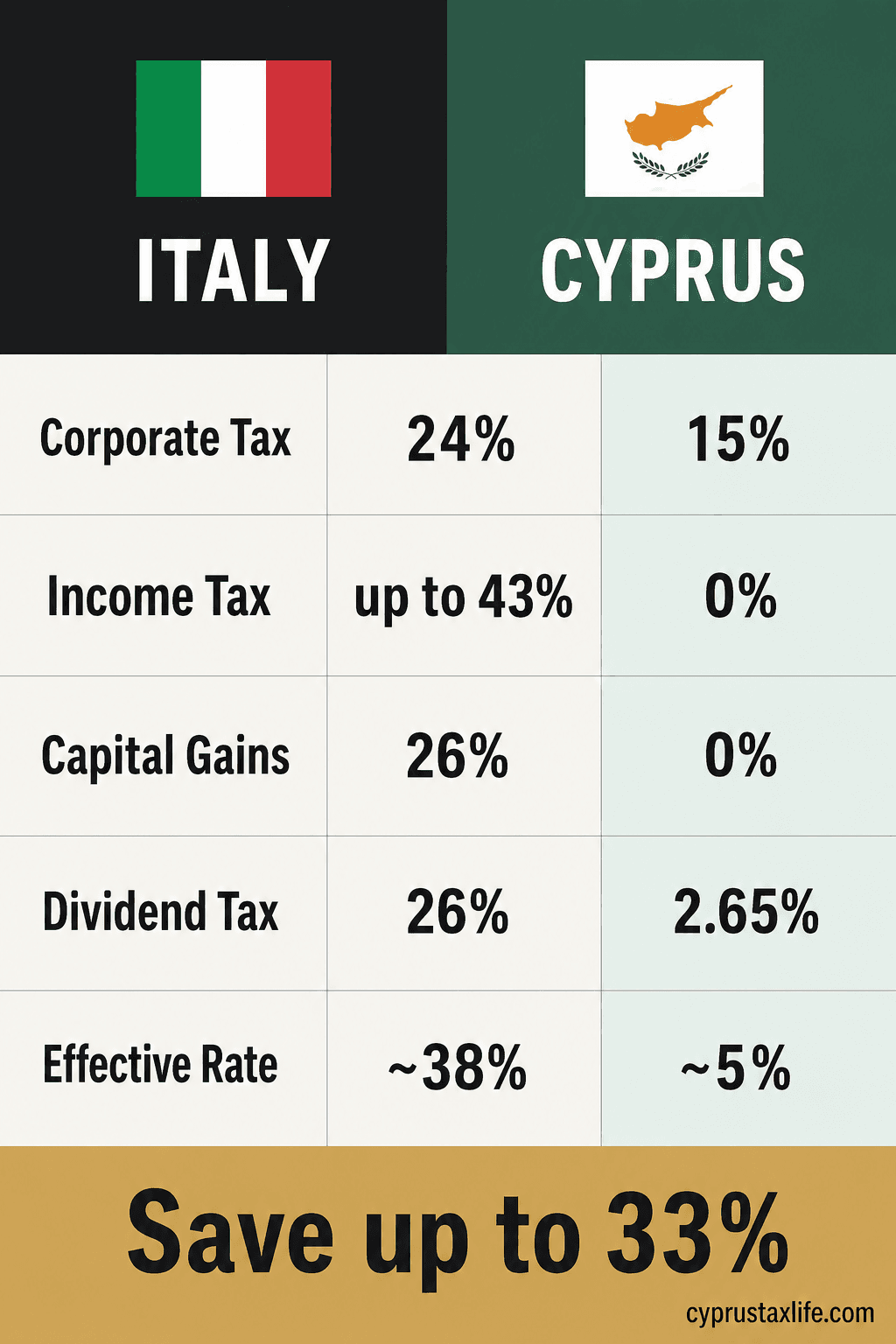
Tax Burden in Italy
Italy is notorious for its high tax burden and bureaucratic complexity. The IRES (Imposta sul Reddito delle Societa) corporate tax rate is 24%, but Italian companies also pay IRAP (Imposta Regionale sulle Attivita Produttive) of 3.9% on productive value (which includes labor costs). The combined effective corporate rate exceeds 27-28%.
Dividends paid to individual shareholders are subject to a 26% substitute tax (imposta sostitutiva), which replaced the prior participation exemption system. Combined with corporate tax of 28%, the total tax on distributed profits reaches approximately 47-48%.
Personal income tax (IRPEF) uses progressive rates: 23% up to EUR 28,000, 35% from EUR 28,000 to EUR 50,000, and 43% above. Regional and municipal surtaxes add a further 1.23-4.5% depending on location. For high earners, the effective marginal rate approaches 47-48%.
Italy does have attractive expat regimes: the Impatriati regime (flat 50% income exemption for 5-8 years) and the EUR 100,000 lump-sum substitution tax for high-net-worth individuals transferring residency to Italy. However, these are inbound regimes that benefit people moving to Italy, not outbound planning tools for Italians moving abroad.
Why Cyprus is Better for Entrepreneurs
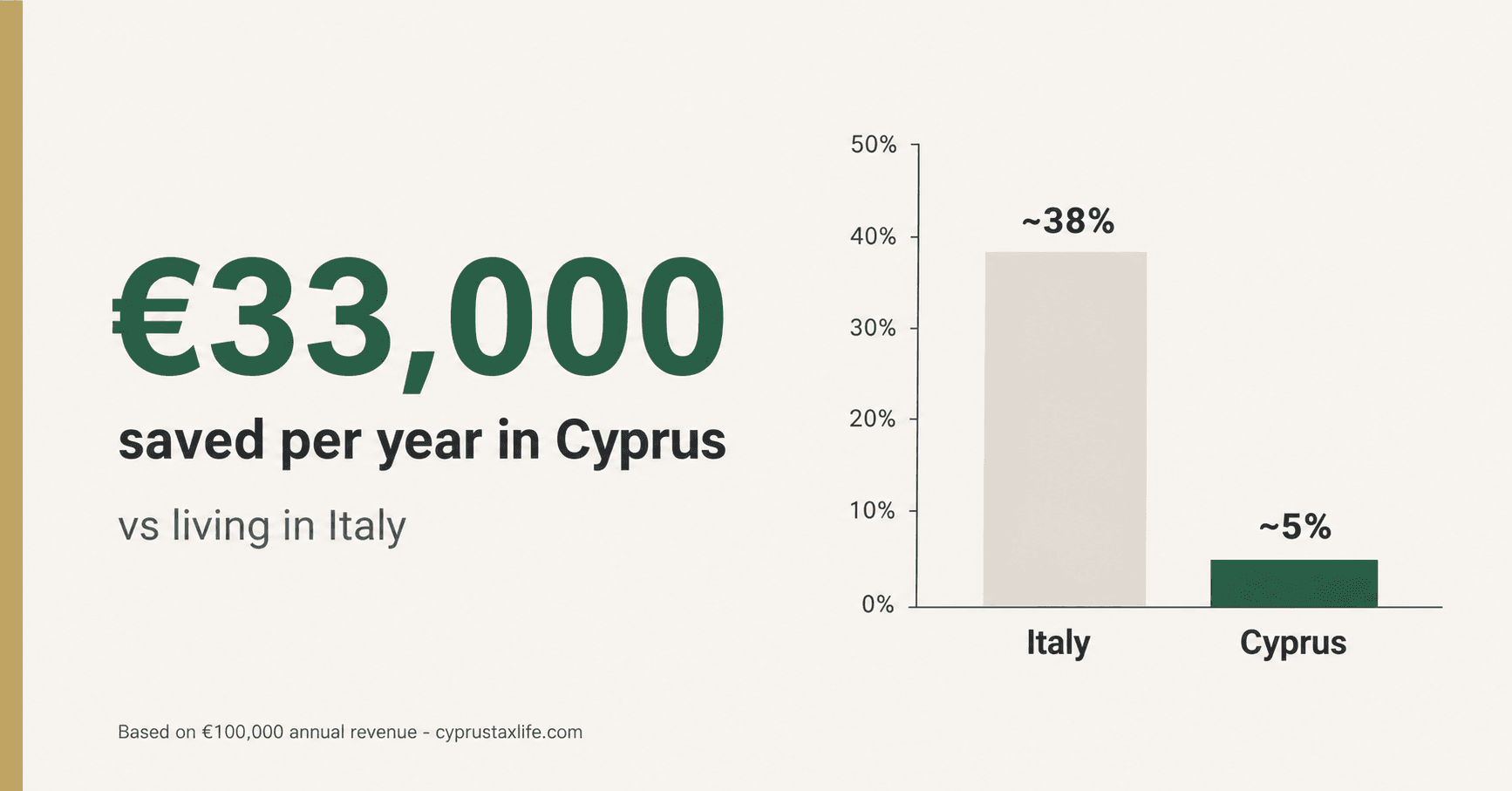
For Italian entrepreneurs, Cyprus offers a comprehensive tax and lifestyle alternative. The effective rate under Cyprus Non-Dom is approximately 5% compared to 38-45% in Italy, representing savings of EUR 33,000-40,000 per year on EUR 100,000 of revenue.
The Cyprus Ltd pays 15% corporate tax (vs. 28% combined IRES+IRAP in Italy). Under Non-Dom, dividends are exempt from income tax (only 2.65% GHS). No IVIE, no IVAFE, no municipal surtaxes, no IRAP.
Both countries are EU members, meaning Italian entrepreneurs can continue to serve EU clients with no additional friction. Cyprus has a well-established Italian-speaking business community, and English is universally spoken. The Mediterranean lifestyle is familiar to Italian professionals, though the cost of living in Cyprus is significantly lower than Rome, Milan, or Bologna.
The administrative burden is also dramatically lower in Cyprus. Italian compliance (dichiarazione dei redditi, IRAP returns, INPS contributions, studi di settore/ISA) requires significant annual accounting work and cost. Cyprus compliance is simpler and more predictable.
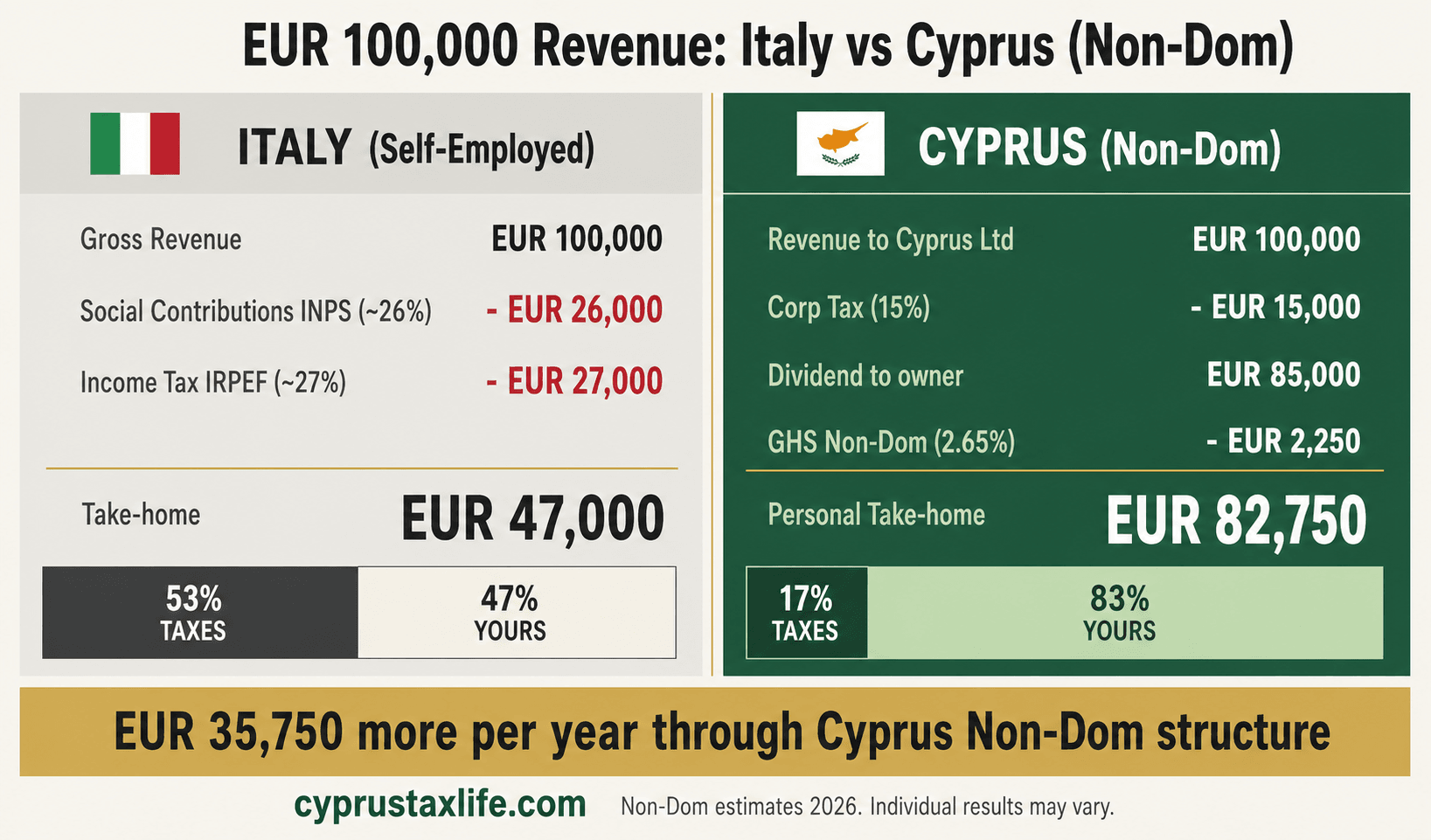
Tax Calculation: EUR 100,000
🇮🇹 Italy
🇨🇾 Cyprus (Non-Dom)
Annual savings moving to Cyprus
EUR 33,000
EUR 165,000 over 5 years
Double Tax Treaty: Italy - Cyprus
Italy and Cyprus have a double tax treaty in force since 1983. Key withholding rates: dividends 0-15% (0% if the beneficial owner is a company holding at least 10%; 15% otherwise), interest 10%, royalties 0%. The treaty follows OECD model principles and contains standard tie-breaker rules. Italian entrepreneurs should be aware that Italy has aggressive CFC rules and anti-avoidance provisions that require genuine economic substance in Cyprus for the treaty benefits to apply. Planning ahead and ensuring genuine residency and business activity in Cyprus is essential.
Exit Tax and Emigration from Italy
Italy introduced a formal exit tax (Article 166-bis TUIR) that applies when a company transfers its tax residence abroad. For individuals, Italy does not impose a formal exit tax on share disposals upon emigration. However, there is a 26% capital gains tax on gains realized from selling qualifying shareholdings (above 2% of share capital for listed companies, or 20% for unlisted). If you sell shares within 5 years of emigrating while being resident in a low-tax country, Italian anti-avoidance rules may challenge the gain. Italy also has a 2-year lookback rule on certain capital gains.
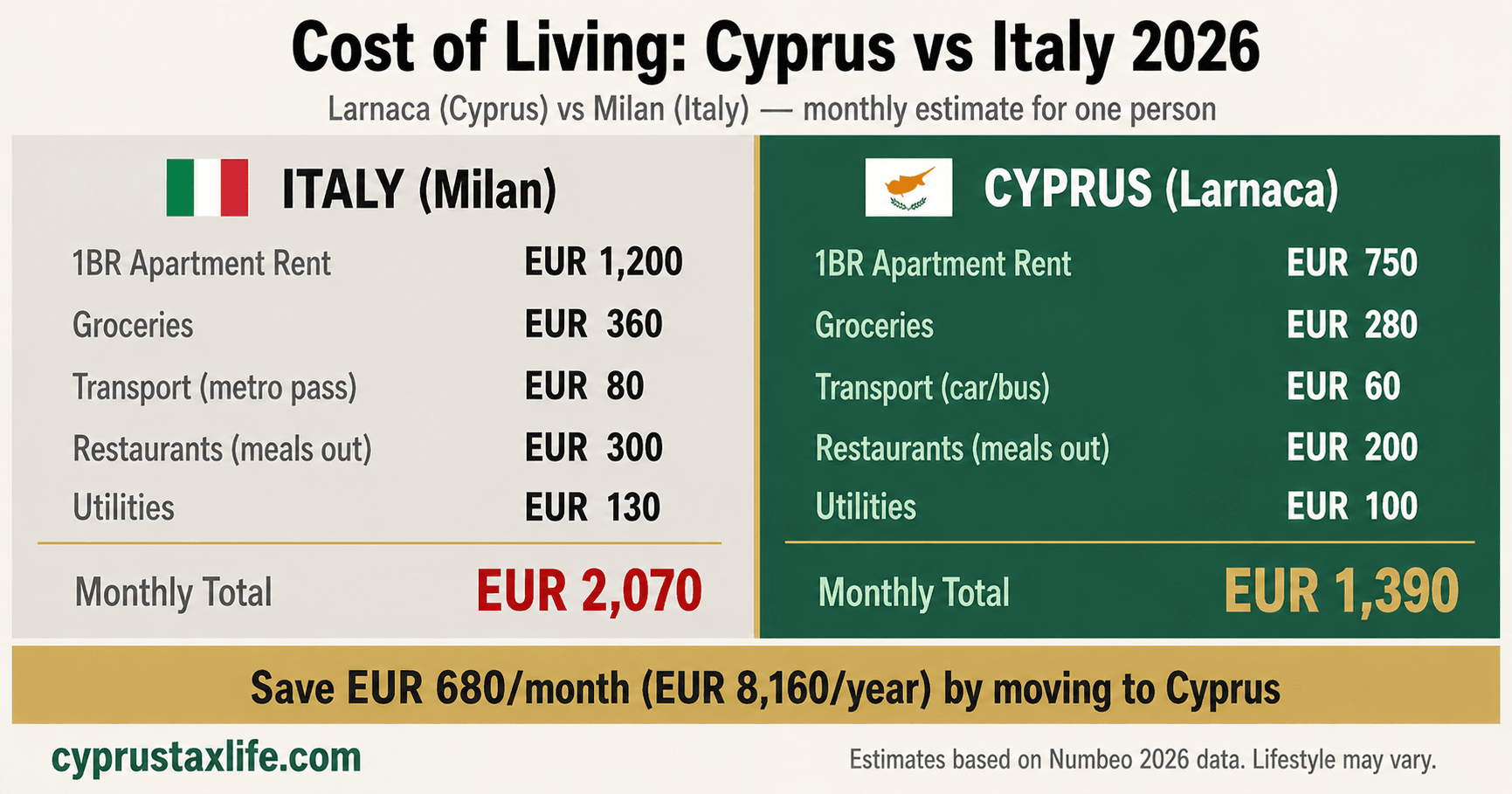
Cost of Living: Italy vs Cyprus
Cyprus is significantly cheaper than the major Italian cities. Rent for a 2-bedroom apartment: Larnaca EUR 550-750, Limassol EUR 650-900, Milan EUR 1,400-2,200, Rome EUR 1,000-1,600, Florence EUR 900-1,400. Bologna and Turin are comparable to Limassol. Southern Italy (Calabria, Sicily) is similar in cost to Cyprus. Groceries are 15-25% cheaper in Cyprus. Dining out is comparable in price, though Cypriot cuisine is different from Italian. Healthcare through the Cyprus GHS system (2.65% contribution) is more affordable than the INPS-funded Italian system, especially for self-employed professionals who pay very high INPS contributions.
Practical Steps to Relocate
Evaluate your Italian tax residence status and existing business structure
Establish a Cyprus Ltd company (5-7 working days, EUR 1,100-1,800 all-in)
Deregister from Italian tax residency (AIRE - Anagrafe degli Italiani Residenti all'Estero)
Submit your final Italian dichiarazione dei redditi for the year of departure
Deregister from INPS and Agenzia delle Entrate
Apply for Cyprus tax residency
Register as Non-Dom at the Cyprus Tax Department
Obtain your Yellow Slip (EU citizen registration)
Open a Cyprus bank account
Close or restructure any Italian entities (SRL, ditta individuale)
Set up payroll structure in Cyprus
Frequently Asked Questions
What is the AIRE and why is it important when leaving Italy?+
Does Italy have CFC rules that could affect a Cyprus company?+
Can I use the Italian EUR 100,000 lump-sum tax regime if I move to Cyprus?+
How does the 26% dividend tax compare between Italy and Cyprus?+
Is there an Italian-speaking community in Cyprus?+
What happens to my Italian pension contributions if I move?+
Sources and References
Tax data: PwC Worldwide Tax Summaries, KPMG Tax Guides (2025/2026), Big Four country guides, government tax authority publications. Effective rates are approximations for entrepreneur structures (company + low salary + dividends). Consult a qualified tax advisor before making decisions.
Free, no commitment
Moving to Cyprus or opening a company?
Tell us your situation and we'll connect you with our specialist expat advisory in Cyprus: Non-Dom tax, company setup and residency, done for you. Free consultation, no commitment.
Related Articles
Germany's exit tax (§6 AStG) taxes unrealised gains on shares >1% when you emigrate. Moving to Cyprus (EU): you can defer payment indefinitely. Full breakdown for German founders and investors.
 Miriam Alonso
- Tax Planning
- Relocation
Canada's departure tax treats you as having sold your worldwide assets the day you stop being a tax resident. What is caught, what is exempt, how to defer it, and what the cost-base reset means for where you go next.
![Countries With No Property Tax [2026]: The Real Cost](https://cdn.sanity.io/images/glqahhks/production/6f7ea0efceed8a692ad7c3785efa8baaf4d1e208-1679x937.jpg?w=700&q=75&auto=format)
Compare countries with no property tax and the stamp duty they charge instead. See the 10-year holding cost that makes Cayman pricier than Portugal.
Miriam Alonso