Cyprus-Italy Double Tax Treaty 2026
Last updated: 2026-04-26
Treaty Information
Signed
1974
In force since
1975
Model
OECD Model
Overview
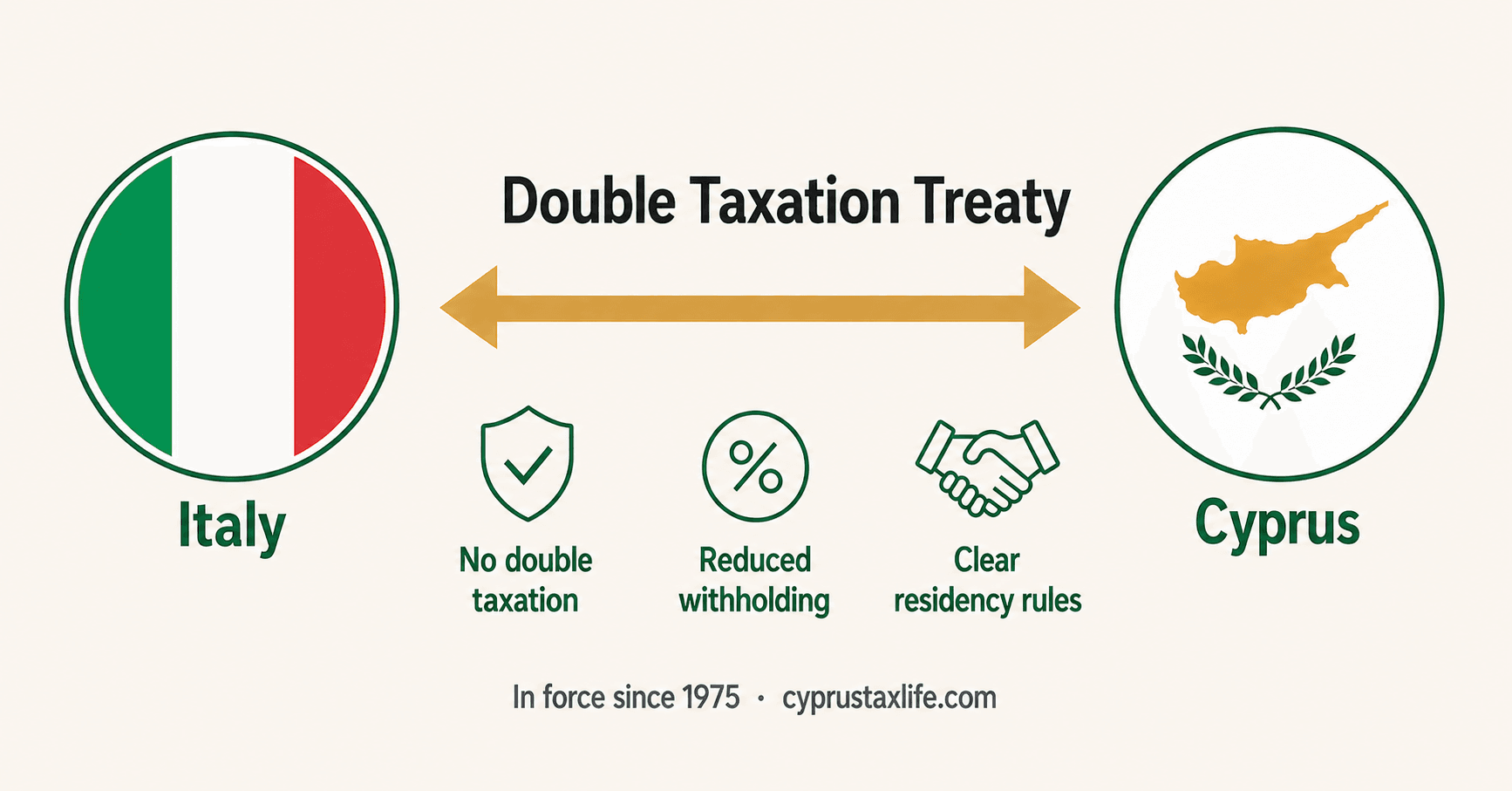
The Cyprus-Italy Double Taxation Agreement was signed in 1974 and has been in force since 1975. It is one of the older Cyprus treaties and predates many modern anti-avoidance provisions. However, the EU Parent-Subsidiary Directive and the Interest & Royalties Directive supplement it significantly for corporate structures.
This treaty matters greatly for Italian entrepreneurs and professionals considering a move to Cyprus. Italy has one of Europe's highest personal income tax burdens: IRPEF reaches 43% at the top bracket, plus regional surcharges of 1.23-3.33% and municipal surcharges, bringing the effective marginal rate to approximately 47% for high earners. Self-employed individuals on Partita IVA also face INPS social contributions (around 25-33%).
Italy has introduced several special tax regimes over the years to attract and retain talent: the regime agevolato per impatriati (returning emigrants: 50% income deduction for 5 years, extendable to 10 years), and the flat tax for high-net-worth newcomers under Article 24-bis TUIR (EUR 100,000 fixed annual payment regardless of foreign income). These regimes are relevant for understanding what Italy offers before choosing Cyprus.
Italy's anti-avoidance framework is robust. Article 47-bis TUIR defines "privileged tax regimes" for controlled foreign company (CFC) and dividend anti-avoidance purposes. Cyprus, with its 15% corporate income tax rate, is generally not considered a privileged tax regime under Italian rules - this is an important point that simplifies the treaty planning.
What the Cyprus-Italy Tax Treaty Means for Expats Moving to Cyprus
Italy's top IRPEF rate is 43%, plus regional surcharges of up to 3.33%, plus municipal surcharges, making the combined marginal rate up to 47% for high earners. Partita IVA freelancers also pay INPS contributions (gestione separata: 26.07% in 2026). Cyprus Non-Dom drops that effective rate to approximately 5% on dividends.
There are two important advantages of the Cyprus-Italy treaty that are often overlooked. First, Italy is not on Cyprus's list of "privileged tax regimes", which means no special Italian anti-avoidance treatment applies to your Cyprus structure. Second, the individual exit tax in Italy (Article 166-bis TUIR) applies to companies moving their registered office, not to individuals changing personal residence. You can leave Italy as an individual without triggering a deemed disposal on your share portfolio.
The 15% Italian withholding on dividends (instead of 0% like the Spain treaty) is the main disadvantage of this older 1974 treaty. For corporate structures with 10%+ holdings, the EU Parent-Subsidiary Directive eliminates this entirely.
| Income source | Where taxed | Effective rate |
|---|---|---|
| Italian Srl dividends (10%+ holding via Cyprus company, 2yr) | Italy 0% WHT (EU PSD) + Cyprus 2.65% GHS | ~2.65% |
| Italian Srl dividends (individual shareholder) | Italy 15% WHT + Cyprus 2.65% GHS | ~17.7% |
| Capital gains on Italian Srl shares | Cyprus only (state of residence) | 0%: Cyprus does not tax securities gains |
| Italian rental income | Italy only (source country rule) | Italian non-resident rate (21% cedolare secca or IRPEF) |
| Income from Cyprus company (non-Italian source) | Cyprus only | ~5% effective (Non-Dom) |
| Italian INPS pension (pensione contributiva) | Cyprus only (state of residence) | 5% flat on amounts above €5,000 |
| Government pension (pensione pubblica) | Italy only (paying state rule) | Italian non-resident rate |
Bottom line
For an Italian entrepreneur with an Srl who relocates to Cyprus: the most valuable move is interposing a Cyprus holding company (10%+ in the Srl, held 2+ years) to reach 0% Italian dividend withholding under the EU Parent-Subsidiary Directive. Without that structure, dividends face 15% Italian WHT. Capital gains from selling the Srl are always taxable only in Cyprus (0%). The impatriati regime gives Italy an interesting planning angle: if you ever want to return to Italy after 3+ years in Cyprus, you can do so with a 50% income deduction for 5 years.
Withholding Tax Rates
| Income type | Withholding rate |
|---|---|
| Dividends | 15% general (0% via EU Parent-Subsidiary for 10%+ corporate holdings ≥2yr) |
| Interest | 10% (0% via EU Interest & Royalties Directive for associated EU companies) |
| Royalties | 0% |
Withholding Details
Dividends (Article 10): - 15% withholding as the general treaty rate (applies to individuals and entities not qualifying for directive treatment) - EU Parent-Subsidiary Directive reduces this to 0% for corporate holdings of at least 10% maintained for a minimum of 2 years - Italian domestic WHT (ritenuta alla fonte) on dividends to non-residents is 26%; the treaty caps this at 15% - For Non-Dom Cyprus residents receiving Italian dividends personally: the 15% Italian WHT applies; in Cyprus, dividends are exempt from income tax under Non-Dom (only 2.65% GHS applies)
Interest (Article 11): - 10% withholding under the treaty - EU Interest & Royalties Directive reduces this to 0% for associated EU companies (25%+ common control, 2-year holding) - Italian domestic WHT on interest to non-residents is 26%; the treaty provides significant relief - Arm's-length interest paid to Cyprus lenders by Italian borrowers benefits from the reduced rate
Royalties (Article 12): - 0% withholding on royalties under the treaty - EU Interest & Royalties Directive also applies for associated EU companies - Covers patents, trademarks, copyrights, designs, models, plans, formulas, processes, and software - Particularly valuable for IP licensing arrangements between Cyprus IP companies and Italian operating entities
The treaty rates are less favorable than some newer Cyprus treaties, but the EU directives effectively provide 0% for most qualifying corporate structures.
Permanent Establishment Rules
The PE definition follows the OECD model. Italian tax law implements PE through Article 162 TUIR (Testo Unico delle Imposte sui Redditi), which mirrors OECD concepts.
Fixed PE: An office, branch, workshop, or place of management in Italy from which business is conducted. Even a desk regularly used in a client's Italian office may be argued as a PE.
Service PE: Italy interprets services PE broadly. Providing services in Italy for more than 183 days in any 12-month period creates PE risk.
Agent PE: An agent in Italy habitually concluding contracts in the name or for the account of the Cyprus company.
Construction PE: 3-month threshold in the treaty (shorter than the standard OECD 12 months), making construction or installation projects in Italy very sensitive.
The Agenzia delle Entrate (Italian Revenue Agency) has been aggressive in asserting PE claims, particularly against technology companies and professional services firms with significant Italian operations. Italy has historically interpreted PE provisions expansively, and the OECD BEPS project has reinforced this approach.
For Cyprus-based consultants serving Italian clients: limit physical presence in Italy, ensure contracts are signed in Cyprus, and document that management decisions are made from Cyprus. Avoid having Italian employees who act as dependent agents. The 183-day service threshold is an absolute limit - track days carefully.
Tie-Breaker Rules
The tie-breaker follows the standard OECD sequence. Italy's domestic residence rules (Article 2 TUIR) define Italian tax residents as individuals who are: - Enrolled in the Italian anagrafe (population register) for the majority of the tax year, OR - Domiciled in Italy (centre of vital interests) for the majority of the year, OR - Resident in Italy (habitual abode) for the majority of the year
Meeting any ONE of these criteria establishes Italian tax residency under domestic law. The Agenzia delle Entrate uses all three as independent tests, which means that remaining enrolled in the anagrafe (even if physically absent) can be sufficient.
For Italian entrepreneurs relocating to Cyprus: - Formally request cancellation from the anagrafe and register in the AIRE (Anagrafe degli Italiani Residenti all'Estero) - Move your domicile (centre of vital interests): family, business relationships, social connections must shift to Cyprus - Do not maintain an Italian home available for your personal use - Spend fewer than 183 days in Italy
Italy has a domestic provision (Article 2(2-bis) TUIR) that reverses the burden of proof for individuals who emigrate to "privileged" countries. The list includes many low-tax jurisdictions - but Cyprus is NOT on this list (given its 15% corporate rate), so the standard burden of proof applies. This is a practical advantage when relocating from Italy to Cyprus compared to, say, Monaco or Dubai.
Pension Provisions
Pensions (Article 18): - Government pensions (pensioni pubbliche): Taxable in the paying state (Italy), unless the recipient is a Cyprus national and not an Italian national - Private pensions: Taxable only in the state of residence (Cyprus) - Italian INPS public pension: Generally taxable only in the state of residence under the treaty
For Italian professionals retiring to Cyprus: private pension income (fondi pensione complementare, assicurazioni vita a scadenza, TFR - trattamento di fine rapporto) is generally taxable only in Cyprus at the special flat rate of 5% on amounts above EUR 5,000 per year. This is dramatically lower than Italian IRPEF rates.
TFR (trattamento di fine rapporto - Italian severance): The tax treatment of TFR lump sums received after emigrating from Italy is complex. TFR is a form of deferred compensation that may be taxed by Italy even if you are no longer resident. Clarify the tax treatment with a cross-border specialist before finalizing your departure date.
INPS public pension: Accrued INPS pension rights are preserved under EU social security coordination rules. You can claim the Italian pension from Cyprus upon reaching retirement age. Under the treaty, it is generally taxable only in Cyprus as the state of residence.
Regime di impatriati interaction: The impatriati regime (50% income deduction) is available only if you have not been Italian tax resident for the previous 3 years. If you moved from Cyprus back to Italy and used the impatriati regime, you would benefit from it. This confirms that the Cyprus-to-Italy return path is also viable for temporary planning.
Capital Gains
Capital gains (Article 13): - Immovable property: Taxable in the country where the property is located - Shares and other assets: Taxable only in the state of residence - The treaty does not contain a specific "real estate-rich company" provision like more modern treaties
Italy's domestic CGT: Italian domestic law taxes capital gains on "qualified participations" (generally 20%+ of voting rights or 25%+ of share capital) at IRPEF rates (potentially 26% substitutive tax). For non-qualified participations, the flat rate is 26%.
For Cyprus residents selling Italian company shares: the gain is taxable only in Cyprus under the treaty. Cyprus does not tax gains on securities. This can be a significant advantage for Italian entrepreneurs who have built up a Srl or SPA.
Italian exit tax (Article 166-bis TUIR): Italy imposes an exit tax on companies (not individuals) when they transfer their tax residency out of Italy. The valuation is at arm's length (normal value). This corporate exit tax does not apply to individual entrepreneurs moving their personal residence.
Individual capital gains on shares: Italy taxes these at 26% (non-qualified) or IRPEF rates (qualified). Once you are a Cyprus resident under the treaty, Italian capital gains on Italian shares are taxable only in Cyprus (treaty prevails). However, if you sold Italian-listed shares while still Italian resident, Italian tax applies before departure.
Anti-avoidance (Art. 47-bis TUIR): Italian law denies preferential dividend treatment for controlled companies in "privileged tax regimes." Since Cyprus has a 15% CIT rate and is not designated as a privileged regime, normal dividend treatment applies.
Practical Implications
For Italian entrepreneurs relocating to Cyprus:
1. AIRE registration: Register with the Italian embassy or consulate in Cyprus within 90 days of establishing residence. AIRE enrollment is obligatory and formally establishes your status as a non-resident Italian citizen. It is also the gateway to consular services.
2. Partita IVA closure: If you operated as a Partita IVA (freelancer/sole trader), file the cessation declaration (Modello AA9/12) with the Agenzia delle Entrate before or shortly after departure.
3. Societa a Responsabilita Limitata (Srl): If you hold an Italian Srl, decide whether to maintain it with an Italian-resident administrator, liquidate it, or transfer operations to a Cyprus Ltd. Maintaining the Srl with a non-resident sole administrator creates governance risk and may attract scrutiny.
4. Flat tax regime (Art. 24-bis TUIR) comparison: The Italian flat tax offers EUR 100,000/year fixed payment on foreign income regardless of amount - attractive for very high earners (billionaires). For entrepreneurs with foreign income under EUR 3-4 million, Cyprus Non-Dom at ~5% effective is substantially more advantageous. The flat tax requires actual Italian residency, which has its own costs and IRPEF on Italian-source income.
5. INPS contributions: Cancel INPS enrollment if you were paying as a self-employed person (gestione separata or artigiani/commercianti). Under EU coordination rules, you switch to Cyprus social insurance.
6. Final Italian return: File your UNICO or Modello 730 for the year of departure. Italian income up to the departure date is subject to IRPEF. After departure, only Italian-source income (rental income, employment in Italy) remains taxable in Italy.
Frequently Asked Questions
Is Cyprus considered a privileged tax regime by Italy?+
How does Cyprus Non-Dom compare to Italy's flat tax for HNW individuals?+
What is the impatriati regime and could I use it if I return to Italy?+
How are Italian dividends taxed when I live in Cyprus?+
Do I need to register with the AIRE (Italian emigrant register)?+
Can my Cyprus company invoice Italian clients?+
Sources and References
Treaty text: Cyprus Ministry of Finance, Italy tax authority publications, IBFD Tax Research Platform, PwC Worldwide Tax Summaries. Treaty provisions are summarized for general guidance. Consult a qualified tax advisor for your specific situation. Last verified: 2026-04-26.
Related Articles
Germany's exit tax (§6 AStG) taxes unrealised gains on shares >1% when you emigrate. Moving to Cyprus (EU): you can defer payment indefinitely. Full breakdown for German founders and investors.
 Miriam Alonso
- Tax Planning
- Relocation
Canada's departure tax treats you as having sold your worldwide assets the day you stop being a tax resident. What is caught, what is exempt, how to defer it, and what the cost-base reset means for where you go next.
![Countries With No Property Tax [2026]: The Real Cost](https://cdn.sanity.io/images/glqahhks/production/6f7ea0efceed8a692ad7c3785efa8baaf4d1e208-1679x937.jpg?w=700&q=75&auto=format)
Compare countries with no property tax and the stamp duty they charge instead. See the 10-year holding cost that makes Cayman pricier than Portugal.
Miriam AlonsoFree, no commitment
Moving to Cyprus or opening a company?
Tell us your situation and we'll connect you with our specialist expat advisory in Cyprus: Non-Dom tax, company setup and residency, done for you. Free consultation, no commitment.