Is Cyprus in Schengen? Entry Rules, 90/180 Days & 2027

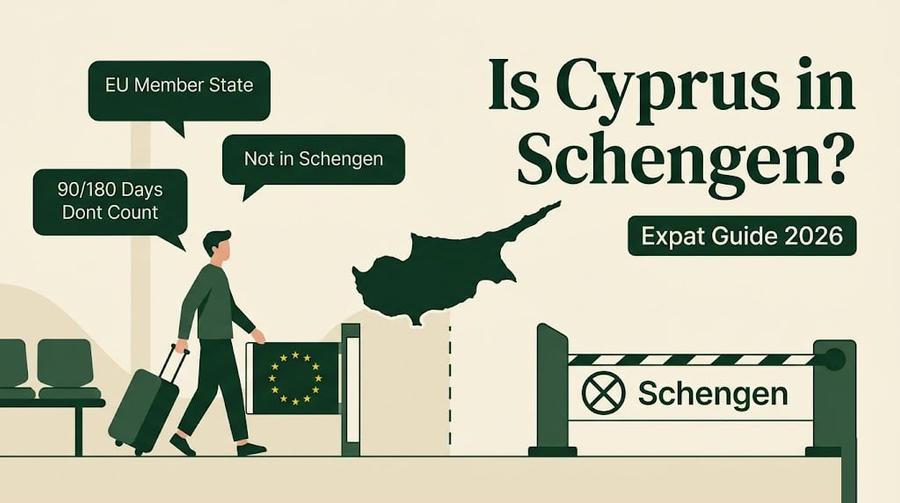
Cyprus is a European Union member state but is not part of the Schengen Area. As of 2026 Cyprus has met the technical requirements and the European Commission has confirmed its readiness, but the Council has not set an accession date. A single-entry Schengen visa does not get you into Cyprus, though a double or multiple-entry one does, and time spent in Cyprus does not count toward the Schengen 90/180-day limit. These distinctions matter for anyone planning to relocate, work remotely, or travel through Europe.
Why Is Cyprus Not in Schengen?
Citizens of many countries can enter Cyprus visa-free for short stays, including:
- United States
- Canada
- Australia
| Travel Aspect | Cyprus (non-Schengen EU) | Schengen EU Country |
|---|---|---|
| Passport check on arrival from Schengen | Yes (border control) | No (open border) |
| Visa required for non-EU citizens from Schengen | No (valid Schengen visa accepted) | N/A |
| Schengen 90/180 day rule applies | No, Cyprus is separate | Yes (shared counter) |
| Travel to other Schengen countries | Need Schengen visa (non-EU) or passport (EU) | Same |
| Driving licence valid | Yes (EU licence) | Yes (EU licence) |
| Work permit in Cyprus | Cyprus-specific permit for non-EU | EU-wide (workers) |
- Japan
- Most Gulf states
Cyprus remains outside Schengen primarily due to the uncontrolled Cyprus-Turkey border in the north, which falls outside the Republic of Cyprus's effective control. Although Cyprus joined the EU in 2004 and is legally obligated to join Schengen eventually, admission requires unanimous approval from all existing members. Austria and other states have blocked accession over concerns about this open boundary and border security risks it presents.
The European Commission completed a positive evaluation of Cyprus in 2023 recommending admission, but the Council decision has not been finalised as of early 2026. The evaluation assessed border management, data protection, police cooperation, and judicial systems - all of which Cyprus was found to meet. The remaining barrier is political rather than technical, and depends on member states reaching consensus at the Council level.
What Visa Do You Need to Enter Cyprus?
EU and EEA citizens enter with a national ID card or passport, no visa required. UK citizens can stay visa-free for up to 90 days in any 180-day period. Non-EU nationals need a Cyprus National Visa: Category C for stays up to 90 days, or Category D for long stays, residency, or employment. There is one important shortcut: under EU Decision 565/2014, Cyprus unilaterally recognises a valid Schengen Category C visa issued for two or more entries as equivalent to its own national visa, for stays of up to 90 days in any 180-day period. A single-entry Schengen visa does not qualify.
Citizens of many countries including the United States, Canada, Australia, Japan and most Gulf states can enter Cyprus visa-free for short stays. The full list of visa-exempt nationalities is maintained by the Civil Registry and Migration Department of Cyprus. It is separate from and not linked to the Schengen visa-exemption list, so the two should never be assumed equivalent when checking entry requirements.
Does Time in Cyprus Count Toward Schengen Days?
No, time in Cyprus does not count toward the Schengen 90/180-day rule because Cyprus is not a Schengen member state. Only days in the 27 Schengen countries count. This makes Cyprus valuable for non-EU nationals seeking a European base without depleting their Schengen allowance, a strategy commonly used by US, Canadian and Australian entrepreneurs relocating to Europe.
For example, a US citizen can spend 6 months in Cyprus, then travel to France, Germany or Spain for up to 90 days within the same 180-day rolling window. Those European trips use the Schengen allowance, but the Cyprus months do not. This flexibility is a practical advantage of Cyprus's current non-Schengen status, even if that status changes in the future as accession progresses.
When Will Cyprus Join Schengen? 2026-2027 Timeline
As of July 2026, Cyprus has no confirmed Schengen accession date. The European Commission gave Cyprus a positive technical evaluation in 2023, and the government has repeatedly stated it aims to join, but Schengen admission requires a unanimous political decision by the Council of all member states, and no such vote has been scheduled.
The realistic outlook points to 2027 or later. Cypriot officials have publicly signalled a target of joining by 2027, yet no formal Council date exists. The precedent of Bulgaria and Romania is instructive: both received positive evaluations years before full admission, finally entering by air and sea in March 2024 and at land borders in January 2025, after more than a decade of assessments.
What this means for you: until Cyprus actually joins, time spent on the island does not count toward the Schengen 90/180-day limit, which is an advantage for many travellers. If and when Cyprus does join, days in Cyprus would then count toward that limit for non-EU nationals without a residence permit. Anyone planning multi-year stays should secure Cyprus residency before that transition to avoid being caught by the rule change.
Practical Implications for Expats and Digital Nomads
EU citizens can live, work, and travel freely in Cyprus under the same treaty rights as in France or Germany, regardless of Schengen membership. EU free movement applies across all member states. EU nationals need only a national ID card to travel between EU states.
For non-EU nationals, the key implications are: a Cyprus-specific visa or residency document is required for legal stays beyond the visa-free period. Days in Cyprus count separately from your Schengen 90-day budget. Traveling within Schengen countries requires separate Schengen entry rights, independent of any Cyprus document. EU residency obtained in Cyprus does not automatically grant Schengen travel rights to non-EU family members who are third-country nationals.
Border Crossings and Travel Between Cyprus and Schengen Countries
Cyprus requires full passport control at external borders because it is outside Schengen. All arrivals and departures at Larnaca and Paphos airports involve passport checks for every traveller, including EU citizens. Flying to Schengen countries like Greece, Germany, or the Netherlands means you undergo exit control in Cyprus and entry control on arrival, not the simplified movement between Schengen states.
This is important for non-EU nationals tracking their Schengen days. The entry stamp you receive on arrival in Greece from Cyprus starts counting Schengen days from that point. The Cypriot portion of your trip does not appear in the Schengen calculation at all, which is why careful passport stamp tracking is advisable for anyone spending time in both zones.
Cyprus as a Tax Base: The EU Advantage Without Schengen Complexity
Cyprus offers full EU membership, 15% corporate tax, and Non-Dom status with 0% dividend tax, independent of Schengen participation. This creates a tax-efficient European base without Schengen complexity. See the complete Cyprus tax guide for rates, residency requirements and worked examples.Non-Dom status with 0% dividend tax - independent of whether Cyprus joins Schengen. See the complete Cyprus tax guide for rates, residency requirements and worked examples.
Establishing tax residency in Cyprus requires spending at least 60 days per year on the island (under the 60-day rule for Non-Dom status) without being tax resident elsewhere for more than 183 days. The Yellow Slip registration for EU citizens formalises residency status and is the standard first step for those relocating from within the EU.
Frequently Asked Questions
Can I use my Schengen visa to enter Cyprus?
Yes, if it is a double or multiple-entry visa. Cyprus is not a Schengen member and cannot issue Schengen visas, but under EU Decision 565/2014 it recognises a valid Category C Schengen visa issued for two or more entries as equivalent to a Cyprus national visa, for stays of up to 90 days in any 180-day period. A single-entry Schengen visa does not work: for that you need a separate Cyprus visa, unless you hold an EU/EEA passport or are a national of a visa-exempt country such as the US, Canada, or Australia.
Does Cyprus count as Schengen for the 90-day rule?
No. Days spent in Cyprus are not counted toward the Schengen 90-day limit. This is confirmed by the Schengen Borders Code, which counts only days in Schengen member states. Cyprus is an EU member but not part of Schengen, so all days there are treated completely separately.
Is Cyprus in the European Union?
Yes. Cyprus joined the EU in 2004. It uses the euro, EU citizens have full free movement rights under EU law, and EU regulations apply. It is specifically the Schengen free-movement zone that Cyprus has not yet joined - the two are separate frameworks with separate membership.
Can Americans stay long-term in Cyprus?
US citizens can enter visa-free for up to 90 days. For longer stays, a Category D national visa or residency permit is required. Cyprus offers several paths including the Business Facilitation Unit fast-track programme for company founders and employment permits for those working for a Cyprus-registered entity.
Does living in Cyprus give you Schengen travel rights?
Not automatically. Cyprus residency permits - Yellow Slip for EU citizens, ARC Pink Slip for non-EU nationals - grant the right to reside in Cyprus. They do not grant Schengen travel rights to non-EU nationals. Non-EU residents of Cyprus still need a separate Schengen visa to travel to Schengen countries, applied for through the relevant embassy or consulate.
Which EU countries are NOT in Schengen?
As of 2026, Cyprus and Ireland are the only EU member states not in the Schengen Area. Ireland opted out of Schengen by choice and maintains its own Common Travel Area with the UK. Cyprus is legally obligated to join but has not yet been admitted. All other EU members are either full Schengen members or have a joining roadmap in place.
Is Cyprus in the Schengen Zone?
No. Cyprus is a member of the European Union but is NOT part of the Schengen Area. This means Cyprus has its own border controls and does not share the Schengen visa-free zone.
Can I travel to Schengen countries with a Cyprus residence permit?
A Cyprus residence permit (Yellow Slip, Pink Card, or Category F visa) does NOT give you automatic access to Schengen countries. You may still need a Schengen visa depending on your nationality.
When will Cyprus join Schengen?
As of mid-2026, Cyprus has not received a formal Council date and officials are targeting 2027. The European Commission confirmed Cyprus’s technical readiness back in 2023-2024, but unanimous Council approval is still pending. For reference, Romania and Bulgaria completed their own Schengen entry across 2024 and 2025.
Does Cyprus passport give Schengen access?
Yes — a Cypriot passport gives visa-free access to all Schengen countries (and 170+ countries worldwide), as Cyprus is an EU member state.
Do I need a visa to visit Cyprus from a Schengen country?
Citizens of EU/Schengen countries can enter Cyprus freely. Non-EU nationals holding a double or multiple-entry Schengen visa can use it to visit Cyprus for up to 90 days in any 180-day period, since Cyprus recognises it as equivalent to its national visa. That covers visits only: it does not grant any residency right in Cyprus, which requires a separate permit.
Sources: PwC Cyprus Tax Facts 2026, Cyprus Tax Department.
Need personalized advice? Book a consultation with an expat tax specialist.
Sources: PwC Cyprus Tax Facts 2026, Cyprus Tax Department.
Considering a move to Cyprus? Our tax advisory service helps entrepreneurs structure their relocation correctly from day one.
![Cyprus Ltd vs Irish Ltd: Company Tax Compared [2026]](https://cdn.sanity.io/images/glqahhks/production/84e3d82538a859345d8d2447e8e097c5777fb238-1679x937.png?w=700&q=75&auto=format)
![Cyprus vs Malta Company Formation [2026]](https://cdn.sanity.io/images/glqahhks/production/97db89d0ce729a9e931d09bc1522631faa6c3474-1679x937.png?w=700&q=75&auto=format)