Social Insurance Self-Employed Cyprus 2026: Rates

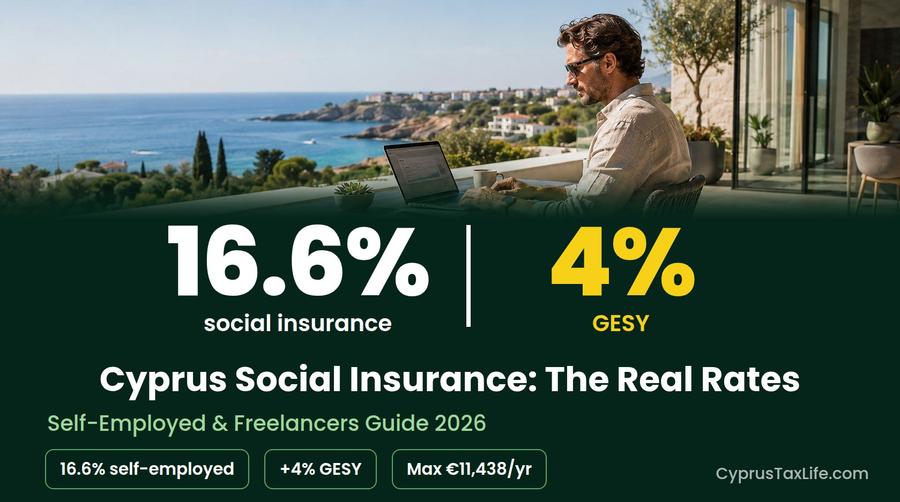
Social insurance in Cyprus is compulsory for anyone working on the island, including self-employed persons and directors of Cyprus limited companies. The contribution structure differs depending on whether you work as a sole trader, a freelancer, or as a director drawing a salary from your own company. Knowing the correct rates for 2026 prevents underpayment penalties and ensures accurate cash-flow planning.
For a full overview of the system including registration requirements and pension entitlements, see the Cyprus Social Insurance Guide. The five rates below are the ones most likely to affect self-employed individuals and company directors on a day-to-day basis.
The 5 Social Insurance Rates You Need to Know
1. Self-Employed Social Insurance Contribution: 16.6%
Per PwC Cyprus Tax Facts 2026, rates and thresholds are current as of 1 January 2026.
Self-employed individuals in Cyprus pay 16.6% of deemed insurable earnings to the Social Insurance Fund, the highest rate in the system.
Self-employed individuals and company directors in Cyprus pay the following contribution rates (2026):
- Social Insurance (SI): 16.6% of insurable earnings
- General Health System (GHS / GESY): 4% of gross income
- Human Resource Development Fund (HRDF): 0.5% of insurable earnings
- Social Cohesion Fund: 2% of insurable earnings
- Redundancy Fund: Exempt for self-employed (only employers pay for employees)
Insurable income cap for 2026: €66,876/year. Contributions above this income ceiling are not required for SI, HRDF, and Social Cohesion. GHS has no income cap.
Unlike employees, who split the contribution with their employer (8.8% each), self-employed persons have no employer counterpart. The 16.6% rate therefore covers both the individual and the fund contributions that would otherwise be split. Contributions are assessed quarterly by the Social Insurance Services based on deemed insurable earnings for the occupational category, not on actual net income.
A freelance consultant in Cyprus with a deemed annual income of EUR 25,000 would pay EUR 4,150 per year in social insurance contributions (16.6% x EUR 25,000), regardless of whether actual earnings were higher or lower. Deemed earnings tables by occupation are published annually by the Social Insurance Services and updated to reflect market changes.
Registration process and contribution schedule: Social Insurance Registration Cyprus
2. GHS (GESY) Health Contribution: 4% for Self-Employed
Self-employed persons pay 4% of their insurable earnings to the General Health System (GHS/GESY) - separate from and in addition to social insurance.
GHS contributions fund access to state healthcare services in Cyprus and, via the European Health Insurance Card, across the EU. The GHS contribution is not part of the Social Insurance Fund. It is administered separately by the Health Insurance Organisation (HIO). Employees pay 2.65% from salary; their employers pay a further 2.90%. Self-employed individuals pay 4% on their own because there is no employer counterpart.
GHS contributions also apply to passive income such as dividends, interest, and rental income at a rate of 2.65%, capped at EUR 180,000 of annual income (maximum EUR 4,770 per year on passive income sources). For a Non-Dom director who draws dividends rather than salary, only the 2.65% GHS applies to dividend income - not the full 4% self-employed rate.
How GHS interacts with Non-Dom dividend income: Cyprus Non-Dom Status Guide
3. Director-Shareholder Rate: 8.8% + 8.8% = 17.6% of Salary
A director-shareholder who draws a salary from their Cyprus Ltd pays both the employee social insurance rate (8.8%) and the employer rate (8.8%), totalling 17.6% of gross salary.
When a Cyprus limited company pays a salary to a director who is also a shareholder, the company acts as employer for social insurance purposes. The director pays 8.8% of gross salary as the employee contribution (deducted from pay). The company pays a further 8.8% of gross salary as the employer contribution (a cost on top of gross salary). Both are capped at the annual ceiling of EUR 68,904 of insurable earnings.
This is why many Cyprus Ltd owners choose to draw dividends rather than salary where possible. Dividends carry only the 2.65% GHS contribution for Non-Dom residents, with no social insurance liability. A director drawing EUR 40,000 salary would trigger EUR 7,040 in total social insurance contributions (17.6%); the same amount taken as dividends by a Non-Dom resident would attract only EUR 1,060 in GHS (2.65%).
Salary vs dividend structuring options: Company Formation in Cyprus
4. Annual Insurable Earnings Cap: EUR 68,904
Social insurance contributions in Cyprus are capped at EUR 68,904 of annual insurable earnings (EUR 1,325 per week). No contributions are due on income above this ceiling.
The annual cap applies to employees, employers, and self-employed persons alike. For an employee earning EUR 80,000, social insurance contributions are calculated only on the first EUR 68,904. For a self-employed person with a high-income occupational category, the same ceiling applies regardless of deemed or actual earnings. The cap is reviewed periodically and has increased over recent years in line with wage growth.
In practical terms, the cap means the maximum annual social insurance contribution for a self-employed person is EUR 11,438 (16.6% of EUR 68,904). For an employee and employer combined, the maximum is EUR 12,127 (2 x 8.8% x EUR 68,904). Contributions above these amounts are not legally owed and should not be paid. Overpayments can be claimed back from the Social Insurance Services.
Full cost breakdown for operating a Cyprus company: Cost to Set Up a Company in Cyprus
5. Redundancy Fund (1.2%) and HRDA (0.5%): Employer-Only Contributions
Employers in Cyprus - including Cyprus Ltd companies paying director salaries - must also contribute 1.2% of gross salary to the Redundancy Fund and 0.5% to the Human Resource Development Authority (HRDA).
The Redundancy Fund covers statutory redundancy payments when employees are dismissed for reasons of redundancy. The HRDA (also called the Human Resource Development Authority or ANAD in Greek) funds training programmes for employees and employers in Cyprus. Both contributions are assessed on the same gross salary as social insurance contributions and are subject to the same annual cap. They are employer-only charges - no deduction is made from the employee's salary.
For a director drawing a salary of EUR 30,000 from a Cyprus Ltd, the combined employer-side contributions are: 8.8% social insurance (EUR 2,640), 2.90% GHS (EUR 870), 1.2% Redundancy Fund (EUR 360), and 0.5% HRDA (EUR 150). Total employer cost on top of gross salary: EUR 4,020, or 13.4% of gross. This is lower than equivalent employer costs in Germany, France, Spain, or the UK.
How employment costs compare across jurisdictions: Moving to Cyprus for Work
Summary: All Contribution Rates at a Glance (2026)
Five contribution rates apply in 2026, each with different payers and caps as shown below.
| Contribution | Rate | Paid by | Cap (annual) |
|---|---|---|---|
| Social insurance (self-employed) | 16.6% | Self-employed | EUR 68,904 |
| GHS/GESY (self-employed) | 4.0% | Self-employed | EUR 68,904 (SI) / EUR 180,000 (passive income) |
| Social insurance (employee) | 8.8% | Employee | EUR 68,904 |
| Social insurance (employer) | 8.8% | Employer / Company | EUR 68,904 |
| GHS/GESY (employee) | 2.65% | Employee | EUR 180,000 |
| GHS/GESY (employer) | 2.90% | Employer / Company | EUR 180,000 |
| Redundancy Fund | 1.2% | Employer only | EUR 68,904 |
| HRDA training levy | 0.5% | Employer only | EUR 68,904 |
Salary vs Dividends: How Structuring Affects Contributions
Social insurance contributions depend entirely on whether you draw income as salary or dividends. Salary triggers 17.6% combined social insurance (employee + employer) plus GHS and employer-only levies. Dividends trigger only 2.65% GHS for Non-Dom residents, with zero social insurance liability. This structural difference creates substantial savings for dividend-based income strategies.
For a director-shareholder of a Cyprus Ltd who qualifies for Non-Dom status, taking EUR 60,000 as salary generates approximately EUR 10,560 in social insurance contributions plus GHS. Taking the same amount as dividends generates only EUR 1,590 in GHS (2.65% x EUR 60,000). The difference is EUR 8,970 per year - which compounds significantly over a 10-15 year planning horizon.
However, salary is not always avoidable. Pension entitlements under the Cyprus social insurance system are based on contributions paid. A director who takes only dividends will not accumulate pension rights. For those planning to rely on a Cyprus state pension in later years, a modest salary may be worth maintaining to build the contribution record. The optimal balance depends on income level, time horizon, and reliance on state benefits.
Structuring options for Cyprus Ltd owners: Company Formation in Cyprus
Registration and Compliance for Self-Employed Persons
Self-employed persons must register with Social Insurance Services within two months of starting activity. Required documents include a valid ID, tax identification number (TIC), and proof of self-employment (business registration or first contract). Late registration triggers penalties and retrospective contribution assessments.
Once registered, contributions are assessed quarterly by the Social Insurance Services. The amount owed is calculated against the deemed insurable earnings for the applicable occupational category. If actual earnings differ significantly from the deemed amount, it is possible to apply for a review of the category, but the deemed earnings remain the default until formally reassessed.
Full registration process and benefit entitlements: Cyprus Social Insurance Guide
Frequently Asked Questions
What is the social insurance rate for self-employed persons in Cyprus?
Is GHS (GESY) included in the 16.6% self-employed social insurance rate?
Do director-shareholders of a Cyprus Ltd pay social insurance?
What is the annual cap on social insurance contributions in Cyprus?
Can a Non-Dom director avoid social insurance by taking dividends instead of salary?
Are late social insurance payments subject to penalties in Cyprus?
Sources: PwC Cyprus Tax Facts 2026, Cyprus Tax Department.
Sources: PwC Cyprus Tax Facts 2026, Cyprus Tax Department.
Want to optimise your social insurance and tax structure in Cyprus? Book a consultation
Related Guides
- Salary Calculator: See Your Net Pay After Tax & Social Insurance
- Cyprus Income Tax Rates 2026: Full Guide
- Cyprus Social Insurance: Complete Guide
- Non-Dom Status: Pay Only 2.65% GHS on Dividends Instead
![Cyprus Ltd vs Irish Ltd: Company Tax Compared [2026]](https://cdn.sanity.io/images/glqahhks/production/84e3d82538a859345d8d2447e8e097c5777fb238-1679x937.png?w=700&q=75&auto=format)
![Cyprus vs Malta Company Formation [2026]](https://cdn.sanity.io/images/glqahhks/production/97db89d0ce729a9e931d09bc1522631faa6c3474-1679x937.png?w=700&q=75&auto=format)