Cyprus Digital Nomad Visa 2026: Requirements, Income and Tax

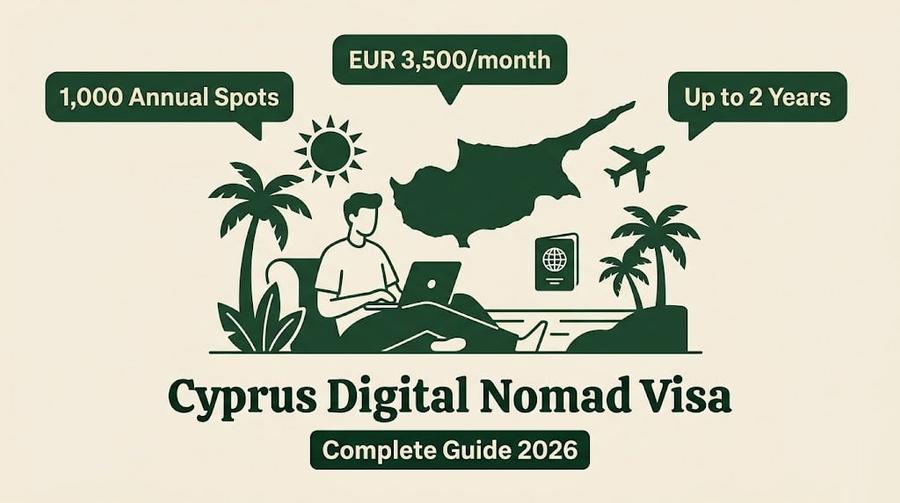
The Cyprus Digital Nomad Visa (DNV) is a temporary residence permit for non-EU/EEA citizens who work remotely. It allows living and working in Cyprus for up to 2 years, provided income comes exclusively from employers or clients outside Cyprus. This guide covers the full 2026 picture: eligibility, documents, the application process, the 1,000-spot annual cap, and - critically - what happens to your taxes if you stay more than 183 days.
This guide covers the tax side of the Cyprus Digital Nomad Visa: when the permit turns you into a Cyprus tax resident, what you pay once it does, and whether you can combine it with Non-Dom status. If what you need is the eligibility checklist instead - income threshold, documents, the annual cap and the application steps - see the Cyprus Digital Nomad Visa requirements page.
EU and EEA citizens do not need the DNV. They can move to Cyprus and register via the Yellow Slip (MEU1) process instead.
What is the Cyprus Digital Nomad Visa
According to PwC Cyprus Tax Facts 2026, the standard corporate income tax rate is 15% flat. Non-Dom residents pay 0% income tax on dividends, with only 2.65% GHS contribution capped at EUR 180,000 annual dividend income.
The Cyprus Digital Nomad Visa is a temporary residence permit for location-independent professionals from third countries who work remotely for foreign clients or employers while living in Cyprus. Introduced in 2022, suspended in 2023-2024, it relaunched in 2025.
Per PwC Cyprus Tax Facts 2026, the following rates and thresholds are current as of 1 January 2026.
Per PwC Cyprus Tax Facts 2026, rates and thresholds are current as of 1 January 2026.
According to PwC Cyprus Tax Facts 2026, Digital Nomad Visa holders who establish Cyprus tax residency (183 days) qualify for Non-Dom status, reducing dividend taxation to 2.65% GHS only.
Key features: up to 2 years total stay (1 year, renewable once), valid only for remote work for non-Cyprus entities, capped at 1,000 new permits per year.
The DNV is not a work visa for the Cyprus job market. Holders cannot be employed by a Cyprus company or provide services to Cyprus-based clients. The income source must be entirely outside Cyprus.
Who Qualifies for the Cyprus Digital Nomad Visa
Only non-EU/EEA citizens qualify for the Cyprus Digital Nomad Visa. EU and EEA citizens have unrestricted residence and work rights in Cyprus.
Eligible applicants include:
- Citizens of third countries (USA, UK, Canada, Australia, India, Brazil, etc.)
- Employees working remotely for a foreign employer
- Freelancers and self-employed with clients exclusively outside Cyprus
- Founders of foreign companies who manage their business remotely from Cyprus
The DNV does NOT apply to:
- EU/EEA nationals (use the Yellow Slip process instead)
- Anyone who plans to work for or with Cyprus companies or clients
- Anyone already holding a Pink Slip or other long-term Cyprus residence permit
Cyprus Digital Nomad Visa Requirements: Full Checklist
The minimum income requirement is €3,500 net per month. This is the single most common reason applications are rejected.
Income documentation is critical. Bank statements must show consistent monthly deposits matching the declared income level. A bank letter confirming the account belongs to the applicant is also recommended. For freelancers, signed contracts and recent invoices showing payment from abroad are required.
The criminal record certificate must be recent (usually within 3-6 months of application) and apostilled if issued in a country that is party to the Hague Convention. If issued in a non-Hague country, it requires consular legalization.
Application Process Step by Step
Step 1 - Prepare Your Documents
Schedule your appointment after gathering all required documents. Documents issued in other languages must be translated into Greek or English by a sworn translator. Certified translations are standard practice.
Step 2 - Submit Application to the Civil Registry and Migration Department
Applications are submitted in person at the Civil Registry and Migration Department (CRMD) in Cyprus. There is no online-only submission option. You must be in Cyprus to apply. The CRMD has offices in Nicosia, Limassol, Larnaca, Paphos, and Famagusta.
Step 3 - Wait for Processing (30-60 Days)
Processing typically takes 30-60 days. There is no expedited track. During this period, you can remain in Cyprus on your entry visa or visa-exempt status.
Step 4 - Biometrics Appointment
Once your application is approved in principle, you will be called for a biometrics appointment to capture fingerprints and a photograph. This is required for the physical residence permit card.
Step 5 - Collect Your Residence Permit Card
The physical DNV residence permit card is collected from the CRMD in person. The card shows your permit category, validity period, and restrictions.
The 1,000-Spot Annual Cap: How Competitive Is It?
1,000 spots per year is a relatively small number given global demand for remote work visas. Portugal's Digital Nomad Visa, for comparison, has no published annual cap. Cyprus is deliberately keeping numbers manageable while the program stabilizes.
Practical implications: if you are considering the Cyprus DNV, apply in January or February of the year you want to move. Late-year applications risk running into a depleted cap. There is no official waitlist - once the cap is reached, new applications are deferred to the following calendar year.
DNV vs Yellow Slip vs Pink Slip: Comparison
Yellow Slip, Pink Slip, and DNV permits each serve different purposes for different applicants. Yellow Slip suits EU/EEA nationals working temporarily; Pink Slip covers third-country nationals in employment; DNV (Residence Permit) is for non-EU nationals seeking long-term residence. Yellow and Pink Slips expire after one year; DNV lasts five years. Only DNV provides a pathway to permanent residence and citizenship after qualifying periods.
| Criteria | Digital Nomad Visa (DNV) | Yellow Slip (MEU1) | Pink Slip (ART. 18(2)) |
|---|---|---|---|
| Who can apply | Non-EU/EEA citizens only | EU/EEA citizens only | Non-EU/EEA citizens |
| Minimum income | €3,500/month net (remote) | Proof of sufficient means | €2,000+/month (self-sufficiency) |
| Duration | 1 year, renewable once (max 2 years) | Indefinite (while residing) | Initially 1-2 years, renewable |
| Path to permanent residency | No direct path | Yes (5 years continuous residence) | Yes (5 years continuous residence) |
| Work rights in Cyprus | No - only for non-Cyprus clients/employers | Yes - full work rights in Cyprus | No - requires separate work permit |
| Cyprus clients/employers | Not allowed | Allowed | Not allowed |
| Annual cap | 1,000 spots | No cap | No published cap |
For a detailed guide to the Yellow Slip, see Yellow Slip Guide (MEU1). For the Pink Slip process, see Cyprus Pink Slip Guide.
Tax Implications of the Cyprus Digital Nomad Visa
Spend 183+ days in Cyprus in a calendar year and you automatically become a tax resident, regardless of visa type.
| Scenario | Tax Status | Obligations | Effective Rate with Non-Dom |
|---|---|---|---|
| DNV holder - under 183 days in Cyprus | Non-resident | No Cyprus income tax. No GESY. Tax obligations remain in home country. | N/A (not Cyprus tax resident) |
| DNV holder - 183+ days in Cyprus | Cyprus tax resident | Cyprus income tax applies. GESY registration required (2.65%). Non-Dom application available. | ~5% on dividends (15% corporate tax + 2.65% GHS) |
Tax residency in Cyprus is governed by the 183-day rule and the 60-day rule. For DNV holders who become tax resident, Cyprus income tax rates apply on worldwide income. However, Non-Dom status changes the picture significantly for dividend and passive income.
Important: becoming a Cyprus tax resident does not automatically end your tax residency in your home country. Most countries use a departure date or severance of ties test. Check your home country tax rules and any applicable tax treaty with Cyprus before your move.
Can Digital Nomad Visa Holders Get Non-Dom Status?
Yes, Digital Nomad Visa holders can obtain Non-Dom status if they establish Cyprus tax residency by spending 183+ days in the country and then apply.
Non-Dom (Non-Domicile) status exempts you from Special Defence Contribution (SDC) on dividends and passive income. Combined with 15% corporate tax and 2.65% GHS on dividends, the effective total tax rate for a Non-Dom business owner is approximately 5%. See the full Non-Dom status guide for details.
The DNV + Non-Dom combination is particularly powerful for:
- Freelancers billing foreign clients through a Cyprus company
- Remote employees who own shares in foreign companies paying dividends
- Founders operating foreign companies who take income as dividends
Non-Dom status must be applied for actively - it is not automatic. Apply in the same tax year you establish Cyprus tax residency. Missing the first year can mean SDC is technically owed on dividends received during that period.
Note: Non-Dom status requires that Cyprus is your domicile of choice (not your domicile of origin). It also requires you have not been Cyprus tax resident for 17 of the last 20 years. Most DNV applicants will meet both conditions easily.
Cost of Living as a Cyprus Digital Nomad Visa Holder
Digital nomads on Cyprus visas need €3,500/month to maintain a comfortable lifestyle, with Limassol and Paphos as top choices. For detailed spending breakdown, see Cost of Living in Cyprus 2026.Cost of Living in Cyprus 2026.
Typical monthly expenses in Limassol or Paphos:
| Expense | Monthly Cost (approx.) |
|---|---|
| 1-bedroom apartment rent (central areas) | €900 - €1,400 |
| Utilities (electricity, water, internet) | €150 - €250 |
| Groceries | €300 - €500 |
| Dining out (mid-range) | €200 - €400 |
| Transportation (car or public) | €100 - €200 |
| Health insurance (private) | €60 - €150 |
| Total comfortable lifestyle | €1,800 - €2,900 |
The €3,500/month minimum income covers a comfortable lifestyle in Cyprus with money left over for savings and travel.
For comparison with long-term relocation options and eventual retirement planning, see Retiring in Cyprus. The DNV can serve as a first step toward longer-term residence.
Processing times for residence documents in Cyprus can vary. For context on typical timelines, see MEU1 processing time in Cyprus. DNV processing (30-60 days) tends to be slightly faster than MEU1 in busy periods.
Frequently Asked Questions
Who is eligible for the Cyprus Digital Nomad Visa?
Can I work for Cyprus companies on a Digital Nomad Visa?
What happens to my taxes if I stay more than 183 days in Cyprus on a DNV?
Can I renew the Cyprus Digital Nomad Visa?
Is there a waiting list for the 1,000 annual spot cap?
Are EU/EEA citizens apply for the Digital Nomad Visa in Cyprus?
Does the Cyprus DNV lead to permanent residency?
Sources: Cyprus Civil Registry and Migration Department, PwC Cyprus Tax Facts 2026. Tax information is general guidance only and not legal or tax advice. Consult a qualified Cyprus tax advisor for your specific situation.
For a broader overview of relocating to Cyprus, see the Moving to Cyprus guide.
Need personalized advice? Book a consultation with an expat tax specialist.
Planning to move to Cyprus on a Digital Nomad Visa? Speak with a specialist to review your eligibility, income documentation, and tax planning before you apply.
Many visa holders also register a Cyprus company - see our Cyprus company formation guide.
![Cyprus Ltd vs Irish Ltd: Company Tax Compared [2026]](https://cdn.sanity.io/images/glqahhks/production/84e3d82538a859345d8d2447e8e097c5777fb238-1679x937.png?w=700&q=75&auto=format)
![Cyprus vs Malta Company Formation [2026]](https://cdn.sanity.io/images/glqahhks/production/97db89d0ce729a9e931d09bc1522631faa6c3474-1679x937.png?w=700&q=75&auto=format)