Cyprus-Belgium Double Tax Treaty 2026
Last updated: 2026-04-26
Treaty Information
Signed
1983
In force since
1985
Model
OECD Model
Overview
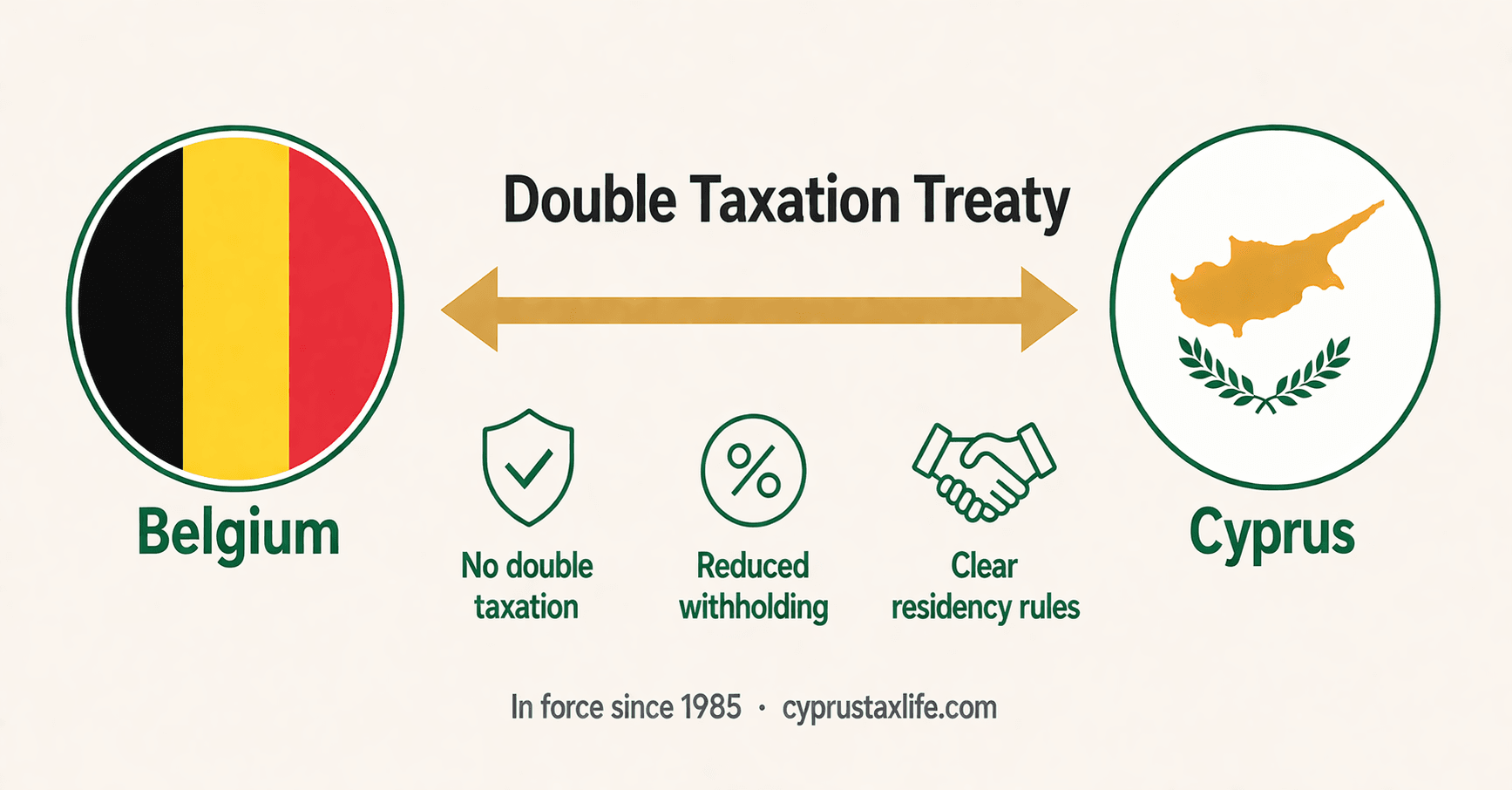
The Cyprus-Belgium Double Taxation Agreement was signed in 1983 and entered into force in 1985. It follows the OECD Model Tax Convention and provides a framework for allocating taxing rights between the two countries.
Belgium's tax system is notable for having one of the highest marginal personal income tax rates in Europe. The top bracket (income above EUR 46,440) is taxed at 50%, and when you add communal taxes (the impot communal or gemeentebelasting, which averages 7% of the federal income tax base), the effective marginal rate reaches approximately 53.5%. Self-employed individuals also pay social contributions through the INASTI/RSVZ system.
There is, however, one famous and unique Belgian tax feature: Belgium does not levy capital gains tax on shares for private individuals. Gains on share sales by individuals are tax-free as long as they are within "normal management of private assets" - an important distinction that makes Belgium stand out among its neighbors.
Belgium also has no wealth tax. Inheritance taxes (droits de succession / erfbelasting) vary significantly by region - Flanders, Wallonia, and Brussels each have their own rates, with Flanders being the most favorable (reduced rates for direct family, and generous exemptions).
For Belgian entrepreneurs considering Cyprus, the primary motivator is the combination of high personal income taxes and professional contribution rates. The Non-Dom regime in Cyprus, providing approximately 5% effective tax on dividends versus 53.5% on employment income in Belgium, represents a substantial difference.
Withholding Tax Rates
| Income type | Withholding rate |
|---|---|
| Dividends | 10% (25%+ holding) / 15% (other); 0% via EU Parent-Subsidiary |
| Interest | 0% (arm's-length) / 15% (profit-participatory) |
| Royalties | 0% |
Withholding Details
Dividends (Article 10): - 10% withholding if the beneficial owner is a company holding directly at least 25% of the capital - 15% in all other cases - EU Parent-Subsidiary Directive reduces this to 0% for qualifying EU corporate holdings (10%+ holding for 2+ years) - Belgian domestic roerende voorheffing (RV) on dividends is 30%; the treaty reduces this significantly for qualifying holdings - For Non-Dom Cyprus residents receiving Belgian dividends personally: treaty WHT at 15% applies; in Cyprus, dividends are exempt from income tax under Non-Dom (only 2.65% GHS)
Interest (Article 11): - 0% on arm's-length interest payments (corporate loans, bank interest, bond interest) - 15% on profit-participatory interest (interest linked to profits or results) - Belgian domestic RV on interest to non-residents is 30%; the treaty provides significant relief for most interest types - EU Interest & Royalties Directive (0%) applies for associated EU companies on qualifying interest
Royalties (Article 12): - 0% withholding on royalties - Covers patents, trademarks, copyrights, literary works, designs, software, and know-how - EU Interest & Royalties Directive also applies - Relevant for licensing arrangements between Cyprus IP companies and Belgian operating entities
The treaty rates compare less favorably than some modern Cyprus treaties for the 25% dividend threshold (the treaty uses 25% vs 10-15% in newer agreements), but EU directives compensate for corporate structures.
Permanent Establishment Rules
The PE definition follows the OECD model. Belgian domestic tax law implements PE concepts through Article 229 CIR (Code des impots sur les revenus / Wetboek van de inkomstenbelastingen).
Fixed PE: An office, branch, workshop, or management center in Belgium from which business is conducted.
Service PE: Services provided in Belgium for more than 30 days (cumulative) in any 12-month period can create a PE under Belgian domestic law. This domestic threshold is significantly shorter than the treaty's implied standard.
Agent PE: A dependent agent in Belgium habitually concluding contracts for the Cyprus company.
Construction PE: 12-month threshold under the treaty.
Belgian PE interpretation: The Belgian tax administration (SPF Finances / FOD Financien) has increasingly focused on substance and economic reality in PE determinations. Structures where a Cyprus company's sole client is Belgian and the director regularly works from Belgium are examined closely.
For Cyprus-based entrepreneurs with Belgian clients: limit physical presence in Belgium, ensure management decisions are made from Cyprus, and avoid maintaining any fixed space in Belgium. Belgium's 30-day domestic service PE threshold (shorter than most treaty limits) means the risk escalates quickly. Track days precisely.
Digital services: Providing software, online services, or consulting remotely from Cyprus to Belgian clients does not create a PE. The business operates from Cyprus, and no physical presence in Belgium is required.
Tie-Breaker Rules
The treaty tie-breaker follows the standard OECD sequence:
1. Permanent home 2. Centre of vital interests 3. Habitual abode 4. Nationality 5. Mutual agreement
Belgium's domestic residence rules consider an individual as Belgian resident if they have their domicile or wealth management seat (zetel van fortuin / siege de la fortune) in Belgium. The "domicile" test is factual - it looks at where you actually live. The "zetel van fortuin" (place where you manage your assets) is a distinctive Belgian concept: if your investments, savings, and wealth management activities are centered in Belgium, you may be deemed resident even if physically absent.
For Belgian entrepreneurs moving to Cyprus: - File a deregistration at your municipal administration (gemeentehuis / administration communale) - Unlink your Belgian address in the Rijksregister / Registre national - Do not maintain a Belgian home available for personal use - Transfer wealth management activities (banking, investment accounts) to Cyprus - Ensure the "zetel van fortuin" is demonstrably in Cyprus
Belgium has no formal exit tax for individuals. Unlike France, Germany, or the Netherlands, moving your personal residence from Belgium to Cyprus does not trigger a deemed disposal or exit assessment on shares. This is a notable advantage - Belgians can relocate more cleanly than many other nationalities from a tax perspective.
Belgium's treaty network is broad, and the Belgian tax administration generally respects treaty-determined residency determinations. Obtaining a Cyprus TIC (Tax Identification Code) and a Cyprus tax residence certificate strengthens your position.
Pension Provisions
Pensions (Article 18): - Government pensions: Taxable in the paying state (Belgium), unless the recipient has Cyprus nationality and is not a Belgian national - Private pensions: Taxable only in the state of residence (Cyprus) - Belgian public pension (rente / pensioen): Generally taxable only in the state of residence under the treaty
For Belgian professionals retiring to Cyprus: private pension income (groepsverzekering / assurance groupe, IPT - Individuele Pensioentoezegging, VAPZ - Vrij Aanvullend Pensioen voor Zelfstandigen) is taxable only in Cyprus at the special flat rate of 5% above EUR 5,000. Belgian pension savings typically face heavy taxation in Belgium at progressive rates; Cyprus offers significant relief.
VAPZ (self-employed supplementary pension): Contributions were tax-deductible in Belgium. Upon retirement, the capital is generally taxable in Belgium under the source principle for certain pension types, though the treaty allocation may give Cyprus the right to tax. Seek specialist advice on the specific VAPZ structure.
Belgian statutory pension (wettelijk pensioen / pension legal): Accumulated rights are preserved under EU coordination rules. You can claim the Belgian pension from Cyprus upon reaching retirement age. The pension is generally taxable only in Cyprus under the treaty.
Pillar 3 (pension saving / epargne-pension): These personal pension products are taxable in the state of residence (Cyprus) upon payout under the treaty, which is favorable.
Capital Gains
Capital gains (Article 13): - Immovable property: Taxable in the country where the property is located - Shares and other assets: Taxable only in the state of residence
Belgium's unique CGT position: Private individuals in Belgium pay no capital gains tax on shares held within "normal management of private assets" (normaal beheer van privevermogen / gestion normale du patrimoine prive). This is a domestic Belgian rule that operates regardless of residence - meaning Belgian residents enjoy CGT-free share sales.
For Belgian entrepreneurs considering Cyprus: if you are already CGT-exempt in Belgium on shares, the CGT argument for Cyprus is less compelling than for German, French, or Dutch residents. The main drivers remain the income tax differential (53.5% vs ~5% effective on dividends) and the absence of wealth tax in Cyprus.
No Belgian exit tax: Belgium does not impose an exit tax on individuals. When you move to Cyprus, there is no deemed disposal of shares, no deferred assessment, and no annual reporting obligation post-departure (unlike Germany, Netherlands, or France). This clean exit is a significant practical advantage.
Belgian real estate: Gains on Belgian property sold after emigrating to Cyprus remain taxable in Belgium (situs principle). Belgian registration duties (registratierechten) and notarial fees also apply.
Speculative gains: Gains outside "normal private asset management" (short-term speculative trading, derivatives) may be taxed by Belgium as "miscellaneous income" at 33%. This rule applies regardless of residency for Belgian-source income.
Practical Implications
For Belgian entrepreneurs and independent professionals relocating to Cyprus:
1. Municipal deregistration: Visit your municipality to formally deregister (uitschrijven / radiation). This removes your entry from the Rijksregister. It is an important administrative step that supports your tax non-residency claim.
2. No exit tax planning needed: Unlike many other European countries, Belgium does not tax unrealized gains upon departure. This simplifies the move substantially - no deemed disposal calculations, no deferred assessments, no annual declarations post-departure.
3. Roerende voorheffing (RV): Belgian withholding tax at 30% applies to dividends and interest from Belgian sources. The treaty reduces dividend WHT to 10-15%. If you maintain Belgian investment accounts, update your residency status so the bank applies treaty rates or the reduced non-resident withholding.
4. Belgian SRL / NV: If you operate a Belgian SRL (formerly BVBA) or NV, decide whether to retain it with a Belgian-resident director, transition management, or liquidate. A Belgian company managed exclusively by a non-resident director from Cyprus may raise management-and-control questions.
5. Regional inheritance tax planning: Inheritance taxes in Belgium depend on the region of the deceased's domicile. Flanders has the most favorable rates for direct family (3-27% on a sliding scale, with significant exemptions for family homes). Once you become a Cyprus resident, Belgian inheritance tax may still apply to Belgian real estate but not to your movable assets (including shares) after a certain period.
6. Professional contributions (INASTI/RSVZ): Cancel your self-employed status in Belgium if you cease Belgian self-employment. Accrued pension rights (including VAPZ) are preserved. Under EU coordination rules, you switch to Cyprus social insurance.
Frequently Asked Questions
Does Belgium tax capital gains on shares?+
Is there a Belgian exit tax when relocating to Cyprus?+
What is the roerende voorheffing and does it apply after I move?+
How does Cyprus compare to Belgium for self-employed professionals?+
Can I keep my Belgian bank accounts after moving to Cyprus?+
Are Belgian inheritance taxes relevant after moving to Cyprus?+
Sources and References
Treaty text: Cyprus Ministry of Finance, Belgium tax authority publications, IBFD Tax Research Platform, PwC Worldwide Tax Summaries. Treaty provisions are summarized for general guidance. Consult a qualified tax advisor for your specific situation. Last verified: 2026-04-26.
Related Articles
Germany's exit tax (§6 AStG) taxes unrealised gains on shares >1% when you emigrate. Moving to Cyprus (EU): you can defer payment indefinitely. Full breakdown for German founders and investors.
 Miriam Alonso
- Tax Planning
- Relocation
Canada's departure tax treats you as having sold your worldwide assets the day you stop being a tax resident. What is caught, what is exempt, how to defer it, and what the cost-base reset means for where you go next.
![Countries With No Property Tax [2026]: The Real Cost](https://cdn.sanity.io/images/glqahhks/production/6f7ea0efceed8a692ad7c3785efa8baaf4d1e208-1679x937.jpg?w=700&q=75&auto=format)
Compare countries with no property tax and the stamp duty they charge instead. See the 10-year holding cost that makes Cayman pricier than Portugal.
Miriam AlonsoFree, no commitment
Moving to Cyprus or opening a company?
Tell us your situation and we'll connect you with our specialist expat advisory in Cyprus: Non-Dom tax, company setup and residency, done for you. Free consultation, no commitment.