Cyprus-Greece Double Tax Treaty 2026
Last updated: 2026-04-26
Treaty Information
Signed
1968
In force since
1968
Model
Pre-OECD Model
Overview
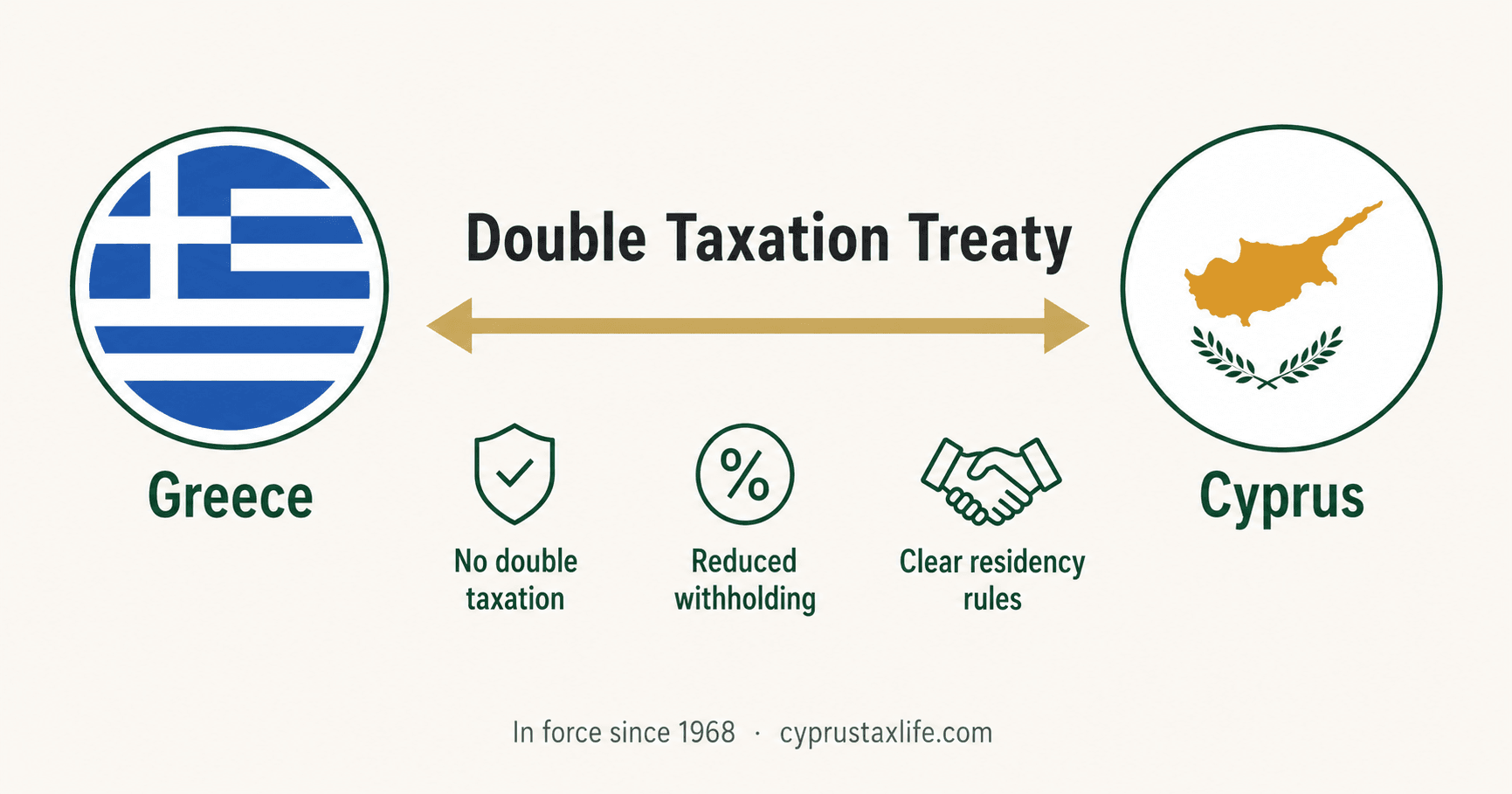
The Cyprus-Greece Double Taxation Agreement is one of the oldest in Cyprus's treaty network, having been signed and entered into force in 1968. This predates the OECD Model Tax Convention and reflects the pre-modern approach to treaty drafting.
Despite its age, the treaty remains the foundational legal framework for Cyprus-Greece tax relations. However, for most corporate structures, the EU Parent-Subsidiary Directive (2011/96/EU) and the EU Interest and Royalties Directive (2003/49/EC) provide more favorable - and more modern - rules, effectively superseding the treaty for qualifying EU corporate relationships.
This treaty pair has significant historical and commercial importance. Cyprus and Greece share deep cultural, linguistic, and business ties. The Greek diaspora globally is one of the largest, and many Greek professionals and entrepreneurs have relocated to Cyprus over the decades (and vice versa). With Greece's income tax reaching 44% and the recently reformed additional levies, Cyprus's Non-Dom regime is particularly attractive.
The Greek tax authority is AADE (Ανεξάρτητη Αρχή Δημοσίων Εσόδων - Independent Authority for Public Revenue), equivalent to HMRC in the UK. AADE has significantly modernized enforcement and cross-border information sharing in recent years. Capital controls that previously restricted transfers from Greek bank accounts were fully lifted in 2023.
The treaty covers Greek income tax (foros eisodimatos) and corporate tax, as well as Cyprus income tax, corporate income tax, and special contribution for defense.
Withholding Tax Rates
| Income type | Withholding rate |
|---|---|
| Dividends | 0% (EU Parent-Subsidiary Directive) / pre-OECD treaty rates for individuals |
| Interest | 0% (EU Directive) / 10% (treaty, individuals) |
| Royalties | 0% (EU Directive / most cases) |
Withholding Details
Given the pre-OECD nature of the 1968 treaty, modern corporate structures almost always rely on EU directives rather than the treaty for withholding determinations:
Dividends: - EU Parent-Subsidiary Directive: 0% for qualifying corporate structures (10%+ holding for 2 years). This is the primary applicable rule for Cyprus-Greece corporate relationships - Treaty rates for individuals and non-qualifying structures: the 1968 treaty predates standard OECD withholding provisions; rates are generally unfavorable compared to modern treaties - Greek domestic withholding on dividends: 5% (reduced from 10% as of 2020). For EU resident individuals, the treaty may provide some relief but the domestic rate is already relatively low
Interest: - EU Interest and Royalties Directive: 0% for qualifying associated EU companies - Treaty rate for individuals: approximately 10% (consult official treaty text and current Greek domestic law) - Greek domestic withholding on interest: 15% for non-residents; directive reduces this to 0% for qualifying structures
Royalties: - EU Interest and Royalties Directive: 0% for qualifying associated EU companies - Most Cyprus-Greece IP licensing arrangements use the directive - Greek domestic withholding on royalties: 20% for non-residents; the directive and treaty provide substantial relief
For individual Greek residents receiving income from Cyprus-registered companies, the domestic withholding rates and treaty caps apply. For corporate structures, always use the EU directives as the primary tool.
Permanent Establishment Rules
The PE definition in the 1968 treaty is less detailed than modern OECD-based treaties but contains the core elements: a fixed place of business through which the enterprise carries out its activities.
For Cyprus companies operating in Greece: - Physical presence in Greece (office, branch, warehouse) constitutes a PE under both the treaty and Greek domestic law - An agent in Greece with authority to conclude contracts regularly creates a PE - Construction sites lasting more than 12 months create a PE
The Greek tax framework uses the concept of "monimos egkatastasi" (permanent establishment). AADE has been increasingly active in investigating cross-border arrangements, particularly involving Cyprus companies with significant Greek operations.
Cultural proximity creates practical risks: Greek entrepreneurs who move to Cyprus sometimes continue managing their Greek business operations remotely as if still physically present. If management decisions, client meetings, and operations are effectively still in Greece, AADE may argue a PE or that the company's place of effective management (edra) remains in Greece.
Genuine substance in Cyprus - local office, management decisions made in Cyprus, local staff or service providers - is essential. The fact that Cyprus and Greece share a language (with dialectal differences) does not reduce the need for proper structural separation. For Cyprus companies serving Greek clients, ensure contracts are concluded in Cyprus and operational decisions are made from Cyprus.
Tie-Breaker Rules
Standard tie-breaker sequence applies under the treaty: 1. Permanent home 2. Centre of vital interests 3. Habitual abode 4. Nationality 5. Mutual agreement
Greece's domestic residency rules (Article 4 of Law 4172/2013, the Greek Income Tax Code) consider an individual Greek tax resident if they have their permanent residence, habitual abode, or center of vital interests in Greece, or if they spend more than 183 days in Greece in any 12-month period.
For Greek entrepreneurs relocating to Cyprus: - Register a Cyprus address as primary residence (yellow slip / certificate of registration as EU citizen) - Deregister from the Greek tax register (update your AFM - Arithmos Forologikou Mitroou - to show foreign address) - Transfer center of vital interests: family, primary bank accounts, main business activity to Cyprus - Spend fewer than 183 days in Greece in any 12-month period - Keep travel records (ferry, flight tickets) as evidence of your time split
Greece's 50% income deduction scheme (new residents tax regime under Law 4472/2017, Article 5A): individuals who transfer tax residence to Greece from abroad and have not been Greek tax residents for the previous 5 years can exclude 50% of their employment and business income from Greek taxation for 7 years. This applies when moving TO Greece, not FROM Greece. Some Greek professionals use this when returning to Greece before potentially moving to Cyprus later.
AADE has increased scrutiny of emigrations to Cyprus, given the proximity and cultural familiarity. Genuine relocation with clear evidence is essential.
Pension Provisions
Pensions (Articles in the 1968 treaty): - Government pensions: Generally taxable in the paying state (Greece for Greek state pensions), unless the recipient has Cyprus nationality - Private pensions: Taxable in the state of residence (Cyprus) - Greek state pension (syntaxi): Generally taxable in the state of residence under the treaty
For Greek retirees in Cyprus: private pension and supplementary fund (epikourika tameia) income is taxable only in Cyprus at the favorable 5% flat rate above EUR 5,000. This compares very favorably to Greek income tax rates which can reach 44%.
Greece's 7% flat tax for foreign pensioners (Article 5B of Law 4172/2013): foreign residents with foreign-source pension income who transfer tax residence to Greece can elect a 7% flat tax on their foreign pension income for 15 years. This is a competitive rate but applies to inbound pensioners moving to Greece, not to those leaving. It illustrates Greece's effort to attract foreign retirees.
Greek IKA and other social insurance pension rights: accrued Greek pension entitlements are preserved under EU Regulation 883/2004 coordination rules. Greek pension rights can be claimed from Cyprus at the applicable Greek retirement age.
Greek supplementary pension funds (ETEAEP): treatment follows the general private pension rules - taxable only in the state of residence.
Capital Gains
Capital gains (treaty provisions): - Immovable property: Taxable in the situs country (Greece for Greek property) - Shares: The 1968 treaty's provisions on capital gains are less detailed than modern treaties. Under the general principle, gains from shares are taxable in the state of residence
Greek domestic capital gains tax: Greece introduced a 15% capital gains tax on share disposals in 2013 (Article 42, Law 4172/2013). For Cyprus tax residents disposing of Greek-listed shares, the treaty allocation and Greece's domestic law interact. The practical position depends on whether the shares are listed on the Athens Stock Exchange and the specific provisions of the 1968 treaty.
Greek property gains for non-residents: sales of Greek immovable property by non-residents are taxable in Greece at 15% (on the gain), applying since 2014. Transfer tax (foros metavivasis) may also apply at 3.09%.
After establishing Cyprus residency: subsequent gains on share and securities disposals are taxable only in Cyprus. Cyprus does not tax gains on securities. Greek property gains remain taxable in Greece.
Real estate in Cyprus: many Greeks own property in Cyprus (particularly in Limassol and Paphos), which is a long-standing pattern given historical ties. Cyprus property gains are taxed in Cyprus (only on immovable property) under the treaty.
Practical Implications
For Greek entrepreneurs and professionals relocating to Cyprus:
1. AFM and tax registration: Notify AADE of your departure and update your tax registration to show Cyprus as your country of residence. File your final Greek tax return (E1 form via myAADE) for the year of departure.
2. Greek company (AE / EPE / IKE): If you have a Greek company, decide whether to maintain it with Greek-resident management, restructure it as a subsidiary of your Cyprus parent, or liquidate. A Cyprus holding company owning a Greek operating subsidiary is a common and effective structure.
3. Capital controls lifted: As of 2023, there are no longer restrictions on transferring funds from Greek bank accounts. Moving working capital and personal savings to Cyprus accounts is straightforward.
4. Greek VAT registration: If registered for VAT (AFM VAT) in Greece, assess whether ongoing registration is needed. Services provided to Greek B2B clients from Cyprus use the reverse charge mechanism.
5. Cultural considerations: The Greek-speaking environment in Cyprus facilitates integration. Limassol has a large Greek community. However, this proximity means AADE is familiar with Cyprus-based arrangements and scrutinizes them carefully.
6. Investment in Greek stocks and bonds: You can maintain Greek brokerage accounts from Cyprus. Greek withholding on interest and dividends applies at domestic rates; claim treaty benefits where applicable.
Frequently Asked Questions
Is the 1968 Cyprus-Greece treaty still useful for corporate structures?+
Will AADE scrutinize my move to Cyprus?+
How are Greek dividends taxed when I live in Cyprus?+
Can I transfer money from Greece to Cyprus freely?+
What happens to my Greek pension if I move to Cyprus?+
Is Cyprus better than Greece's 7% retiree flat tax?+
Sources and References
Treaty text: Cyprus Ministry of Finance, Greece tax authority publications, IBFD Tax Research Platform, PwC Worldwide Tax Summaries. Treaty provisions are summarized for general guidance. Consult a qualified tax advisor for your specific situation. Last verified: 2026-04-26.
Related Articles
Germany's exit tax (§6 AStG) taxes unrealised gains on shares >1% when you emigrate. Moving to Cyprus (EU): you can defer payment indefinitely. Full breakdown for German founders and investors.
 Miriam Alonso
- Tax Planning
- Relocation
Canada's departure tax treats you as having sold your worldwide assets the day you stop being a tax resident. What is caught, what is exempt, how to defer it, and what the cost-base reset means for where you go next.
![Countries With No Property Tax [2026]: The Real Cost](https://cdn.sanity.io/images/glqahhks/production/6f7ea0efceed8a692ad7c3785efa8baaf4d1e208-1679x937.jpg?w=700&q=75&auto=format)
Compare countries with no property tax and the stamp duty they charge instead. See the 10-year holding cost that makes Cayman pricier than Portugal.
Miriam AlonsoFree, no commitment
Moving to Cyprus or opening a company?
Tell us your situation and we'll connect you with our specialist expat advisory in Cyprus: Non-Dom tax, company setup and residency, done for you. Free consultation, no commitment.