Cyprus-Israel Double Tax Treaty 2026
Last updated: 2026-04-26
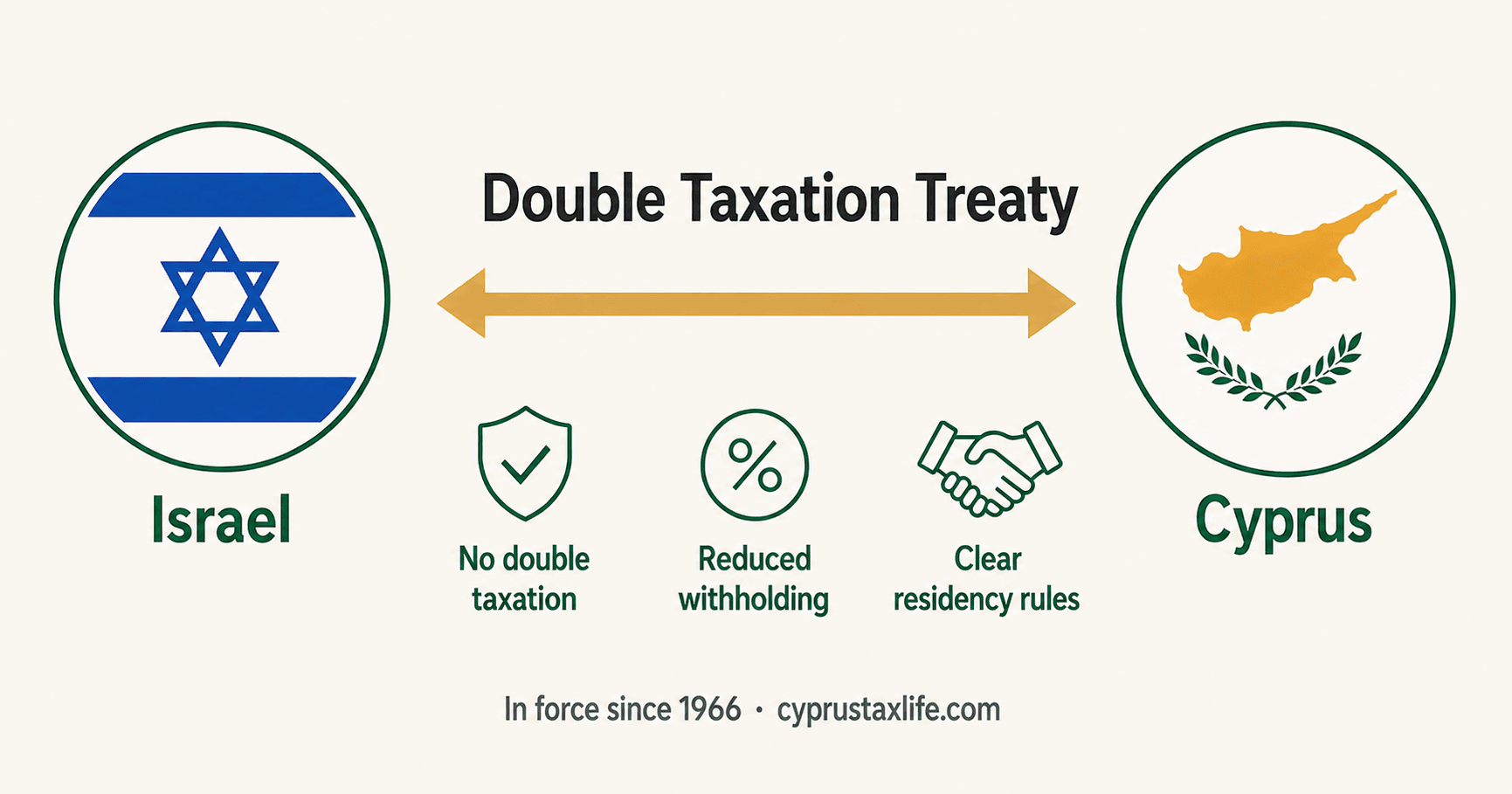
Treaty Information
Signed
1966
In force since
1966
Model
OECD-influenced
Overview
The Cyprus-Israel Double Taxation Agreement was signed in 1966 and has been updated by protocols over the years. It is an OECD-influenced treaty reflecting the bilateral relationship between two countries with longstanding economic and cultural ties.
A critical distinction: Israel is NOT a member of the European Union or the EEA. EU directives - including the Parent-Subsidiary Directive and the Interest and Royalties Directive - do NOT apply to Cyprus-Israel transactions. The treaty rates are the governing framework for withholding between the two countries.
Cyprus and Israel share strong business connections: regular El Al flights link Larnaca and Tel Aviv, a significant Israeli business community has established itself in Cyprus (particularly in Limassol), and many Israeli entrepreneurs incorporate in Cyprus for EU market access, regulatory benefits, and tax efficiency. Cyprus serves as an EU gateway for Israeli companies and investors.
Israel has a top income tax rate of 50% (for income above ILS 698,280 in 2024, approximately EUR 175,000) plus bituach leumi (National Insurance) contributions at up to 12%. Israel is a CRS signatory, so Israeli financial institutions automatically exchange account information with Cyprus and vice versa. FATCA-like obligations apply to US persons in Israel.
The Israeli tech ecosystem ("startup nation") is globally recognized, producing numerous unicorns and acquisition targets. Israeli tech entrepreneurs are among the primary users of Cyprus-Israel tax structuring. The combination of Cyprus's 15% corporate tax, Non-Dom dividend exemption, and EU market access makes Cyprus highly attractive for Israeli founders scaling internationally.
Withholding Tax Rates
| Income type | Withholding rate |
|---|---|
| Dividends | 0% (10%+ holding, 1yr) / 10% (other) |
| Interest | 10% |
| Royalties | 0% (most) / 5% (certain) |
Withholding Details
Because EU directives do NOT apply (Israel is not EU), the treaty rates govern:
Dividends (Article 10): - 0% if the beneficial owner is a company holding directly at least 10% of the paying company for a continuous period of at least 1 year - 10% in all other cases (individuals, non-qualifying holdings) - Israeli domestic withholding on dividends to non-residents: 25-30% depending on circumstances. The treaty significantly reduces this - For Non-Dom Cyprus residents receiving Israeli dividends: 0% (10%+ corporate, 1yr) or 10% (individual). In Cyprus, dividends are exempt from income tax under Non-Dom (2.65% GHS only)
Interest (Article 11): - 10% withholding on interest payments - Israeli domestic withholding on interest to non-residents: 25%. The treaty reduces this to 10% - For Cyprus holding companies with Israeli loan relationships: the 10% withholding is a cost to factor into structures. Consider equity over debt for Israeli-Cyprus related party financing where possible
Royalties (Article 12): - 0% on most royalties (patents, copyrights, software, literary works) - 5% on royalties for the use of industrial, commercial, or scientific equipment (machinery and equipment rentals) - Israeli domestic withholding on royalties: 25% for non-residents; the treaty reduces this substantially - Very favorable for IP licensing from Cyprus to Israeli operating companies
The interest rate of 10% is less favorable than many other Cyprus treaties (0% for UK, Germany, Spain, Denmark, Norway, Finland). Structures involving Cyprus-Israel cross-border financing should account for this cost.
Permanent Establishment Rules
The PE definition follows OECD-influenced principles in the 1966 treaty. Israel applies the concept of "esek kavu" (permanent establishment) under its domestic tax law (Pekudat Mas Hachnasa - Income Tax Ordinance).
PE risk areas for Cyprus companies with Israeli operations: - Fixed place of business in Israel (office, branch, workshop) - An agent in Israel habitually concluding contracts on behalf of the Cyprus company - Construction or installation projects lasting more than 12 months - Services provided in Israel by personnel of the Cyprus company for extended periods
The Israeli Tax Authority (Rashut HaMisim - Tax Authority under the Ministry of Finance) is thorough and sophisticated in analyzing international structures. Israel has implemented BEPS measures and anti-avoidance provisions and actively monitors arrangements involving Cyprus and other commonly used jurisdictions.
For Israeli tech entrepreneurs who relocate to Cyprus while serving Israeli clients or managing Israeli subsidiaries: the PE risk is real. Visiting Israel for board meetings, investor relations, or client development is acceptable, but conducting operations primarily from Israel would create a PE. Ensure management decisions for the Cyprus company are made in Cyprus.
Israeli startup incorporation patterns: many Israeli founders initially incorporate in Israel (primarily as a Chevra Baam - private company, or Chul - foreign company). A common evolution is to establish a Cyprus holding company above the Israeli subsidiary to access EU investors, simplify cap table international structuring, and benefit from Cyprus's corporate tax rate for profits accrued at the Cyprus level.
Substance requirements in Cyprus are especially important for Cyprus-Israel structures, as Israeli tax authorities are aware of Cyprus's common use and scrutinize substance carefully.
Tie-Breaker Rules
Standard OECD-influenced tie-breaker sequence applies under the treaty. Israel's domestic residency rules are defined under the Income Tax Ordinance and consider as Israeli residents individuals with their center of life in Israel, assessed based on family location, dwelling, economic interests, and time spent.
For Israelis relocating to Cyprus: - Register as Cyprus resident (yellow slip as EU citizen right of residence, or long-stay visa for non-EU Israeli nationals) - Update Israeli Population Registry of address change - Notify Rashut HaMisim of change of residence - Ensure your center of life transfers to Cyprus: family, primary residence, main business activity - Spend fewer than 183 days in Israel in any 12-month period - Keep travel records as evidence
Olim Chadashim (new immigrants) tax exemption: This is Israel's tax incentive for new immigrants and returning residents. New immigrants (and returning residents who were absent for at least 10 years) receive a 10-year exemption from Israeli tax on foreign-source income and from the obligation to report foreign-source income to Rashut HaMisim. This exemption applies to people moving TO Israel, not FROM Israel.
However, the Olim exemption has an interesting interaction with Cyprus planning: Israeli nationals who previously immigrated under Olim status and are now considering Cyprus can structure income through Cyprus entities. The Olim exemption covers foreign-source income - income from a Cyprus company may qualify as foreign-source during the 10-year period, potentially allowing layered efficiency. This is a complex area requiring Israeli tax advice.
Israelis who were never Olim: if you are an Israeli resident without Olim status, your worldwide income is taxable in Israel at progressive rates up to 50%. Relocating to Cyprus and establishing genuine Cyprus residency removes Israeli tax on non-Israeli-source income.
Pension Provisions
Pensions (Article in the 1966 treaty): - Government pensions: Taxable in the paying state (Israel), unless the recipient is a Cyprus national - Private pensions: Taxable only in the state of residence (Cyprus) - Israeli National Insurance (bituach leumi) old-age benefit: Generally taxable in the state of residence
For Israeli professionals relocating to Cyprus: Israeli private pension savings (keren pensia - provident funds, keren hishtalmut - continuing education funds) distributions are generally taxable only in Cyprus. Cyprus's 5% flat rate on pension income above EUR 5,000 is far below Israeli rates.
Bituach leumi (National Insurance Institute - Bituach Leumi): provides old-age pensions, disability benefits, and other social insurance. Upon genuine relocation to Cyprus, bituach leumi contribution obligations as a self-employed or employed person transfer to Cyprus social insurance (under general bilateral coordination principles - note: not under EU regulation as Israel is not an EU/EEA member, but under the bilateral social security agreement if one exists; Cyprus and Israel have generally coordinated social security). Confirm the current bilateral social security arrangement before departure.
Keren hishtalmut (continuing education fund): A popular Israeli savings vehicle that is tax-exempt in Israel after a 6-year holding period. Withdrawals before the 6-year period are taxable in Israel. Once you are a Cyprus resident, subsequent growth and withdrawals from keren hishtalmut may be taxable only in Cyprus under treaty allocation. The tax treatment of this instrument outside Israel is specialized - consult both Israeli and Cypriot tax advisors.
Israeli pension reforms have made provident funds (gemel) more flexible. Tax treatment of these instruments for non-residents follows the treaty allocation principles.
Capital Gains
Capital gains (Article in the 1966 treaty): - Immovable property: Taxable in the situs country (Israel for Israeli property, Cyprus for Cyprus property) - Shares: Generally taxable in the state of residence for non-real-estate companies
Israeli capital gains tax: Israel applies a 25% capital gains tax on share disposals (for individuals). For substantial shareholdings (10%+), the rate is 30%. For qualifying Israeli tech companies, various incentives apply under the Law for the Encouragement of Capital Investments.
After establishing Cyprus residency: gains from share disposals are taxable only in Cyprus under the treaty. Cyprus does not tax gains on securities. Israeli property gains remain taxable in Israel.
Israeli company exit considerations: when an Israeli tech company is acquired (M&A exit), the proceeds flow to shareholders. If the shareholder is a Cyprus-resident individual, the gain is taxable only in Cyprus (tax-free, as Cyprus does not tax securities gains). This is a significant planning opportunity for Israeli founders who establish Cyprus residency before a liquidity event.
Timing of residency establishment: for M&A exits in particular, the timing of genuine Cyprus residency establishment relative to the share sale is critical. Israeli tax authorities will scrutinize attempts to transfer residency immediately before a sale. Genuine residency established well in advance - not manufactured last-minute - is essential.
Israeli company in Cyprus holding structure: a Cyprus Ltd holding Israeli startup shares, with the Cyprus Ltd itself owned by an individual Non-Dom resident, creates a clean structure. The Cyprus Ltd pays 15% on any dividend received from Israel (after foreign tax credit for Israeli withholding), then distributes to the Non-Dom individual at 2.65% GHS.
Practical Implications
For Israeli entrepreneurs and tech founders relocating to Cyprus:
1. Registered address and yellow slip: Non-EU nationals (Israeli passport holders) require a residence permit in Cyprus. Options include registration as a self-employed person (if working as freelancer), company director of a Cyprus Ltd, or under the Digital Nomad Visa (Category F Permit). Register with the Civil Registry and Migration Department.
2. Israeli company structure: Decide whether to maintain the Israeli company (for Israeli operations and employees), establish a Cyprus holding company above it, or transition operations fully to Cyprus. The holding structure is most common for Israeli tech companies accessing EU markets.
3. Startup Nation to EU gateway: Many Israeli B2B SaaS and tech companies establish Cyprus as their EU legal and tax headquarters while keeping R&D and core team in Israel. Contracts with EU clients are signed by the Cyprus entity, revenue accrues in Cyprus, and the Israeli subsidiary provides development services under an intercompany service agreement.
4. CRS reporting: Israel is a CRS signatory. Cypriot banks will report Israeli-connected accounts to the Israeli Tax Authority, and Israeli institutions will report to Cyprus. Full transparency exists between the two jurisdictions. Ensure your Israeli and Cyprus tax filings are consistent.
5. El Al and Ryanair connectivity: Larnaca airport has regular direct flights to Tel Aviv (El Al, Ryanair, and others). The approximately 45-minute flight makes Cyprus practically accessible for business visits to Israel, which supports maintaining the relocation while staying connected to the Israeli business ecosystem.
6. Limassol Israeli community: Limassol has a substantial Israeli business community, Hebrew-speaking residents, and Israeli-focused services. This social ecosystem facilitates settling in Cyprus. However, the community density also means Rashut HaMisim is aware of Cyprus as a relocation destination and scrutinizes Israeli-Cyprus arrangements carefully.
Frequently Asked Questions
Does the EU Parent-Subsidiary Directive apply between Israel and Cyprus?+
How does the Olim Chadashim exemption interact with Cyprus planning?+
Can I sell my Israeli tech startup from Cyprus tax-free?+
Why do Israeli entrepreneurs incorporate in Cyprus rather than other EU countries?+
What is the withholding tax on interest from Israel to Cyprus?+
How long does it take to establish genuine Cyprus residency for an Israeli national?+
Sources and References
Treaty text: Cyprus Ministry of Finance, Israel tax authority publications, IBFD Tax Research Platform, PwC Worldwide Tax Summaries. Treaty provisions are summarized for general guidance. Consult a qualified tax advisor for your specific situation. Last verified: 2026-04-26.
Related Articles
Germany's exit tax (§6 AStG) taxes unrealised gains on shares >1% when you emigrate. Moving to Cyprus (EU): you can defer payment indefinitely. Full breakdown for German founders and investors.
 Miriam Alonso
- Tax Planning
- Relocation
Canada's departure tax treats you as having sold your worldwide assets the day you stop being a tax resident. What is caught, what is exempt, how to defer it, and what the cost-base reset means for where you go next.
![Countries With No Property Tax [2026]: The Real Cost](https://cdn.sanity.io/images/glqahhks/production/6f7ea0efceed8a692ad7c3785efa8baaf4d1e208-1679x937.jpg?w=700&q=75&auto=format)
Compare countries with no property tax and the stamp duty they charge instead. See the 10-year holding cost that makes Cayman pricier than Portugal.
Miriam AlonsoFree, no commitment
Moving to Cyprus or opening a company?
Tell us your situation and we'll connect you with our specialist expat advisory in Cyprus: Non-Dom tax, company setup and residency, done for you. Free consultation, no commitment.