Cyprus-Portugal Double Tax Treaty 2026
Last updated: 2026-04-26
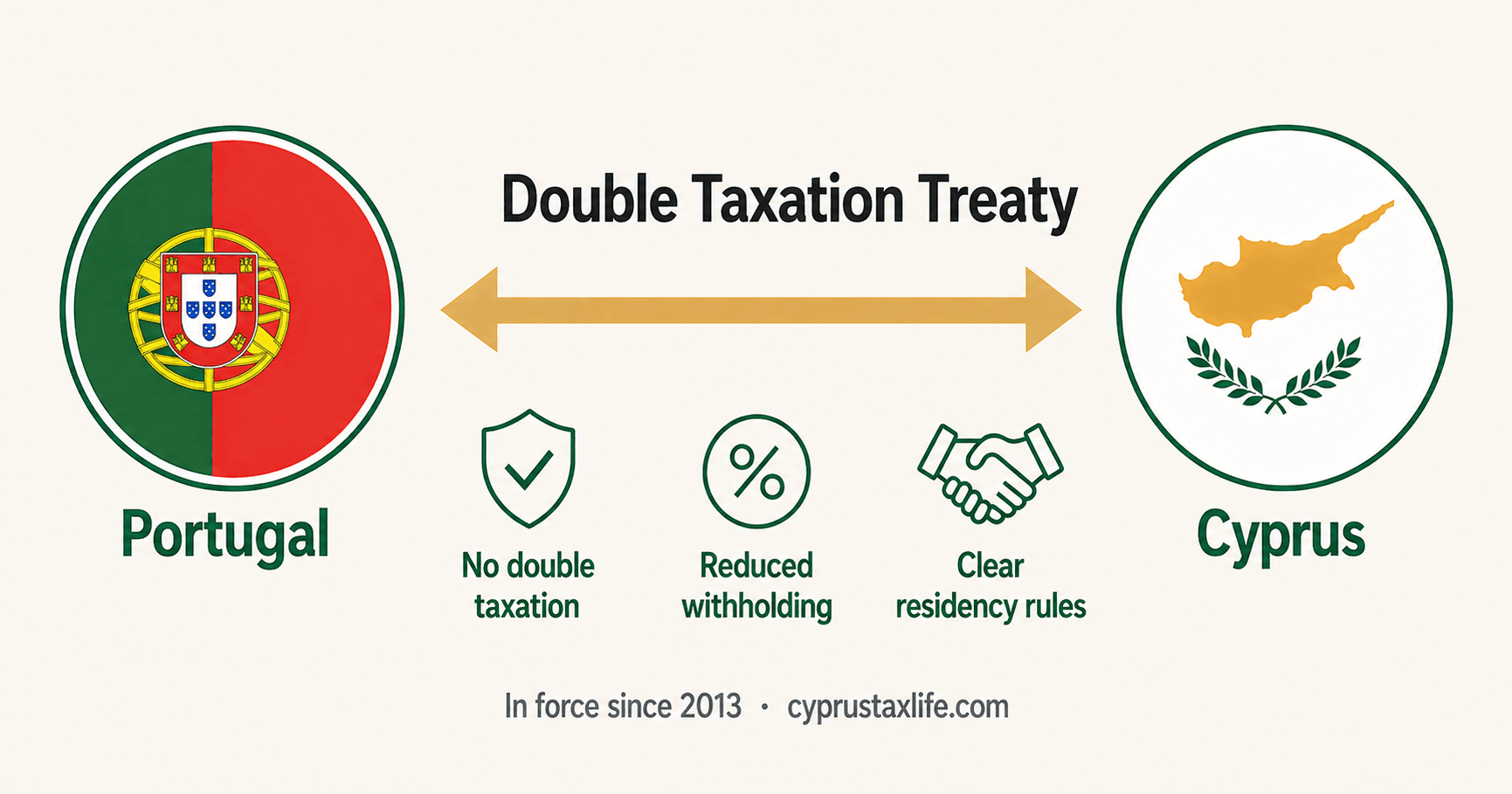
Treaty Information
Signed
2012
In force since
2013
Model
OECD Model (modern treaty)
Overview
The Cyprus-Portugal Double Taxation Agreement was signed in 2012 and entered into force in 2013. It is a modern treaty, following the OECD Model Tax Convention with updated provisions including exchange of information, anti-abuse rules, and comprehensive allocation of taxing rights.
This treaty is particularly timely given the significant change in Portugal's tax landscape. Portugal's famous NHR (Non-Habitual Resident) regime was terminated in 2024 for new applicants (existing NHR holders are grandfathered). The NHR successor, the IFICI (Incentivo Fiscal a Investigacao Cientifica e Inovacao) regime, is considerably narrower - it only applies to researchers, qualified professionals in technology and R&D, and certain employees of qualifying companies. General entrepreneurs, freelancers, digital nomads, and holding company owners are largely excluded from IFICI.
This development directly enhances the relative attractiveness of Cyprus Non-Dom for mobile entrepreneurs. Previously, Portugal was a genuine competitor: the NHR offered a 20% flat tax on Portuguese-source income and 0% on most foreign income for 10 years. Without NHR access, new arrivals in Portugal face the standard IRS (Imposto sobre o Rendimento das Pessoas Singulares) rates up to 53%, while Cyprus Non-Dom continues to offer approximately 5% effective tax on dividends with no time limit.
The treaty covers IRS (personal income tax), IRC (corporate income tax, 21%), and IMI (municipal property tax) in Portugal, and income tax, corporate tax, and special contribution for defense in Cyprus.
Withholding Tax Rates
| Income type | Withholding rate |
|---|---|
| Dividends | 0% (10%+ holding for ≥2yr) / 10% (other) |
| Interest | 0% (most) / 10% (profit-linked) |
| Royalties | 0% |
Withholding Details
Dividends (Article 10): - 0% withholding if the beneficial owner is a company holding directly at least 10% of capital for at least 2 years - 10% in all other cases (for individuals and non-qualifying corporate holdings) - EU Parent-Subsidiary Directive also provides 0% for qualifying corporate holdings (10%+ for 2 years) - Portuguese domestic WHT on dividends to non-residents is 28% for individuals; the treaty reduces this to 10% - This is one of the most favorable dividend WHT rates in Cyprus's treaty network
Interest (Article 11): - 0% on most interest (bank deposits, government securities, standard corporate loans) - 10% on profit-linked interest (interest contingent on profits, results, or similar) - Portuguese domestic WHT on interest to non-residents is 28%; the treaty provides substantial relief - EU Interest & Royalties Directive (0%) applies for associated EU companies
Royalties (Article 12): - 0% withholding on royalties - Covers patents, trademarks, copyrights, software, designs, models, and know-how - EU Interest & Royalties Directive supplements this for corporate structures - Particularly relevant for tech IP licensing between Cyprus entities and Portuguese operating companies
The 2012 treaty is notably modern and includes favorable rates. The 0% dividend WHT for 10%+ corporate holdings held for 2+ years is among the best conditions in the Cyprus treaty network.
Permanent Establishment Rules
The PE definition follows the OECD model. Portugal implements PE concepts through Article 5 CIRC (Codigo do Imposto sobre o Rendimento das Pessoas Coletivas).
Fixed PE: An office, branch, workshop, or management center in Portugal from which business operations are conducted.
Service PE: Providing services in Portugal for more than 183 days (cumulative) in any 12-month period.
Agent PE: A dependent agent in Portugal habitually concluding contracts for the Cyprus company.
Construction PE: 12-month threshold.
Portugal's AT (Autoridade Tributaria e Aduaneira - Tax and Customs Authority) has become more sophisticated in PE analysis following BEPS implementation. Structures where a Cyprus company's key personnel are primarily located in Portugal are at risk.
For Cyprus-based entrepreneurs serving Portuguese clients: remote service delivery from Cyprus does not create a PE. Physical visits to Portugal for meetings, pitches, or short project work are generally acceptable. Maintain documentation that contracts are concluded in Cyprus and that management decisions are made from Cyprus.
Digital nomad context: Portugal has attracted many digital nomads via its D8 Digital Nomad visa. A digital nomad working in Portugal for an extended period through their Cyprus company may inadvertently create a PE if they have a fixed work location (apartment used as office) and provide services to Portuguese clients for more than 183 days. The line between "working while in Portugal" and "PE in Portugal" depends on facts and circumstances.
Tie-Breaker Rules
The treaty tie-breaker follows the standard OECD sequence:
1. Permanent home 2. Centre of vital interests 3. Habitual abode 4. Nationality 5. Mutual agreement
Portugal's domestic residence rules (Article 16 CIRS) define Portuguese tax residents as individuals who: - Spend more than 183 days in Portugal in a calendar year (consecutive or not), OR - On 31 December of the year, have a home in Portugal intended as a habitual residence
Meeting either criterion makes you a Portuguese tax resident under domestic law. The 183-day test is straightforward, but the "habitual residence intent" test is more subjective and can catch people who nominally depart but maintain a Portuguese home.
For entrepreneurs relocating from Portugal to Cyprus: - Formally register as non-resident with the AT (file the departure declaration) - Cancel or surrender your Portuguese NIF (or notify of non-residency status) - Sell or rent out your Portuguese property (renting is preferable to leaving a home available to you) - Spend fewer than 183 days in Portugal from the departure year onward - Establish Cyprus residency under the 60-day or 183-day rule
Portugal has no exit tax for individuals. Unlike France, Germany, or the Netherlands, there is no deemed disposal or deferred tax assessment when you relocate. Share gains accrued before departure are not automatically subject to a departure-triggered tax event - they are taxed in Portugal only if disposed of before departure (at 28% flat rate for individuals).
This clean exit, combined with Portugal's modern treaty network and no wealth tax, makes Portugal-to-Cyprus one of the more administratively straightforward European relocations.
Pension Provisions
Pensions (Article 17): - Government pensions: Taxable in the paying state (Portugal), unless the recipient has Cyprus nationality and is not a Portuguese national - Private pensions: Taxable only in the state of residence (Cyprus) - Portuguese public pension (pensao de velhice via Seguranca Social): Generally taxable only in the state of residence under the treaty
For Portuguese professionals retiring to Cyprus: private pension income (planos de poupanca-reforma - PPR, seguros de vida retirement products) is taxable only in Cyprus at the special flat rate of 5% on amounts above EUR 5,000. Portuguese IRS on pension income reaches 53% at the top bracket; Cyprus offers substantial relief.
NHR holders who grandfathered into the regime: If you secured NHR status before the 2024 cutoff, your 10-year window continues with 0% tax on most foreign-source income including pensions from qualifying sources. After NHR expiry, standard Portuguese IRS rates apply.
IFICI and pensions: The IFICI regime focuses on active researchers and technology professionals. Pension income typically does not qualify under IFICI. Retirees considering Portugal now face standard IRS rates, which further advantages Cyprus for this group.
Seguranca Social pension: EU coordination rules preserve accrued Portuguese pension rights when you move to Cyprus. You can claim the Portuguese state pension from Cyprus when eligible. Under the treaty, it is taxable only in Cyprus as the state of residence.
Capital Gains
Capital gains (Article 13): - Immovable property: Taxable in the country where the property is located - Shares and assets: Taxable only in the state of residence
No Portuguese exit tax for individuals: Portugal does not impose an exit tax on individuals departing. When you move to Cyprus, no deemed disposal of shares occurs. Gains accrued during your Portuguese residency are taxable in Portugal only if you dispose of the asset before departure.
After establishing Cyprus residency: gains on share disposals are taxable only in Cyprus. Cyprus does not tax gains on securities. This is fully aligned - a clean exit with no Portuguese tax on post-departure gains.
Portuguese property: Gains on Portuguese real estate sold after you have emigrated to Cyprus are taxable in Portugal at non-resident rates (28% flat rate for EU residents). Portugal deducts proportional mortgage interest and improvement costs from the gain. If you sell before becoming a non-resident, progressive rates (up to 53%) may apply to 50% of the gain under standard IRS rules.
IRC (corporate gains): Portuguese corporate income tax (IRC) at 21% applies to gains of Portuguese companies. Cyprus companies owning Portuguese entities are subject to this at the entity level, not at the shareholder level under the treaty.
Investment funds: Portuguese-domiciled investment funds (fundos de investimento) may have domestic taxation. The treaty allocation rules and the EU Savings Directive context are relevant for cross-border fund investments.
Practical Implications
For Portuguese residents and NHR holders considering Cyprus:
1. NHR end impact: If you are approaching the end of your NHR 10-year period (or did not qualify for NHR/IFICI), Portuguese IRS at up to 53% on employment and business income replaces the previous 0-20% treatment. This makes Cyprus Non-Dom at ~5% effective significantly more attractive post-NHR. Plan your move before your NHR expires, not after.
2. No exit tax required: Unlike moves from France, Germany, or the Netherlands, relocating from Portugal to Cyprus requires no complex exit tax calculations. There are no deferred assessments, no annual post-departure declarations, and no conserverende aanslag equivalents.
3. Portuguese company (LDA/SA): If you operate a Portuguese Lda or SA, decide whether to maintain it with a Portuguese-resident administrator, liquidate it, or transition operations to a Cyprus Ltd. A Portuguese company managed from Cyprus by its sole non-resident director may attract AT scrutiny regarding effective management location.
4. Golden Visa holders: Portugal's Golden Visa requires 7 days of presence per year in Portugal (reduced threshold). Holding a Portuguese Golden Visa while resident in Cyprus is administratively possible but requires careful management of the residency trigger. Golden Visa does not automatically make you a Portuguese tax resident.
5. D7 and Digital Nomad visa holders: If you have a D7 (passive income) or D8 (digital nomad) visa in Portugal, these visas are tied to Portuguese residency. Transitioning to Cyprus means giving up the Portuguese visa but gaining Cyprus residency (MEU1 or similar). The visa decision and tax residency decision should be coordinated.
6. Banking and NIF: You can maintain your Portuguese bank accounts and NIF (Portuguese tax ID) as a non-resident. Update your residency status with your bank and with Finanças (AT portal). Non-resident bank accounts in Portugal continue to function and are covered by EU deposit guarantee schemes.
Frequently Asked Questions
Is the NHR regime still available for new arrivals to Portugal?+
How does Cyprus Non-Dom compare to Portugal post-NHR?+
Is there a Portuguese exit tax when moving to Cyprus?+
Can I keep my Portuguese Golden Visa while living in Cyprus?+
How are Portuguese dividends taxed when I live in Cyprus?+
What happens to my NIF (Portuguese tax ID) after moving?+
Sources and References
Treaty text: Cyprus Ministry of Finance, Portugal tax authority publications, IBFD Tax Research Platform, PwC Worldwide Tax Summaries. Treaty provisions are summarized for general guidance. Consult a qualified tax advisor for your specific situation. Last verified: 2026-04-26.
Related Articles
Germany's exit tax (§6 AStG) taxes unrealised gains on shares >1% when you emigrate. Moving to Cyprus (EU): you can defer payment indefinitely. Full breakdown for German founders and investors.
 Miriam Alonso
- Tax Planning
- Relocation
Canada's departure tax treats you as having sold your worldwide assets the day you stop being a tax resident. What is caught, what is exempt, how to defer it, and what the cost-base reset means for where you go next.
![Countries With No Property Tax [2026]: The Real Cost](https://cdn.sanity.io/images/glqahhks/production/6f7ea0efceed8a692ad7c3785efa8baaf4d1e208-1679x937.jpg?w=700&q=75&auto=format)
Compare countries with no property tax and the stamp duty they charge instead. See the 10-year holding cost that makes Cayman pricier than Portugal.
Miriam AlonsoFree, no commitment
Moving to Cyprus or opening a company?
Tell us your situation and we'll connect you with our specialist expat advisory in Cyprus: Non-Dom tax, company setup and residency, done for you. Free consultation, no commitment.