Moving from Spain to Cyprus: Tax Savings, Exit Process...

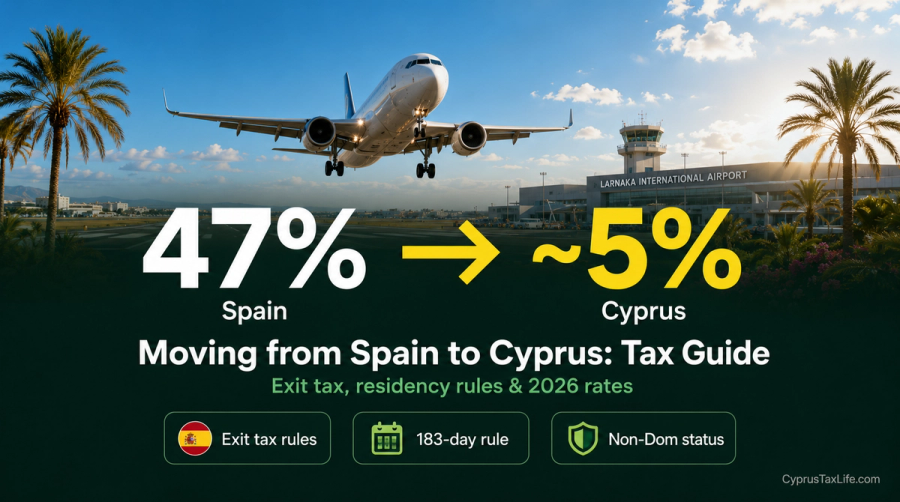
Why we decided to move from Spain to Cyprus
In 2023, I was working remotely for BetterPic, an international AI photography company, and my income had grown to a point where the Spanish tax burden stopped being a minor inconvenience and became the single biggest cost of my business. It wasn't just the Impuesto de Sociedades. It was the sum of everything: the IS, dividends, personal IRPF on what I paid myself as a working partner, and the autónomos quota charged month after month regardless of whether that month was good or bad.
I was honest with myself: in Spain, the real effective rate on the profits of an SL — including IS, dividends, and social contributions — can easily exceed 40–50%. The minimum autónomos quota under the general scheme was around €294 per month in 2023, and with the new real-income contribution system it could grow significantly. All of that before a single euro of net profit reached my pocket.
Cyprus was not my first choice. I researched Dubai (no taxes, but outside the EU and with banking perception issues), Portugal with the old NHR scheme (already in the process of being scrapped), and Estonia with its e-Residency system (attractive for digital startups, but the 20% distribution tax when you take dividends makes it less efficient than it looks). In the end, Cyprus won through a combination of factors no other territory offered simultaneously: inside the European Union, access to the European market, a Double Taxation Treaty with Spain, Mediterranean climate, an English-speaking community, and a favorable tax structure that was not just marketing — it was real and verifiable.
In January 2024, we made the decision. In June 2024, we were in Larnaca.
The real comparison in numbers: Spain vs Cyprus
| Income type | Spain (resident) | Cyprus Non-Dom |
|---|---|---|
| Salary / professional fees | 19%–47% progressive IRPF | 0% up to €22,000 / 20–35% above that |
| Domestic dividends | 19%–28% (savings income) | 0% (no SDC for Non-Dom) |
| Foreign dividends | 19%–28% | 0% + 2.65% GHS |
| Capital gains on securities | 19%–28% | 0% (shares) / 8% crypto |
| Rental income | 19%–47% IRPF + IBI | 20% in Cyprus |
| Sole trader / company | 25% IS + dividend 19–28% | 15% IS + 0% dividend Non-Dom |
| Net wealth | 0.2%–3.5% (varies by CCAA) | 0% |
| Inheritance Tax | Up to 34% + regional surcharge | 0% |
I'm going to be specific, because generic numbers are useless for making decisions. Let's look at a concrete example: a company with €150,000 in annual revenue and €30,000 in operating expenses. Gross profit: €120,000.
In Spain, with an SL under the general regime: Corporate Tax (Impuesto de Sociedades) at25%on €120,000 = €30,000. Net profit after IS: €90,000. If you distribute that as dividends, the IRPF tax bill is: 19% on the first €6,000, 21% from €6,000 to €50,000, 23% from €50,000 to €200,000. On €90,000 in dividends, the effective rate works out to approximately €18,900 in withholding. Add the estimated autónomo contribution of €4,800 per year. Total direct taxes: approximately €53,700. Effective rate on gross profit: 35.8%.
In Cyprus, with a Cyprus Ltd under theNon-Domregime: Corporate Tax at 15% on €120,000 = €18,000. Net profit after corporate tax: €102,000. Dividends under the Non-Dom regime are taxed at only 2.65% GHS (health contribution) and 0% SDC (Special Defence Contribution). On €102,000: €2,703. Total direct taxes: €20,703. Effective rate: 13.8%.
The annual difference is approximately €33,000. Over five years, that's €165,000 that stays in your company instead of going to the tax authorities. That's not aggressive optimization — it's the difference between two distinct tax systems within the same European Union.
The Spanish exit tax: the risk that frightens everyone, and the reality
When I started researching the move, the "exit tax" was the first topic that came up in every forum and Telegram group. People mentioned it as though it were an insurmountable barrier. The reality is considerably more nuanced.
The Spanishexit taxis governed by Article 95 bis of the IRPF Act. It applies to unrealized capital gains on shares or holdings when a taxpayer transfers their tax residence outside Spain. But it has specific thresholds: it kicks in if the market value of the shares exceeds €4 million, OR if it exceeds €1 million and they represent more than 25% of the company's share capital. Additionally, the taxpayer must have been a tax resident in Spain for at least 10 of the last 15 years.
For the vast majority of freelancers and entrepreneurs in the growth phase, these thresholds are never reached. In my case, it didn't apply. If you have doubts about your specific situation, consulting a tax advisor is non-negotiable — this is not a question to resolve with a blog post.
What does apply to everyone without exception: you must file Modelo 030 with the AEAT notifying them of your change of tax residence to Cyprus. You can do this online using a digital certificate or Cl@ve. You must also process your deregistration from the municipal census (padrón municipal), or register with the Registro de Matrícula Consular at the Spanish consulate in Cyprus. If you retain real estate in Spain generating income (rental income), you will remain a taxpayer under the Non-Resident Income Tax (Impuesto sobre la Renta de No Residentes — IRNR) on that Spanish-source income.
What to do in Spain before you leave: the exit checklist
This is the order I followed and the one I recommend:
- File Modelo 030 with the AEAT notifying them of your change of tax residence to Cyprus. This can be done online with a digital certificate. Keep the submission confirmation.
- Process your deregistration from the padrón municipal at the town hall where you were registered, or register with the Registro de Matrícula Consular at the Spanish Embassy in Nicosia. Both options are valid; the second carries more documentary weight if the tax authorities ask questions later.
- File your final Spanish IRPF return as a resident, covering the period during which you were resident in Spain in that tax year. If you leave in June, you declare from January to June as a resident.
- Deregister your activities from the RETA (Régimen Especial de Trabajadores Autónomos) if you were registered. The process is handled through the Seguridad Social and takes effect from the date of deregistration.
- Assess what to do with your Spanish bank accounts. Closing them is not mandatory (and keeping one for payments in Spain can be useful), but reducing them to the bare minimum simplifies administration.
- If you have a Spanish SL that you plan to keep active while operating from Cyprus, consult a specialist advisor about the implications of the "effective place of management." If you manage it from Cyprus, there may be permanent establishment implications in Cyprus or conflicts regarding corporate tax residency.
Point 6 is the one most people ignore and the one that can create the most problems. A "zombie" Spanish SL that nobody manages from Spain can be a source of conflicts with the AEAT years down the line.
The first 30 days in Cyprus: what to do and in what order
The order of procedures in Cyprus is non-negotiable. There are sequential dependencies that, if you ignore them, will cost you weeks.
- Find an apartment and sign a rental contract in your name. This document is the cornerstone of everything else. Without a rental contract, you cannot apply for the Yellow Slip. Without the Yellow Slip, you cannot obtain the fiscal TIN. Without a TIN, you cannot open a corporate bank account. The contract must be in your personal name, not in the company's name.
- Open a personal bank account. Personal Revolut is the fastest option (it can be done online in days). Local Cypriot banks (Bank of Cyprus, Hellenic Bank) take weeks and require in-person attendance with extensive documentation. For the first few months, Revolut or Wise are sufficient for day-to-day needs.
- Apply for the Yellow Slip (Registration Certificate for EU citizens) at the Civil Registry and Migration Department in your district. You will need: original passport, rental contract, proof of sufficient funds (bank statement), and passport-sized photos. In Larnaca, the office is at the Foreigners Unit. The process can take between 1 and 4 weeks.
- With the Yellow Slip in hand, apply for the TIN (Tax Identification Number) at the Cypriot Tax Department. This number is your local tax identifier for everything: tax returns, dealings with the company, payroll.
- Incorporate the Cyprus Ltd if you have not already done so with a local lawyer or registration agent. You can start the process in parallel with the previous steps, but the corporate bank account will require your personal TIN.
- Register with the Cypriot Social Insurance Services as a self-employed director of the Ltd. Contributions are significantly lower than in Spain, but they are mandatory.
In my case, the entire process from signing the rental contract to having the TIN and the company incorporated took approximately 6 weeks. Plan with plenty of margin.
What nobody tells you: the real surprises
After two years in Cyprus, these are the things I wish someone had told me beforehand:
- Cypriot bureaucracy is slow by design, not by negligence. The Yellow Slip can take between 1 and 4 weeks. Company registrations, an additional 2 to 4 weeks. Plan to arrive with at least 2–3 months of margin before you need the tax structure to be fully operational.
- English works in virtually all public administrations in Cyprus — a legacy of the British colonial period. However, some official forms and documents are in Greek only. A local accountant or lawyer with experience working with expats is literally worth their weight in gold.
- First-year setup costs are real and must be budgeted for: annual accountant (€1,500–2,500), first-year audit (€1,500–2,000, because it is the most complex being the inaugural one), company registration (~€1,000 in fees and charges), annual company maintenance fee (€350). Budget between €4,500 and €6,000 in structure costs alone during the first year.
- The Non-Dom regime requires genuine substance. It is not a mailbox structure. Cypriot authorities and double taxation treaties require you to be a genuine resident: that you live here, that you make decisions from here, that you have a real economic life in the country. If you use the 60-day rule (valid for cases where you spend more days in no other country than in Cyprus), you need rigorous documentation: entry and exit records, paid accommodation, local invoices.
- The Spanish expat community in Cyprus is surprisingly large, active, and helpful. Especially in Larnaca and Limassol. There are WhatsApp and Telegram groups where people share recommendations for advisors, banks, doctors, and all the practical information that does not appear in any official guide. Find them before you arrive — they will save you weeks of trial and error.
Cyprus is not perfect. Supermarkets do not have the variety of Spain, direct flights to mid-sized Spanish cities are scarce, and you will miss things you took for granted. But if your tax situation justifies it, the equation makes sense. For us, it clearly did.
Frequently Asked Questions
Need personalized advice?Book a consultationwith an expat tax specialist.
Can I keep my Spanish SL while operating from Cyprus?
Technically yes, but there are important implications. If you manage the Spanish SL from Cyprus — making decisions, signing contracts, running the business from there — the AEAT may consider that the effective place of management is in Cyprus, which could mean the company becomes subject to tax obligations in Cyprus instead of (or in addition to) Spain. The cleanest solution is either to wind up the Spanish SL and operate solely through the Cyprus Ltd, or to retain a resident administrator in Spain with genuine decision-making authority. Consult a specialist advisor in international taxation before making this decision.
How long do I have to live in Cyprus to be a tax resident there?
The general rule in Cyprus, as in most countries, is 183 days per year in the territory. However, Cyprus also offers the 60-day rule: you can be considered a Cypriot tax resident by spending just 60 days in Cyprus if you meet the following conditions: you do not spend more than 183 days in any other single country, you are not a tax resident in any other country, you have economic ties to Cyprus (a company, employment, or rental property), and you have permanent accommodation available in Cyprus (owned or rented). This rule is particularly useful for people with intensive international activity, but it requires rigorous documentation.
Can the Spanish tax authorities come after me if I have been in Cyprus for a year?
If you have correctly completed the Spanish deregistration procedures (Modelo 030, municipal register deregistration, or consular registration) and can demonstrate effective tax residence in Cyprus (more than 183 days, or compliance with the 60-day rule with supporting documentation), the AEAT has no legal basis to claim you as a Spanish tax resident. The risk exists if the departure was incomplete: if you failed to file the Modelo 030, if your centre of vital interests clearly remains in Spain (family, properties, main bank account, etc.), or if you cannot prove actual physical presence in Cyprus. Cyprus and Spain have a Double Taxation Treaty that establishes tie-breaker criteria for cases of dual residence.
Is it possible to move at the beginning of the year so that Cypriot residence applies from January?
Yes, and it is the cleanest strategy. If you establish residence in Cyprus in January or February, you can accumulate the 183 days relatively easily and have the entire tax year fall under Cypriot jurisdiction. If you move mid-year, the year will be split: part of it as a Spanish resident and part as a non-resident (or Cypriot resident, depending on when you reach the required days). This complicates the tax filings for that transition year. The ideal moving date, from a tax perspective, is 1 January or as early in the year as possible.
What happens to my accumulated Spanish Social Security contributions?
The contributions you have accumulated in Spain toward your pension do not disappear. Spain and Cyprus have totalization agreements for contribution periods within the European Union framework, which means that the years contributed in Spain can be added to those contributed in Cyprus to determine pension entitlement. However, the amount of the Spanish pension will be calculated proportionally to the years contributed in Spain. If you have deregistered from the RETA, you stop accumulating contributions in Spain, but everything already contributed remains protected. Consult the Spanish Social Security office to obtain a certificate of your contribution history before you leave.
Is it possible to split time between Spain and Cyprus while meeting the tax requirements?
It depends on how many days you spend in each country. If you spend more than 183 days in Spain in a tax year, you will be considered a Spanish tax resident regardless of what you have in Cyprus. If you spend fewer than 183 days in Spain but more than 183 in Cyprus, Cypriot residence is clear. The grey area is when you spend fewer than 183 days in both countries: that is where the Double Taxation Treaty and the tie-breaker criteria come into play (permanent home, centre of vital interests, nationality). The split-living strategy is possible but requires a rigorous day count and documentation of your actual life in Cyprus. Many advisors recommend the safety threshold: if in doubt, stay more than 183 days in Cyprus that year.
![Cyprus Ltd vs Irish Ltd: Company Tax Compared [2026]](https://cdn.sanity.io/images/glqahhks/production/84e3d82538a859345d8d2447e8e097c5777fb238-1679x937.png?w=700&q=75&auto=format)
![Cyprus vs Malta Company Formation [2026]](https://cdn.sanity.io/images/glqahhks/production/97db89d0ce729a9e931d09bc1522631faa6c3474-1679x937.png?w=700&q=75&auto=format)