Cyprus vs Ireland: Tax and Living Compared for Entrepreneurs
Irish entrepreneurs face 12.5% corporate tax but up to 52% income tax + PRSI. Cyprus Non-Dom achieves ~5% effective rate with 0% on dividends. Full 2026 comparison.
Last updated: 2026-06-01
Effective tax rate comparison
~45-52%
Ireland
~5%
Cyprus Non-Dom
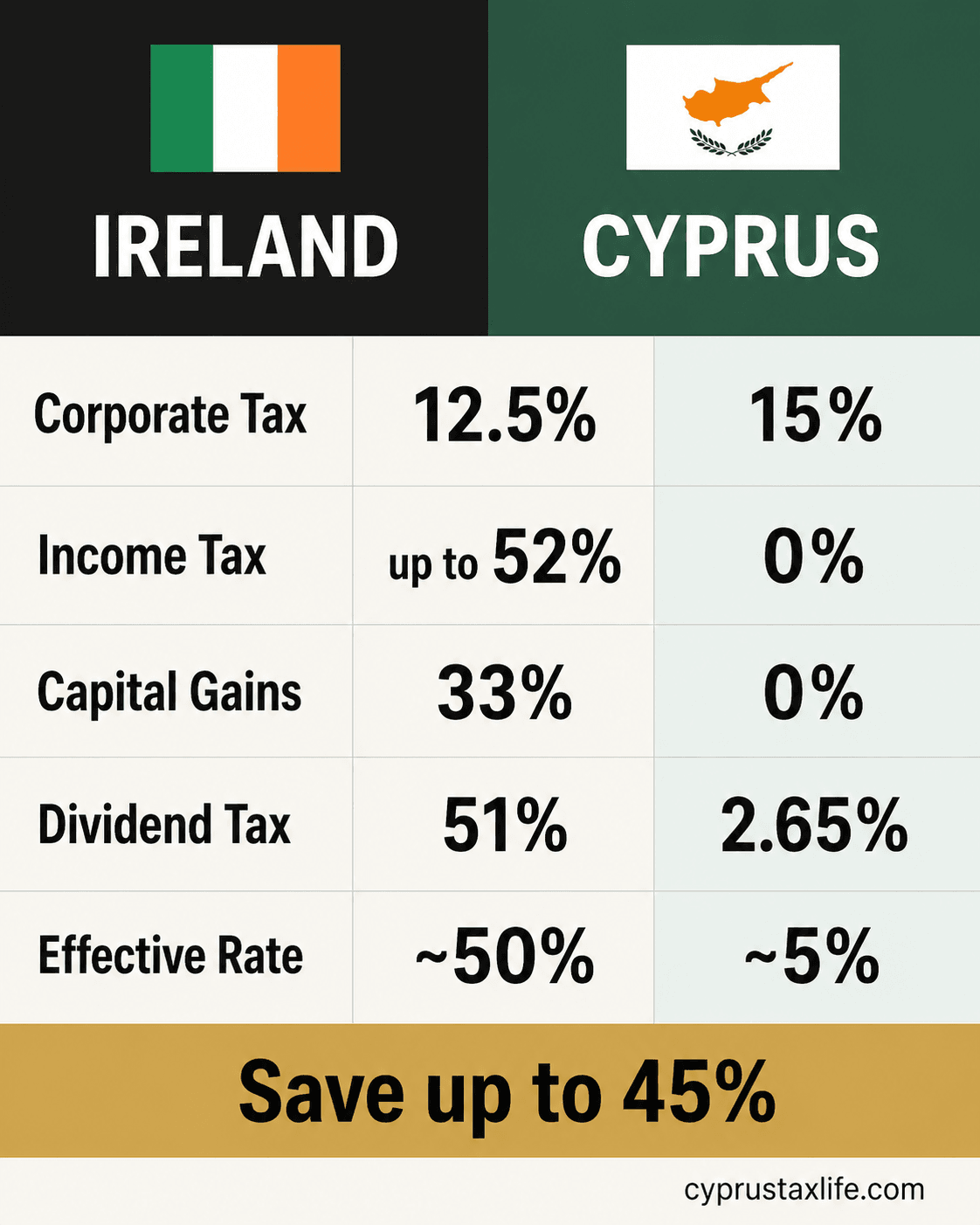
Tax Comparison: Ireland vs Cyprus
| 🇮🇪 Ireland | 🇨🇾 Cyprus (Non-Dom) | |
|---|---|---|
| Corporate tax | 12.5% (trading) / 25% (passive) | 15% |
| Income tax | Up to 40% income tax + 4-8% USC + PRSI | 0% (dividends) |
| Capital gains tax | 33% | 0% (no Cyprus property) |
| Dividend tax | Taxed as income (up to 52% total) | 0% income tax + 2.65% GHS |
| Wealth tax | None | None |
| Social contributions | 4% PRSI employee + 11.15% employer PRSI | ~4% on salary (capped) |
| Effective rate (entrepreneur) | ~45-52% | ~5% |
| VAT | 23% | 19% |
Tax Burden in Ireland
Ireland is famous for its 12.5% corporate tax rate, which has attracted global multinationals. However, for owner-managed businesses and entrepreneurs, the effective rate is dramatically higher once you factor in personal taxation on extracted profits.
The Corporation Tax (CT) rate of 12.5% applies to trading income. This is genuinely low and is Ireland's main competitive advantage. However, when directors of close companies want to extract profits, they face substantial personal taxes. Dividends from a close company are treated as schedule F income and taxed at the full income tax rate (up to 40%) plus USC (Universal Social Charge, up to 8%) plus PRSI (4% for employees, effectively making the total marginal rate 52%).
For a company with EUR 100,000 of profit: corporation tax of 12.5% leaves EUR 87,500. If distributed as dividends: income tax 40% + USC 8% + PRSI 4% = 52% of EUR 87,500 = EUR 45,500. Total tax: EUR 57,000+ on EUR 100,000 of revenue - an effective rate approaching 58% for higher earners.
Ireland also has one of the highest VAT rates in the EU at 23%. Capital gains tax at 33% is high. The cost of living in Dublin is among the highest in Europe. For entrepreneurs who are not benefiting from the corporate rate (because they take salaries or dividends), Ireland is one of the most expensive places to do business in Europe.
Why Cyprus is Better for Entrepreneurs
For Irish entrepreneurs, the contrast with Cyprus could not be more dramatic. While Ireland's 12.5% CT rate is celebrated, the reality for owner-managed businesses is a combined effective rate of 45-52% once personal extraction is considered. Cyprus Non-Dom achieves approximately 5%.
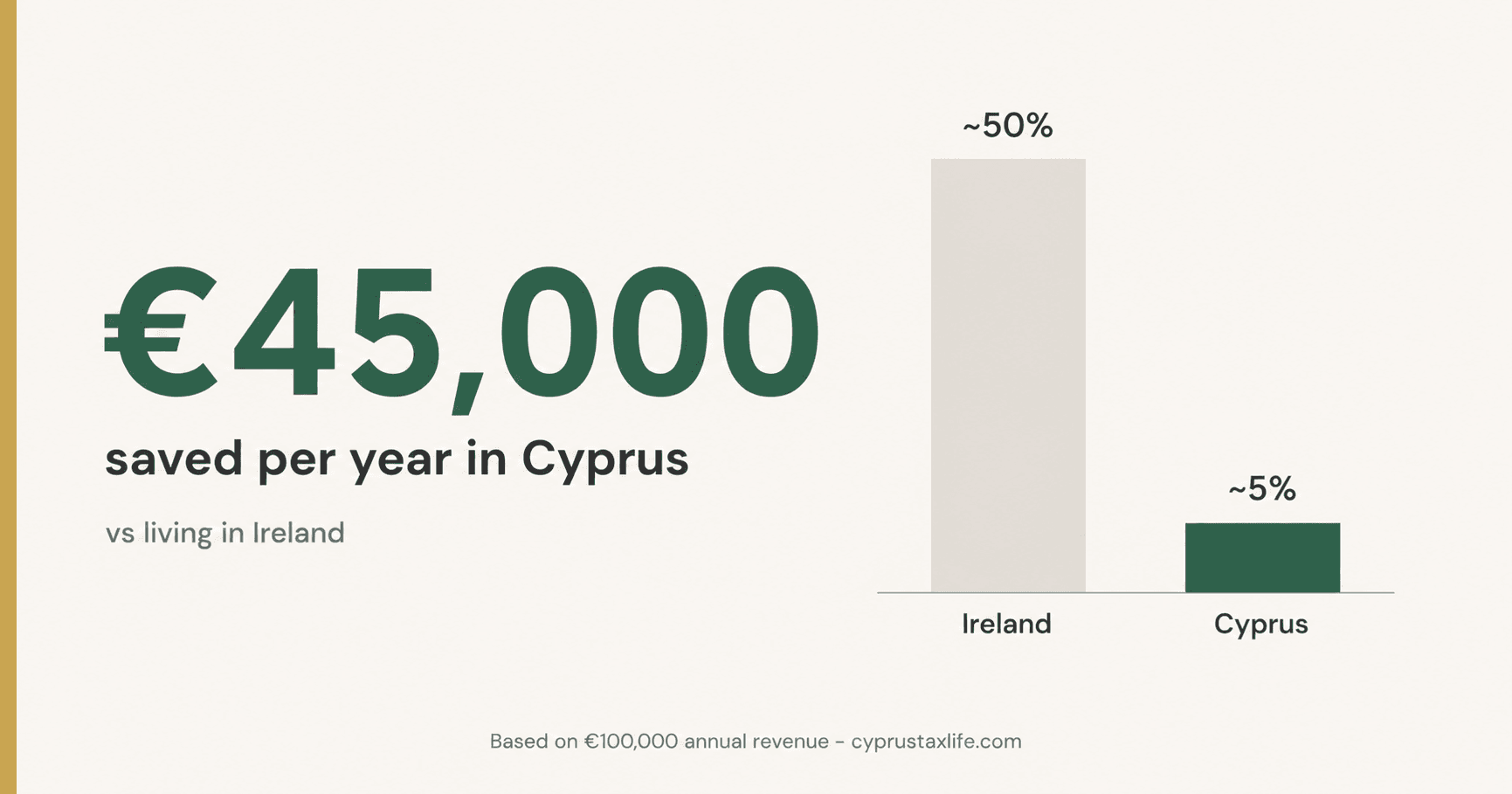
On EUR 100,000 of revenue: Cyprus total tax approximately EUR 5,000 (15% CT on profit, 2.65% GHS on dividends) vs. Ireland EUR 45,000-58,000 (12.5% CT + 52% extraction). Annual saving: EUR 40,000-53,000.
Both Ireland and Cyprus are EU member states with full single market access. Both are English-speaking countries. Both have common law legal systems. Cyprus offers everything Ireland offers in terms of EU membership, plus dramatically lower personal taxes and a lower cost of living.
There is a growing Irish expat community in Cyprus, particularly in Limassol. Ireland's excellent connectivity (direct Ryanair flights from Dublin to Larnaca) makes the move accessible. The cultural adjustment is minimal: English-speaking environment, similar legal framework, EU membership.
Tax Calculation: EUR 100,000
🇮🇪 Ireland
🇨🇾 Cyprus (Non-Dom)
Annual savings moving to Cyprus
EUR 43,000
EUR 215,000 over 5 years
Double Tax Treaty: Ireland - Cyprus
Ireland and Cyprus have a comprehensive double tax treaty in force since 2010. Key provisions: dividends 0% withholding (if the beneficial owner holds at least 75% of capital) or 15%, interest 0%, royalties 0%. Both countries use common law legal systems which simplifies cross-border structuring. The treaty follows OECD principles. Irish entrepreneurs moving to Cyprus need to establish genuine non-residency in Ireland: spending fewer than 183 days in Ireland per year (full non-residence requires fewer than 30 days in most cases if still visiting regularly).
Exit Tax and Emigration from Ireland
Ireland introduced a formal exit tax in 2019 that applies to certain gains when a company transfers its tax residence from Ireland. For individuals, Ireland does not impose a formal exit charge on personal capital gains when emigrating. However, the Capital Gains Tax (CGT) applies to gains from Irish-located assets. Ireland also has a 5-year "shadow" period: if you return to Ireland within 5 years of emigrating, gains realized while abroad on Irish assets may be retrospectively charged. The Irish Revenue Commissioners can challenge emigration if they believe Irish residency is maintained through domicile or habitual abode.
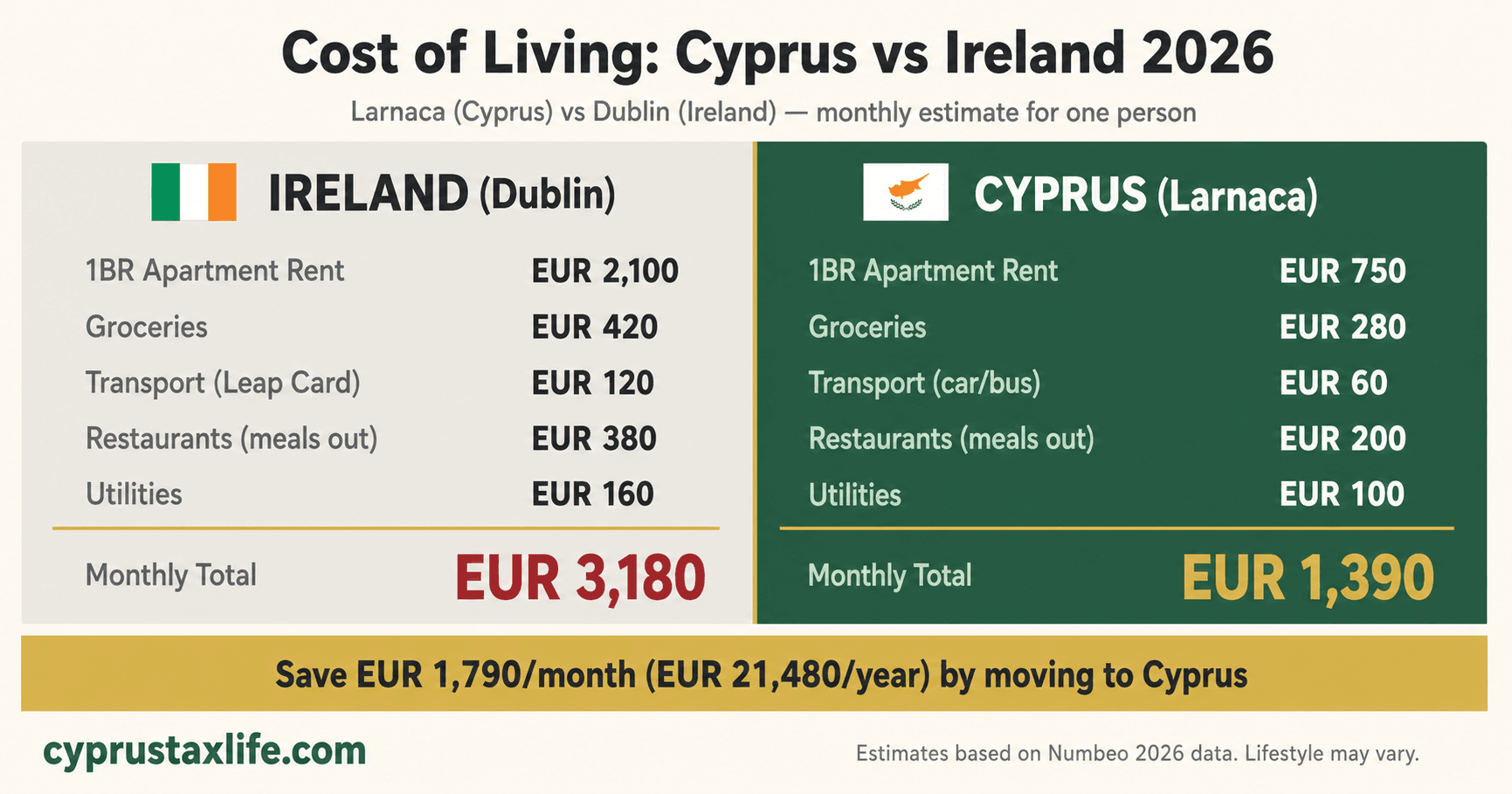
Cost of Living: Ireland vs Cyprus
Dublin is one of the most expensive cities in Europe for housing. 2-bedroom apartment rent in Dublin: EUR 2,000-3,500. Other Irish cities: EUR 1,200-2,000. Cyprus: Larnaca EUR 550-750, Limassol EUR 650-900. Groceries in Ireland are 20-30% more expensive than Cyprus. A restaurant meal for two in Dublin: EUR 60-100 vs EUR 30-45 in Cyprus. Healthcare is a mix of public (with long waits) and private (requiring insurance at EUR 1,000-2,500/year). The combination of high taxes and high cost of living makes Ireland significantly more expensive for entrepreneurs. Moving to Cyprus typically saves EUR 40,000+ annually in combined tax and cost-of-living reductions.
Practical Steps to Relocate
Establish a Cyprus Ltd company (5-7 working days, EUR 1,100-1,800 all-in)
Arrange genuine Cyprus residence (rental agreement, utility bills in your name)
Deregister from Irish tax residency: notify Revenue Commissioners of change of address
File your final Irish tax return (Form 11)
Cancel Irish social insurance (PRSI) contributions
Apply for Cyprus tax residency
Register as Non-Dom at the Cyprus Tax Department
Obtain your Yellow Slip (EU citizen registration)
Open a Cyprus bank account
Address any Irish corporate structures (Ltd)
Register for Cyprus GHS healthcare contributions
Frequently Asked Questions
If Ireland has 12.5% corporation tax, why is the effective rate so high?+
Can I keep my Irish Ltd after moving to Cyprus?+
How does Ireland's common law system compare to Cyprus?+
Are there Ryanair flights from Ireland to Cyprus?+
Does Cyprus have a similar startup culture to Dublin?+
What about Irish VAT registration for my Cyprus company?+
Sources and References
Tax data: PwC Worldwide Tax Summaries, KPMG Tax Guides (2025/2026), Big Four country guides, government tax authority publications. Effective rates are approximations for entrepreneur structures (company + low salary + dividends). Consult a qualified tax advisor before making decisions.
Free, no commitment
Moving to Cyprus or opening a company?
Tell us your situation and we'll connect you with our specialist expat advisory in Cyprus: Non-Dom tax, company setup and residency, done for you. Free consultation, no commitment.
Related Articles
Germany's exit tax (§6 AStG) taxes unrealised gains on shares >1% when you emigrate. Moving to Cyprus (EU): you can defer payment indefinitely. Full breakdown for German founders and investors.
 Miriam Alonso
- Tax Planning
- Relocation
Canada's departure tax treats you as having sold your worldwide assets the day you stop being a tax resident. What is caught, what is exempt, how to defer it, and what the cost-base reset means for where you go next.
![Countries With No Property Tax [2026]: The Real Cost](https://cdn.sanity.io/images/glqahhks/production/6f7ea0efceed8a692ad7c3785efa8baaf4d1e208-1679x937.jpg?w=700&q=75&auto=format)
Compare countries with no property tax and the stamp duty they charge instead. See the 10-year holding cost that makes Cayman pricier than Portugal.
Miriam Alonso