Quick Answer
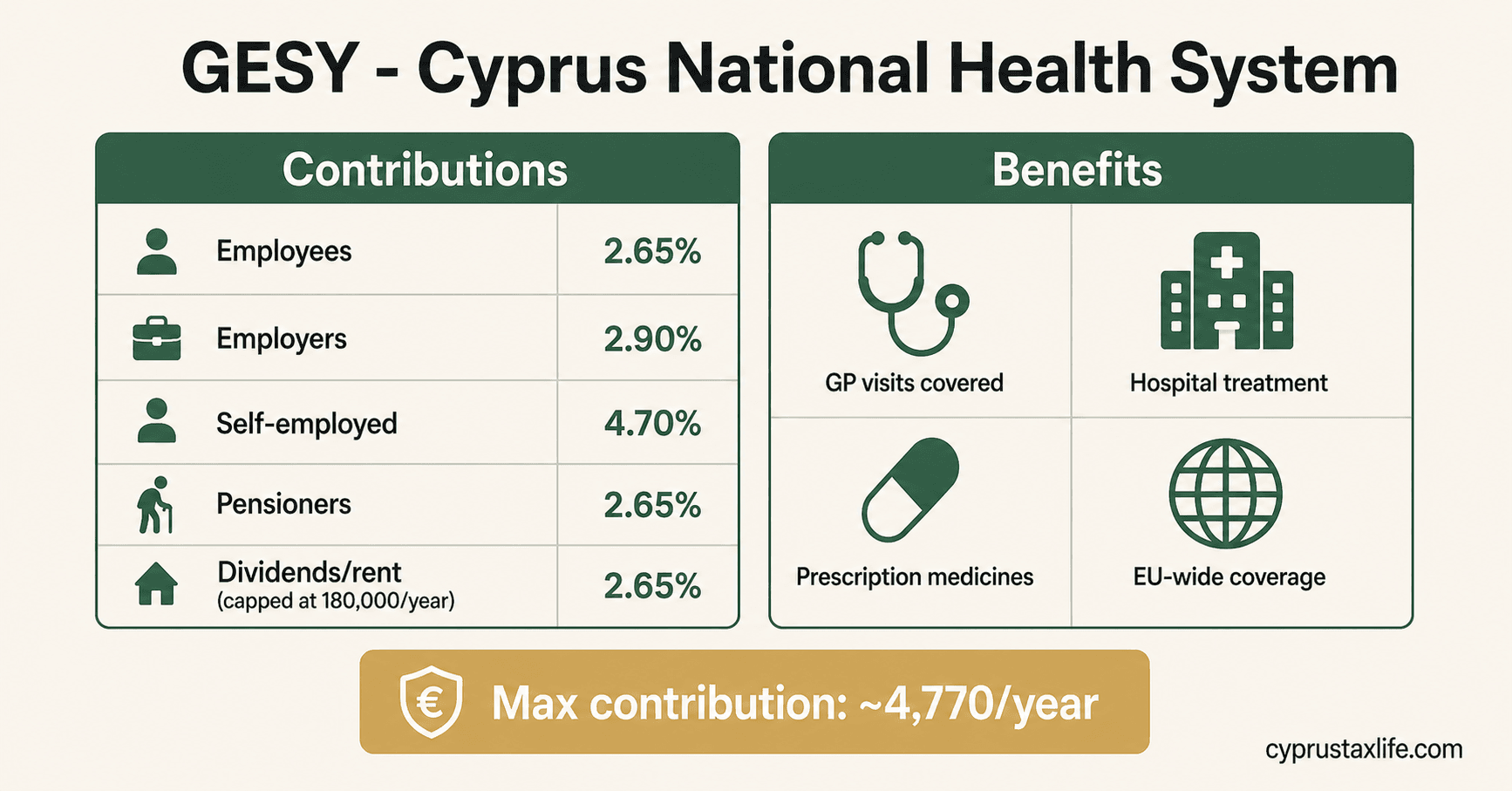
The Cyprus General Healthcare System (GHS/GESY) contribution is 2.65% on all income types including dividends, salary, and rental income. For employees, 2.65% is deducted from salary with an additional 2.90% paid by the employer. The annual cap applies to income up to EUR 180,000, making the maximum annual GHS contribution approximately EUR 4,770.
Cyprus GHS (GESY): Healthcare for Residents and Expats
The General Health System provides universal healthcare coverage to all Cyprus residents. Contributions are 2.65% of income, one of the lowest in the EU.
Last updated:
GHS Contribution Rates: What You Pay in Cyprus
The General Health System (GHS), known in Greek as GESY (Γενικό Σύστημα Υγείας), is funded through contributions levied on all types of income earned or received by Cyprus tax residents. The rates vary depending on your employment status. Employees contribute 2.65% of their gross salary, and their employer contributes a matching 2.65% on top. For a salaried employee earning EUR 50,000 per year, this means a personal GHS contribution of EUR 1,325 annually, with the employer paying a further EUR 1,325.
Self-employed individuals face a higher contribution rate of 4.70% of their taxable income. This reflects the fact that there is no employer to share the cost. A freelancer or sole trader earning EUR 60,000 net would therefore pay EUR 2,820 per year in GHS contributions. This is a meaningful but manageable cost, especially compared to healthcare systems in countries like Germany or the Netherlands where social health contributions can reach 7-8% with income caps set at higher levels.
Passive income, dividends, interest, and rental income, is also subject to GHS at 2.65%. For a Non-Dom resident receiving EUR 100,000 in dividends from a Cyprus holding company, the GHS charge is EUR 2,650. This is the same rate that employees pay on salary. Pensioners receiving pensions from Cyprus or abroad also contribute 2.65% of pension income. The system is designed to be broad-based, capturing most forms of income received by residents.
The EUR 180,000 Annual Cap on Passive Income
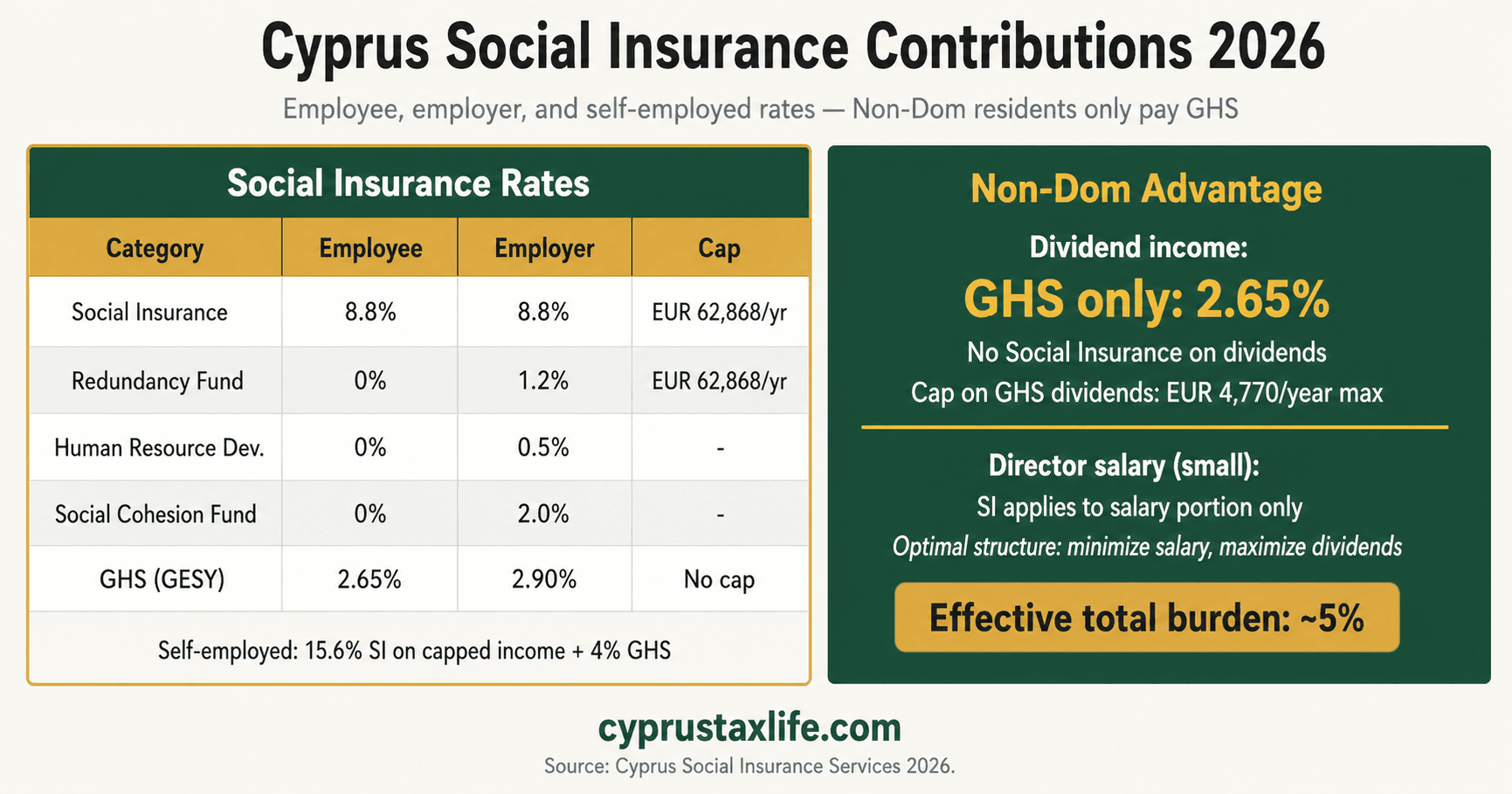
One of the most important planning details for entrepreneurs and investors is the annual GHS cap that applies to passive income categories: dividends, interest, and rental income. GHS contributions on these income types are capped at a base of EUR 180,000 per year. This means the maximum GHS you will ever pay on dividends and interest combined is EUR 4,770 (EUR 180,000 × 2.65%), regardless of how large your dividend distributions are.
For a Non-Dom business owner distributing EUR 500,000 in dividends from their Cyprus company, the total GHS cost is still only EUR 4,770, not EUR 13,250 as a naive calculation would suggest. This cap makes Cyprus extremely attractive for founders and investors who rely on dividend income. The cap applies per income category, so if you receive EUR 180,000 in dividends and EUR 180,000 in rental income, the GHS on each category is capped separately at EUR 4,770, for a combined maximum of EUR 9,540.
There is no cap on GHS contributions for employment income or self-employment income, only for the passive income categories. This distinction matters for structuring decisions. Many entrepreneurs who move to Cyprus opt to operate through a Cyprus Limited company, take a modest director's salary, and distribute profits as dividends, keeping total GHS costs predictable. The EUR 180,000 cap has been in place since GESY's full launch in 2019 and was maintained in the December 2025 tax reform.
Who Is Covered: Residents, EU Citizens, and Dependents
GESY provides universal healthcare coverage to all legal residents of Cyprus, regardless of nationality. This includes Cypriot citizens, EU citizens exercising treaty rights (who register with a Yellow Slip or Pink Slip / ARC), third-country nationals with valid residency permits, and their registered dependents. Coverage begins from the date of registration in the system, not from any qualifying waiting period.
Dependent family members, spouses or civil partners, children under 18, and full-time students up to age 23, are covered under a contributing resident's account at no additional GHS cost. If a relocating entrepreneur registers in GESY and pays GHS on their income, their spouse and two children automatically receive full GESY coverage without any extra contribution. This is a significant benefit for families comparing Cyprus to countries where healthcare premiums are charged per person.
EU citizens who register as tax residents in Cyprus under the 60-day rule, spending at least 60 days per calendar year in Cyprus, not being tax resident elsewhere, and maintaining a business or property connection, are fully entitled to GESY coverage. Third-country nationals on a Digital Nomad Visa, Category F (private income) permit, or company investor visa also qualify once their residency is formalised. GESY registration for both groups is handled through gesy.org.cy using their Tax Identification Number (TIC).
What GESY Covers: Services, Hospitals, and Medications
GESY is a comprehensive public health system that covers primary care, specialist consultations, hospital treatment, emergency services, mental health, maternity care, and a substantial portion of prescription medication costs. Once registered, you choose a Personal Doctor (a GP contracted with GESY) through the gesy.org.cy portal. Your Personal Doctor is your entry point for the system and provides referrals to specialists as needed. There are over 3,000 registered doctors and specialists on the GESY network across Cyprus.
Specialist visits require a referral from your Personal Doctor in most cases, though some categories, such as dermatology, ophthalmology, and gynaecology, allow direct booking. Consultations with GESY-contracted specialists involve a small co-payment: EUR 6 for a specialist visit as of 2026. Emergency hospital admissions and surgeries are covered with minimal or no co-payment. GESY-contracted private and public hospitals are both included in the network, which means you often benefit from private hospital infrastructure at public system rates.
Medications prescribed through GESY are subsidised, with patients paying 0-30% of the cost depending on the drug category. Chronic illness medications, cancer treatments, and certain high-cost therapies have zero co-payment. Dental care for adults is included for basic services (examinations, extractions, emergency treatment), though cosmetic dentistry and orthodontics remain outside GESY coverage. Mental health services, including psychiatrist and psychologist consultations, are covered, a feature absent from many comparable European health systems.
How to Register: Step-by-Step for New Residents
Registration for GESY is done entirely online through gesy.org.cy. The process requires three things: a Cyprus Tax Identification Number (TIC), a valid email address, and proof of residency (typically a Yellow Slip, Pink Slip / ARC, or residency permit). You create an account on the portal, verify your identity, enter your TIC, and confirm your Cyprus residential address. Registration typically takes 10-15 minutes and is available in both Greek and English.
Once registered, you must select a Personal Doctor from the GESY database within 30 days of account creation. You can filter doctors by location, language, and accepting-new-patients status. Your Personal Doctor selection can be changed once per year, or immediately if you relocate to a different district. After selecting your doctor, you receive a GESY number and a digital health card accessible through the portal or the GESY mobile app.
For entrepreneurs setting up a Cyprus company, the sequence matters: incorporate the company, register for tax at the Tax Department to obtain your personal TIC, register for social insurance if you will be a self-employed director, and then register for GESY using the TIC. If you are an employee of a Cyprus company, your employer is required to register you for GESY as part of the employment formalisation process. Self-employed individuals must declare their income category to GESY so the correct contribution rate (4.70%) is applied rather than the employee rate.
GHS for Non-Dom Residents: The 2.65% That Is Not an Exemption
A critical point for Non-Dom tax planning: the Non-Domicile status exempts you from the Special Defence Contribution (SDC), it does not exempt you from GHS. Non-Dom residents pay GHS at 2.65% on dividends, interest, and rental income, subject to the EUR 180,000 passive income cap. For the typical Non-Dom entrepreneur distributing dividends from a Cyprus holding company, the combined tax cost is 0% income tax + 0% SDC (Non-Dom exemption) + 2.65% GHS, up to the EUR 180,000 cap. The effective headline rate on dividend income is therefore 2.65% for most Non-Dom founders.
This is why the widely quoted 'effective rate of ~5%' for Non-Dom residents exists: it reflects corporate tax of 12.5% (now 15% from 2025) at the company level on profits, with the residual post-tax profit distributed as dividends bearing only 2.65% GHS. For a company earning EUR 100,000 in profit: EUR 15,000 corporate tax leaves EUR 85,000; GHS on EUR 85,000 dividend at 2.65% = EUR 2,253; total tax EUR 17,253, effective rate of about 17% on pre-tax profit, or approximately 2.65% on the dividend itself.
Domiciled residents, by contrast, pay both GHS (2.65%) and SDC (5% from 2026, down from 17% under the December 2025 reform) on dividends. Even for domiciled residents the 2026 reform dramatically reduced the dividend burden. Non-Dom status is obtained automatically for individuals who were not domiciled in Cyprus for the 20 years preceding their arrival and lasts for 17 years from the date of becoming a Cyprus tax resident. There is no application, it is confirmed at the Tax Department when you register.
GESY vs Private Health Insurance: What Expats Actually Do
Many expats and entrepreneurs who relocate to Cyprus maintain both GESY coverage and a supplementary private health insurance policy. GESY is excellent for primary care, emergency treatment, and routine specialist visits, but waiting times for elective procedures and non-emergency specialist appointments can be longer than what high-earners accustomed to top-tier private healthcare in the UK, Germany, or the UAE expect. A supplementary policy from providers such as Bupa International, AXA, or a local insurer like CNP Cyprialife costs roughly EUR 1,500-4,000 per year for an individual, depending on age and coverage level.
For entrepreneurs and self-employed individuals paying GHS at 4.70%, the combined cost of GHS plus a private top-up policy is still substantially less than what they would pay for equivalent healthcare coverage in most Western European countries. A self-employed person earning EUR 80,000 pays EUR 3,760 in GHS. Adding a EUR 2,000 annual private policy gives comprehensive primary-to-tertiary coverage for EUR 5,760 total, less than the healthcare contribution alone in countries like France or Belgium.
Families with children often find GESY sufficient for paediatric care, which is well-resourced in the system. The main gap expats cite is elective surgery waiting times and access to highly specialised care for complex conditions, where medical travel to Greece, Israel, or the UK may still be preferable even for GESY-registered residents. The practical advice for new arrivals: register for GESY immediately (it is mandatory for tax residents), use it for routine care, and evaluate whether a private top-up makes sense based on your personal health profile and risk tolerance.
Key Facts 2026
| GHS on dividends (Non-Dom) | 2.65% |
| GHS annual cap (dividends) | EUR 4,770 (max income base EUR 180,000) |
| GHS employee contribution | 2.65% of gross salary |
| GHS employer contribution | 2.90% of gross payroll |
| GHS self-employed contribution | 4.00% of income |
| GHS pension income contribution | 2.65% |
| What GHS covers | GP visits, specialist referrals, hospital care, prescriptions |
| Opting out | Not possible for Cyprus tax residents |
Free, no commitment
Moving to Cyprus or opening a company?
Tell us your situation and we'll connect you with our specialist expat advisory in Cyprus: Non-Dom tax, company setup and residency, done for you. Free consultation, no commitment.
Frequently Asked Questions
What is the GHS contribution rate in Cyprus?
Do Non-Dom residents pay GHS on dividends in Cyprus?
What is the GHS cap on passive income (dividends and interest)?
Is GHS mandatory in Cyprus for expats?
How do I choose a doctor under the Cyprus GHS?
Can I use GHS if I am visiting Cyprus and not a resident?
What are the GHS/GESY contribution rates in 2026?
GESY (General Health System) contribution rates for 2026 are unchanged from 2025: employees pay 2.65% of gross salary; employers pay 2.90% of the employee gross salary; self-employed pay 4.00% of declared income; dividend recipients pay 2.65% on dividend income received; rental income: 2.65%. There is a cap: contributions apply on income up to EUR 180,000 per year.
Non-domiciled residents pay GESY on dividends at 2.65% - this is the only tax they typically pay on foreign dividend income distributed from their Cyprus company. GESY contributions give full access to the public healthcare system (GESY), including GPs, specialists, diagnostics, and hospital care, with small fixed co-payments per visit.
How much does GHS/GESY cost for a self-employed person in Cyprus?
Self-employed individuals in Cyprus pay 4.00% of their declared gross income to GESY, capped at EUR 180,000 of income, so the maximum GESY contribution is EUR 7,200 per year. If you also take dividends from your Cyprus company, you additionally pay 2.65% on those dividends.
The 4% self-employed rate is higher than the 2.65% employee rate because it covers both the employee and a portion of the employer share. This covers full access to the public healthcare system (GESY), including GPs, specialists, diagnostics, and hospital care, with small fixed co-payments per visit.
How do I register for GESY as a new Cyprus resident?
Register online at gesy.org.cy. You need your Cyprus Tax Identification Number (TIC), a valid email address, and proof of Cyprus residency (Yellow Slip, Pink Slip/ARC, or residency permit). After creating your account, select a Personal Doctor from the GESY network within 30 days. The process takes around 15 minutes and is available in English.
What GHS rate do self-employed people and freelancers pay?
Self-employed individuals and freelancers pay GHS at 4.70% of their taxable self-employment income. This is higher than the employee rate of 2.65% because there is no employer making a matching contribution. For example, a freelancer with EUR 60,000 net income pays EUR 2,820 per year in GHS.
Are family members covered under GESY without extra cost?
Yes. Registered dependents, spouses or civil partners, children under 18, and full-time students up to age 23, are covered under a contributing resident's GESY account at no additional cost. If you are paying GHS on your income, your entire immediate family receives full GESY healthcare coverage.
Is private health insurance still necessary in Cyprus if I have GESY?
GESY covers primary care, specialist visits, hospital treatment, emergency services, and subsidised medications comprehensively. Many expats supplement GESY with a private top-up policy (approximately EUR 1,500-4,000 per year) primarily for faster access to elective procedures and highly specialised care. GESY alone is legally sufficient and practically adequate for most routine and emergency healthcare needs.
Need a Cyprus accountant?
We connect you for free with a vetted, English-speaking accountant who handles VAT, accounts and payroll for expats and Cyprus Ltds.
Related Guides
Sources
Health Insurance Organisation Cyprus (hio.org.cy). GHS Law 2001 as amended 2019. Contribution rates confirmed for 2026. Updated: April 2026.
Use our Cyprus GESY Calculator to calculate your exact annual health contribution based on your income type: employee (2.65%), self-employed (4.70%), or dividend recipient (2.65%). The calculator shows how close you are to the EUR 180,000 annual income cap.
Free, no commitment
Moving to Cyprus or opening a company?
Tell us your situation and we'll connect you with our specialist expat advisory in Cyprus: Non-Dom tax, company setup and residency, done for you. Free consultation, no commitment.
Related resources
GHS on top of income tax
See how GHS and income tax combine to give your total effective rate
GHS vs Social Insurance
GHS and SI are separate contributions — rates, caps and who pays what
GHS for Non-Doms
Non-Doms pay 2.65% GHS on dividends, capped at €4,770/yr — no other tax
GHS for self-employed
4% GHS for self-employed and contractors in Cyprus
Free newsletter
What do you want to hear about?
No spam. Unsubscribe any time.