Cyprus-Denmark Double Tax Treaty 2026
Last updated: 2026-04-26
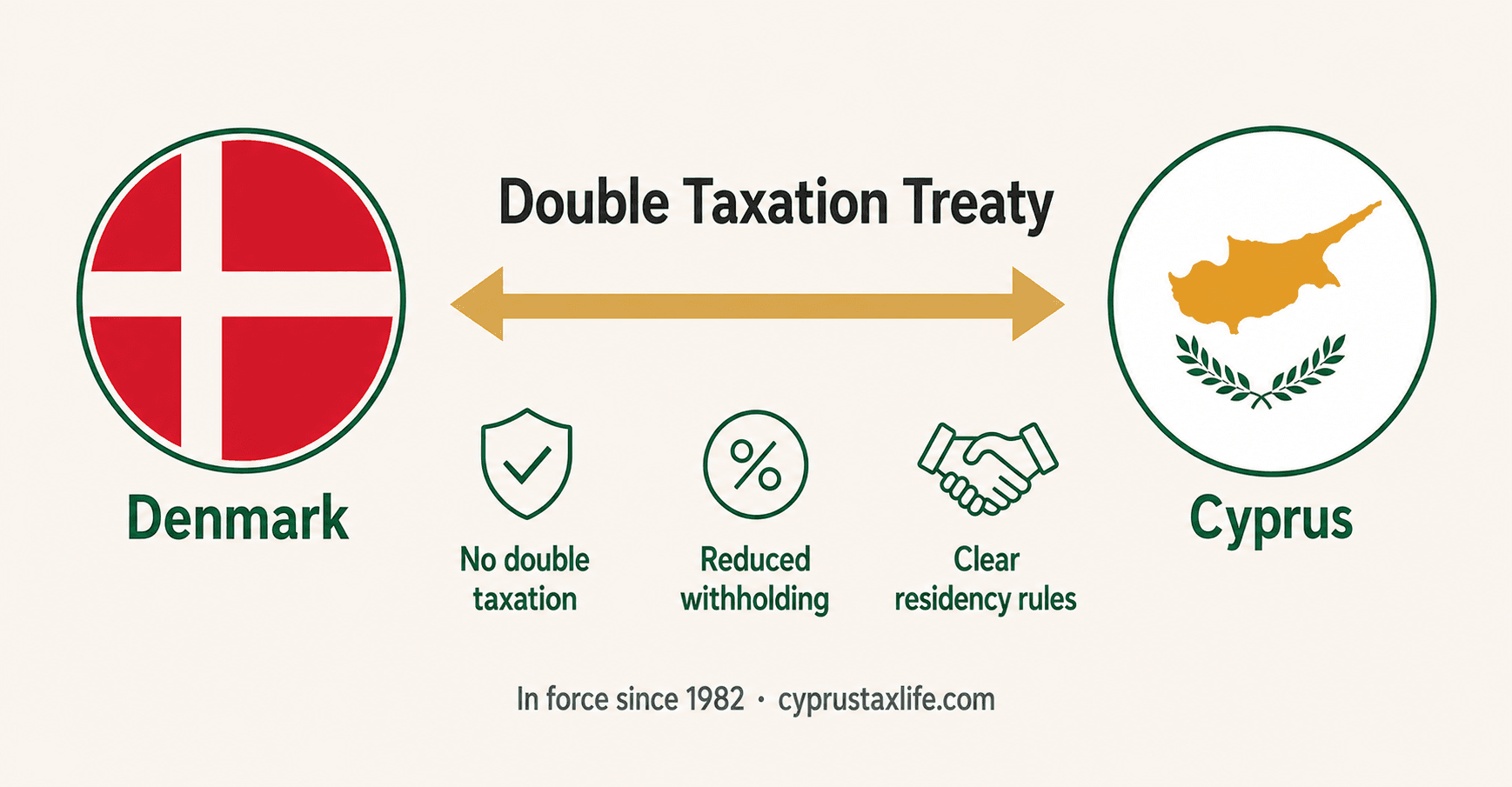
Treaty Information
Signed
1981
In force since
1982
Model
OECD Model
Overview
The Cyprus-Denmark Double Taxation Agreement was signed in 1981 and entered into force in 1982. It follows the OECD Model Tax Convention and has been supplemented by the application of EU directives for qualifying corporate structures.
Denmark has one of the highest marginal income tax rates in Europe, reaching approximately 55.9% for the highest earners (a combination of state tax, municipal tax at approximately 25%, and the top tax bracket). This makes Cyprus's Non-Dom regime particularly compelling for Danish entrepreneurs and high-income professionals.
The Danish tax authority is SKAT (Skattestyrelsen). Denmark has a highly efficient and digitalized tax system; Danish taxpayers receive pre-filled tax returns (arsopgorelse) and the system is known for its thoroughness in tax collection and enforcement.
A notable and practically significant feature of Danish tax law is the absence of an individual exit tax equivalent to Germany's Section 6 AStG or the Netherlands' conserverende aanslag. When a Danish individual emigrates, there is generally no deemed disposal or deferred exit tax on shares in companies (with limited exceptions for certain pension assets). This makes departure from Denmark relatively clean from a tax perspective compared to many other high-tax European countries.
The treaty covers Danish income taxes (indkomstskat til staten, kommunal indkomstskat, amtskommunal indkomstskat, and others), and Cyprus income tax, corporate income tax, and special contribution for defense.
Withholding Tax Rates
| Income type | Withholding rate |
|---|---|
| Dividends | 0% (EU Parent-Subsidiary Directive, 10%+ holding) / 15% (other, treaty) |
| Interest | 0% |
| Royalties | 0% |
Withholding Details
Dividends (Article 10): - EU Parent-Subsidiary Directive: 0% for qualifying EU corporate structures (10%+ holding for 2 years). This is the primary rule for Cyprus-Denmark corporate relationships - Treaty rate: 15% for other cases (individuals, non-qualifying holdings) - Danish domestic withholding on dividends: 27% for non-residents. The treaty caps this at 15% for individuals; the EU directive reduces to 0% for qualifying corporate structures - Aktieindkomst (share income) for Danish individual taxpayers: 27% on amounts up to approximately DKK 61,000 and 42% above that. These rates apply while you are a Danish resident, not after relocation
Interest (Article 11): - 0% withholding on interest - Very favorable for Cyprus holding structures lending to Danish subsidiaries or holding Danish bonds - Danish domestic interest income of non-residents is generally not subject to Danish withholding
Royalties (Article 12): - 0% withholding on royalties - Covers patents, copyrights, software, trademarks, and know-how - EU Interest and Royalties Directive also provides 0% for qualifying associated EU companies - Favorable for IP licensing between Cyprus IP companies and Danish operating entities
The 0% rates on interest and royalties make the Cyprus-Denmark treaty one of the more favorable in Cyprus's network, alongside the UK and Spain treaties.
Permanent Establishment Rules
The PE definition follows standard OECD guidelines. Denmark uses the concept of "fast driftssted" (permanent establishment) in its domestic tax law (selskabsskatteloven and kildeskatteloven).
PE risk areas for Cyprus companies with Danish operations:
Fixed place PE: An office, branch, workshop, or other fixed location in Denmark from which business is conducted.
Construction PE: A building or installation project lasting more than 12 months.
Agent PE: A dependent agent (afhaengig agent) in Denmark habitually exercising authority to conclude contracts on behalf of the Cyprus company.
SKAT has become more active in investigating international arrangements following the EU Anti-Tax Avoidance Directives and BEPS. Arrangements that are primarily tax-motivated without genuine substance in Cyprus may be challenged under Danish domestic anti-avoidance rules (ligningslovens Section 3 - general anti-abuse rule).
The forskerordning (researcher and key employee scheme): Denmark offers a 26% flat income tax rate for qualifying researchers and highly paid employees (minimum monthly salary of approximately DKK 75,000) for up to 7 years. This applies to inbound workers moving to Denmark, not to those leaving. Some Danish professionals compare this to Cyprus Non-Dom when evaluating options.
For Denmark-based entrepreneurs and consultants serving Danish clients from Cyprus: ensure all management and decision-making occurs in Cyprus, contracts are concluded in Cyprus, and physical presence in Denmark does not create a service PE (avoid exceeding 183 days of services in Denmark within any 12-month period).
Tie-Breaker Rules
Standard OECD tie-breaker sequence: 1. Permanent home available 2. Centre of vital interests 3. Habitual abode 4. Nationality 5. Mutual agreement
Denmark's domestic residency rules: a person is Danish tax resident if they have a home (bopael) in Denmark or stay in Denmark for more than 6 consecutive months (with minor exceptions for temporary stays). The concept of "bopael" is interpreted broadly and includes a dwelling you have available for your use, even if you do not own it.
Key steps for Danish entrepreneurs relocating to Cyprus: - Give up your Danish home (sell, sublet, or ensure it is not available for your personal use) - Deregister from the Danish central person register (CPR) as an emigrant (fraflytning) at borger.dk - Transfer your primary residence and center of vital interests to Cyprus - Notify SKAT of your departure (via the Danish e-tax system TastSelv)
No individual exit tax advantage: unlike moving from Germany or France, Danish individuals generally do not face exit tax on unrealized share gains when emigrating. Shares in Danish or other companies can be held through a move without triggering deemed disposal. This is a significant advantage of departing Denmark compared to other high-tax European jurisdictions.
Pension assets: certain pension assets (pensionsopsparing) may be subject to special rules upon emigration. Danish pension funds may impose restrictions or tax implications upon departure. Consult a Danish tax advisor regarding specific pension products before relocating.
Pension Provisions
Pensions (Article 18): - Government pensions: Taxable in the paying state (Denmark), unless the recipient is a Cyprus national - Private pensions: Taxable only in the state of residence (Cyprus) - Danish folkepension (state pension): Generally taxable in the state of residence under the treaty
For Danish professionals relocating to Cyprus: private pension savings (ratepension, livsvarig pension, aldersopsparing) are taxable only in Cyprus upon distribution. Cyprus taxes pension income at a special flat rate of 5% on amounts above EUR 5,000. Danish pension income taxed in Denmark at up to 55.9% would instead face only 5% in Cyprus - a transformative difference.
Danish pension fund withholding: Danish pension providers may withhold Danish tax on distributions, particularly if they believe the recipient is still subject to Danish tax. Once you have properly deregistered and established Cyprus residency, you should reclaim any Danish withholding via the mutual agreement procedure or Danish reclaim process.
ATP (Arbejdsmarkedets Tillaegspensson): Denmark's mandatory supplementary pension scheme. Contributions are mandatory for Danish employees. Accrued ATP rights are preserved after emigration and payable at Danish retirement age. The ATP pension is likely covered by the treaty as a private pension taxable only in Cyprus.
Early access to Danish pension assets (pensionsafkastskat / PAL tax): Denmark levies a 15.3% annual tax (PAL) on pension fund returns, paid by the fund. This is separate from income tax on distributions and applies regardless of where you live.
Capital Gains
Capital gains (Article 13): - Immovable property: Taxable in the situs country (Denmark for Danish property) - Shares deriving 50%+ value from immovable property: Taxable in the situs country - Other shares and assets: Taxable only in the state of residence
Individual exit tax absence: Denmark does not impose an individual exit tax on unrealized gains in company shares upon emigration (with limited exceptions). A Danish person moving to Cyprus with shares in a Danish or foreign company does not face a deemed disposal tax event. This contrasts sharply with Germany (Section 6 AStG), France (Article 167 bis CGI), and the Netherlands.
Aktieindkomst after departure: once you are a Cyprus tax resident, gains from share sales are taxable only in Cyprus. Cyprus does not tax gains on securities. The Danish system of aktieindkomst (share income tax at 27%/42%) no longer applies.
Danish property: sales of Danish immovable property after emigration remain taxable in Denmark at applicable rates (ejendomsavance).
Danish company (A/S or ApS) held through Cyprus: many Danish entrepreneurs establish a Cyprus holding company above their Danish ApS. Dividends flow from the Danish ApS to the Cyprus holding company at 0% (EU Parent-Subsidiary Directive) and are then distributed to the Non-Dom resident at effective 2.65% GHS. This structure is clean and legally sound under both Danish and EU law.
Practical Implications
For Danish entrepreneurs relocating to Cyprus:
1. Deregistration: Notify the Danish CPR register of emigration (fraflytning til udlandet). This triggers automatic updates to SKAT, ATP, and other Danish registrations. Do this on or just before your actual departure date.
2. Clean exit advantage: The absence of individual exit tax means you can take your share portfolio or company stakes with you without a tax bill on departure day. This is one of Denmark's most favorable emigration features compared to other high-tax EU countries.
3. Danish ApS structure: Many Danish entrepreneurs maintain their Danish ApS for Danish clients while establishing a Cyprus company for international operations. Ensure the Danish ApS has a Danish-resident board member or that management decisions are clearly made in Denmark to avoid the company becoming Cyprus tax resident.
4. SKAT audit risk: SKAT may audit you for the years surrounding your departure, particularly if you had high income before leaving. Maintain thorough records of your Cyprus residency (apartment lease, utility bills, Cyprus tax registration, days in Cyprus vs Denmark).
5. Social security: EU coordination rules apply. Register with Cyprus Social Insurance Services and obtain confirmation of coverage transfer. Danish accrued social benefits (dagpenge, ATP) follow the coordination rules.
6. Entrepreneur scheme (ivaerksaetterordningen): Denmark has tax incentives for early-stage company investors (deferred tax on gains reinvested in startups). If you benefit from this scheme, understand its interaction with your departure before relocating.
Frequently Asked Questions
Is there a Danish exit tax when moving to Cyprus?+
How much tax do I save by moving from Denmark to Cyprus?+
What is aktieindkomst and does it apply after moving to Cyprus?+
Can I maintain my Danish ApS after moving to Cyprus?+
How do I deregister from Denmark properly?+
Does the forskerordning (researcher scheme) offer anything for me before moving?+
Sources and References
Treaty text: Cyprus Ministry of Finance, Denmark tax authority publications, IBFD Tax Research Platform, PwC Worldwide Tax Summaries. Treaty provisions are summarized for general guidance. Consult a qualified tax advisor for your specific situation. Last verified: 2026-04-26.
Related Articles
Germany's exit tax (§6 AStG) taxes unrealised gains on shares >1% when you emigrate. Moving to Cyprus (EU): you can defer payment indefinitely. Full breakdown for German founders and investors.
 Miriam Alonso
- Tax Planning
- Relocation
Canada's departure tax treats you as having sold your worldwide assets the day you stop being a tax resident. What is caught, what is exempt, how to defer it, and what the cost-base reset means for where you go next.
![Countries With No Property Tax [2026]: The Real Cost](https://cdn.sanity.io/images/glqahhks/production/6f7ea0efceed8a692ad7c3785efa8baaf4d1e208-1679x937.jpg?w=700&q=75&auto=format)
Compare countries with no property tax and the stamp duty they charge instead. See the 10-year holding cost that makes Cayman pricier than Portugal.
Miriam AlonsoFree, no commitment
Moving to Cyprus or opening a company?
Tell us your situation and we'll connect you with our specialist expat advisory in Cyprus: Non-Dom tax, company setup and residency, done for you. Free consultation, no commitment.