Cyprus-Norway Double Tax Treaty 2026
Last updated: 2026-04-26
Treaty Information
Signed
1952 (updated by protocol)
In force since
1952
Model
OECD Model
Overview
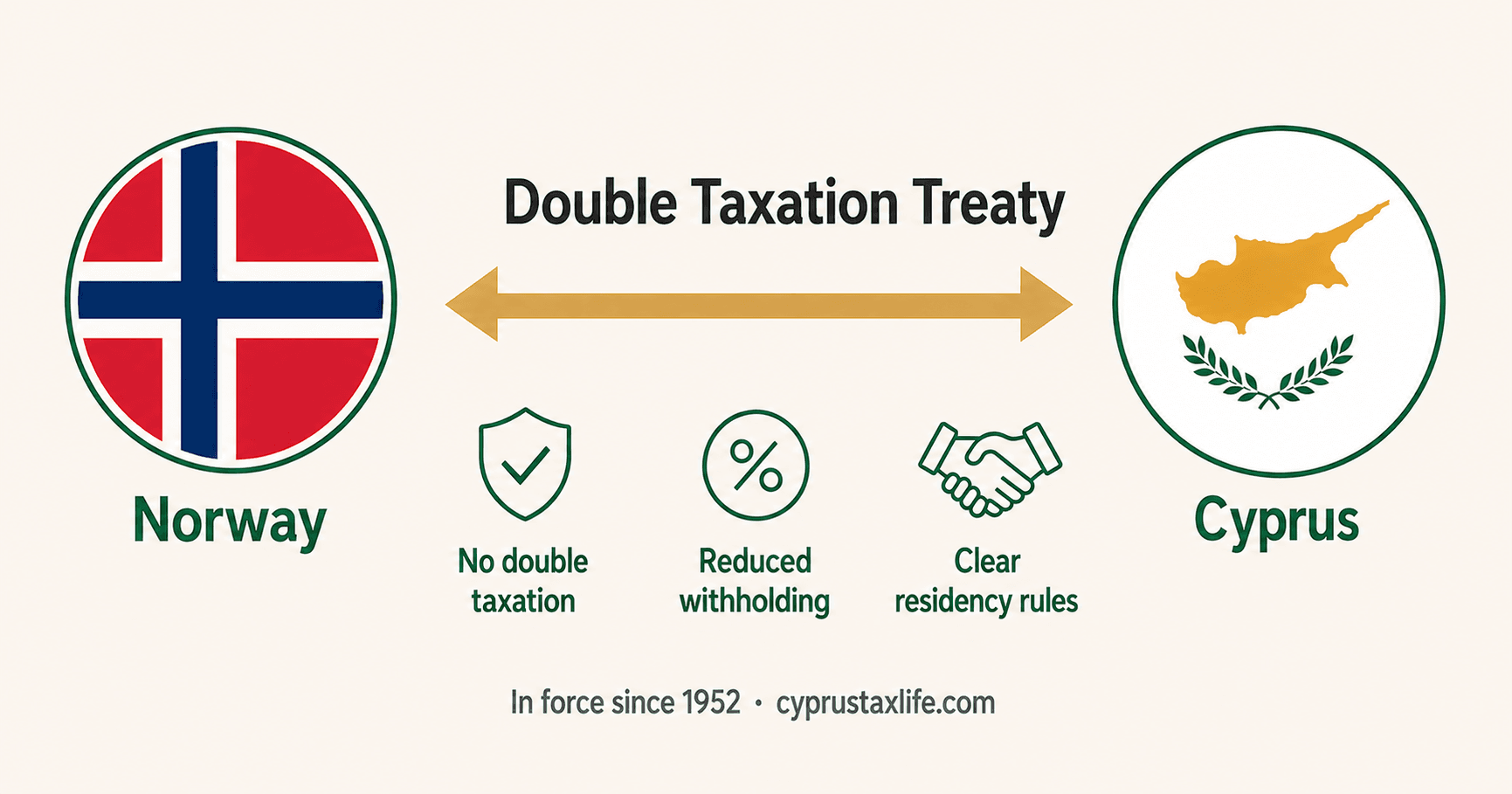
The Cyprus-Norway Double Taxation Agreement was originally signed in 1952, making it one of Cyprus's oldest treaties, and has been updated by subsequent protocols. It follows the OECD Model Tax Convention.
A critical point for understanding this treaty: Norway is NOT a member of the European Union. It is a member of the European Economic Area (EEA) via the EEA Agreement. This means EU directives - including the Parent-Subsidiary Directive and the Interest and Royalties Directive - do NOT apply to Cyprus-Norway transactions. The treaty rates are the governing rates for withholding.
However, Norway's EEA membership is significant for another reason: Norway's domestic exit tax rules for individuals provide deferral for moves to EU/EEA countries. Since Cyprus is an EU member (and therefore also in the EEA), Norwegian citizens moving to Cyprus benefit from this deferral mechanism.
Norway has one of the highest living costs in the world, sustained by extraordinary oil wealth. The combined income tax rate for high earners reaches approximately 47%: a flat 22% (fellesskatt) plus up to 17.4% bracket tax (trinnskatt) on the highest income bracket, along with employers' and employees' National Insurance contributions. For entrepreneurs with Norwegian company income, this is a substantial burden that Cyprus's Non-Dom regime can significantly reduce.
The Norwegian tax authority is Skatteetaten (formerly Ligningskontoret). The treaty covers Norwegian income taxes (inntektsskatt) and Cyprus income tax, corporate income tax, and special contribution for defense.
Withholding Tax Rates
| Income type | Withholding rate |
|---|---|
| Dividends | 0% (10%+ holding) / 15% (other) |
| Interest | 0% |
| Royalties | 0% |
Withholding Details
Because EU directives do NOT apply to Norway (non-EU), the treaty rates are the primary governing framework:
Dividends (Article 10): - 0% if the beneficial owner is a company holding directly at least 10% of the voting power of the paying company - 15% in all other cases (individuals, non-qualifying holdings) - Norwegian domestic withholding on dividends to non-residents: 25% (NUF and foreign companies) / 25% for individuals. The treaty reduces this significantly - For Non-Dom Cyprus residents: Norwegian dividends face 0% (10%+ corporate holding) or 15% (individual). In Cyprus, dividends are exempt from income tax under Non-Dom (2.65% GHS only)
Interest (Article 11): - 0% withholding on interest - Norway generally does not impose withholding on interest payments to non-residents under domestic law either, so this reinforces existing practice
Royalties (Article 12): - 0% withholding on royalties - Norway imposes a 15% domestic withholding on royalties to non-residents in some cases; the treaty reduces this to 0% - Relevant for Norwegian IP licensing to Cyprus companies
The 0% rates on interest and royalties, combined with 0% dividends for 10%+ holdings, make the treaty effective for proper corporate structures. The absence of EU directives is offset by the favorable treaty rates.
Permanent Establishment Rules
The PE definition follows OECD guidelines. Norway uses the concept of "fast driftssted" (permanent establishment) under its tax law (skatteloven).
For Cyprus companies with Norwegian operations: - Physical presence (office, branch, etc.) creates a PE - Construction sites lasting more than 12 months - Dependent agents in Norway with authority to conclude contracts
Norwegian tax authorities have historically been thorough in reviewing international structures, particularly those involving oil sector contractors, shipping companies, and tech entrepreneurs. Skatteetaten has significant investigative resources.
For Norwegian entrepreneurs who relocate to Cyprus and operate remotely for Norwegian clients: visiting Norway for client meetings, conferences, or limited project work is generally acceptable. Extended physical presence in Norway - particularly using a regular Norwegian office or coworking space - can create a service PE if it exceeds 183 days in a 12-month period.
NOKUS rules (Norsk Kontrollert Utenlandsk Selskap - Norwegian CFC rules): These are the Norwegian equivalent of CFC rules and apply to Norwegian residents owning shares in low-tax foreign companies. Under NOKUS, the Norwegian resident is taxed on the company's income as if distributed, regardless of actual distributions. Once you cease to be a Norwegian tax resident, NOKUS rules no longer apply to your personal situation. This is one of the significant tax benefits of relocating from Norway - Norwegian CFC attribution ceases.
Norwegian AS (Aksjeselskap): Norway's standard limited company. Many Norwegian entrepreneurs structure their business through an AS. Post-relocation, the AS can continue as a Norwegian operating entity or be held through a Cyprus holding company.
Tie-Breaker Rules
Standard OECD tie-breaker sequence: 1. Permanent home available 2. Centre of vital interests 3. Habitual abode 4. Nationality 5. Mutual agreement
Norway's domestic residency rules (skatteloven Section 2-1): a person is considered Norwegian tax resident if they have stayed in Norway for more than 183 days in any 12-month period, or more than 270 days in any 36-month period.
Four-year exit rule: once you have been a Norwegian tax resident, you remain subject to Norwegian tax for 4 years after departure (on certain types of income) unless you can prove you are a genuine resident of another country and have no home available in Norway. This requires active documentation and is a practical challenge for departing Norwegians.
Steps for Norwegian entrepreneurs relocating to Cyprus: - Notify Skatteetaten of your emigration (skattemessig utflytting) - Give up your Norwegian home (sell, rent out, or ensure it is not available for your personal use) - Register in Cyprus and obtain your yellow slip (Certificate of Registration as EU Citizen) - Document your physical presence in Cyprus carefully (>183 days annually) - Ensure family and center of vital interests move to Cyprus
Norwegian exit tax for individuals (emigration tax): Norway imposes an exit tax on unrealized gains on shares held in Norwegian AS or foreign companies when a shareholder emigrates. The exit tax applies to gains above NOK 500,000. For EU/EEA moves - and Cyprus qualifies as EEA via EU membership - payment is deferred indefinitely (no time limit on deferral). The deferred tax becomes due if you return to Norway or sell the shares before the deferral is cancelled. If you remain outside Norway for 5 years after departure, the deferred exit tax is cancelled.
Pension Provisions
Pensions (Article 18): - Government pensions: Taxable in the paying state (Norway for Norwegian government pensions), unless the recipient is a Cyprus national - Private pensions: Taxable only in the state of residence (Cyprus) - Norwegian National Insurance pension (Folketrygden alderspensjon): Generally taxable in the state of residence
For Norwegian professionals relocating to Cyprus: private pension savings (IPS - individuell pensjonssparing, OTP - obligatorisk tjenestepensjon) are taxable only in Cyprus upon distribution at the favorable 5% flat rate above EUR 5,000. Norwegian pension income taxed at up to 47% in Norway would face dramatically lower rates in Cyprus.
Norwegian National Insurance (NAV - Nav Arbeids- og velferdsetaten) and EEA coordination: Norway's social security system (Trygd) is coordinated with EU member states' social security systems under EEA regulations. When you move to Cyprus to work, you register with the Cyprus Social Insurance Services and cease Norwegian Trygd contributions. Accrued Norwegian pension rights (opptjente pensjonsrettigheter) are preserved under the coordination rules.
The A1 certificate from the Cyprus Social Insurance Services documents that you are covered by Cyprus social insurance, exempting you from Norwegian Trygd contributions during your time in Cyprus.
Norwegian defined contribution pension plans (innskuddsordning): rights accrued in employer pension schemes are preserved and can be drawn at Norwegian retirement age. The distributions are taxable only in Cyprus (state of residence) under the treaty.
Capital Gains
Capital gains (Article 13): - Immovable property: Taxable in the situs country (Norway for Norwegian property) - Shares deriving 50%+ value from immovable property: Taxable in the situs country - Other shares and assets: Taxable only in the state of residence
Norwegian individual exit tax interaction: as described in the tie-breaker section, Norway imposes exit tax on unrealized gains above NOK 500,000 upon emigration. For EEA moves (Cyprus qualifies), payment is deferred. The deferred tax is cancelled after 5 years of non-Norwegian residency. This is a generous deferral-and-cancellation mechanism.
After establishing Cyprus residency: gains from share sales after the move are taxable only in Cyprus. Cyprus does not tax gains on securities. The pre-move gains subject to exit tax are deferred and eventually cancelled if you remain outside Norway for 5 years.
Norwegian AS holding structure: Many Norwegian entrepreneurs set up a Cyprus holding company that owns their Norwegian AS. Dividends flow from the AS to the Cyprus holding at 0% (treaty, 10%+ holding) and are then distributed to the Non-Dom resident individual at 2.65% GHS. This is a standard and effective structure.
Norwegian oil and shipping income: Norway has specific tax rules for petroleum activities and shipping (rederiskatteordningen). These are specialized areas requiring Norwegian tax advice. The general treaty principles apply, but sector-specific Norwegian domestic rules may override or modify them.
Practical Implications
For Norwegian entrepreneurs relocating to Cyprus:
1. Emigration notification: File a formal emigration notification (utflyttingsmelding) with Skatteetaten. This triggers the 4-year exit review period. Document your Cyprus residency rigorously throughout the first 4 years.
2. Exit tax planning: Assess unrealized gains in your company shares. If gains exceed NOK 500,000, exit tax is triggered but deferred for EEA moves. Plan for the 5-year period after which deferral converts to cancellation. Do not sell shares during the deferral period if you want cancellation.
3. NOKUS cessation: Once you are no longer a Norwegian tax resident, Norwegian CFC rules (NOKUS) no longer attribute low-tax foreign company income to you. Your Cyprus company's retained earnings are no longer attributable to you as a Norwegian taxpayer. This is a meaningful benefit, particularly for those with Cyprus investment holding companies.
4. Norwegian AS management: If your AS continues operating, ensure a Norwegian-resident board (styre) handles Norwegian management. Mixing Norwegian board decisions with Cyprus-based management creates risk that the AS becomes dual-resident.
5. NAV registration: Update your NAV (social insurance) registration to reflect emigration. Cease Norwegian Trygd contributions. Register with Cyprus Social Insurance Services. Obtain the A1 certificate if you continue any work in Norway temporarily.
6. Wealth tax consideration: Norway imposes an annual wealth tax (formuesskatt) at approximately 1% on net assets above approximately NOK 1.7 million. Upon genuine relocation to Cyprus, the wealth tax obligation ceases. This is an additional saving beyond income tax.
Frequently Asked Questions
Does the EU Parent-Subsidiary Directive apply between Norway and Cyprus?+
How does the Norwegian exit tax work for a move to Cyprus?+
What are NOKUS rules and do they stop applying after I move?+
Will Norway's 4-year exit rule affect my Cyprus residency?+
Does Norway's wealth tax apply after I move to Cyprus?+
Can I keep my Norwegian AS after moving to Cyprus?+
Sources and References
Treaty text: Cyprus Ministry of Finance, Norway tax authority publications, IBFD Tax Research Platform, PwC Worldwide Tax Summaries. Treaty provisions are summarized for general guidance. Consult a qualified tax advisor for your specific situation. Last verified: 2026-04-26.
Related Articles
Germany's exit tax (§6 AStG) taxes unrealised gains on shares >1% when you emigrate. Moving to Cyprus (EU): you can defer payment indefinitely. Full breakdown for German founders and investors.
 Miriam Alonso
- Tax Planning
- Relocation
Canada's departure tax treats you as having sold your worldwide assets the day you stop being a tax resident. What is caught, what is exempt, how to defer it, and what the cost-base reset means for where you go next.
![Countries With No Property Tax [2026]: The Real Cost](https://cdn.sanity.io/images/glqahhks/production/6f7ea0efceed8a692ad7c3785efa8baaf4d1e208-1679x937.jpg?w=700&q=75&auto=format)
Compare countries with no property tax and the stamp duty they charge instead. See the 10-year holding cost that makes Cayman pricier than Portugal.
Miriam AlonsoFree, no commitment
Moving to Cyprus or opening a company?
Tell us your situation and we'll connect you with our specialist expat advisory in Cyprus: Non-Dom tax, company setup and residency, done for you. Free consultation, no commitment.