How to Apply for Cyprus Non-Dom Status: Step by Step

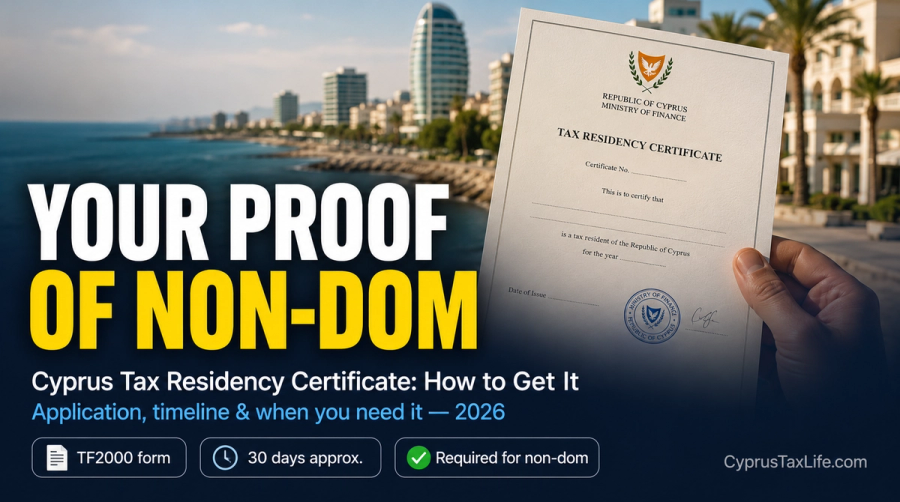
Most people who ask me about non-dom status in Cyprus ask the wrong question. They want to know what it is, the tax benefits, the dividend exemption, the savings. What they rarely ask, and what actually matters when you arrive, is how to apply for it. The process is not complicated, but it has several steps that happen in a specific order, and getting one of them wrong can delay your status by an entire fiscal year.
I went through this process myself when I arrived in Cyprus in 2024 and set up Synaptum Digital LTD in Larnaca. What follows is what I wish someone had told me before I started: the exact documents, the real timeline, the counterintuitive fact that there is no standalone "non-dom application form," and the specific mistakes that can undo everything.
Who Can Apply for Non-Dom? The Prerequisites
Non-dom status in Cyprus is not something you apply for as a standalone process on arrival. It is a tax classification that gets established through your first income tax return (the IR1), provided you already qualify as a Cyprus tax resident. This distinction matters enormously for planning your timeline.
The first prerequisite is Cyprus tax residency. You become a Cyprus tax resident under one of two rules. The classic rule: spending 183 days or more in Cyprus during a calendar year. The alternative 60-day rule (introduced in 2017): spending at least 60 days in Cyprus, maintaining a permanent home here (owned or rented), having some business activity or employment in Cyprus, and not being a tax resident in any other country in the same year. Most self-employed founders and remote workers setting up in Cyprus use the 60-day rule, but it requires careful documentation of your physical presence.
The second prerequisite is not having been domiciled in Cyprus. In Cypriot tax law, domicile is different from residency. You are domiciled in Cyprus if you were born in Cyprus of Cypriot parents (domicile of origin), or if you have been a tax resident of Cyprus for 17 or more of the last 20 years (domicile of choice). The overwhelming majority of expatriates moving to Cyprus from abroad meet neither condition and therefore qualify as non-domiciled by default.
If you are a foreign national with no Cypriot heritage who has never previously lived in Cyprus, you almost certainly qualify for non-dom status from your very first year as a Cyprus tax resident. The practical implication: you do not need to prove anything special or file a separate petition. You simply need to ensure your tax return correctly reflects your non-dom status, and that is where the process can go wrong.
Documents You Need to Gather
Before your accountant can mark the non-dom election on your IR1, you need several documents in place. These are not documents you submit for non-dom specifically, they are the foundational registration documents that establish you as a legal resident and taxpayer in Cyprus. Get them in the correct order, because some depend on others.
The Tax Identification Number (TIN) is the starting point. Every individual paying taxes in Cyprus needs one. You can obtain your TIN at the Tax Department in person, or your accountant can apply on your behalf with a power of attorney. You will need your passport, your ARC (see below), and in some cases your rental agreement. Without a TIN, nothing else in this process moves forward.
The Yellow Slip or ARC (Alien Registration Certificate) is the residency document issued by the Civil Registry and Migration Department. EU citizens receive a Registration Certificate (sometimes called the yellow slip because of its color). Non-EU citizens receive the ARC, a biometric card. Both serve the same purpose: official proof of residency in Cyprus. The address on this document must match where you actually live, a provisional or incorrect address can cause problems when the Tax Department cross-references it.
- Valid passport (and a copy)
- Yellow Slip / ARC, your official Cyprus residency certificate with current address
- Rental contract or property title deed in your name, matching the address on the ARC
- Tax Identification Number (TIN), obtained at the Tax Department before this step
- Proof of Cyprus business ties: company registration documents (HE1 form), articles of incorporation, or a Cypriot employment contract
- Signed declaration of non-domicile status, your accountant prepares this based on your personal history
The declaration of non-domicile is not a government form you fill in, it is a statement your accountant prepares confirming that you do not hold Cypriot domicile of origin or domicile of choice. Your accountant will ask you questions about your parents' nationality, your prior residency history in Cyprus, and the number of years you have lived here. Based on your answers, they draft the declaration. This document stays in your file and supports the non-dom election in the IR1.
The Step-by-Step Process, How It Actually Works
The most important thing to understand about non-dom status in Cyprus is that there is no separate application form for it. There is no document titled "Non-Dom Application" that you submit to a government office. The non-dom status is established through a checkbox (or equivalent field) on the IR1 income tax return form. This surprises almost everyone who asks me about it, including people who have done significant research beforehand.
Step 1: Obtain your TIN. Go to the Tax Department office in your city (Nicosia, Limassol, Larnaca, wherever you reside) with your passport and ARC. The process is usually same-day. If you use an accountant, give them a signed authorization and they can handle this for you. The TIN is your entry point into the Cypriot tax system and into TaxisNet, the online tax portal.
Step 2: Ensure your TaxisNet profile is set up. TaxisNet is the Cyprus Tax Department's online platform where all tax filings, correspondence, and status updates happen. Your accountant will typically set this up for you or obtain the credentials so they can file on your behalf. Your non-dom status will eventually be visible, or verifiable, through TaxisNet once it is processed.
Step 3: File your first IR1. The IR1 is the annual personal income tax return in Cyprus. It covers income earned during the previous calendar year and is typically due in April or July of the following year (deadlines shift, and electronic filing usually gets an extension, your accountant will know the current deadline). On the IR1, your accountant includes your declaration of non-domicile and elects thenon-dom status. This is the critical step. If your accountant forgets to include it, or files without the declaration, you may lose non-dom for that entire fiscal year.
Step 4: The Tax Department processes your return. Once the IR1 is filed with the non-dom declaration, the Tax Department updates your tax profile accordingly. There is no approval letter, no notification, and no physical certificate of non-dom status. The status simply appears (or is verifiable) in your TaxisNet profile. Ask your accountant to confirm it is showing correctly after the return is processed, usually within a few months of filing.
Realistic Timeline, How Long Does Everything Take?
| Step | Action | Typical Timeframe |
|---|---|---|
| 1 | Arrive in Cyprus, secure accommodation | Day 1-7 |
| 2 | Register with Civil Registry (Yellow Slip / MEU1) | 1-4 weeks |
| 3 | Open Cypriot bank account | 1-3 weeks |
| 4 | Obtain Tax Identification Number (TIC) via TaxisNet | 1-5 days (online) |
| 5 | File formal Non-Dom declaration with Tax Commissioner | 2-6 weeks for confirmation |
| 6 | Register with Social Insurance (if self-employed/director) | 1-2 weeks |
| 7 | Receive written Non-Dom confirmation letter | Total: 2-4 months from arrival |
The single biggest misconception about non-dom status in Cyprus is that you can "get it" quickly after arriving. In practice, the formal establishment of non-dom status takes considerably longer than most guides suggest, because it is tied to the annual tax return cycle. Here is a realistic timeline for someone arriving mid-year.
Months 1-2 after arrival: Get your Yellow Slip or ARC (typically 1-4 weeks if you apply promptly and have all documents), then obtain your TIN (usually 1-2 weeks after the ARC). Set up or register with an accountant who handles Cyprus expat tax matters. If you are incorporating a company, this happens in parallel, the HE1 certificate from the Registrar of Companies typically takes 5-10 business days through a service provider.
Year 1 in Cyprus: You are accumulating the days of residence (183 under the standard rule, or 60+ with active documentation under the 60-day rule). During this year, your non-dom status is not yet formally established, but it is already economically effective in the sense that you have not incurred SDC on dividends because you have not been assessed as a domiciled taxpayer. Your company can pay dividends, and they will be subject to 2.65% GHS only, not the 5% SDC that applies to domiciled residents.
April-July of the following year: Your accountant files your first IR1 covering your first full or partial year in Cyprus. This return includes the non-dom declaration and election. Once processed, yournon-dom status is formally on record for that fiscal year, and it applies retroactively to 1 January of that year. If you arrived in June 2024 and your accountant files the IR1 in April 2025 covering fiscal year 2024, yournon-dom status is effective from 1 January 2024 (or from the date you became tax resident, whichever applies under your specific situation).
Total elapsed time from arrival to formal non-dom establishment: anywhere from 10 to 18 months, depending on when in the year you arrive and when the IR1 is filed. This does not mean you are unprotected during that time, the dividends your company pays during Year 1 are already being treated correctly if your accountant structures them properly. But the formal tax record establishing non-dom will not exist until after that first IR1 is processed.
What Can Go Wrong and How to Avoid It
The non-dom process in Cyprus is administratively simple, but it has failure points that are easy to miss if you are managing it without experienced local support. The following are the most common problems I have seen or heard about from other expats who went through this process.
Yellow Slip with incorrect or provisional address. When you first arrive, you may be staying in temporary accommodation, a short-term rental, an Airbnb, a friend's place. If you register your ARC with that provisional address and then move, you need to update your civil registration and your tax records. The Tax Department uses the address on file to cross-reference your domicile declarations. Mismatches can trigger questions or delays in processing your return. Update your address at both the Civil Registry and the Tax Department any time you move permanently.
Insufficient documentation of presence under the 60-day rule. If you are claiming tax residency under the 60-day rule rather than the 183-day rule, you are relying on a narrower threshold. The Tax Department may request evidence of your physical presence: flight records, hotel receipts, bank transactions in Cyprus, utility bills showing activity at your Cyprus address. Keep a travel log and preserve boarding passes, because the burden of proof is on you if the 60-day basis is ever questioned.
The accountant not marking non-dom on the IR1. This is the most operationally consequential mistake, and it happens more often than it should. Some local accountants who handle straightforward salary earners are not accustomed to flagging non-dom status for self-employed expats or company owners. Explicitly instruct your accountant in writing, before they file your IR1, to include the non-domicile declaration and election. After filing, ask for confirmation that the non-dom field was included. Do not assume it was done automatically.
Undiscovered Cypriot domicile. If you have Cypriot parents or grandparents, or if you have lived in Cyprus for extended periods in the past that you have not disclosed, your domicile status may be more complicated than it appears. Cypriot domicile of origin follows paternal lineage in traditional interpretation. Before assuming you are non-dom, discuss your full family and residency history with your accountant. This is rare for most expatriates but worth confirming explicitly.
Changing address without updating the Tax Department. Cyprus requires that you keep your registered address current with the Tax Department separately from the Civil Registry. If you move, notify both. Failure to do so can result in tax correspondence going to the wrong address, which can mean missing assessments, deadlines, or queries about yournon-dom status.
After Your Non-Dom Status Is Established, What Changes in Practice
Once the non-dom status is on your TaxisNet record, the operational difference is significant. Your company, a Cyprus Limited, for example, can distribute dividends to you as a shareholder, and those dividends are subject to2.65% GHS contribution only. There is no Special Defence Contribution (SDC). For context, domiciled Cyprus tax residents currently pay 5% SDC on dividend income after the 2026 reform reduced it from 5%. As a non-dom, you pay neither the old rate nor the new one.
Your accountant will handle dividend distributions through the company's accounting records, there is no special form to file each time you take a dividend. The GHS contribution (2.65%) is calculated on the gross dividend amount and is paid by you personally as a contribution to the General Healthcare System. Your accountant will include this in your annual tax return calculations.
How to verify your non-dom status is active: the most reliable method is to ask your accountant to log into TaxisNet and confirm that your taxpayer profile reflects non-dom status. Alternatively, when you receive the assessment notice for your IR1 from the Tax Department, the non-dom classification should be reflected in how your dividend income is taxed (or not taxed) in the assessment. If the assessment shows SDC being applied to dividend income, contact your accountant immediately, it means the non-dom election was not processed correctly.
The non-dom status in Cyprus lasts for a maximum of 17 years from the date you became a Cyprus tax resident. After 17 years of tax residency, you cross into domicile of choice territory and the SDC would apply to your dividend income from that point. For the vast majority of expatriates who arrive as adults and may not stay for nearly two decades, this limit is not practically relevant. But it is worth knowing: non-dom is not permanent by design.
One final note on the practical value: with a corporate tax rate of 15% on company profits and non-dom status eliminating SDC on dividends, the effective total tax burden for a self-employed professional running a Cyprus company can be structured at approximately 5% or below on distributed income, when accounting for the personal income tax threshold of €22,000 exempt from income tax. This is what makes Cyprus genuinely competitive, but it only works if thenon-dom status is correctly established from the start.
Frequently Asked Questions
Need personalized advice? Book a consultation with an expat tax specialist.
Is non-dom automatic or do I have to actively apply for it?
It is not automatic in the sense that it requires action, but it is also not a separate application process. Non-dom status is established through your annual IR1 income tax return. Your accountant must include a non-domicile declaration and tick the relevant election on the IR1. If your accountant files the IR1 without this declaration, non-dom will not be on record for that year, so while there is no standalone application form, you do need to actively ensure it is included in your tax return. Always confirm with your accountant before they file.
Can I apply for non-dom if I have been in Cyprus for less than one year?
You cannot formally establish non-dom status until you have filed at least one IR1 covering a year in which you qualified as a Cyprus tax resident. If you arrived mid-year, your first IR1 will typically cover a partial year of residency. However, even during your first year before the IR1 is filed, dividends paid to you by your Cyprus company should not attract SDC, because you have not been assessed as a domiciled taxpayer. The formal establishment via the IR1 retroactively confirms the status. In practical terms: structure your dividends correctly from Day 1 (with your accountant's guidance), and the IR1 formalises what was already the case.
Do I need a lawyer or just an accountant for the non-dom application?
For the non-dom process itself, a Cyprus tax accountant (registered with ICPAC or a licensed tax representative) is sufficient. You do not need a lawyer. A lawyer is useful if you are incorporating a company (though many company formation agents handle this without a lawyer), if you are purchasing property, or if there is any dispute or complexity in your domicile status. For the straightforward non-dom election on the IR1, which is the core of the process, an experienced Cyprus tax accountant handles everything.
What if I did not claim non-dom on my first IR1?
You can file an amended IR1 (a corrected return) for a previous tax year. The Cyprus Tax Department allows amendments within a certain window after the original filing. If your accountant did not include the non-dom declaration in a prior year's return, they can file a corrected IR1 with the declaration included. This may result in a recalculation of any SDC that was assessed on dividend income for that year. The sooner you identify the omission, the easier the correction, contact your accountant immediately if you believe this happened.
Does non-dom cover interest income and rental income too?
Non-dom status exempts you from SDC (Special Defence Contribution) on dividends, interest, and rental income. Prior to the 2026 reform, SDC rates were 17% on dividends, 30% on interest, and 3% on rental income for domiciled residents. After the 2026 reform, SDC on dividends is 5% for domiciliados, and the rules on interest have also been revised. As a non-dom, you are exempt from SDC on all three income types. Interest income and rental income may still be subject to personal income tax depending on amounts and your specific situation, consult your accountant for the full picture on your income profile.
Do I lose non-dom status if I spend extended periods outside Cyprus?
Non-dom status itself does not expire due to time spent abroad. However, if you spend extended periods outside Cyprus to the point that you no longer qualify as a Cyprus tax resident, meaning you drop below 183 days in a year (or no longer meet the 60-day rule criteria), then you lose Cyprus tax residency, which is the prerequisite for non-dom. If you lose tax residency for a year, that year's IR1 cannot include the non-dom election. You do not lose the underlying non-domicile qualification (you are still not Cypriot-domiciled), but you cannot use it in a year when you are not a Cyprus tax resident. Plan your travel carefully if maintaining Cyprus tax residency matters to you, and discuss the implications with your accountant before taking extended trips.
![Cyprus Ltd vs Irish Ltd: Company Tax Compared [2026]](https://cdn.sanity.io/images/glqahhks/production/84e3d82538a859345d8d2447e8e097c5777fb238-1679x937.png?w=700&q=75&auto=format)
![Cyprus vs Malta Company Formation [2026]](https://cdn.sanity.io/images/glqahhks/production/97db89d0ce729a9e931d09bc1522631faa6c3474-1679x937.png?w=700&q=75&auto=format)