Social Insurance in Cyprus: How the Self-Employed Register

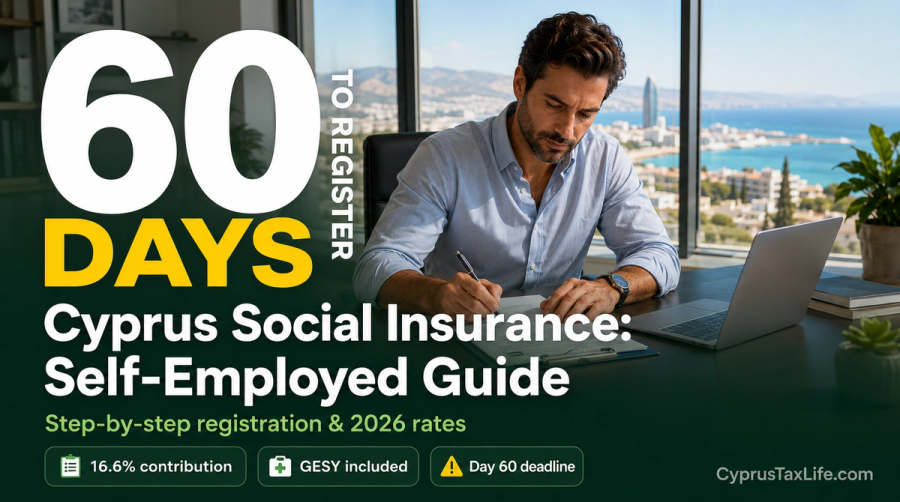
If you're setting up as self-employed in Cyprus or running your own Cyprus Ltd as a director-shareholder, registering with Social Insurance (Κοινωνικές Ασφαλίσεις) is not optional, it's a legal requirement from the moment you start your activity. This guide walks you through exactly what to do, what documents to bring, where to go, and what it costs.
Director of a Cyprus Ltd vs Freelance: Social Insurance Regime Differences
The Social Insurance regime that applies to you depends on how you are structured legally.
If you are both a director AND a shareholder of your Cyprus Ltd, Cypriot law treats you as self-employed for Social Insurance purposes, even though you are technically an employee of your own company. This means you pay the combined self-employed rate of 16.6% on your declared insurable income. You do not split it into an employee portion (8.8%) and an employer portion (10.5%) the way a regular salaried employee would.
If you are only an employee of a Cyprus company (no shares), the company pays the employer contribution and you pay the employee portion separately, but this is rarely the situation for expats who set up their own structure.
According to the Cyprus Department of Social Insurance Services, self-employed persons are required to register within 60 days of commencing business activity and contribute at a rate of 16.6% of declared earnings in 2026, with a minimum declared income of EUR 20,318 per year for most self-employed categories.
For the vast majority of expatriates who form a Cyprus Ltd, appoint themselves as director, and hold shares in the company, the self-employed regime is the one that applies. This surprises many people coming from countries like the UK, Germany, or Spain, where a director-employee would be treated under the general employment scheme.
The practical implication: you register as self-employed at the Social Insurance office, declare an insurable income, and pay contributions quarterly, not through a payroll system.
Documents You Need for Social Insurance Registration
Gather these documents before your visit to the Social Insurance office. Bring originals and photocopies of everything.
For director-shareholders registering as self-employed:
- Valid passport or EU national identity card
- Yellow Slip or ARC (Alien Registration Certificate), your official residence document in Cyprus
- TIN (Tax Identification Number), your personal Cypriot tax number, issued by the Tax Department
- Certificate of Registration of the company from the Registrar of Companies (showing you as director)
- Copy of the Memorandum and Articles of Association (M&AA) of the company
- Appointment letter as director (the formal document issued by the company recording your appointment)
For freelancers without a company structure:
- Valid passport or EU national identity card
- Yellow Slip or ARC
- TIN (personal)
- Proof of economic activity: invoices issued to clients, a signed contract, or a client engagement letter
If you have not yet obtained a TIN or Yellow Slip, you must get those first. The Social Insurance registration cannot proceed without them. The TIN is obtained from the Tax Department; the Yellow Slip or ARC is obtained from the Civil Registry and Migration Department.
Where to Register and How to Get an Appointment
Social Insurance registration is handled by the Social Insurance Services District Offices (Υπηρεσίες Κοινωνικών Ασφαλίσεων). There are offices in all five districts:
- Nicosia, main district office, handles the highest volume
- Limassol, second busiest, serves a large expat community
- Larnaca, common first stop for expats landing at Larnaca airport
- Paphos, serves western Cyprus including Polis
- Famagusta, serves the eastern district (Paralimni, Ayia Napa area)
You register at the office of the district where you live or where your business is based.
As of 2026, there is no online appointment booking system for Social Insurance registration. You can call the relevant district office to ask about wait times or simply go in person during office hours: Monday to Friday, 8:00 to 13:00. Afternoon hours are limited and not all services are available.
Taking your accountant with you is highly recommended if your Greek is limited. Most officials speak functional English, but registration forms may be in Greek and having a professional with you speeds up the process and reduces errors in declaring your insurable income.
The Registration Process Step by Step
Here is exactly what happens on the day you go to register:
- Step 1, Prepare your documents. Use the checklist in Section 2. Bring originals and photocopies. If you are a director-shareholder, confirm your company is already registered with the Registrar of Companies.
- Step 2, Go to your district Social Insurance office during morning hours (8:00-13:00). Take a number at the door.
- Step 3, At the counter, tell the official you are there to register as self-employed (or as a director-shareholder of a Cyprus Ltd). They will give you the relevant registration form, commonly referenced as the SI registration form for self-employed. Fill it in with the official's guidance.
- Step 4, Declare your estimated insurable income. This is the annual salary or director's remuneration you plan to declare. It determines the basis for your quarterly contributions. Be realistic, you can adjust later, but starting too low and then underpaying creates retroactive liabilities.
- Step 5, The official creates your Social Insurance record and assigns you a Social Insurance number if you do not already have one from a previous period of employment in Cyprus. If you were previously employed in Cyprus, your existing SI number will be reactivated.
- Step 6, Confirmation documents are sent to you by post, usually within a few weeks. Keep these, they show your registration date, your SI number, and your declared insurable income basis.
Important: your registration is effective from the date you started your activity, not the date of your appointment. If you started operating three months ago, you owe contributions from that date. Declare the correct start date, the office will calculate any arrears.
How Much You Pay and When
The self-employed Social Insurance rate in Cyprus is 16.6% of your declared insurable income (2026 rate). This covers all Social Insurance branches: old-age pension, sickness, maternity, and unemployment.
There is an annual insurable income ceiling of approximately €62,868 in 2026, updated yearly. Even if your actual earnings are higher, you do not pay Social Insurance above this ceiling.
A practical example: if you declare a director's salary of €9,600 per year (a common minimum for director-shareholders), your Social Insurance works out as follows:
- €9,600 × 16.6% = €1,593.60 per year in Social Insurance contributions
- Paid quarterly: approximately €398.40 per quarter
- Payment months: January, April, July, October
Payments can be made at the Social Insurance district office in person, or online through JCCsmart.com (the main Cypriot government payment portal). JCCsmart is the easier option once you are registered and have your SI reference number.
Social Insurance and GHS (General Healthcare System) are two entirely separate systems with separate contributions and separate payment channels. Do not confuse them:
- Social Insurance (16.6%), paid quarterly directly to the Social Insurance Services
- GHS (2.65% on salary + 2.65% on dividends as non-dom), managed through your annual IR1 tax return via the Tax Department and TaxisNet
Your accountant typically handles GHS through the annual return. Social Insurance quarterly payments are your direct responsibility.
| Contribution Type | Rate (Self-Employed) | What It Covers |
|---|---|---|
| Social Insurance (main) | 16.6% of insurable income | Pension, sickness, maternity, unemployment |
| General Healthcare System (GHS) | 4% of gross income | Public healthcare (GESY) |
| Redundancy Fund | N/A, exempt for self-employed | - |
| Human Resource Development | 0.5% of insurable income | Training fund |
| Social Cohesion Fund | 2% of insurable income | Welfare programs |
| Total effective contribution | ~23.1% | On insurable income (capped) |
Consequences of Not Registering or Registering Late
Failure to register or late registration carries financial and practical consequences that compound over time.
Financial penalties:
- 3% penalty surcharge on unpaid contributions for each month of delay
- 9% annual interest on the outstanding amount from the date contributions were originally due
- These can add up quickly if you have been operating for a year or more without registering
Enforcement risk: The Social Insurance Department cross-references data with the Tax Department and the Registrar of Companies. If your company is active in the Registrar with you listed as director, but no Social Insurance contributions are recorded, this flags for investigation. The department does pursue these cases.
Loss of benefits: Every quarter you are not registered is a quarter where you are not building your Social Insurance contribution record. In Cyprus, pension entitlements, sickness benefits, and maternity benefits are all contribution-based. For expatriates planning to stay in Cyprus long term, these contributions are not wasted, they accumulate towards a Cypriot state pension and access to Social Insurance benefits.
The practical advice: register as soon as you start your activity, even if your income is modest at first. The administrative cost of registering late is always higher than the cost of registering on time.
Frequently Asked Questions
Need personalized advice? Book a consultation with an expat tax specialist.
¿Puedo registrarme en el Social Insurance antes de abrir la empresa?
El registro en el Social Insurance como director-accionista de una Cyprus Ltd requiere que la empresa ya esté constituida e inscrita en el Registrar of Companies. Sin el certificado de registro de la empresa y el nombramiento como director, el trámite no puede iniciarse. Si eres freelance sin empresa, puedes registrarte una vez que tengas tu TIN y Yellow Slip, pero necesitas poder demostrar actividad económica (facturas, contrato con un cliente).
¿Qué ingreso asegurable debo declarar si mis dividendos son muy variables?
Los dividendos no son base de cotización del Social Insurance. El Social Insurance se calcula sobre el salario o remuneración de director que declaras, no sobre los dividendos. Por eso muchos directores-accionistas declaran un salario mínimo (por ejemplo €9,600/año) como base asegurable y distribuyen el resto como dividendos. Los dividendos tributan solo en GHS al 2.65% (para no-doms), no en Social Insurance. Si tu actividad varía mucho, habla con tu contador sobre el nivel de salario director más eficiente para tu situación.
¿El social insurance chipriota me da derecho a prestación por desempleo?
Para los autónomos y directores-accionistas registrados en el régimen de autónomos, la cobertura por desempleo del Social Insurance no aplica de la misma manera que para los empleados. Los empleados tienen acceso a prestación por desempleo si son despedidos; los autónomos en Chipre no tienen acceso a la prestación contributiva por desempleo a través del Social Insurance. Sin embargo, sí acumulan derechos de pensión, baja por enfermedad (sickness benefit) y, en el caso de las mujeres, baja por maternidad, siempre que hayan cumplido el periodo mínimo de cotización requerido.
¿Tengo que registrarme aunque mi empresa lleve meses sin actividad?
La obligación de registro surge cuando inicias actividad económica, no cuando constituyes la empresa. Si tu Cyprus Ltd está constituida pero no ha facturado ni ha habido movimiento de directores, técnicamente no hay actividad que registrar. Sin embargo, en cuanto comienzas a ejercer funciones como director activo o emites la primera factura, la obligación nace desde ese momento. Mantener una empresa dormida (dormant company) durante meses sin actividad no genera obligación de SS, pero cuando reactives la actividad debes registrarte sin demora.
¿Se puede cambiar el ingreso asegurable declarado a mitad del año?
Sí. Puedes solicitar una modificación de tu base asegurable declarada en la oficina del Social Insurance. Los cambios suelen aplicarse a partir del trimestre siguiente a la solicitud. Es habitual revisar la base asegurable cuando la situación financiera de la empresa cambia significativamente, ya sea al alza o a la baja. Tu contador puede gestionar este trámite junto con el ajuste de la IR1 anual para que las dos declaraciones sean coherentes.
¿El SS chipriota se puede coordinar con las cotizaciones que ya tengo en España?
Chipre y España son ambos miembros de la UE, por lo que se aplican los Reglamentos europeos de coordinación de seguridad social (883/2004 y 987/2009). En principio, los periodos de cotización en ambos países pueden sumarse para calcular derechos de pensión en cada uno (totalización de periodos). Esto significa que si cotizas en Chipre y previamente cotizaste en España, no pierdes los años españoles, se computan conjuntamente para determinar si tienes derecho a pensión en cada país. Para obtener un cálculo preciso de cómo interactúan tus cotizaciones en ambos países, necesitarás contactar con la Seguridad Social española (INSS) y solicitar un informe de vida laboral actualizado.
Related Guides
Social Insurance in Cyprus: Rates, Pension Rights and Registration
Income Tax in Cyprus: Rates, Brackets and Non-Dom Benefits
Non-Dom Status in Cyprus: Pay Only 2.65% GHS on Dividends Instead of Social Insurance
![Cyprus Ltd vs Irish Ltd: Company Tax Compared [2026]](https://cdn.sanity.io/images/glqahhks/production/84e3d82538a859345d8d2447e8e097c5777fb238-1679x937.png?w=700&q=75&auto=format)
![Cyprus vs Malta Company Formation [2026]](https://cdn.sanity.io/images/glqahhks/production/97db89d0ce729a9e931d09bc1522631faa6c3474-1679x937.png?w=700&q=75&auto=format)