Is Cyprus a Tax Haven? 2026: What the EU and OECD Data...

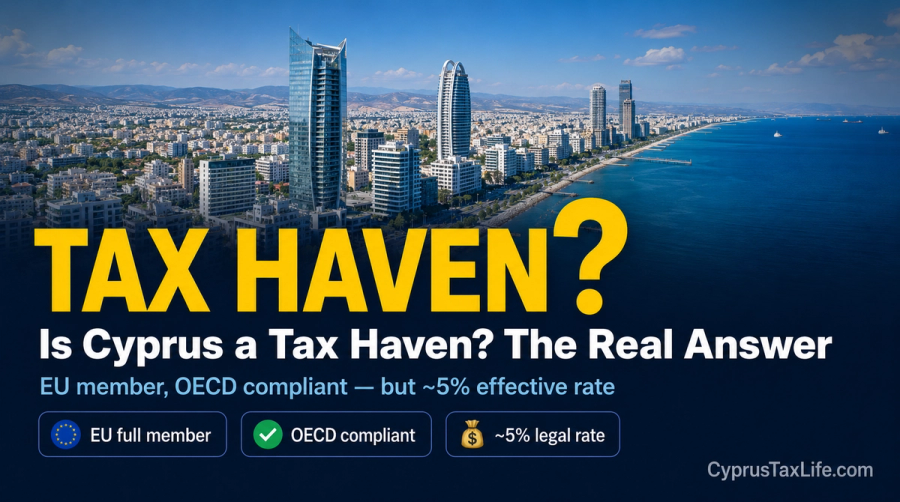
Cyprus is not a tax haven in the offshore sense. It is an EU member state with a 15% corporate tax rate, full OECD transparency compliance, and automatic information exchange with over 60 countries. What makes it attractive is not secrecy - it is structure.
The Non-Domiciled (Non-Dom) regime eliminates tax on dividends and passive income for qualifying residents. Under this status, dividend income is subject to 0% income tax and only 2.65% GHS (healthcare) contributions, with no Special Defence Contribution. For an entrepreneur relocating from Germany, France, or the UK, that difference is structural, not marginal.
This is what the "tax haven" debate misses. Cyprus does not hide money. It taxes it differently - and legally. The EU Parent-Subsidiary Directive applies. Beneficial ownership registers are public. The rates are simply lower than the European average, and that is a policy choice, not a loophole.
Source: PwC Cyprus Tax Facts 2026. Tax rates and compliance status current as of January 2026.
What Makes a Tax Haven?
The OECD and the EU Code of Conduct Group define tax havens by four main criteria: zero or near-zero tax rates with no substance requirements, lack of transparency and information exchange, absence of effective exchange of tax information with other countries, and artificial arrangements with no real economic purpose. Classic examples are the Cayman Islands, British Virgin Islands, and Bermuda - jurisdictions with 0% corporate tax, limited CRS participation, and no obligation to share financial data with other countries.
- Zero or near-zero tax rates with no real economic substance requirements
- Lack of transparency and information exchange with other countries
- No effective exchange of tax information
- Artificial arrangements that serve no real economic purpose
- Secrecy laws that prevent oversight
Classic tax havens include the Cayman Islands, British Virgin Islands (BVI), Bermuda, and Jersey. These jurisdictions charge zero corporate tax, have minimal reporting requirements, and historically resisted sharing financial information with other countries.
Now let us see how Cyprus compares.
Cyprus Tax Reality: The Numbers
Cyprus' corporate tax rate is 15%, low by European standards (France 25%, Germany ~30% with trade tax) but meaningfully above zero.
Here is the full picture:
- Corporate tax: 15% on worldwide profits
- Personal income tax: Progressive rates from 0% to 35%
- VAT: 19% (standard rate)
- Capital gains tax: 0% on securities (shares, bonds, etc.)
- Dividend tax: 0% for Non-Dom residents (2.65% GHS contribution applies)
- Social insurance contributions: Yes, mandatory
- Defence levy (SDC): 5% on dividends for domiciled residents (reformed in December 2025)
A country with 15% corporate tax, 19% VAT, and progressive income tax up to 35% does not fit any reasonable definition of a tax haven. It is a low-tax jurisdiction within the EU, which is a very different thing.
EU Membership and Compliance
Cyprus has been a full EU member since 2004, which directly refutes "tax haven" characterizations.
That means Cyprus:
- Follows all EU tax directives, including the Anti-Tax Avoidance Directives (ATAD I and II)
- Participates in the Common Reporting Standard (CRS), automatically exchanging financial account information with over 100 countries
- Complies with OECD Base Erosion and Profit Shifting (BEPS) guidelines
- Is NOT on any EU blacklist or grey list of non-cooperative tax jurisdictions
- Has signed over 65 double tax treaties
- Implements beneficial ownership registers
- Follows EU Anti-Money Laundering directives
Compare this to the Cayman Islands, which has no direct taxation, no CRS participation for domestic entities, and limited transparency mechanisms. The difference is fundamental.
The Non-Dom Regime: Legitimate, Not a Loophole
Cyprus's Non-Dom regime exempts foreign residents from tax on worldwide income and gains, provided they don't remit funds to Cyprus - a legitimate incentive, not a loophole. Non-domiciled residents pay only local taxes on Cyprus-sourced income at standard rates (roughly 5% effective rate after reliefs) plus 0% Special Defence Contribution and 2.65% General Healthcare Scheme levy. The regime applies to individuals not born in Cyprus and without established domicile there, creating a transparent framework aligned with international tax principles rather than artificial avoidance structures.
- Special Defence Contribution (SDC) on dividends
- SDC on interest income
- SDC on rental income from abroad
This sounds aggressive, but it is important to understand context. The Non-Dom concept originated in the UK and has been used for over 200 years. Ireland, Malta, and other EU countries have similar frameworks. The UK only abolished its Non-Dom regime in 2025 after decades of use.
Cyprus Non-Dom is not a secret. It is publicly documented, available to anyone who qualifies, and fully reported to EU institutions. There is nothing hidden about it.
Why the Misconception Exists
The misconception stems from three overlapping sources: historically loose regulation before 2013, the heavy use of Cyprus by Russian businesses in the 2000s and early 2010s, and oversimplified "pay zero tax in Cyprus" content that ignores substance requirements and GHS contributions.
Historical issues. Before 2013, Cyprus had a more relaxed regulatory environment. The banking crisis of 2013 exposed weaknesses in oversight. Since then, Cyprus has significantly tightened regulations, but the reputation lingers.
Russian money flows. In the 2000s and early 2010s, Cyprus became popular with Russian businesses, partly due to the Cyprus-Russia double tax treaty. Media coverage focused heavily on this, creating an association between Cyprus and offshore finance. The treaty was revised in 2020 to increase withholding taxes.
Low corporate tax rate. At 15%, Cyprus has one of the lowest corporate tax rates in the EU. People see "low tax" and jump to "tax haven." But low is not zero. Ireland charged 15% for years (now 15% under the OECD minimum) and was rarely called a tax haven with the same intensity.
YouTube and social media. A wave of "move to Cyprus, pay no tax" content creators has oversimplified the regime. They often ignore GHS contributions, the need for real economic substance, or the fact that salary income is still taxed at progressive rates.
What Cyprus Actually Offers (Honestly)
Cyprus actually offers three genuine advantages: a 15% corporate tax rate, non-dom tax status (~5% effective rate), and EU membership with common law protections. The real limitations: you need genuine substance (physical office, employees, real operations), enforcement of tax rules has tightened significantly since 2020, and the OECD Base Erosion and Profit Shifting initiatives have closed many historical loopholes. Cyprus works best for legitimate businesses, not tax avoidance schemes.
Real advantages:
- 15% corporate tax rate (among the lowest in the EU)
- 0% tax on dividends for Non-Dom residents (only 2.65% GHS applies)
- 0% capital gains tax on securities
- Extensive double tax treaty network
- EU membership with full legal protections
- 60-day tax residency rule (one of the shortest in the world)
- No inheritance tax
- No wealth tax
Real limitations:
- Personal income tax goes up to 35% on employment income
- GHS contributions apply to almost all income types
- Corporate tax at 15% is low but not zero
- You need genuine economic substance (office, employees, or real activity)
- Anti-avoidance rules apply under EU directives
- Banking compliance is strict, and opening accounts takes 4 to 8 weeks
- Transfer pricing rules follow OECD guidelines
Comparing Cyprus to Actual Tax Havens
Cyprus is not a tax haven by international standards, though it offers competitive tax rates compared to EU peers. Major tax havens like the Cayman Islands (0% corporate tax), Monaco (no income tax), and the Bahamas (no income/corporate tax) feature zero or near-zero taxation. Cyprus imposes 15% corporate tax, non-dom treatment at roughly 5% effective rate, and mandatory social contributions. While lower than many EU nations, these rates reflect EU compliance and OECD standards, not tax haven status. Cyprus has signed extensive tax treaties, participates in automatic information exchange, and maintains regulatory oversight, distinguishing it from jurisdictions deliberately designed to minimize tax collection.
Cayman Islands: 0% corporate tax, 0% income tax, 0% capital gains tax. No CRS for domestic entities. Population of 65,000. Economy based almost entirely on financial services. On the EU's monitoring list.
British Virgin Islands (BVI): 0% corporate tax, 0% income tax. Over 400,000 registered companies for a population of 30,000. Limited transparency until recent reforms. Frequently used for shell companies.
Bermuda: 0% corporate tax, 0% income tax. Major insurance and reinsurance hub. Not an EU member.
Cyprus: 15% corporate tax, up to 35% income tax, 19% VAT, mandatory social contributions, full EU membership, CRS compliance, OECD alignment, 65+ tax treaties, real economy with tourism, shipping, and services.
The comparison speaks for itself. Cyprus is simply not in the same category.
The EU Perspective
The EU Code of Conduct Group on Business Taxation has examined Cyprus' IP box regime as part of regular reviews of member state tax practices. Cyprus faces similar scrutiny to Ireland, Luxembourg, the Netherlands, and Malta from the European Commission.
Cyprus has adjusted its rules when required. The IP box regime was reformed in 2016 to align with the OECD's modified nexus approach. This is exactly what happens in a transparent, cooperative jurisdiction. It is the opposite of what a tax haven does.
Should You Care About the Label?
The "tax haven" label is mostly noise if you're considering moving to Cyprus for tax optimization. What matters is:
- Is it legal? Yes, fully.
- Is it compliant with international standards? Yes.
- Will it trigger issues with your home country? Not if structured properly with real substance.
- Is it sustainable long-term? Yes, as an EU member, Cyprus' framework is protected by EU law.
The people who should worry about the "tax haven" label are those trying to use Cyprus as a mailbox jurisdiction with no real presence. That does not work anymore. CRS reporting, substance requirements, and anti-avoidance rules have closed those doors.
For legitimate businesses and individuals who actually live and work in Cyprus, the tax framework is simply a competitive advantage within the EU. Every country competes on tax to some degree. Cyprus competes more aggressively than most, but it does so within the rules.
The Bottom Line
Cyprus is not a tax haven by any standard definition. It is a low-tax EU jurisdiction with legitimate incentives for foreign residents and businesses. The Non-Dom regime is transparent, legal, and similar to frameworks that existed in the UK for centuries.
Is Cyprus tax-friendly? Absolutely. If you structure things correctly and maintain genuine presence, you can achieve an effective tax rate well below most European countries. That is not a haven. That is competitive tax policy within a fully regulated EU framework.
Explore the full picture on our Cyprus tax overview page, learn how the Non-Dom regime works in practice, and see our methodology for how we compare tax systems.
Beyond the tax question, there are many practical reasons expats choose Cyprus. Explore our guide to the top reasons to move to Cyprus.
For a broader perspective on legal tax optimization, read our guide on how to pay less taxes in Europe.
The difference matters, not just semantically, but legally and practically. Understanding it is the first step to using Cyprus' advantages responsibly.
Source: OECD , Global Forum on Transparency and Exchange of Information
Cyprus Tax Rates in Full: The Complete Picture for 2026
Cyprus applies these tax rates in 2026: 15% corporate income tax, 0-35% personal income tax (progressive), 2.65% general health scheme contribution (max EUR 4,770), 0% stamp duty on corporate documents, and 19% VAT. Non-residents qualify for Non-Domicile status with an effective rate of approximately 5% on Cyprus-sourced income. The tax system is progressive for individuals and competitive for businesses, making Cyprus attractive for both corporate and personal tax planning.
| Tax Type | Rate | Notes |
|---|---|---|
| Corporate Income Tax | 15% | Applies to all Cyprus Ltd profits after 2024 increase |
| Personal Income Tax | 0-35% | Nil on first EUR 22,000; progressive above |
| Dividend Income (Non-Dom) | 0% | 0% on dividends for 17 years under Non-Dom status |
| Interest Income (Non-Dom) | 0% | No Special Defence Contribution for Non-Dom residents |
| Capital Gains Tax | 0% | No CGT on shares, securities, bonds, crypto |
| Inheritance Tax | 0% | Cyprus abolished inheritance tax in 2000 |
| VAT (standard) | 19% | Standard EU-equivalent rate |
| VAT (reduced) | 9% | Applies to hotels, restaurants, some services |
| IP Box Regime | 3% | Effective rate on qualifying IP income |
| Special Defence Contribution | 17% on dividends | Only for Cyprus tax residents who are NOT Non-Dom |
The 15% corporate tax rate, effective from January 2024, reflects the OECD Pillar Two minimum tax agreement, which Cyprus signed. This is deliberately designed to keep Cyprus off international watchlists. A true tax haven would not sign Pillar Two.
The OECD Blacklist: Why Cyprus Is Not On It
Cyprus is not on the OECD or EU blacklists of non-cooperative tax jurisdictions. This matters because "tax haven" classification carries legal weight in international law, triggering specific consequences for cross-border transactions rather than serving as mere informal designation.
The EU list of non-cooperative jurisdictions (updated every six months) currently includes countries like American Samoa, Fiji, Palau, Panama, Russia, Trinidad and Tobago, and Vanuatu. Cyprus is not on this list. It never has been under its current EU-member status.
The OECD Global Forum on Transparency and Exchange of Information rates jurisdictions on their compliance. Cyprus has a Largely Compliant rating, the same as the United Kingdom, Canada, and France. True tax havens like the Cayman Islands and the British Virgin Islands have historically struggled with these ratings.
For current OECD ratings: OECD Global Forum transparency ratings.
Practical Tax Example: How Much Do You Actually Pay in Cyprus?
A self-employed professional earning EUR 150,000 annually pays approximately EUR 7,500 in Cyprus under the Non-Dom structure, compared to EUR 37,500-52,500 in other EU countries.
| Country | Annual Tax Burden (EUR 150K income) | Effective Rate | Includes Social Security |
|---|---|---|---|
| Cyprus (Non-Dom via Ltd) | EUR 22,500 - 30,000 | 15 - 20% | Capped social security applies |
| Germany | EUR 60,000 - 70,000 | 40 - 47% | Yes |
| France | EUR 65,000 - 75,000 | 43 - 50% | Yes |
| Spain | EUR 55,000 - 65,000 | 37 - 43% | Yes |
| Italy | EUR 55,000 - 70,000 | 37 - 47% | Yes |
| Portugal (NHR ended 2024) | EUR 30,000 - 48,000 | 20 - 32% | Partial |
| Netherlands | EUR 55,000 - 65,000 | 37 - 43% | Yes |
These figures use dividend extraction via a Cyprus Limited company. The individual pays 15% corporate tax on company profits, then 0% on dividends received under Non-Dom. The net tax burden is dramatically lower than most EU peers, but it is still a tax. Cyprus residents pay tax. They just pay less of it.
What the Panama Papers and Pandora Papers Actually Showed About Cyprus
Cyprus appeared in both the Panama Papers (2016) and Pandora Papers (2021), yet this does not make it a tax haven by legal or OECD definition. The label persists despite lacking factual basis. Context matters: media coverage conflates financial services activity with illicit tax avoidance, when Cyprus complies with OECD standards, FATCA, CRS, and EU directives on beneficial ownership and anti-money laundering.
What the papers showed was that Cyprus was used as a conduit for structures involving third-country entities, particularly from Eastern Europe and Russia. Some of these structures were legal but aggressive; others crossed into the grey zone. Cyprus has since tightened anti-money-laundering legislation significantly, delisted thousands of shelf companies, and implemented stricter beneficial ownership registers.
The Passport by Investment scheme (also called the Golden Passport) was cancelled in November 2020 following a media investigation showing officials bragging about giving citizenship to convicted criminals. This scheme did attract controversy, but it was a citizenship program, not a tax program. Its cancellation removed one of the main criticism vectors.
Cyprus Compliance with International Standards: A Summary
Cyprus meets all OECD standards for tax transparency and automatic exchange of financial information (AEOI). The country complies with Common Reporting Standard (CRS) and Foreign Account Tax Compliance Act (FATCA) requirements. Cyprus has signed over 70 bilateral tax treaties and participates in the inclusive framework for Base Erosion and Profit Shifting (BEPS). The government implements EU directives on Anti-Money Laundering (AML) and Know Your Customer (KYC) procedures. These formal commitments ensure Cyprus operates within international regulatory frameworks and removes risks associated with jurisdictions lacking established compliance infrastructure.
- EU Member State since 2004: subject to all EU directives on taxation, state aid, and anti-money-laundering
- OECD BEPS participant: Cyprus signed and implements Base Erosion and Profit Shifting action plans
- CRS/FATCA compliant: Cyprus exchanges financial account information automatically with over 100 countries
- Pillar Two: Cyprus increased corporate tax to 15% in 2024 specifically to align with OECD minimum tax rules
- Anti-Hybrid Rules: DAC6 and ATAD2 directives implemented, limiting aggressive cross-border tax planning
- Substance requirements: Cyprus now requires genuine economic substance for companies to access treaty benefits
None of this means Cyprus has high taxes. It means Cyprus has legitimate, treaty-compliant tax incentives that are available to genuine residents who build real lives here. That is fundamentally different from being a tax haven.
Official Cyprus Tax Department information: Cyprus Tax Department.
Cyprus vs Actual Tax Havens: A Final Comparison
Cyprus differs fundamentally from true tax havens like the Cayman Islands, Monaco, and Bermuda in both structure and regulation. Cyprus operates a standard 15% corporate tax rate with full EU compliance, whereas genuine tax havens impose zero or near-zero corporate taxes with minimal reporting requirements. Cyprus applies stamp duty on immovable property (0.15-0.20%) and general health scheme contributions (2.65%), creating transparent revenue streams absent in true havens. The island maintains robust tax treaties, automatic information exchange, and EU regulatory oversight - features that define it as a legitimate jurisdiction rather than a tax avoidance vehicle. Cyprus Non-Dom status offers ~5% effective rates through lawful incentives, not secrecy structures.
| Criterion | Cyprus | Cayman Islands | British Virgin Islands | Panama |
|---|---|---|---|---|
| EU Member | Yes | No | No | No |
| OECD Blacklist | Never listed | Previously listed | Previously listed | Listed 2017-2019 |
| Corporate Tax Rate | 15% | 0% | 0% | 25% (territorial) |
| Tax Information Exchange | Full CRS/FATCA | Limited historically | Limited historically | Improving |
| Pillar Two Compliance | Yes (2024) | N/A (British territory) | N/A | In progress |
| EU Beneficial Ownership Register | Yes | No | No | No |
| Public Company Registry | Yes | No | No | No |
The contrast is stark. A genuine tax haven has zero or near-zero corporate tax, refuses to exchange financial information, has no public company registry, and appears on international non-cooperation lists. Cyprus has none of these characteristics. Calling Cyprus a tax haven is a category error, not a description of reality.
Cyprus offers legitimate, transparent, treaty-compliant tax advantages that are available to genuine residents who comply with all local obligations. This is a choice that more than 20 countries in the world offer in one form or another. It is called tax competition, and it is legal.
The bottom line: Cyprus is a low-tax country, not a tax haven. There is a meaningful legal and practical difference between the two. Low-tax countries offer legitimate incentives with full international compliance. Tax havens operate in secrecy, outside international norms. Cyprus operates firmly in the first category, which is why major law firms, international businesses, and EU institutions all treat it as a legitimate jurisdiction, not a pariah state.
Cyprus ranks among the best legitimate low-tax jurisdictions in Europe precisely because it has invested in compliance, transparency, and international credibility. The benefits are real, documented, and available to anyone who becomes a genuine Cypriot resident.
Related Guides
Cyprus Personal Income Tax Rates 2026
Cyprus Capital Gains Tax: 0% on Securities
If you want to make the most of Cyprus tax law, Book a consultation with our Cyprus tax specialists.
How Does Cyprus Compare to Other Low-Tax Jurisdictions?
Cyprus offers a transparent, compliant tax framework that competes effectively with genuine offshore centers without the reputational risks. The 15% corporate tax rate, Non-Dom regime (~5% effective rate), and EU residency combine to deliver legitimate tax efficiency while maintaining OECD compliance, distinguishing it from opaque jurisdictions that face regulatory pressure and international scrutiny.
| Jurisdiction | Corporate tax | Dividend tax (non-dom) | OECD compliant | EU member |
|---|---|---|---|---|
| Cyprus | 15% | 0% (Non-Dom) | Yes | Yes |
| Cayman Islands | 0% | 0% | Blacklisted | No |
| Malta | 5% (effective) | 0-15% | Yes | Yes |
| Ireland | 12.5% | Standard rates | Yes | Yes |
| Bulgaria | 10% | 5% | Yes | Yes |
| UAE (Dubai) | 9% | 0% | Partial | No |
The contrast is clear: jurisdictions with 0% corporate tax tend to fail OECD compliance tests or have no real economic substance requirements. Cyprus at 15% sits within EU norms while offering the Non-Domicile regime for individuals, which is a legal personal tax benefit, not a corporate loophole.
What Is the Non-Dom Regime and Why Does It Matter?
The Non-Dom regime allows Cyprus tax residents who aren't domiciled in Cyprus to pay 0% on dividends, interest income, and capital gains on securities for up to 17 years, making it a primary draw for high-net-worth individuals. Immovable property gains in Cyprus remain taxable. This preferential treatment on investment income creates significant tax efficiency for qualifying residents.
To qualify, you need to spend at least 60 days in Cyprus per tax year, not be a tax resident of any other country, and have some economic activity in Cyprus. This is a clearly defined, reported regime that Cyprus discloses to the EU and OECD. It is the opposite of the secrecy-based structures that define traditional tax havens.
Does Cyprus Appear on Any Tax Haven Blacklists?
Cyprus does not appear on the EU list of non-cooperative tax jurisdictions (the EU blacklist). It was removed from scrutiny years ago after strengthening its anti-money-laundering frameworks, implementing automatic exchange of financial information (CRS/FATCA), and updating its corporate governance rules.
The OECD BEPS (Base Erosion and Profit Shifting) framework applies to Cyprus as an EU member. Companies operating in Cyprus must demonstrate economic substance: real employees, management decisions made locally, and genuine business activity. Shell companies with no real operations do not qualify for the tax benefits.
Common Misconceptions About Cyprus Taxation
- **Reality:** Cyprus offers selective tax advantages, not blanket zero rates. Non-Dom residents enjoy approximately 5% effective taxation on foreign income, while corporate tax stands at 15%. Specific categories like Stock Dividend Credit (SDC) are indeed 0%, and Gifting and Inheritance Surcharge (GHS) caps at 2.65% (max EUR 4,770). The system rewards strategic planning but requires proper structuring and compliance. Universal zero taxation across all income types is impossible under EU law and OECD standards.
Reality: Corporate tax is 15%. Personal income tax follows progressive rates up to 35% on employment income. Only passive income (dividends, interest) under Non-Dom is tax-exempt, and only for residents who are not domiciled in Cyprus.
- Misconception: You can use Cyprus without actually living there.
Reality: Cyprus tax residency requires genuine presence. Under the 60-day rule you need 60+ days per year in Cyprus, a permanent home or lease, and economic activity. Under the standard 183-day rule you simply need 183+ days. Both require you to not be tax resident elsewhere.
- Misconception: Cyprus will protect assets from creditor claims.
Reality: Cyprus is an EU member with full asset recovery cooperation. Court judgments from other EU countries are enforceable. It offers no special asset protection that a non-EU offshore center might.
The Practical Verdict
Cyprus cuts your effective tax rate to roughly 5% through the Non-Dom regime, 0% capital gains on securities, and 15% corporate tax - all legitimate EU-compliant tools. Freelancers, startup founders, and investors relocating from high-tax EU countries can leverage these structures legally and transparently.
What Cyprus is not: a place to hide income, avoid reporting obligations, or operate shell companies. Anyone suggesting otherwise is either misinformed or selling something. The due diligence required to actually benefit from Cyprus tax law, including becoming a genuine tax resident, is substantial.
Which Countries Are Considered EU Tax Havens?
The term 'EU tax haven' is used informally to describe EU member states that offer significantly lower effective tax rates than the European average. None of these are on any official blacklist - they are fully compliant jurisdictions that have chosen to set low rates to attract investment and business.
| Country | Corp Tax | Dividend (Non-Dom) | Capital Gains | Key Advantage |
|---|---|---|---|---|
| Cyprus | 15% | 2.65% GHS only | 0% on shares | ~5% effective on dividends |
| Malta | 5% effective (6/7 refund) | 0% (remittance basis) | 0% | Corporate refund system |
| Bulgaria | 10% | 5% WHT | 10% | 10% flat on everything |
| Hungary | 9% | 15% KHOT | 15% | Lowest corp tax in EU |
| Estonia | 0% retained / 20% distributed | 0% if profits retained | 20% | Best for reinvestment |
| Ireland | 12.5% (trading) | 25-52% personal tax | 33% | Best for large corporates |
Of these, Cyprus stands out for individual entrepreneurs and investors because the Non-Dom regime applies to personal income from dividends and interest - not just corporate profit. You can legitimately pay ~5% effective tax on dividend income without any complex corporate restructuring, simply by establishing genuine tax residency under the 60-day rule.
Is Cyprus officially classified as a tax haven?
Why is Cyprus often called a tax haven despite being in the EU?
Has Cyprus been blacklisted as a tax haven?
Is it legal to use Cyprus for tax optimization?
What is the difference between Cyprus and actual tax havens like the Cayman Islands?
What are the main EU tax havens?
Are EU tax havens legal to use?
See the official Cyprus Tax Department residency requirements
OECD guidance on non-cooperative jurisdictions
![Cyprus Ltd vs Irish Ltd: Company Tax Compared [2026]](https://cdn.sanity.io/images/glqahhks/production/84e3d82538a859345d8d2447e8e097c5777fb238-1679x937.png?w=700&q=75&auto=format)
![Cyprus vs Malta Company Formation [2026]](https://cdn.sanity.io/images/glqahhks/production/97db89d0ce729a9e931d09bc1522631faa6c3474-1679x937.png?w=700&q=75&auto=format)