Moving from Australia to Cyprus
Quick Answer
Moving from Australia to Cyprus with Non-Dom status reduces your effective tax rate from ~35-47% to approximately 5%. Cyprus applies 0% Special Defence Contribution on foreign dividends, a flat 15% corporate tax, and offers tax residency with just 60 days of physical presence per year under the 60-day rule. A double tax treaty between Australia and Cyprus prevents double taxation during the transition.
Last updated: 2026-06-17

Why Australia Professionals Consider Cyprus
Australia is a prosperous, high-quality country — and one of the most expensive places in the world to run a business as an entrepreneur. The combination of high personal income tax rates, mandatory superannuation contributions, Medicare Levy, and extreme cost of living (particularly in Sydney and Melbourne) makes Australia increasingly challenging for high-earning self-employed individuals and company founders.
The personal income tax rate reaches 45% on income above A$180,001. Add the 2% Medicare Levy and the effective marginal rate for high earners is 47%. The 19% rate that applies between A$18,201 and A$45,000 sounds low, but the 32.5% rate from A$45,001 hits well before most entrepreneurs cross into profitability.
The Superannuation Guarantee — currently 11.5%, rising to 12% by 2025 — represents a mandatory contribution paid by employers on top of salary. For company owner-directors, this is effectively an additional tax on labour income, albeit one that accrues in the founder's own super fund. For young entrepreneurs who want to deploy capital now rather than lock it away until age 60+, super is a significant constraint.
Capital gains are taxed as ordinary income, though assets held for more than 12 months qualify for a 50% CGT discount. At the 47% marginal rate, the effective CGT rate on long-term gains is 23.5% — still substantial compared to Cyprus's 0% on securities.
Corporate tax at 30% (or 25% for base rate entities with turnover below A$50 million) is well above Cyprus's 15%. The franking credit system allows companies to pass Australian tax already paid through to shareholders, avoiding double taxation — but the end result for the entrepreneur is still a high overall tax burden.
Sydney and Melbourne consistently rank among the world's 10 most expensive cities. Median house prices exceed A$1.2 million in Sydney. Rent for a two-bedroom apartment in Sydney's inner suburbs reaches A$3,000-4,500 per month. Combined with food, transport, and childcare costs, the total cost of a comfortable professional lifestyle is among the highest globally.
For Australian entrepreneurs with international income streams, digital businesses, or investment portfolios — especially those with clients or revenue outside Australia — Cyprus offers a compelling alternative.
Australia Tax Burden at a Glance
| Tax type | 🇦🇺 Australia |
|---|---|
| Income tax | Up to 45% (above A$180,001) + 2% Medicare Levy |
| Corporate tax | 30% (large companies) / 25% (base rate entities) |
| Capital gains tax | Included in income tax (50% discount for assets >12 months) |
| Dividend tax | Included in income tax (franking credit offset) |
| Social contributions | 11.5% Super Guarantee (employer, on top of salary) |
| Effective rate | ~35-47% |
Tax Comparison: Australia vs Cyprus
On A$250,000 (approximately EUR 150,000) of business revenue:
Australia (Pty Ltd + salary/dividends): Corporate tax at 25-30% = A$62,500-75,000. Distributing remainder as dividends with franking credits: the individual still pays marginal income tax less franking credit offset. Total effective take after super guarantee obligation and Medicare: approximately A$90,000-110,000 in total taxes (36-44% effective rate).
Cyprus (Ltd + Non-Dom): Corporate tax at 15% = EUR 22,500. Dividends distributed at 0% income tax + 2.65% GHS. Total tax: approximately EUR 8,000-9,000 (5-6% effective rate).
Annual saving: approximately EUR 65,000-85,000 on EUR 150,000 revenue.
Beyond income tax, Australian entrepreneurs who relocate to Cyprus also benefit from: - Zero wealth tax (Australia has no formal wealth tax, but the super system locks assets) - Zero CGT on securities disposals as a Cyprus Non-Dom (vs 23.5% effective in Australia for long-term gains) - No stamp duty on share transfers in Cyprus - Cost of living savings of approximately EUR 20,000-35,000 per year for a professional couple
Over a 5-year horizon, the combined tax and cost-of-living benefit for a A$250,000/year entrepreneur can exceed A$400,000.
Interactive Tax Calculator
Australia
Effective rate
43%
Est. tax: €43,000
Cyprus (Non-Dom)
Effective rate
5%
Est. tax: €5,000
Annual savings by moving to Cyprus
€38,000
Estimates based on effective rates. Consult a tax advisor for your specific situation.
Cyprus Non-Dom: ~5% effective tax
The alternative most entrepreneurs do not know about
- ✓15% corporate tax (flat, no surcharges)
- ✓0% dividend income tax (Non-Dom)
- ✓2.65% GHS on all income
- ✓No wealth tax, no inheritance tax
- ✓60-day rule for flexible tax residency
- ✓Full EU membership and treaty network
Double Tax Treaty: Australia - Cyprus
Australia and Cyprus have a comprehensive double tax treaty in force. Dividends: 15% withholding (reduced to 0% in many cases under the treaty provisions). Interest: 10%. Royalties: 10%. The treaty provides tie-breaker rules for dual residency. Australian pension income (superannuation withdrawals in retirement) paid to Cyprus residents is generally taxable only in Australia under the treaty — meaning your super is taxed where it was accumulated, not where you retire. Capital gains on shares in non-land companies are generally taxable in the state of residence of the seller (Cyprus). Professional advice is essential given the interaction between the treaty and Australia's foreign residency CGT rules.
Leaving Australia: Exit Process
Australia has specific rules that apply when you become a foreign resident for tax purposes:
Becoming a foreign resident: You become a non-resident for Australian tax purposes when you no longer reside permanently or habitually in Australia. The ATO applies a facts and circumstances test. Moving to Cyprus with a Cyprus rental contract, Cyprus company, and demonstrated intention to remain is generally sufficient. There is no single bright-line test.
Foreign residency CGT rules: On the day you become a foreign resident, you are deemed to have disposed of most CGT assets at market value (and immediately reacquired them). This triggers CGT on unrealised gains at the time of departure — a significant consideration for founders with valuable company shareholdings. Assets that are "taxable Australian property" (Australian real estate, interests in Australian land-rich entities) are exempt from this deemed disposal and remain subject to Australian CGT regardless of residency.
Super: Your superannuation remains in Australia. You cannot access super until you reach preservation age (currently 60) and meet a condition of release. If you permanently depart Australia, you may be able to apply for a Departing Australia Superannuation Payment (DASP) — but the withholding tax on DASP is extremely high (35-65%) and makes it worthwhile only for those with small super balances. In most cases, leaving super in place until retirement is the better strategy.
Tax file number: Your TFN remains valid regardless of residency. Notify your Australian bank and investment platforms of your foreign residency status.
Australian tax return: You must file an Australian tax return for the year of departure (generally by 31 October). Include a note of your change of residency status.
Medicare Levy: You stop being liable for Medicare Levy once you cease to be an Australian resident for tax purposes. You may be eligible for a Medicare Levy exemption for the portion of the year you were non-resident.
Australia's Foreign Residency CGT Rules: The Most Important Pre-Departure Planning Step
Australia's treatment of capital gains tax upon becoming a foreign resident is one of the most significant — and most overlooked — aspects of Australian tax emigration. Unlike many other countries where CGT applies only when you sell an asset, Australia applies a deemed disposal rule on the date you become a non-resident.
Under Section 104-160 of the Income Tax Assessment Act 1997, when you stop being an Australian resident, you are treated as having disposed of each of your CGT assets (excluding taxable Australian property) at market value on that day, and immediately reacquired them at that same value. This is a CGT event. If the asset has increased in value since you acquired it, you have a capital gain — taxable at your marginal rate, with a 50% discount if you have held the asset for more than 12 months.
What counts as "taxable Australian property" and is therefore excluded from the deemed disposal: - Australian real estate (land and buildings) - Indirect interests in Australian real estate through entities where the entity's value is principally derived from Australian real property (the "land-rich" test) - Business assets of an Australian permanent establishment
Everything else — shares in Australian companies, shares in your own business (if not land-rich), international share portfolios, foreign currency deposits held in Australia, options and rights relating to non-land assets — is subject to the deemed disposal.
For a founder who owns shares in an Australian tech startup (or any non-land company), the deemed disposal on departure can crystallise a substantial capital gain. If you acquired your shares for A$0.01 each (founder shares) and they are now worth A$2.00 each, the deemed disposal triggers CGT on the full gain at departure — regardless of whether you have sold a single share.
The 50% CGT discount is available if you have held the asset for more than 12 months at the date of deemed disposal. So if you are planning to move to Cyprus, holding assets for at least 12 months before departure is important to access the discount.
Pre-departure strategies that can reduce this liability include: 1. **Timing the departure** to a tax year when asset values are lower (post-market correction, pre-major value event) 2. **Crystallising losses** before departure by realising other assets at a loss to offset gains 3. **Seeking an election under Section 104-165** (the alternative position): instead of the deemed disposal, you can elect to be treated as if you remained an Australian resident for CGT purposes for those particular assets. This defers the CGT event until you actually dispose of the asset. However, you lose the 50% discount on the deferred portion if you were not an Australian resident when the actual disposal occurs. This election is complex and requires specific advice. 4. **Restructuring before departure**: in some cases, restructuring the asset (e.g., through a scrip-for-scrip rollover into a Cyprus holding company) before ceasing Australian residency can defer the CGT event, but this involves significant legal and accounting work.
For Australian entrepreneurs with valuable company interests, taking pre-departure Australian tax advice is not optional — it is the most important financial planning step before committing to the move.
Cost of Living: Australia vs Cyprus
The cost of living contrast between Australia's major cities and Cyprus is dramatic:
Housing: Sydney inner suburbs A$3,000-4,500/month (2-bed) vs Larnaca EUR 550-750/month (savings: 75-85%) Housing: Melbourne inner suburbs A$2,500-3,800/month vs Larnaca EUR 550-750/month (savings: 70-80%) Groceries: Australia A$600-800/month vs Cyprus EUR 250-350/month (savings: 50-60%) Dining out: Australia A$400-600/month vs Cyprus EUR 150-200/month (savings: 60-70%) Transport: Australia A$150-250/month (public) vs Cyprus EUR 100-150/month (car-needed) Childcare: Australia A$2,500-4,000/child/month (after subsidies) vs Cyprus EUR 400-700/month (large saving for families) Utilities: Australia A$200-350/month vs Cyprus EUR 100-150/month
Total monthly (professional couple): Australia A$6,000-9,000 vs Cyprus EUR 3,000-4,500
The time zone difference between Australia and Europe is significant for entrepreneurs with European clients (8-11 hour gap). Cyprus is UTC+2 (UTC+3 in summer), making it ideal for servicing European, Middle Eastern, and even Asian (morning overlap) clients — a genuine advantage over working from Sydney or Melbourne with European counterparts.
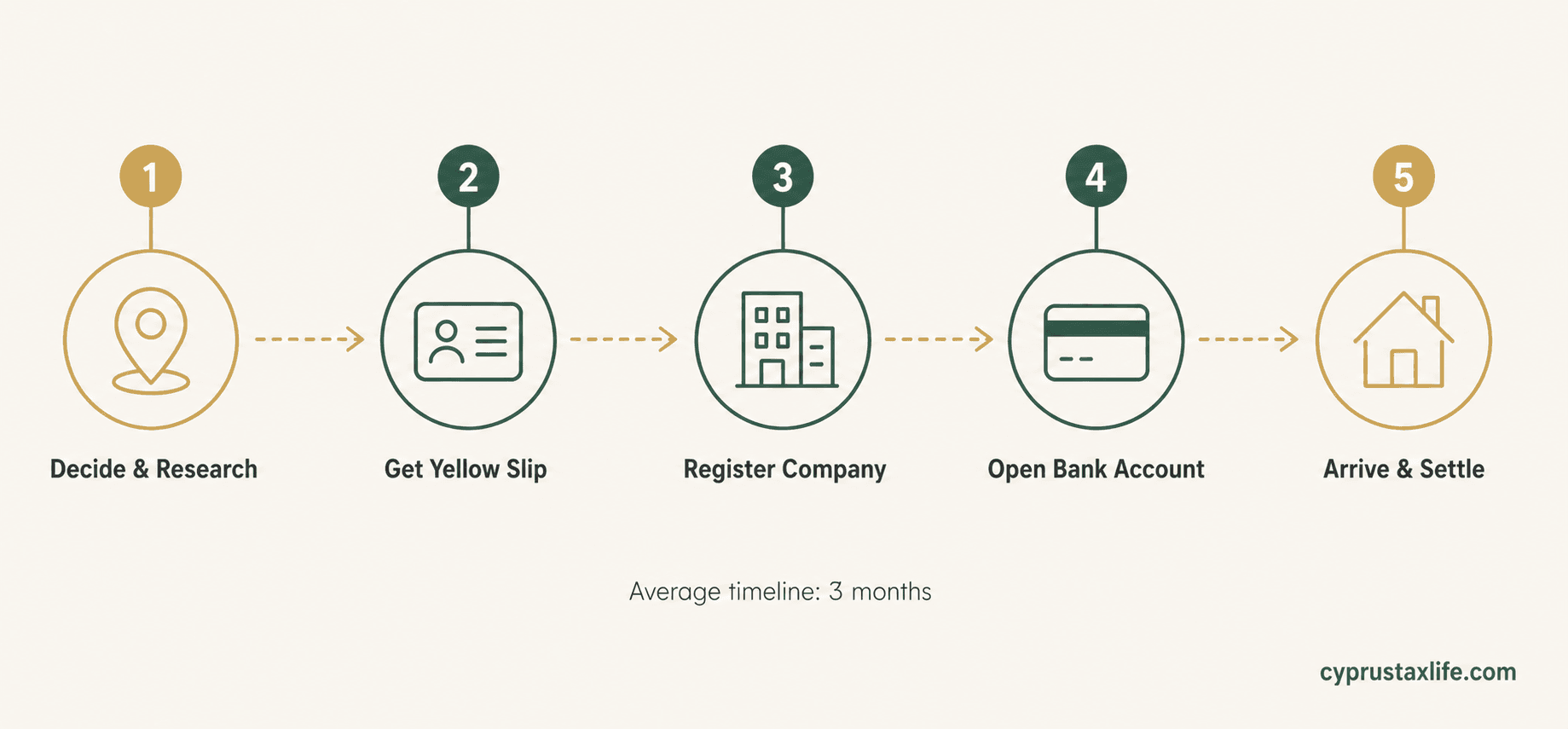
Step-by-Step Relocation Checklist
Assess unrealised CGT gains on all assets before departure — get a valuation for the deemed disposal calculation
Consult an Australian tax adviser on the foreign residency CGT deemed disposal implications
Decide on superannuation strategy: leave in place (usually better) vs DASP (only if balance is small)
Set up a Cyprus Ltd company (5-7 working days, approximately EUR 2,100)
Find accommodation in Cyprus and sign a rental contract (evidence for ATO non-residency claim)
Notify the ATO of your change in residency status
File your final Australian tax return for the year of departure
Notify Australian banks and investment platforms of foreign residency (withholding tax rates change)
Register with Cyprus Tax Department to obtain Tax Identification Number (TIC)
Apply for Cyprus tax residency under 60-day or 183-day rule
Register for Non-Dom status at Cyprus Tax Department
Obtain Category F visa or company director work permit as an Australian (third-country national post-Brexit rules do not apply — but similar non-EU national rules do)
Open a Cyprus bank account
Register for GHS healthcare
Set up payroll: low salary (within EUR 22,000 exempt threshold) + dividends
Retain a Cyprus tax adviser for annual filings and treaty interaction
Frequently Asked Questions
Do I still pay Australian tax after moving to Cyprus?+
What happens to my superannuation when I leave Australia?+
Is there a CGT cost when I stop being an Australian resident?+
Do I need a visa to live in Cyprus as an Australian?+
How does the Australia-Cyprus tax treaty affect my situation?+
Is there an Australian community in Cyprus?+
How much can I save annually by moving from Australia to Cyprus?+
Sources and References
- PwC Worldwide Tax Summaries — Cyprus
- KPMG Cyprus — Tax and Advisory
- EY Cyprus — Tax Services
- Cyprus Ministry of Finance (mof.gov.cy)
Effective rates are approximations for entrepreneur structures (company + low salary + dividends). Consult a qualified tax advisor before making decisions.
Free, no commitment
Moving to Cyprus or opening a company?
Tell us your situation and we'll connect you with our specialist expat advisory in Cyprus: Non-Dom tax, company setup and residency, done for you. Free consultation, no commitment.
Related Articles
Germany's exit tax (§6 AStG) taxes unrealised gains on shares >1% when you emigrate. Moving to Cyprus (EU): you can defer payment indefinitely. Full breakdown for German founders and investors.
 Miriam Alonso
- Tax Planning
- Relocation
Canada's departure tax treats you as having sold your worldwide assets the day you stop being a tax resident. What is caught, what is exempt, how to defer it, and what the cost-base reset means for where you go next.
![Countries With No Property Tax [2026]: The Real Cost](https://cdn.sanity.io/images/glqahhks/production/6f7ea0efceed8a692ad7c3785efa8baaf4d1e208-1679x937.jpg?w=700&q=75&auto=format)
Compare countries with no property tax and the stamp duty they charge instead. See the 10-year holding cost that makes Cayman pricier than Portugal.
Miriam Alonso