Quick Answer

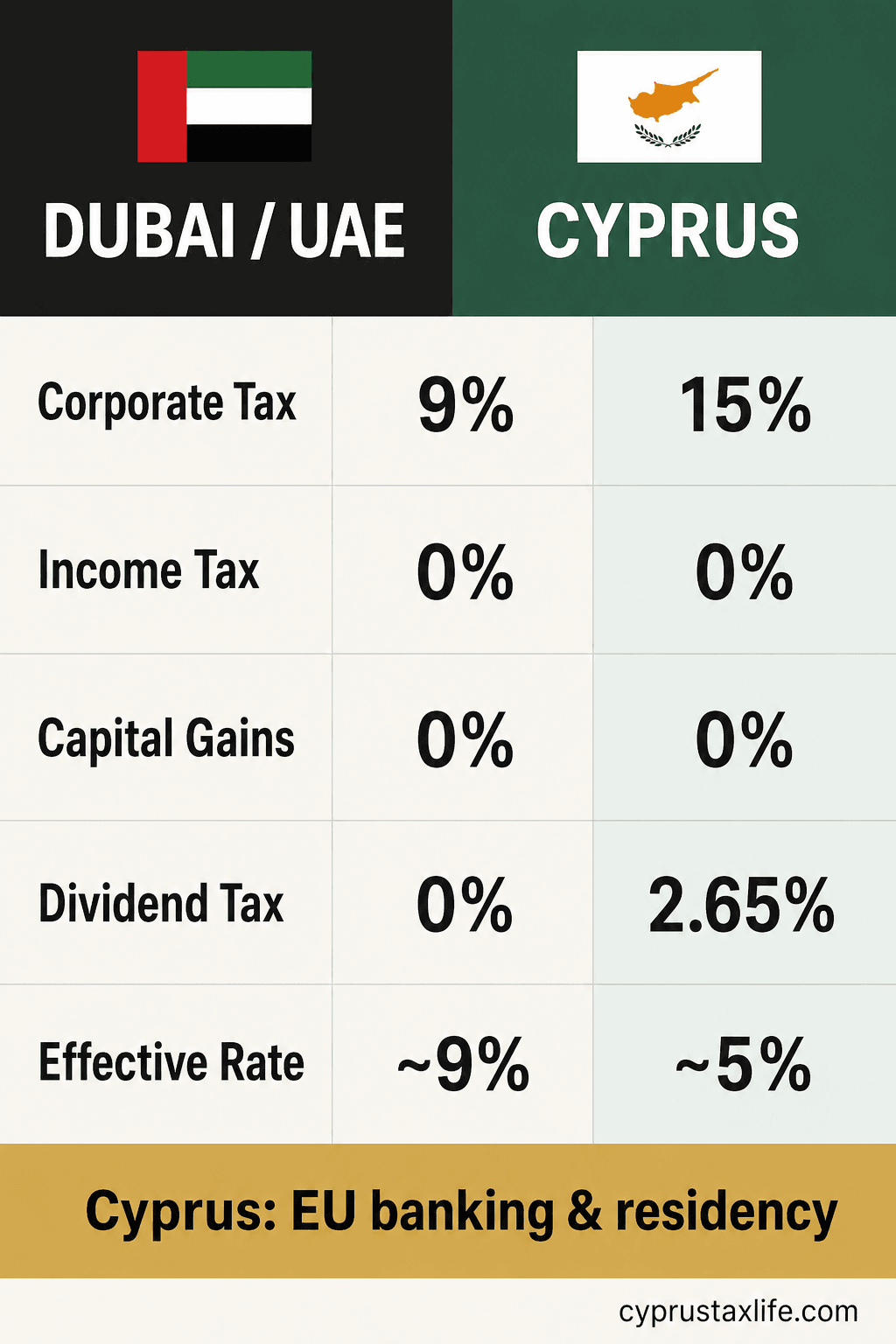
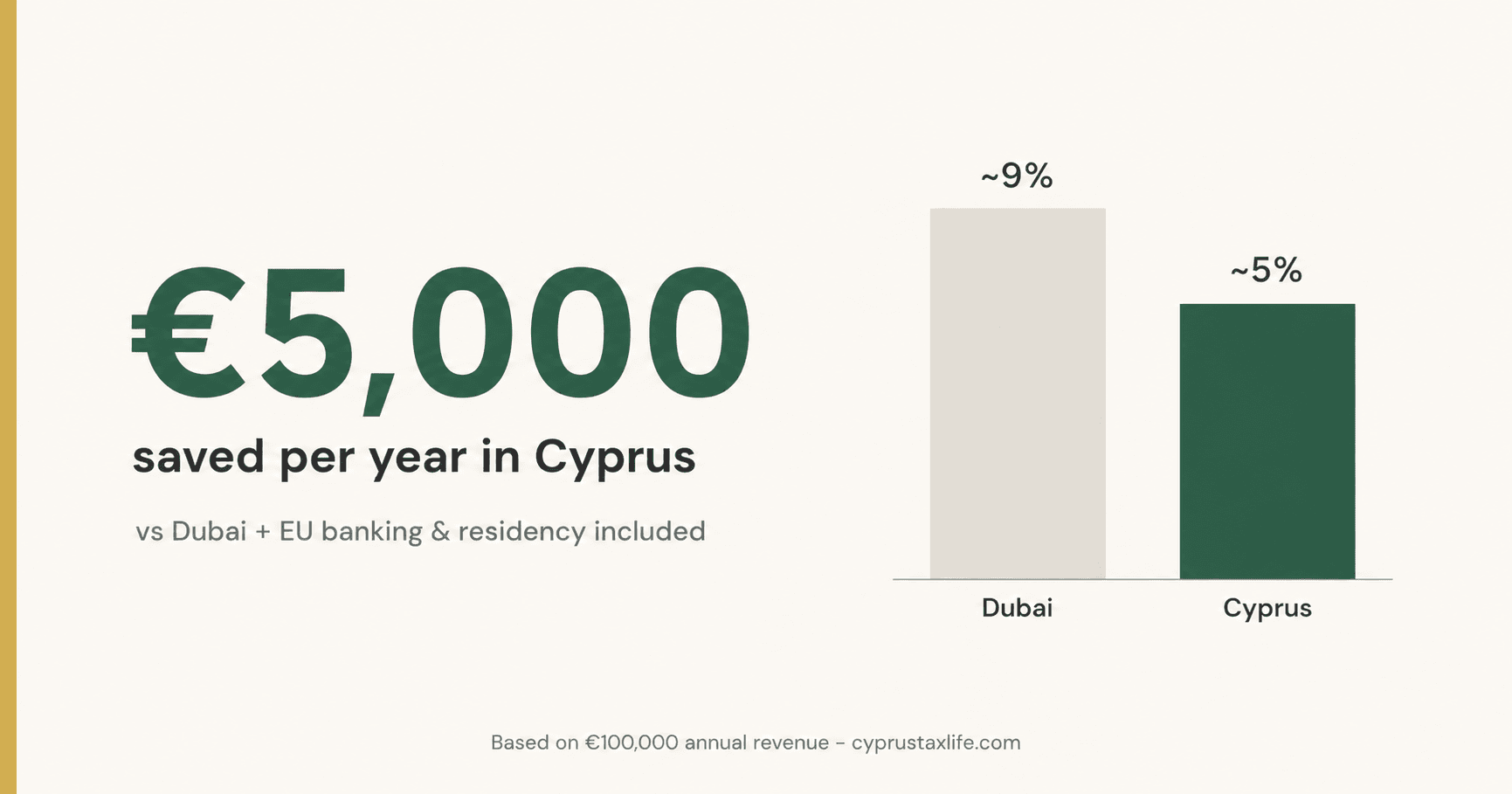
Dubai charges 0% personal income tax, but the real cost of living - housing, flights, schooling, lifestyle - means many entrepreneurs end up spending more than in Cyprus. Cyprus Non-Dom offers ~5% effective tax rate with EU residency, Schengen access, and a cost of living roughly 40% lower than Dubai.

Cyprus vs Dubai [2026]: UAE Zero Tax vs EU 5% Rate

Read time: 8 minutes
Share
Cyprus vs Dubai [2026]: UAE Zero Tax vs EU 5% Rate

The Hidden Costs of Dubai "Zero Tax" That Nobody Mentions

Dubai's zero income tax comes with hidden costs that often exceed Cyprus's competitive rates. While Dubai markets itself as "tax-free," residents face substantial visa sponsorship fees (AED 1,000-2,500 annually), mandatory health insurance (AED 2,000+), real estate transfer taxes (4%), and municipality fees. For digital entrepreneurs earning EUR 50,000-100,000 annually, these hidden costs typically amount to 3-5% of income. Cyprus's Non-Dom regime offers an effective rate of approximately 5% with transparent costs, making it financially comparable or superior for most relocators. The "zero tax" narrative ignores enforcement complexity and economic substance requirements in Dubai that create additional compliance burdens.

The short answer: Dubai has not been zero-tax since June 2023.

The UAE introduced a 9% corporate tax on business profits exceeding 375,000 AED (approximately 95,000 EUR). Free zone companies still advertise 0% tax, but the exemption only applies to qualifying income, a definition far narrower than most people assume.

This article compares Cyprus vs Dubai taxes in full detail, covering corporate tax, personal income, hidden costs, quality of life, and who each option actually works for.

The End of Zero Taxes in Dubai

The UAE abolished its zero-tax status in 2023, introducing corporate tax for the first time in decades. Previously, the emirate had no corporate tax, no personal income tax, and no capital gains tax.

What Changed in 2023

In June 2023, the UAE Federal Corporate Tax Law came into effect. Key provisions:

CategoryDubai Tax Rate
Corporate tax (profit up to 375,000 AED)0%
Corporate tax (profit above 375,000 AED)9%
Free zone qualifying income0%
Free zone non-qualifying income9%
Personal income tax0%
VAT5%
Capital gains (generally)0%

The 375,000 AED threshold is approximately 95,000 EUR. Any entrepreneur or company earning above this now pays 9% corporate tax on the excess.

The Free Zone Reality

Free zones in Dubai (DMCC, JAFZA, DIFC, etc.) still advertise 0% corporate tax. While technically true for qualifying income, the conditions are strict and the setup costs are not:

  • Annual license fees: 10,000-50,000 AED (2,500-12,500 EUR)
  • Visa costs per person: 5,000-10,000 AED (1,250-2,500 EUR)
  • Office or desk requirement: 15,000-60,000 AED per year (3,750-15,000 EUR)
  • Audit requirements: 5,000-15,000 AED (1,250-3,750 EUR)
  • Mandatory health insurance: 5,000-15,000 AED per person per year

These costs apply regardless of revenue and can add up to 15,000-40,000 EUR annually before any business activity begins.

Cyprus: The EU Alternative

Cyprus Non-Dom status offers an effective tax rate of approximately 5%, making it a compelling EU alternative to Dubai for high-net-worth individuals seeking tax efficiency within Europe.

Under Non-Dom status, an entrepreneur operating through a Cyprus limited company achieves:

  • Corporate tax: 15% on net profits (after deductions of 25-35%)
  • Dividend tax: 0% income tax, only 2.65% GHS contribution
  • Capital gains on securities: 0%
  • No wealth tax
  • No inheritance tax on most assets

The effective overall rate for an optimised structure comes to approximately 5%.

Company Setup Costs: Cyprus vs Dubai

CostCyprusDubai Free Zone
Company formation~2,100 EUR5,000-15,000 EUR
Annual maintenance (accounting, VAT, returns)~3,000 EUR/year8,000-20,000 EUR/year
Registered officeIncluded in accounting3,750-15,000 EUR/year
Visa and residence~2,200 EUR (one-time)1,250-2,500 EUR/year per person
Health insuranceGHS: 2.65% of income1,250-3,750 EUR/year (mandatory)
AuditFrom 1,500 EURFrom 1,250 EUR

Cyprus vs Dubai Taxes: Complete Comparison

CategoryCyprus Non-DomDubai
Corporate tax15%9% above 375K AED, or 0% free zone qualifying
Dividend tax0% + 2.65% GHS0%
Personal income tax0% (on dividends)0%
Capital gains on securities0%0%
VAT19%5%
Double tax treaties65+ countries100+ countries
EU membershipYesNo
EU passporting (financial services)YesNo
Cost of living, single monthly1,500-2,500 EUR3,000-5,000+ EUR
Public healthcareYes (GHS)No (private only)

For businesses serving European clients, Cyprus offers a critical advantage: EU membership means no customs barriers, SEPA payments, and full access to EU financial passporting.

Who Pays Less? Three Real Scenarios

Three concrete scenarios show who pays less.

Scenario 1: 50,000 EUR Revenue

ItemCyprus Non-DomDubai Free Zone
Revenue50,000 EUR50,000 EUR
Business deductions (~30%)-15,000 EUR-15,000 EUR
Taxable profit35,000 EUR35,000 EUR
Corporate tax5,250 EUR (15%)0 EUR (under threshold)
Dividends distributed29,750 EUR35,000 EUR
Tax on dividends788 EUR (2.65%)0 EUR
Total tax6,038 EUR0 EUR
Operational costs (annual)~5,100 EUR~18,000 EUR
Total cost (tax + operations)~11,138 EUR~18,000 EUR

At 50,000 EUR revenue, Dubai's zero-tax advantage is completely erased by operational costs. Cyprus ends up approximately 7,000 EUR cheaper overall.

Scenario 2: 100,000 EUR Revenue

ItemCyprus Non-DomDubai Free Zone
Revenue100,000 EUR100,000 EUR
Business deductions (~30%)-30,000 EUR-30,000 EUR
Taxable profit70,000 EUR70,000 EUR
Corporate tax10,500 EUR (15%)0 EUR (qualifying income)
Dividends distributed59,500 EUR70,000 EUR
Tax on dividends1,577 EUR (2.65%)0 EUR
Total tax12,077 EUR0 EUR
Operational costs (annual)~5,100 EUR~20,000 EUR
Total cost (tax + operations)~17,177 EUR~20,000 EUR

At 100,000 EUR, the gap narrows but Cyprus still comes out ahead when factoring in operational costs and cost of living differences.

Scenario 3: 200,000 EUR Revenue

ItemCyprus Non-DomDubai Free Zone
Revenue200,000 EUR200,000 EUR
Business deductions (~30%)-60,000 EUR-60,000 EUR
Taxable profit140,000 EUR140,000 EUR
Corporate tax21,000 EUR (15%)5,940 EUR (9% on excess over 95K)
Dividends distributed119,000 EUR134,060 EUR
Tax on dividends3,154 EUR (2.65%)0 EUR
Total tax24,154 EUR5,940 EUR
Operational costs (annual)~5,100 EUR~22,000 EUR
Cost of living difference (annual)baseline+18,000-30,000 EUR
Total real cost~29,254 EUR~45,940-57,940 EUR

At higher revenue levels, Dubai's pure tax bill is lower. However, significantly higher living costs in Dubai (rent, healthcare, schooling) offset most of that advantage for people who actually live there.

Quality of Life: Beyond the Tax Bill

Dubai's zero income tax rate matters far less than your actual cost of living and lifestyle quality.

Climate

Climate factorCyprusDubai
Summer (Jun-Aug)35-40°C, 90% humidity on coast40-48°C, extreme humidity
Winter (Dec-Feb)10-18°C, mild, 5% rain chance20-28°C, dry and comfortable
Year-round livabilityGood (mild winters, bearable summers)Difficult summers, excellent winters

Healthcare

Cyprus has a universal public healthcare system (GHS/GESY) funded by the 2.65% GHS contribution. This covers GP visits, hospital care, and specialist referrals. Dubai requires private health insurance, which is mandatory and costs 1,250-3,750 EUR per person per year minimum.

Residency Requirements

Cyprus offers the 60-day rule for tax residency: only 60 days of physical presence per year required (with additional conditions). Dubai requires 183 days of actual residence to establish genuine tax domicile.

Housing Costs

Housing typeCyprus (Larnaca)Cyprus (Limassol)Dubai Marina/JBR
1BR apartment/monthEUR 700-900EUR 900-1,300AED 6,000-9,000 (~EUR 1,500-2,250)
2BR apartment/monthEUR 900-1,200EUR 1,200-1,800AED 10,000-16,000 (~EUR 2,500-4,000)

Housing in Cyprus is roughly 40-60% cheaper than equivalent areas in Dubai.

For the full framework behind the Cyprus numbers above: read the guide to Cyprus Non-Dom status, understand the 60-day tax residency rule, and see the full Cyprus dividend tax breakdown.

Who Should Choose Cyprus and Who Should Choose Dubai

**Cyprus and Dubai each suit different profiles.** Choose Cyprus if you earn under EUR 100k annually, prioritize EU residency, or need asset protection with moderate taxes. Choose Dubai if you seek zero income tax, conduct substantial Gulf trade, or prefer complete tax isolation. Your decision hinges on revenue level, business structure, family needs, and lifestyle.

Cyprus is the better choice if you

  • Earn between 50,000 and 300,000 EUR per year, the range where operational cost differences matter most
  • Serve European clients and need EU banking, SEPA, and passporting
  • Want public healthcare without paying private insurance
  • Prefer Mediterranean lifestyle with 4 seasons (mild winters, not extreme summers)
  • Have a family, international schools in Cyprus cost 5,000-12,000 EUR vs 10,000-30,000 EUR in Dubai
  • Value flexibility, the 60-day residency rule means you can spend most of the year elsewhere
  • Want simpler bureaucracy within an EU legal framework

Dubai is the better choice if you

  • Earn above 500,000 EUR, at this level, the 9% corporate tax advantage starts to outweigh cost differences
  • Already have a lifestyle that works in an expensive city
  • Have strong business ties to the Gulf region or MENA markets
  • Prefer a purely commercial environment with no personal income tax on salary
  • Want access to Dubai's international business network and events ecosystem
  • Are comfortable with private-only healthcare and no public safety net

The EU Membership Advantage: What It Actually Means for Business

EU membership cuts your compliance costs and legal risk dramatically if you operate across borders.

Here's why it matters: Cyprus businesses get passporting rights across all EU markets, eliminating duplicate licensing in 27 countries. You apply one set of regulations (GDPR, VAT directives, employment law) instead of managing 27 separate frameworks. Banking and payments settle through the EU clearance system, not correspondent networks. Your intellectual property registration covers the entire bloc with a single filing.

Dubai offers tax breaks. Cyprus offers operational integration worth millions in saved legal fees and faster market entry. That's the real comparison.

  • SEPA payments: send and receive EUR instantly across 36 countries at near-zero cost. Dubai requires SWIFT for most transfers, which costs 15-40 EUR per transaction and takes 1-3 business days.
  • EU VAT registration: sell services to EU business clients with a valid VAT number. Dubai businesses selling into the EU face compliance complexity.
  • Financial passporting: a Cyprus-registered financial services firm can passport its licence into all EU member states. This is not possible from Dubai.
  • Banking relationships: EU banks are comfortable with Cyprus companies. Some EU banks refuse to process payments from UAE entities due to AML screening.
  • Contracts and legal: EU contract law is familiar to European clients. UAE law is less so, and disputes can be harder to resolve.

For a solo entrepreneur or small team focused purely on personal tax optimisation, these factors may be secondary. For any business with European clients, partners, or growth plans, they are significant.

Practical Steps: How to Set Up in Cyprus

Setting up in Cyprus involves five key steps: registering your business with the Registrar of Companies, obtaining a tax identification number from the Tax Department, opening a Cyprus bank account, registering for VAT if turnover exceeds EUR 15,600, and maintaining statutory accounting records. The entire process typically takes 2-4 weeks. You'll need your passport, proof of address, and initial business documentation. Most setup can be completed remotely, though some banks may require in-person verification. Consider engaging a local tax advisor or accountant to navigate registration requirements and ensure compliance with Cyprus tax law from day one.

Step 1: Establish tax residency

Cyprus offers two paths: the 183-day rule (standard) and the 60-day rule (for those who do not have tax residency elsewhere). Under the 60-day rule, you need to spend at least 60 days in Cyprus, not be a tax resident in any other country, have a permanent address in Cyprus (owned or rented), and carry out some business activity in Cyprus.

Step 2: Get your Yellow Slip (MEU1)

EU citizens register their right to reside in Cyprus through the MEU1 certificate, commonly called the Yellow Slip. This is required to open bank accounts, register a company, and interact with most government services. The process takes 1-3 months depending on the district office.

Step 3: Register a Cyprus Ltd

A Cyprus limited company takes approximately 2-4 weeks to register. Total formation cost including legal fees and government charges is around 2,100 EUR. Annual maintenance (accounting, VAT returns, corporate tax return) runs 2,500-4,000 EUR depending on the provider.

Step 4: Apply for Non-Dom status

Non-Dom status is applied for through the Tax Department. It exempts qualifying individuals from Special Defence Contribution (SDC) on dividends and interest for 17 years from first becoming a Cyprus tax resident. This is the mechanism that makes the 0% dividend tax possible for new residents.

Is Dubai really zero tax in 2026?
No. Since June 2023, the UAE charges 9% corporate tax on profits exceeding 375,000 AED (approximately 95,000 EUR). Personal income tax remains 0%, but anyone running a business above that threshold pays corporate tax.
Can I get 0% corporate tax in a Dubai free zone?
Only on qualifying income, which generally means income from other free zone entities or from foreign sources. Revenue from UAE mainland clients or from services delivered to UAE-based customers typically does not qualify, and is taxed at 9%.
How does VAT compare between Cyprus and Dubai?
Cyprus has 19% VAT, Dubai has 5%. However, VAT is a pass-through cost for B2B businesses. For B2C businesses, Dubai's lower VAT is a genuine advantage.
Is it easier to set up a company in Dubai or Cyprus?
Both take 2-4 weeks. Dubai free zone setup can be faster but involves higher upfront costs (5,000-15,000 EUR vs ~2,100 EUR in Cyprus). Cyprus also offers simpler ongoing compliance within the EU framework.
What about banking in each country?
Cyprus banks operate within the EU banking framework (SEPA, SWIFT). Dubai banks are well-connected internationally but outside SEPA, which can complicate European transactions and client payments.
Can I live in Dubai and have a Cyprus company?
Technically possible, but this raises substance and tax residency questions. Tax authorities in your home country and in Cyprus both look at where you actually manage and control the company. This setup requires careful structuring and legal advice.
Which is better for crypto businesses?
Both offer favourable treatment. Dubai has positioned itself as a crypto hub with the VARA regulatory framework. Cyprus has 0% capital gains on crypto sales for individuals and 0% dividend tax for Non-Dom residents. Cyprus has the advantage of EU regulatory clarity.
What about cost of living with families?
The gap widens significantly with families. International schools in Dubai cost 10,000-30,000 EUR per child per year. In Cyprus, international schools cost 5,000-12,000 EUR. Public schooling is available in Cyprus at low cost.

Sources: Cyprus Tax Department · Dubai Government, Cost of Living · KPMG Cyprus Tax Summary 2026

If this is the direction you are heading in, Book a consultation with our Cyprus tax specialists.


Stay Updated on Cyprus Tax Changes

Join our newsletter for the latest on Non-Dom benefits, tax regulations, and relocation tips.

I want updates on:

Join 500+ expats already subscribed|2,000+ guides downloaded

No spam. Unsubscribe anytime. Please use a real email, your free content will be delivered by email.

Related Articles

Best IP Box Regimes in Europe 2026: Cyprus, Netherlands, Ireland, Luxembourg Compared

Compare the best IP box regimes in Europe: Cyprus 2.5%, Luxembourg 5.2%, Ireland 6.25%, Netherlands 9%. NEXUS rules, qualifying IP, and which regime suits SaaS and software companies.

Miriam AlonsoMiriam Alonso

  • Tax Planning
Exit Tax Germany 2026: Wegzugsteuer Explained for GmbH Owners

Germany's Wegzugsteuer applies to GmbH shareholders with 1%+ stake who have been resident for 10+ years. Learn the rates, the 7-instalment EU option, and how Cyprus interacts with it.

Miriam AlonsoMiriam Alonso

  • Tax Planning
Exit Tax Netherlands 2026: Dutch Emigration Levy Explained

The Dutch exit tax (conserverende aanslag) applies to substantial shareholdings and pension rights when you leave. Learn rates, EU deferral rules, and how Cyprus interacts with it.

Miriam AlonsoMiriam Alonso

  • Tax Planning