Larnaca vs Limassol for Expats: Cost, Community, Quality...

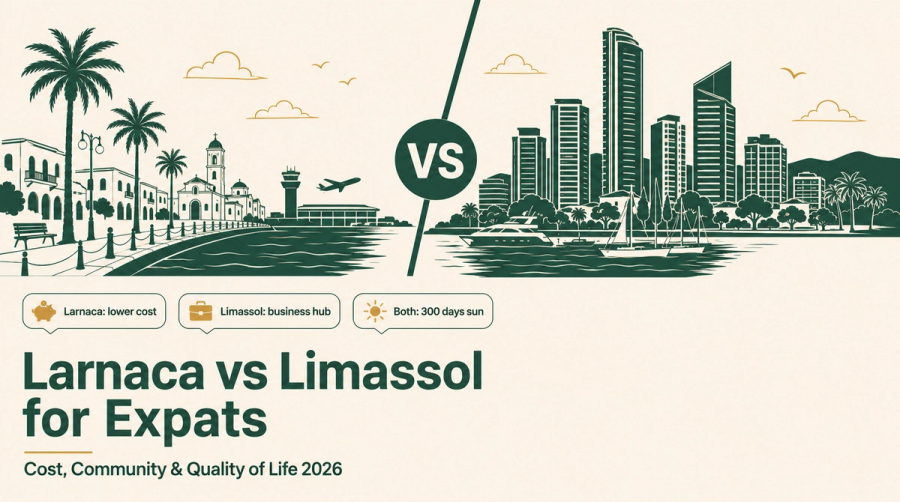
The first question every expat moving to Cyprus eventually asks is: Larnaca or Limassol? Both are coastal cities with EU residency, warm weather, and English-speaking professional services. But they attract very different types of people, and the choice matters more than most newcomers expect.
This guide compares the two cities head-to-head on the criteria that actually matter for expats: cost of living, community, airport access, business infrastructure, and quality of life. For a full breakdown of each city individually, see the Larnaca city guide and the Limassol city guide.
Quick Comparison: Larnaca vs Limassol at a Glance
| Factor | Larnaca | Limassol |
|---|---|---|
| 1BR apartment rent | €700-900/month | €1,100-1,500/month |
| 2BR apartment rent | €900-1,300/month | €1,500-2,200/month |
| Vibe | Quiet, residential, authentic | Cosmopolitan, business-driven |
| International airport | Yes, Larnaca International | No, 70km to Larnaca, 40km to Pafos |
| Business hub | Moderate | Strong, many international companies |
| Expat community | Mixed, calmer | Large Russian/Israeli/British community |
| Nightlife | Low-key | Active, bars, clubs, marina |
| Private hospitals | Good | Better, more choice |
| Traffic | Manageable | Heavy, especially peak hours |
| Best for | Remote workers, families, retirees | Founders, professionals, networkers |
Quick comparison, the key differences between Larnaca and Limassol for expats:
- Cost: Larnaca rents are 30-40% lower than Limassol for equivalent properties
- Airport: Larnaca International Airport is 5 min from central Larnaca; Limassol is 60-75 min
- Business: Limassol is the financial hub, most accountants, law firms, and corporate advisors are there
- Nightlife and dining: Limassol wins clearly, broader restaurant scene, more bars, busier promenade
- English: Both are equally English-friendly; expat communities strong in both cities
- Beaches: Larnaca has better accessible city beaches; Limassol has more beach bars
- Traffic: Limassol traffic is noticeably worse, especially in summer and peak hours
- Family-friendliness: Both excellent for families; similar school options
- Recommendation: If your accountant and company are in Limassol, live there. If your priority is lower costs and airport access, Larnaca is the better value.
Cost of Living: Larnaca Wins on Price
The single biggest practical difference between Larnaca and Limassol is rent. In 2026, a one-bedroom apartment in a decent Larnaca neighbourhood, Mackenzie, Drosia, Oroklini, runs €700-900 per month unfurnished. The same apartment in Limassol, in areas like Neapolis, Germasogeia or close to the marina, costs €1,100-1,500. For a two-bedroom, the gap widens further.
Monthly rent comparison (2026 estimates):
| Apartment type | Larnaca | Limassol |
|---|---|---|
| Studio | €500-650 | €750-1,000 |
| 1 bedroom | €700-900 | €1,100-1,500 |
| 2 bedrooms | €900-1,300 | €1,500-2,200 |
| 3 bedrooms (family) | €1,200-1,800 | €2,000-3,500 |
Outside rent, day-to-day costs are broadly similar. Supermarkets (Lidl, Alphamega, Papantoniou) have comparable prices across both cities. A restaurant meal for two at a mid-range spot is €30-45 in both locations. Coffee is €2-3. The real gap is accommodation, everything else is roughly equal.
Full breakdown of numbers: Cost of Living in Cyprus (2026)
Lifestyle and Community
Larnaca has a reputation for being quieter and more authentically Cypriot. The old town around Finikoudes promenade and Hala Sultan Tekke mosque retains a local character. The expat community exists, plenty of digital nomads, retirees, and families from the UK, Eastern Europe and the Middle East, but it has not replaced the local identity. McKenzie beach is genuinely beautiful and rarely overcrowded outside peak summer.
Limassol is Cyprus's second-largest city and functions as its commercial capital. The marina area, Molos promenade, and the rebuilt old town have a cosmopolitan energy. The Russian and Israeli expat communities are very visible, there are Russian-language schools, Israeli restaurants, and business networks that run almost entirely in those communities. British expats cluster in particular neighbourhoods and beach clubs.
The tradeoff is real: Limassol offers more social variety, more international restaurants, better rooftop bars, and a busier events calendar. Larnaca is slower, cheaper, and gives you more of an actual Cyprus experience rather than a pan-European expat bubble.
Business Infrastructure and Networking
For anyone running or growing a business, Limassol has a clear advantage. The city hosts a high concentration of international companies, fintech firms, crypto companies, shipping, and tech startups, many of which relocated from Russia, Israel, Ukraine, and the UK in the past few years. This creates a dense professional network that does not exist to the same degree in Larnaca.
Limassol's co-working scene is more developed. Events, startup meetups, and professional networking happen there with regularity. Law firms, accounting firms, and corporate service providers with international client bases are more concentrated in Limassol than anywhere else in Cyprus.
Larnaca has grown its business infrastructure but remains more suited to remote workers who do not need local networking. Most professional service providers (accountants, lawyers, company formation agents) are available in both cities, but the depth of the Limassol ecosystem is noticeably greater.
Airport Access: A Practical Consideration
This point is underrated by most city comparisons but matters significantly for frequent travellers. Larnaca has its own international airport, Larnaca International, which is one of the two main airports serving Cyprus. It handles the majority of international routes including direct flights to the UK, Germany, France, the UAE, Israel, and most major European destinations.
Limassol has no airport. Residents must travel to either Larnaca International (approximately 70km, around 45-60 minutes by car depending on traffic) or Pafos International (approximately 40km, 30-40 minutes). In practice, most Limassol residents use Pafos for short-haul European flights and Larnaca for intercontinental or less-served routes.
For a remote worker or frequent business traveller, living 10 minutes from Larnaca airport versus 40-60 minutes from the nearest airport is a real quality-of-life difference. Early morning flights, frequent trips, or families with children will feel this more acutely.
Who Should Choose Larnaca?
Larnaca is the better choice if you prioritise lower cost, proximity to the airport, a quieter environment, and a more authentic Cypriot experience. It suits:
Remote workers and digital nomads with no need for local business networking. Families looking for more space per euro. Retirees or people who want to slow down. Frequent travellers who value living 10 minutes from the airport. People moving from a large city who want a genuine change of pace.
The savings on rent alone, typically €300-600 per month compared to Limassol equivalents, compound quickly. Over a year that is €3,600-7,200 back in your pocket for a comparable apartment. The beaches are excellent, the climate identical, and the essential services are all present.
Who Should Choose Limassol?
Limassol is the better choice if local networking, business development, and urban lifestyle are priorities. It suits:
Founders and entrepreneurs building companies in Cyprus who need access to a professional ecosystem. Employees of international companies already based in Limassol. People who want an active social life, bars, restaurants, events, and a cosmopolitan community. Those who specifically want to be embedded in the Russian-speaking or Israeli business community. Professionals in fintech, crypto, shipping, or legal services where the Limassol network has real value.
The higher cost of living in Limassol is a real consideration, but for many professionals the business ecosystem justifies it. The city has better private hospital options, a more developed service infrastructure, and a social scene that Larnaca genuinely cannot match.
Can You Live in Both?
Many expats do exactly this. Cyprus is a small island, Larnaca and Limassol are connected by the A1 motorway and the drive between city centres takes around 45 minutes. It is entirely practical to live in Larnaca and commute to Limassol for meetings, networking events, or social occasions.
A common pattern for self-employed professionals: live in Larnaca (lower rent, airport access, quieter home environment), work remotely, and drive to Limassol once or twice a week for client meetings or business networking. You get the cost advantage of Larnaca with access to the Limassol ecosystem when needed.
Some expats spend their first year in Limassol to establish their network and understand the landscape, then relocate to Larnaca once they are settled and no longer need daily proximity to the business hub. Both approaches are common and practical.
Frequently Asked Questions
Is Larnaca cheaper than Limassol?
Which city is better for expats: Larnaca or Limassol?
Does Limassol have an airport?
Is Limassol worth the extra cost compared to Larnaca?
Can I live in Larnaca and work in Limassol?
Thinking about relocating to Cyprus? Speak with a specialist
![Cyprus Ltd vs Irish Ltd: Company Tax Compared [2026]](https://cdn.sanity.io/images/glqahhks/production/84e3d82538a859345d8d2447e8e097c5777fb238-1679x937.png?w=700&q=75&auto=format)
![Cyprus vs Malta Company Formation [2026]](https://cdn.sanity.io/images/glqahhks/production/97db89d0ce729a9e931d09bc1522631faa6c3474-1679x937.png?w=700&q=75&auto=format)