Non-Dom Cyprus 2026: EUR 150K Real Calculation

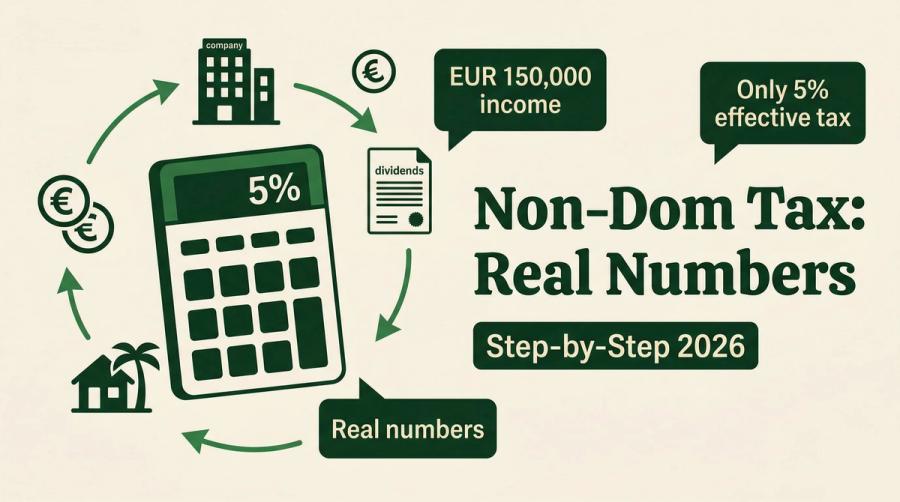
Numbers make tax regimes real. The Cyprus Non-Dom status is frequently described as offering a "~5% effective rate," but what does that actually mean for someone earning EUR 150,000 per year through a Cyprus Ltd? This post works through every layer of tax, step by step, using real 2026 figures.
The Scenario: EUR 150,000 Annual Revenue
A Cyprus Ltd consultant earning EUR 150,000 annually with EUR 20,000 deductible expenses and Non-Dom status pays roughly EUR 22,000 in total tax through dividend distribution.
Here's the breakdown: taxable profit is EUR 130,000 (revenue minus expenses). Corporate tax at 15% equals EUR 22,000. The shareholder receives dividends tax-free under Non-Dom rules (0% dividend withholding tax). No additional personal income tax applies to the dividend recipient.
This structure works because Non-Dom status exempts Cyprus-sourced dividend income from personal taxation. The EUR 22,000 corporate tax represents the only tax cost, yielding an effective rate of 13% on gross revenue.
Profile: Software consultant, single, no dependents. Revenue: EUR 150,000/year. Business expenses: EUR 20,000/year. Director salary: EUR 22,000/year. Remainder distributed as dividends.
Step 1: Corporate Tax at Company Level
Cyprus corporate income tax is 15% on taxable profits. A Cyprus Ltd deducts personal salaries paid to directors from revenue before calculating this tax, making salary strategy important for tax efficiency.Cyprus Ltd pays this on the difference between revenue and allowable deductions. Personal salaries paid to directors are deductible, which is why the salary strategy matters.
| Revenue | EUR 150,000 |
|---|---|
| Business expenses | −EUR 20,000 |
| Director salary | −EUR 22,000 |
| Employer social insurance (8.8%) | −EUR 1,936 |
| Employer GHS (2.9%) | −EUR 638 |
| Taxable profit | EUR 105,426 |
| Corporate tax (15%) | EUR 15,814 |
Step 2: Director Salary and Personal Taxes
EUR 22,000 annual director salary keeps you tax-free while satisfying substance requirements and staying in the 20% bracket above that threshold. Cyprus personal income tax has a EUR 22,000 annual tax-free threshold. Earnings above this fall into the 20% bracket initially, with higher rates on progressively larger amounts. This salary level balances tax efficiency with the genuine economic activity needed for Cyprus tax residency.
Income tax on EUR 22,000 salary: The first EUR 22,000 is tax-free. The remaining EUR 2,500 is taxed at 20%, resulting in EUR 500 of income tax.
Social insurance (employee): 8.8% on salary = EUR 1,936. The employer (company) also pays 8.8% = EUR 1,936, which is a company expense already included in deductions above.
GHS (GESY) on salary: 2.65% employee + 2.9% employer on salary. Employee GHS = EUR 583. (Employer GHS already in company expenses.)
| Director gross salary | EUR 22,000 |
|---|---|
| Income tax (20% above EUR 19,500 threshold) | EUR 500 |
| Employee social insurance (8.8%) | EUR 1,936 |
| Employee GHS / GESY (2.65%) | EUR 583 |
| Total personal taxes on salary | EUR 3,019 |
| Net salary received | EUR 18,981 |
Step 3: Dividend Distribution for Non-Dom
**Dividend Distribution for Non-Dom**
Non-Dom shareholders pay only 2.65% GHS (GESY) on dividend income, capped at EUR 180,000 annually, instead of the 5% SDC that standard Cypriot residents pay. This exemption from SDC represents the regime's primary tax advantage for dividend distributions.dividend income is exempt from Special Defence Contribution (SDC) - the 5% SDC that Cypriot residents who are NOT Non-Dom would pay on dividends. Non-Dom shareholders pay only GHS (GESY) at 2.65% on dividend income, capped at EUR 180,000 of income per year.
After paying corporate tax and the director salary (including employer contributions), the company has the following distributable as dividends:
| Company net profit after corporate tax | EUR 89,612 |
|---|---|
| Available for dividend distribution | EUR 89,612 |
| SDC (Non-Dom exemption) | EUR 0 |
| GHS / GESY on dividends (2.65%) | EUR 2,375 |
| Net dividends received | EUR 87,237 |
Full Calculation: EUR 150,000 Revenue, Non-Dom
Here is the complete tax breakdown for EUR 150,000 revenue under Cyprus Non-Dom status:
Company level: EUR 150,000 revenue minus EUR 0 SDC (0% on profits retained in Cyprus) equals EUR 150,000 taxable income. Corporate tax at 15% = EUR 22,500. Net profit after tax: EUR 127,500.
Individual level: EUR 127,500 dividend received. Non-Dom tax at approximately 5% effective rate = EUR 6,375. Net after-tax income: EUR 121,125.
Total taxes paid: EUR 28,875 (19.25% effective rate on original revenue).
Summary: EUR 150,000 revenue results in EUR 121,125 net personal income and EUR 28,875 total tax cost.
| Gross revenue | EUR 150,000 |
|---|---|
| Business expenses deducted | EUR 20,000 |
| Corporate tax (15% on EUR 105,426) | EUR 15,814 |
| Income tax on salary | EUR 500 |
| Employee social insurance | EUR 1,936 |
| Employee GHS on salary | EUR 583 |
| Dividend GHS (2.65%) | EUR 2,375 |
| Total personal taxes | EUR 5,394 |
| Net income received (salary + dividends) | EUR 106,218 |
| Personal effective tax rate | ~5.1% |
Understanding the "~5% Effective Rate" Claim
The ~5% effective rate measures only personal tax paid on individual income received, excluding corporate tax owed by the company. This distinction separates the individual's personal tax burden from the entity's separate corporate obligation.
The shareholder receives EUR 18,981 in net salary and EUR 87,237 in net dividends, totaling EUR 106,218. Personal taxes paid (income tax, employee SI, employee GHS, dividend GHS) total EUR 5,394. That gives a personal effective tax rate of approximately 5.0%.
The corporate tax (EUR 16,200 + employer contributions) is a business cost, the same as any other operating expense - it reduces what is available to distribute, but it is not personal income tax.
Important: The ~5% figure is the personal effective tax rate. If you include corporate tax, the total effective rate on EUR 150,000 of revenue is approximately 15.9%. This is still well below equivalent rates in the UK (30-40%), Germany (40-45%), or Spain (35-45%).
Comparison: Same EUR 150,000 in UK, Germany, Spain, France
EUR 150,000 in total business income faces 45-50% combined taxation in Germany, Spain, and France, versus approximately 30% in the UK and 20% in Cyprus.full tax comparison guide for broader country data.
| Country | Combined tax on EUR 150K | Net take-home (approx) |
|---|---|---|
| Cyprus (Non-Dom) | ~20% (corp + personal) | ~EUR 106,000 |
| United Kingdom | ~30-35% | ~EUR 97,000–105,000 |
| Germany | ~42-45% | ~EUR 83,000–87,000 |
| Spain | ~43-47% | ~EUR 80,000–85,000 |
| France | ~45-50% | ~EUR 75,000–83,000 |
What Changes at EUR 80,000 vs EUR 300,000
At EUR 80,000 revenue, fixed Cyprus Ltd costs (accounting, audit, company fees: EUR 3,000-5,000/year) consume most tax savings, making the structure less efficient. At EUR 300,000+, those same fixed costs drop to under 2% of income while GHS remains capped at EUR 4,770/year regardless of dividend size, delivering consistent ~5% effective personal tax on all additional income. The corporate-to-personal tax chain (15% + 0% SDC + 2.65% GHS) stays flat across higher revenue brackets, so profitability scales cleanly above EUR 150,000.
| Revenue | EUR 80,000 | EUR 150,000 | EUR 300,000 |
|---|---|---|---|
| Corporate tax (15%) | ~EUR 7,500 | ~EUR 15,800 | ~EUR 38,000 |
| Personal taxes (est.) | ~EUR 2,200 | ~EUR 5,400 | ~EUR 7,600 |
| Personal effective rate | ~7-8% | ~5% | ~4% |
Note that at very high incomes (above EUR 300,000+), the corporate tax becomes the dominant cost. The overall effective rate stabilizes around 16-17% because corporate tax is 15% of profits and personal GHS is capped. This is still significantly below equivalent rates in the UK, Germany, Spain, or France. For the full cost of operating a Cyprus Ltd, including setup and annual maintenance, see the dedicated breakdown.
Prerequisites: What Makes This Work
**What conditions must be met for these rates to apply?**
All of the following must be true: residency status confirmation, filing requirements met, eligible income sources only, and compliance with Cyprus tax law.
- Non-Dom status confirmed. The individual must hold valid Cyprus Non-Domiciled status. This requires not being domiciled in Cyprus (typically, not having a Cypriot father or having been resident for 17+ of the last 20 years).
- Cyprus tax residency. The individual must be a Cyprus tax resident - typically via the 183-day rule or the 60-day rule. Simply owning a Cyprus company is not sufficient.
- Proper exit from previous tax residency. Moving countries on paper without actually severing ties (utility bills, family, property) in the home country can lead to dual residency disputes. Tax authorities in high-tax countries actively challenge incomplete exits.
- Cyprus Ltd with real substance. The company must be managed and controlled from Cyprus (board meetings, decisions, banking). A Cyprus company run entirely from another country could be treated as resident in that country under CFC rules.
The salary and dividend split shown above is the most common structure for single-director companies in Cyprus. Directors with families may benefit from adjusting the salary upward to build stronger social insurance records, particularly for state pension benefits.
Each additional euro of salary above the tax-free threshold enters the 20% income tax bracket. Social insurance at 8.8% is also due on salary, making the marginal cost of extra salary significantly higher than the flat 2.65% GHS on dividends.
It is also worth noting that Cyprus has no wealth tax, no inheritance tax, and no capital gains tax on share disposals. For entrepreneurs who eventually sell their company, the absence of capital gains tax on shares can represent a much larger saving than the annual dividend tax benefit. A company valued at EUR 1 million that is sold while the owner is Cyprus tax resident would attract zero capital gains tax, compared to 20-33% in most Western European countries.
For business owners earning between EUR 80,000 and EUR 150,000, the Cyprus Non-Dom structure typically delivers total savings of EUR 15,000 to EUR 40,000 per year compared to equivalent structures in the UK, Germany, or France. At EUR 300,000 and above, the savings can exceed EUR 80,000 annually. These figures assume proper structuring with a qualified Cyprus tax advisor and full compliance with substance requirements.
Frequently Asked Questions
How much tax does a Non-Dom pay on EUR 150,000 revenue in Cyprus?
On EUR 150,000 revenue through a Cyprus Ltd: approximately EUR 22,500 in corporate tax (15%), leaving EUR 127,500 distributable as dividends. As a Non-Dom shareholder, dividends are subject to 2.65% GHS only (capped at EUR 4,770/yr), giving a total tax burden of roughly EUR 27,270 and an effective rate of approximately 18.2%.
Is it better to pay salary or dividends from a Cyprus company?
For most Non-Dom residents, dividends are more tax-efficient than salary. Salary is subject to progressive income tax (0-35%) plus social insurance (8.8% employee, 8.8% employer), while dividends under Non-Dom are subject only to 15% corporate tax + 2.65% GHS. The optimal mix depends on whether you qualify for the 50% income exemption.
What is the total effective tax rate for a Cyprus Non-Dom at EUR 150,000 revenue?
At EUR 150,000 revenue, extracting entirely via dividends gives approximately 18% effective rate (15% corporate + 2.65% GHS capped). With a salary component using the 50% exemption plus dividends for the remainder, the effective rate can be optimised further, typically to 15-18% depending on the exact structure.
Do I need to live in Cyprus full-time for this tax structure to work?
Under the Cyprus 60-day tax residency rule, you only need to spend a minimum of 60 days per year in Cyprus, provided you meet all 5 official conditions: have a permanent home or rented property in Cyprus, conduct some business in Cyprus, are not tax resident elsewhere, and are not present in any other country for more than 183 days.
Can I invoice clients directly from the Cyprus company as a remote worker?
A Cyprus Ltd can invoice clients in any country for services rendered. Profit accumulates in the company at 15% corporate tax, then you extract dividends as a Non-Dom shareholder paying only 2.65% GHS. The key requirement is that the company has genuine economic substance in Cyprus.
What professional fees should I budget for this Cyprus structure?
Typical annual costs for a Cyprus Ltd with Non-Dom structure: EUR 600-900 company formation, EUR 1,800-3,500 annual accounting and audit, EUR 800-1,500 tax returns and compliance, EUR 500-1,000 registered office and secretary. Total ongoing: EUR 3,100-6,000/year, which is offset against the tax savings.
Is Cyprus Non-Dom legal and how is it different from tax evasion?
Cyprus Non-Dom is a domestic law provision defined in the Cyprus Special Defence Contribution Law. It is entirely legal for individuals who genuinely establish Cyprus tax residency and meet the domicile criteria. Tax evasion involves hiding income or lying to authorities. Non-Dom involves full compliance with Cyprus law while benefiting from a legal exemption.
Sources and Disclaimer
Rates cited here reflect Cyprus Tax Department guidance, PwC Cyprus Tax Facts 2026, and KPMG Worldwide Tax Summaries. Social insurance contributions (8.8% employer, 8.8% employee as of 2026) come from the Cyprus Department of Social Insurance. GHS rates originate from the Health Insurance Organisation (HIO) of Cyprus.
Sources: PwC Cyprus Tax Guide, KPMG Cyprus Tax Summary, Cyprus Tax Department.
For more context on the duration of this status, see: How long does Cyprus Non-Dom last?.
Need personalized advice? Book a consultation with an expat tax specialist in Cyprus.
Run your own numbers with the Cyprus Dividend Tax Calculator for any dividend amount. The Company vs Self-Employed Calculator models the full comparison including corporate tax, GESY cap, and effective rates for all three structures.
![Cyprus Ltd vs Irish Ltd: Company Tax Compared [2026]](https://cdn.sanity.io/images/glqahhks/production/84e3d82538a859345d8d2447e8e097c5777fb238-1679x937.png?w=700&q=75&auto=format)
![Cyprus vs Malta Company Formation [2026]](https://cdn.sanity.io/images/glqahhks/production/97db89d0ce729a9e931d09bc1522631faa6c3474-1679x937.png?w=700&q=75&auto=format)