Retire Tax-Free in Cyprus: Complete 2026 Guide for Expats

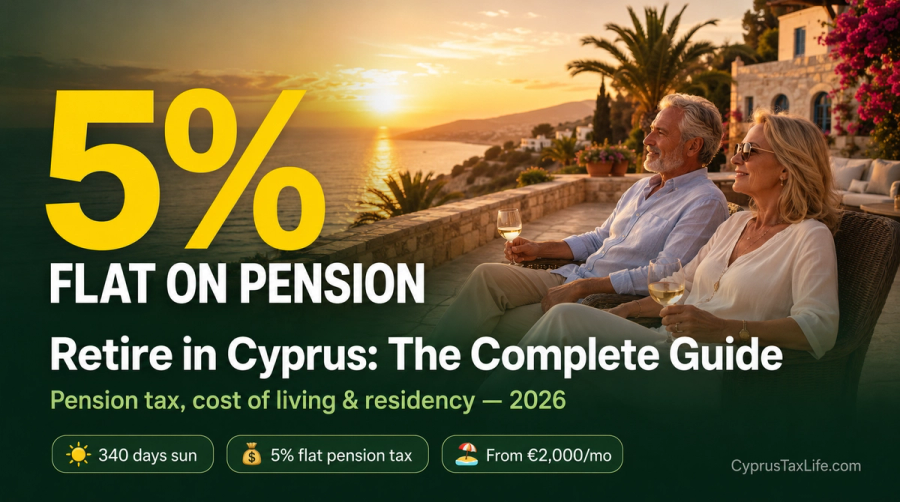
Retiring in Cyprus is not a new idea, but it has become significantly more attractive in recent years as more retirees look beyond Spain and Portugal for their next chapter. Cyprus offers a combination that is hard to find elsewhere in Europe: year-round sunshine, low crime, English widely spoken, EU membership, modern healthcare through the GESY system, and a tax regime that treats pension income and investment returns favourably.
For full documents, costs and processing times, see the Cyprus Yellow Slip (MEU1) complete guide.
Retiring abroad is a major decision, and the marketing materials rarely tell you the full story. This guide covers the real picture: how pension income is taxed in Cyprus, what visa options exist for non-EU retirees, how GESY works and what it costs, what daily life actually costs in different parts of the island, and the honest pros and cons that should inform your decision.
Cyprus Pension Tax: The Numbers That Matter
Foreign pension income in Cyprus is taxed under one of two regimes you can elect. The choice you make determines your tax liability for all future pension distributions.
Per PwC Cyprus Tax Facts 2026, rates and thresholds are current as of 1 January 2026.
Option 1: Flat 5% rate on foreign pension income. Foreign pensions received by Cyprus tax residents are taxed at a flat rate of 5% on the amount exceeding 3,420 euros per year. The first 3,420 euros of annual pension income is tax-free under this option. This flat rate is available as an annual election: you can choose it in any year where it is more advantageous.
| Tax Type | Rate in Cyprus | Notes |
|---|---|---|
| Personal income tax | 0% up to €22,000 | Then 20-35% progressively |
| UK/EU pension income | 5% flat (above €3,420/year) | Double tax treaty benefit |
| Dividends (Non-Dom) | 0% + 2.65% GHS | No SDC for non-domiciled residents |
| Capital gains on property | 20% CGT | Primary residence exemption up to €85,430 |
| Inheritance tax | 0% | Cyprus abolished inheritance tax in 2000 |
| Wealth tax | 0% | No annual wealth or net worth tax |
| VAT on day-to-day | 9% (reduced rate on most goods) | Standard rate 19%, but reduced on essentials |
Option 2: Normal progressive rates. Alternatively, you can apply the standard Cyprus income tax scale, which starts with a 0% band up to 22,000 euros per year. If your pension income is below 22,000 euros annually, you would pay zero income tax under the normal scale.
In practice, most retirees with moderate pension incomes will find the normal progressive scale more favourable (because the first 22,000 euros is tax-free), while those with higher pension incomes may prefer the flat 5% rate.
Important: UK state pension and most private pensions paid from the UK are treated as foreign source income in Cyprus. Under the tax treaty between Cyprus and the UK, most private pension income is taxable only in the country of residence (Cyprus), not in the country of source (UK). This means UK retirees living in Cyprus typically pay 0% or 5% on their UK pension, rather than the higher UK rates that would apply if they remained in the UK.
The specific rules depend on the type of pension (government vs. private) and the applicable tax treaty. A Cypriot tax adviser can confirm the position for your specific situation.
Investment Income and Non-Dom Status for Retirees
Retirees with investment income can benefit from Cyprus's Non-Dom regime, which applies to dividends, interest, and fund distributions. The effective tax rate on Non-Dom investment income is approximately 5% (combining the 0% corporate rate with the 2.65% defence contribution, capped at EUR 4,770 annually). This makes Cyprus particularly attractive for retirement income planning.Non-Dom regime is highly relevant here.
If you qualify as Non-Domiciled in Cyprus (which is the case for most people who move to Cyprus from abroad and have not lived there for most of their lives), dividends and interest income from abroad are subject only to the 2.65% GHS healthcare contribution. There is no additional income tax. The effective rate on dividend income for Non-Dom residents is approximately 5%.
This compares very favourably with the UK (where dividend income above the annual allowance is taxed at 8.75%, 33.75%, or 39.35% depending on your income tax band) or France (where the default rate on dividends is 30% under the PFU). Read more about dividend tax in Cyprus.
Capital gains: Cyprus does not levy capital gains tax on gains from the sale of shares in companies that do not hold Cypriot real estate. If you hold an investment portfolio and plan to draw it down in retirement, gains on share disposals are not taxed in Cyprus.
Visa Options for Retiring in Cyprus
EU and EEA citizens can live in Cyprus without a visa, but must register with the Civil Registry and Migration Department within four months if staying longer than three months (obtaining a Yellow Slip/MEU1 form). Long-term residency requires proof of sufficient financial resources to avoid relying on Cypriot social assistance and valid health insurance.
If you are a citizen of an EU or EEA country, you have the right to live in Cyprus without a visa. You will need to register with the Civil Registry and Migration Department (receiving a Yellow Slip, officially the MEU1 form) within four months of arrival if you plan to stay longer than three months. For long-term residency you need to demonstrate you have sufficient resources to support yourself without relying on Cypriot social assistance, plus proof of health insurance.
Non-EU citizens (including UK citizens post-Brexit): The most commonly used route for non-EU retirees is the Category F Visa (or the informal "Retirement Visa"). This requires:
- Proof of a secured annual income from abroad (pension, investment income, or similar). The threshold is approximately 9,568 euros per year for a single applicant, plus 4,613 euros per year for each dependent.
- The income must be sourced from outside Cyprus.
- Proof of a place to live in Cyprus (owned or rented).
- A clean criminal record certificate from your home country.
- Proof of health insurance (until you are registered with GESY).
The Category F visa is renewable annually and can lead to permanent residency after five years of continuous legal residence. It does not automatically entitle you to work in Cyprus.
Fast-track permanent residency: Cyprus also offers a permanent residency permit (Category F Permanent) for non-EU citizens who make a qualifying investment in Cyprus (typically a property purchase above a certain value). This provides immediate permanent residency without the annual renewal process.
GESY: Cyprus's Public Healthcare System
GESY fully launched in 2020 and provides universal healthcare coverage through a mixed public and private provider network modelled on the UK's NHS. Before GESY, public healthcare was limited and most residents relied on private providers. The system now guarantees access to essential medical services for all contributors.
How GESY works: Residents contribute a percentage of their income as a GESY contribution (the 2.65% GHS figure that applies to dividends under Non-Dom is one part of this). In return, they have access to a network of registered GESY providers, including GPs, specialists, hospitals, and pharmacies. Most services are free at the point of use, with small co-payments for some specialist visits and medications.
Eligibility: All legal residents of Cyprus, including retirees, are eligible to register with GESY. Registration requires a valid residency status in Cyprus and a local ID or residency document.
For retirees: GESY is genuinely useful. The quality of care varies by provider, but the system covers routine GP visits, specialist referrals, hospital treatment, and a defined list of medications. For complex or specialist care, many residents also maintain supplementary private health insurance.
Limitations: GESY waiting times for specialist appointments can be longer than private sector equivalents. The formulary (list of covered medications) does not cover everything. For people accustomed to the UK's NHS, GESY will feel familiar in structure but generally somewhat more responsive. For people coming from countries with purely private healthcare systems, GESY provides a safety net they did not previously have.
Private health insurance in Cyprus is relatively affordable compared to Western European or North American equivalents. A comprehensive policy for a healthy 60-year-old typically costs 150 to 300 euros per month, depending on the level of cover.
Cost of Living in Cyprus: Real Figures
Cyprus costs 15-25% less than Western Europe, but prices have risen sharply since 2014. Expenses depend heavily on location: Nicosia and Paphos are cheaper than Limassol and Larnaca.
Limassol: The most expensive city in Cyprus. Limassol has attracted a large influx of international residents and businesses in recent years, driving property prices and rents up significantly. A two-bedroom apartment in Limassol city centre rents for 1,200 to 2,000 euros per month. A modern two-bedroom apartment for purchase starts at around 250,000 to 350,000 euros. Restaurants and services are priced at a Western European level in the main areas. See our Limassol city guide for more detail.
Nicosia (Lefkosia): The capital is more affordable than Limassol. Two-bedroom rental apartments are available from 800 to 1,400 euros per month. The city has good infrastructure, hospitals, and services, but it is inland and hot in summer.
Larnaca: Good value compared to Limassol, with proximity to the international airport. Two-bedroom rentals from 700 to 1,200 euros per month. Larnaca has a mixed population of locals and long-term expats and is popular with retirees who want a quieter life with good amenities.
Paphos: Popular with British retirees in particular. Paphos has a large established expat community, English-speaking services, and a more relaxed pace. Rentals are similar to Larnaca in price. Property prices for purchase are lower than Limassol. Read our Paphos city guide for the full picture.
Rural and village areas: If you are willing to live outside the main towns, rents can be 500 to 800 euros per month for a comfortable property. The trade-off is distance from services and reduced convenience.
Monthly budget estimate for a couple: A comfortable but not extravagant lifestyle in Larnaca or Paphos typically costs 2,500 to 3,500 euros per month, including rent, food, utilities, transport, and leisure. In Limassol or with a higher lifestyle standard, 4,000 to 5,500 euros per month is more realistic.
Grocery prices are broadly comparable to the UK or slightly cheaper for locally produced food. Dining out is affordable: a meal for two at a mid-range restaurant typically costs 35 to 60 euros including drinks.
The Honest Pros and Cons of Retiring in Cyprus
Pros:
- Weather. Over 320 sunny days per year. Mild winters (10-15 degrees in January and February in coastal areas). Long hot summers.
- English widely spoken. Road signs, official documents, menus, and most professional services in English.
- EU membership. Provides rule of law, property rights, freedom of movement within the EU, and access to EU institutions.
- Low tax on pension and investment income. The combination of the 5% pension flat rate, Non-Dom dividend treatment, and no CGT on shares is genuinely rare in Europe.
- Affordable by Western European standards. Not cheap, but significantly less expensive than the UK, Germany, or France for comparable quality of life.
- Good private healthcare. GESY provides coverage and the private sector is accessible and affordable.
- Safe. Cyprus consistently ranks as one of the safest countries in the EU by crime statistics.
- Small island. You are never more than about two hours from anywhere on the island by car.
Cons:
- Summer heat. July and August temperatures regularly exceed 38-40 degrees Celsius in inland areas. Coastal areas are cooler but still very hot. Not everyone adjusts well.
- Limited public transport. Cyprus is a driving culture. Without a car, getting around is difficult outside the main cities.
- Bureaucracy. Dealing with Cypriot government departments requires patience. Processes that should take days can take weeks or months.
- Property issues. There have been historical issues with title deeds in Cyprus (a legacy of past development practices). Before purchasing any property, thorough legal due diligence is essential.
- Limited winter culture. Outside the main cities, Cyprus is quiet in winter. If you need constant cultural stimulation and variety, a small island may feel limiting.
- Distance from family. Depending on where your family is based, Cyprus can feel far away. Flight connections to the UK and mainland Europe are good from Larnaca and Paphos airports, but it is still an island.
Is Retiring in Cyprus Right for You?
Pension income is tax-free up to EUR 22,000 annually, then 5% flat rate; investment income under Non-Dom status averages 5%; no capital gains tax on shares. GESY healthcare covers all residents affordably. Lower cost of living than Western Europe and excellent lifestyle outside summer peak make Cyprus genuinely attractive for retirees who research thoroughly.
The cons are real too: the heat, the bureaucracy, the driving dependency, and the need for careful due diligence on property. But for most retirees who have thought it through, the balance is strongly positive.
For a comprehensive overview of the relocation process, read our complete moving to Cyprus guide which covers the practical steps from decision to arrival.
Can I retire to Cyprus as a foreigner?
Can I retire in Cyprus on a pension?
How much money do you need to retire in Cyprus?
How is pension income taxed in Cyprus?
Do UK pensioners pay tax in Cyprus or the UK?
What visa do I need to retire in Cyprus as a non-EU citizen?
What is GESY and how does it work for retirees?
Which does it cost to retire in Cyprus per month?
Is Cyprus safe for retirees?
Are is the Non-Dom regime and does it apply to retirees?
Where is the best place to retire in Cyprus?
Ready to plan your retirement in Cyprus? Book a consultation to get personalised advice on tax residency, visa options, and setting up your finances in Cyprus.
Sources: PwC Cyprus Tax Facts 2026, Cyprus Tax Department.
Sources: PwC Cyprus Tax Facts 2026, Cyprus Tax Department.
Disclaimer: This article is for informational purposes only and does not constitute tax, legal, or financial advice. Tax rules change and individual circumstances vary. Always consult a qualified Cypriot tax adviser before making decisions based on this information. Sources: PwC Cyprus Tax Facts 2024, KPMG Cyprus Tax Guide, Cyprus Tax Department (taxdept.mof.gov.cy).
![Cyprus Ltd vs Irish Ltd: Company Tax Compared [2026]](https://cdn.sanity.io/images/glqahhks/production/84e3d82538a859345d8d2447e8e097c5777fb238-1679x937.png?w=700&q=75&auto=format)
![Cyprus vs Malta Company Formation [2026]](https://cdn.sanity.io/images/glqahhks/production/97db89d0ce729a9e931d09bc1522631faa6c3474-1679x937.png?w=700&q=75&auto=format)