Does the UK Have an Exit Tax? The 2026 Proposal, Explained

Introduction
Where the UK exit tax stands right now
Short answer: there is no UK exit tax today. The UK is one of the few large economies that lets you leave without a settling-up charge on unrealised gains, which is exactly why it keeps being proposed. Here is the state of play, and what already costs you money whether or not the charge ever arrives.
| In force today | No exit tax. No deemed disposal when you cease UK residency. |
| What is proposed | A charge of around 20% on unrealised gains on business and investment assets, treating them as sold at market value on the day you leave, with a deferred payment option discussed because the assets are illiquid. |
| Status | Proposed and repeatedly speculated about around the Budget, and still not ruled out publicly as of mid-2026. Nothing enacted. Treat any page telling you the UK "has" an exit tax as wrong. |
| What already applies | The temporary non-residence rule: gains you realise while abroad become taxable if you return within five years. Non-residents also remain liable to CGT on UK land and property. Trusts and companies ceasing UK residence already face exit charges. |
| Why it matters now | Every exit tax introduced elsewhere has applied from the announcement date rather than retroactively. If you were going to leave anyway, the window is while no charge exists — not after one is announced. |
The wider context is the outflow of high-net-worth residents that prompted the proposal in the first place: see the numbers on millionaires leaving the UK.
UK exit tax triggers a substantial tax bill when you stop being a UK resident, even if you haven't sold anything. The exit tax (formally deemed disposal and departure charge rules) applies through automatic deemed disposals of certain assets at market value. Many assume UK tax obligations end upon departure, but the reality is more complicated. The rules can create significant liabilities on exit, particularly for capital gains, intangible assets, and certain investment holdings held at the time of departure.
Source: PwC Cyprus Tax Facts 2026. Rates current as of January 2026.
If you hold shares, funds, or other assets worth a significant amount, understanding the UK exit tax rules before you leave is not optional. This guide explains how the rules work in 2026, who is affected, and why countries like Cyprus have become popular destinations for those looking for a legal, straightforward path to lower taxation.
What Is the UK Exit Tax?
The UK has no single "exit tax" law like France or Germany; instead, departure charge rules combine capital gains tax provisions, anti-avoidance rules, and deemed disposal rules triggering when you become non-resident.
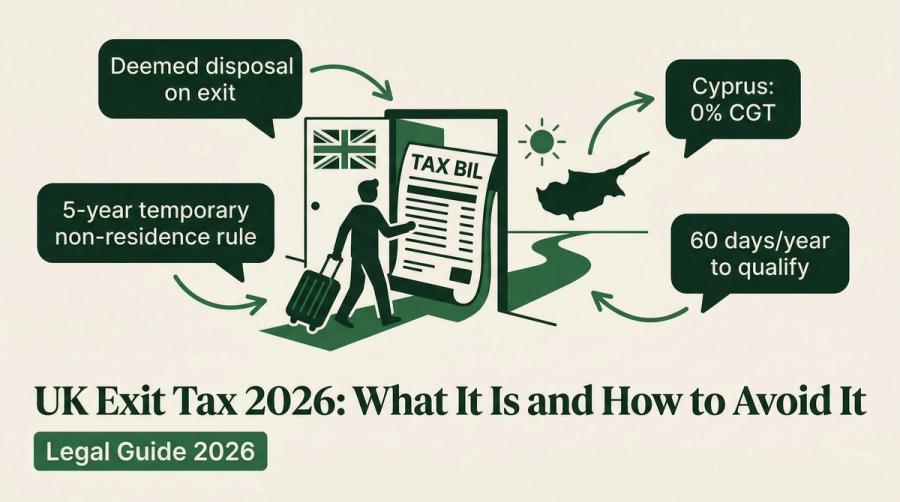
The core mechanism is simple: when you leave the UK and stop being a tax resident, HMRC treats certain assets as if you had sold them on the day of departure. You are therefore liable for capital gains tax on the unrealised gain up to that point, even though no actual sale has taken place.
This primarily affects:
- Individuals who hold UK assets (shares, property interests, certain funds) and who have been UK tax residents for a significant period.
- Taxpayers who leave and then return to the UK within five years (the so-called temporary non-residence rules).
| Jurisdiction | Exit Tax? | Threshold | Key Rule |
|---|---|---|---|
| United Kingdom | Limited | Varies by asset type | No general exit tax, but temporary non-residence rules apply to dividends |
| Germany | Yes (§6 AStG) | ≥1% shareholding, 10yr residency | Deemed sale at market value on departure |
| Netherlands | Yes | ≥5% shareholding | 10-year deferral for EU moves |
| France | Yes (Exit Fiscale) | ≥50% in company or €800k | Deferred if moving to EU/EEA |
| Spain | Yes (Impuesto de Salida) | >€4M or 25% + >€1M | Instalment plan available |
| Italy | Yes | Business assets + significant holdings | EU deferral available |
| Cyprus | None | N/A | No exit tax, clean departure |
- Trustees and close companies in certain structures.
The Five-Year Temporary Non-Residence Rule
HMRC can tax gains and income arising during your absence if you return within five complete tax years of leaving the UK. This means moving abroad for a few years does not permanently remove your UK tax exposure on pre-departure assets.
Under the temporary non-residence rules, gains realised while you are abroad on assets you held before departure can be brought back into charge when you return. The logic is to prevent people from briefly leaving, selling assets tax-free, and then returning.
The key takeaway: if you want the UK exit tax rules to work in your favour, you need to stay outside the UK for at least five complete UK tax years (April 6 to April 5). A shorter absence is not enough to shelter gains realised abroad.
Who Is Most at Risk?
**Who Is Most at Risk?**
Individuals with substantial UK-source income, significant unrealized gains on non-UK assets, or complex tax residency situations face the highest exit tax exposure. This includes entrepreneurs with growing businesses, investors holding appreciated securities outside the UK, and those with uncertain departure dates that affect tie-breaking rules under statutory residence test provisions. Non-doms converting to UK tax residency or UK residents relocating also encounter heightened liability if they've accumulated assets during their UK tax years.
Founders and shareholders: If you hold shares in a company that has increased substantially in value, leaving the UK triggers a deemed disposal at the current market value. You owe CGT on the gain even if you have not received any cash.
High-net-worth individuals with investment portfolios: Large portfolios of shares, funds, or bonds held outside ISAs can carry substantial unrealised gains. The deemed disposal rules mean you could face a six-figure CGT bill on departure.
People with offshore trusts or complex structures: Anti-avoidance provisions targeting offshore trusts can accelerate charges when the settlor or beneficiaries become non-resident.
Property owners: UK residential property remains subject to UK CGT regardless of your residence status, so property is not the main concern here. It's liquid financial assets that create the biggest exposure on departure.
How the UK Statutory Residence Test Affects Your Exit
You become non-UK resident when the Statutory Residence Test (SRT) determines you've met specific criteria in a tax year. The SRT, introduced in 2013, uses three factors: days spent in the UK, ties to the country, and work pattern. Meeting its non-residence conditions ends your UK tax residency liability for that year. Your exit timing directly affects which tax year marks the transition.
The exact date you become non-resident matters because it sets the deemed disposal date for exit charge purposes. Getting this wrong, even by a few weeks, can shift your exit tax liability significantly.
Key points under the SRT:
- Spending 183 or more days in the UK in a tax year makes you automatically UK resident.
- If you have strong UK ties (family, home, work), even fewer days can make you resident.
- A split-year treatment applies in the year you leave, which can reduce the period you are treated as UK resident and therefore limit the gain subject to exit charges.
Getting advice from a qualified UK tax adviser before you leave is essential. The rules are detailed, and the cost of getting them wrong is high.
What Assets Are Caught by UK Exit Charges?
UK exit charges apply to assets held at your departure date where the gain would have been taxable in the UK if sold while resident. These include: chargeable assets such as land, buildings, and securities; assets in UK trusts; and certain foreign assets if acquired while UK resident. The charge crystallizes on departure, not sale, calculating gains from acquisition to departure date. Non-residents can defer payment on some assets until actual disposal.
- Shares in UK and non-UK companies (unless covered by specific exemptions).
- Units in funds and collective investment schemes.
- Bonds and other securities.
- Business assets used in a UK trade (with some exceptions).
UK residential property is specifically excluded from the deemed disposal rules because it remains fully within UK CGT regardless of your residence. But this is cold comfort if your main exposure is shares or investment portfolios.
Cyprus as a Legal Alternative
Cyprus offers a legally compliant EU tax system that attracts UK expatriates seeking permanent tax reduction. The island combines favorable rates, Non-Dom status (effective ~5%), and robust legal frameworks with EU protections. For corporate entities, the 15% rate competes favorably against global standards. Cyprus's appeal extends beyond climate: its tax infrastructure, exchange controls compliance, and transparent regulations create genuine opportunities for lawful tax optimization unavailable in higher-tax jurisdictions.
The key features:
Non-Domiciled status (Non-Dom): Cyprus offers a Non-Dom regime that exempts qualifying residents from tax on dividends and interest income earned abroad. The effective tax rate on dividends under Non-Dom is approximately 5% (a 2.65% GHS contribution applies, with no income tax on dividends for Non-Doms). Read more about Non-Dom in Cyprus.
No capital gains tax on shares: Cyprus does not impose CGT on gains from the disposal of shares in non-property companies. If you are a Cyprus tax resident when you sell your shares, your gain is not subject to Cypriot CGT. This is a fundamental difference from the UK.
The 60-day rule: You can become a Cyprus tax resident by spending as few as 60 days per year in Cyprus, provided you are not tax resident anywhere else and you meet additional conditions (such as having a permanent home in Cyprus and business or employment ties there). This makes it one of the most accessible residence rules in Europe. You can read more about how Cyprus tax residency works.
Corporate tax at 15%: If you are considering incorporating in Cyprus, the corporate tax rate is 15%. This is relevant if your assets include a business you plan to continue operating.
The Practical Sequence: Leaving the UK for Cyprus
**The sequence for relocating from the UK to Cyprus is: obtain Cyprus residency or visa, notify HMRC of departure, close or retain UK bank accounts, register with tax authorities in Cyprus, and establish domicile status for tax purposes.**
Key steps in order: secure your Cyprus residency permit or visa first; inform HMRC you're leaving the UK within three months of departure; decide whether to maintain UK banking relationships; register with the Cyprus tax office (TAO) and obtain a tax identification number; confirm your non-domiciled status if eligible.
Each step influences your tax obligations in both jurisdictions, particularly regarding capital gains tax and employment income treatment. Timing is critical: early notification to HMRC prevents unexpected tax bills, while prompt Cyprus registration ensures compliance from day one.
- Take UK tax advice first. Understand your exact exit charge exposure before you leave. This includes identifying all assets subject to deemed disposal and calculating the approximate gain.
- Establish Cyprus tax residency properly. This means spending at least 60 days in Cyprus in the relevant tax year, having a permanent home there, and not being tax resident elsewhere. Simply renting an apartment is not enough on its own.
- Do not sell assets immediately after leaving the UK. Under the temporary non-residence rules, gains realised on assets held before departure can be pulled back into UK tax if you return within five years. Wait until you are clearly and permanently non-UK resident.
- Get Cyprus tax advice on the timing of any disposals. Once you are a Cyprus tax resident, disposals of qualifying shares are not subject to Cypriot CGT. But the timing relative to your UK departure date matters for UK purposes.
- Keep records of days spent in the UK. During the five-year period after departure, every day you spend in the UK reduces your safety margin under the temporary non-residence rules.
Common Mistakes When Leaving the UK
UK tax residency doesn't end simply by moving abroad or buying property overseas. The Statutory Residence Test is more complex: you can remain UK resident despite living abroad if you maintain strong ties to the UK, such as accommodation, family, or employment connections.
Selling assets in the wrong tax year. Selling assets before your departure date (when you are still UK resident) or in a year where the temporary non-residence rules apply can result in a larger UK CGT bill than necessary.
Ignoring the deemed disposal rules. Some people are unaware that unrealised gains can trigger a tax bill on departure. They only discover this when they receive a tax assessment from HMRC after leaving.
Not keeping a permanent home in the destination country. For Cyprus residency under the 60-day rule, you need a permanent home available to you in Cyprus. If you have a home available in the UK at the same time, this creates a UK tie that counts against you in the SRT.
Is the UK Introducing a Formal Exit Tax?
The UK has not introduced a formal comprehensive exit tax as of 2026. Existing deemed disposal rules already capture significant unrealised gains for departing residents. Policy discussions continue around strengthening exit charges, particularly following cases where founders left before company sales.
Staying informed about legislative changes in this area is important if you are planning a departure in 2026 or later.
Conclusion
UK exit tax rules impose CGT on unrealised gains when you leave, potentially creating large bills despite no cash realisation. The five-year temporary non-residence rule means brief absences don't permanently escape UK tax on pre-departure gains, requiring careful planning for significant asset holders.
Cyprus offers a well-established, legally compliant path for people who want to restructure their tax position. With no CGT on share disposals, a genuine Non-Dom regime with around 5% effective tax on dividends, and a 60-day residency rule that is accessible for people who want to maintain flexibility, it is one of the most practical options available to UK leavers in 2026.
If you are considering moving to Cyprus, cyprustaxlife.com covers the full picture: residency requirements, the Non-Dom regime, company formation options, and practical guides for people moving from the UK. Start with our UK movers guide for a complete overview.
Related Guides
Moving from UK to Cyprus: Full Tax Guide
Cyprus vs UK Tax Comparison 2026
Cyprus 60-Day Tax Residency Rule
Source: HMRC , Leaving the UK and Tax
Related Guides
Cyprus Double Tax Treaties (UK Included)
Does the UK have an exit tax when leaving the country?
What are the UK temporary non-residence rules?
How do I become non-resident in the UK for tax purposes?
Does moving to Cyprus from the UK trigger any UK tax on exit?
How does the UK-Cyprus double tax treaty affect expats?
What should UK nationals do before moving to Cyprus to minimise taxes?
Is there an exit tax when leaving the UK?
Which is the UK temporary non-residence rule?
Are the UK tax me on dividends from my UK company after I leave?
Can long do I need to stay out of the UK to be tax non-resident?
Do should I do before leaving the UK to minimise tax?
For a similar analysis of the France exit tax.
For those also facing exit tax, see why Cyprus is the top alternative after UK Non-Dom abolition.
Looking for professional support? Book a consultation with our Cyprus tax specialists.
Complete guide for British expats: British Expats in Cyprus, Complete Tax Guide 2026
![Cyprus Ltd vs Irish Ltd: Company Tax Compared [2026]](https://cdn.sanity.io/images/glqahhks/production/84e3d82538a859345d8d2447e8e097c5777fb238-1679x937.png?w=700&q=75&auto=format)
![Cyprus vs Malta Company Formation [2026]](https://cdn.sanity.io/images/glqahhks/production/97db89d0ce729a9e931d09bc1522631faa6c3474-1679x937.png?w=700&q=75&auto=format)