UK High Income Tax: 6 Legal Options If You're in the 45%...

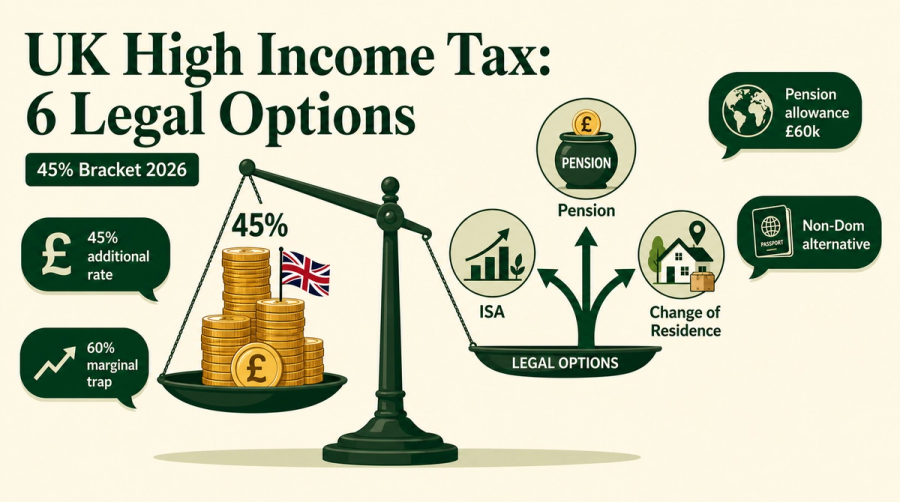
Once you cross the £125,140 threshold in the UK, you are in the 45% additional rate band and your personal allowance has been fully withdrawn. For business owners taking dividends, the additional rate is 39.35%. Add employer and employee National Insurance, and the effective marginal rates on many forms of income exceed 50%.
According to HMRC's employer rates and thresholds guide 2026/27, the Personal Allowance tapers to zero between £100,000 and £125,140, creating a 60% effective marginal rate band that affects approximately 800,000 UK taxpayers.
There are six categories of legal options available to high-bracket taxpayers. They range in complexity and impact from modest domestic adjustments to a full change of tax residency. This guide covers all six honestly, including their limits.
The 60% Marginal Rate Trap: Understanding the Problem First
Before covering solutions, it is worth understanding exactly why the UK tax burden feels disproportionate at certain income levels.
Between £100,000 and £125,140, the UK withdraws the personal allowance at £1 for every £2 of income. This creates an effective marginal income tax rate of 60% in this band, not 40% or 45%. On top of this, you still pay Class 4 NIC at 2% if self-employed, or Employee NIC at 2% above the upper earnings limit if employed.
Above £125,140, you are at 45% on all additional income (plus NIC where applicable). Dividends from your own company attract the 39.35% additional dividend rate on top of 25% corporation tax already paid, making the combined corporate + personal tax on profits extracted as dividends approximately 54% in the worst case.
This is the problem. Here are the options.
Option 1, Maximise Pension Contributions
Pension contributions remain the most tax-efficient tool available to UK high earners. Every pound paid into a pension reduces your adjusted net income, which directly affects your effective marginal rate.
- Annual allowance: £60,000 in 2026 (including employer contributions)
- Carry-forward: you can use unused allowance from the previous 3 tax years, potentially allowing contributions of £200,000+ in a single year
- Tax relief: at 45% for additional rate taxpayers, you pay in £55,000 and the pension pot receives £100,000 (via basic rate relief at source plus reclaim via self-assessment)
- Salary sacrifice: if employed, salary sacrifice contributions reduce your gross salary, saving both income tax AND employer and employee NIC
The limit: pension contributions are excellent for deferring tax and building retirement wealth, but the money is locked in until age 57 (rising to 58 in 2028). For business owners who want access to capital sooner, this is a significant constraint. Also, the annual allowance tapers for incomes above £260,000 (adjusted income), at £360,000+ you are down to a £10,000 annual allowance.
Option 2, ISA and Wrapper Strategy
ISAs shelter returns (interest, dividends, capital gains) from tax permanently. Once money is inside an ISA, it grows and can be withdrawn completely tax-free.
- Annual ISA allowance: £20,000 per person (2026)
- Stocks and Shares ISA: capital gains and dividends within the wrapper are tax-free
- For couples: £40,000 combined annual allowance, and a large existing ISA pot produces meaningful tax-free income
The limit: £20,000 per year is a slow build for high earners. If you are paying 45% on an extra £200,000 per year, sheltering £20,000 is meaningful but not transformative. ISAs work best as part of a long-term strategy combined with other approaches.
Option 3, EIS and VCT Investments
The Enterprise Investment Scheme (EIS) and Venture Capital Trusts (VCTs) offer income tax relief specifically designed for higher-rate taxpayers.
- EIS: 30% income tax relief on investments up to £1,000,000 per year (£2,000,000 for knowledge-intensive companies); also defers capital gains if the gain is reinvested into EIS
- VCTs: 30% income tax relief on investments up to £200,000 per year; dividends from VCTs are tax-free; capital gains on VCT shares are tax-free
- SEIS (Seed EIS): 50% income tax relief on up to £200,000 per year for very early-stage investments
The limit: EIS and VCT investments are high-risk. You are investing in early-stage or smaller companies. The tax relief does not make a bad investment good. The 30% relief on an EIS that loses 100% of its value still leaves you down 70%. These work well as part of a diversified strategy, not as a primary tax reduction tool.
Option 4, Salary and Dividend Structure (If You Own a Company)
If you are a director-shareholder of a limited company, the classic advice is to take a low salary (to the NIC threshold, approximately £12,570) and extract the remainder as dividends.
At lower income levels this is highly effective. At additional rate levels, the picture is more nuanced. The additional rate dividend tax is 39.35%. The corporation tax rate is 25% (above £250,000 profits). Combined effective rate on profits extracted as dividends in the additional rate band: approximately 54% (25% + 39.35% × 75%).
There is still a saving versus employment income (which would attract NIC on top), but the gap narrows significantly above £125,140. The strategy remains valid but the marginal benefit of dividends over salary becomes much smaller at high income levels.
Option 5, Timing Income Across Tax Years
Spreading income across two tax years can keep you below key thresholds or reduce the exposure to the 45% band. Common strategies:
- Defer a bonus from March to April, this pushes it into the next tax year
- Accelerate or defer dividend declarations from your company to smooth income
- Time the sale of investments to use your capital gains annual exempt amount (£3,000) across two years
- If you have losses from earlier years, use them against gains before they expire
The limit: timing strategies are one-off or limited in their repeatability. You cannot indefinitely defer income. And if HMRC considers the timing artificial, it may apply anti-avoidance rules.
Option 6, Change Your Tax Residency
This is the most powerful option and the most commonly misunderstood. Changing tax residency does not mean evading tax on existing UK income, it means legally restructuring where future income is earned and taxed.
The mechanism: if you cease to be a UK tax resident (by meeting the UK Statutory Residence Test non-UK tests), future income earned and sourced outside the UK is no longer subject to UK income tax. Income that remains UK-sourced (UK rental income, UK employment income, dividends from UK companies) continues to be taxed in the UK under non-resident rules.
For a business owner who has relocated their company and activities abroad, the savings are dramatic. On £200,000 of annual dividend income in 2026:
| Scenario | Annual Tax | Effective Rate |
|---|---|---|
| UK resident, additional rate dividend tax (39.35%) + 25% corp tax already paid | ~£108,000 | ~54% |
| Cyprus Non-Dom resident, 0% income tax on dividends + 2.65% GHS | ~£5,300 | ~2.65% |
| Annual saving by relocating to Cyprus | ~£102,700 | - |
The requirements for leaving the UK properly are specific. You cannot simply spend more time abroad, you must meet one of the automatic non-UK residence tests under the Statutory Residence Test (SRT). The most common: spend fewer than 16 days in the UK in the tax year (automatic non-resident), or 46 days if you have no UK ties. In practice, most people leaving the UK permanently spend under 90 days in the UK and meet at least one of the other non-UK tests.
For the full relocation process, see our guide on moving from the UK to Cyprus and our expat tax planning guide.
What Happened to UK Non-Dom Status?
Until April 2025, UK non-domiciled residents could use the remittance basis to keep foreign income outside the UK tax net. This was a significant planning tool for internationally mobile individuals.
The non-dom regime was abolished from 6 April 2025. It has been replaced by the Foreign Income and Gains (FIG) regime, which is available only to individuals in their first 4 years of UK tax residency. For those who have been UK resident for more than 4 years, the FIG regime provides no relief.
This abolition is one of the primary drivers of high earners considering leaving the UK entirely. The remittance basis is gone; the replacement covers only new arrivals. Long-term UK residents who relied on non-dom status now face UK tax on their worldwide income with no transitional relief beyond specific protected trusts.
Can I legally reduce my UK tax bill without leaving the UK?
Options 1-5 are all domestic and legal. Pension contributions, ISAs, EIS/VCT investments, optimal salary-dividend structure, and income timing all reduce your UK tax without requiring you to move. However, the savings are capped. For someone paying 45% on £300,000 of income, maxing out a pension and ISA might save £30,000-£40,000 per year, meaningful, but far less than changing tax residency.
What is the 60% effective rate trap and how do I escape it?
Between £100,000 and £125,140, the personal allowance is withdrawn at £1 per £2 of income, creating a 60% effective marginal rate (40% income tax + 20% effective rate from allowance loss). The most effective escape is reducing your adjusted net income below £100,000 through pension contributions. A £30,000 pension contribution by someone earning £115,000 brings their adjusted net income to £85,000, recovering the full personal allowance and saving approximately £15,000-£18,000 in tax.
What is the minimum time I need to spend outside the UK to break UK tax residency?
Under the Statutory Residence Test (SRT), the automatic non-UK residence test requires fewer than 16 days in the UK in the tax year. If you have 3+ UK ties (job in UK, accommodation available, resident family member, 90+ days in UK in either of the previous 2 years), you need fewer than 16 days. Without any UK ties, you can spend up to 45 days in the UK and still be non-resident. Most people leaving permanently comfortably meet the non-resident test.
Does leaving the UK trigger an exit tax on my investments?
The UK has a specific exit charge for certain assets. When you cease UK residence, you are treated as having sold and reacquired your non-UK assets at market value (the "deemed disposal" rule does not apply to UK assets for non-residents). For CGT purposes, there is a temporary non-residence rule: if you leave the UK and return within 5 tax years, capital gains realised during your absence may still be taxable in the UK. Plan your exits from investments accordingly.
Can I keep my UK company and still not pay UK income tax on dividends?
Dividends from a UK-resident company paid to a non-UK resident are subject to UK dividend withholding tax at 0% under current UK rules (the UK does not impose WHT on dividends). However, HMRC may challenge whether you have genuinely ceased UK tax residency if you continue to actively manage a UK company. The key question is the location of the central management and control of the company, if that remains in the UK, the company remains UK-resident for tax purposes.
How does salary sacrifice differ from a direct pension contribution for UK 45% taxpayers?
Both reduce taxable income, but salary sacrifice is processed by your employer before payroll — it reduces both your income tax and your National Insurance Contributions (NICs), saving an extra 2% NIC on top of the income tax relief. A direct pension contribution is made by you after receiving your salary, providing income tax relief (via self-assessment or PAYE adjustment) but no NIC saving. For a 45% taxpayer earning above £125,140, salary sacrifice is the more efficient route if your employer offers it, as the combined tax and NI saving can exceed 47% of each £1 contributed. Both carry the same annual allowance limits (£60,000 for most people in 2024/25).
Sources: HMRC, Income Tax rates and allowances 2025-26; HMRC, Statutory Residence Test guidance (RDR3); PwC UK Tax Guide 2026; HMRC, National Insurance rates and categories; Finance Act 2025 (non-dom abolition); Harneys Cyprus Non-Dom overview 2026.
Need personalized advice? Book a consultation with an expat tax specialist.
This guide is for informational purposes only and does not constitute tax or legal advice. Tax laws change and individual circumstances vary. Consult a qualified UK and international tax adviser before making any decisions about residency or tax planning.
![Cyprus Ltd vs Irish Ltd: Company Tax Compared [2026]](https://cdn.sanity.io/images/glqahhks/production/84e3d82538a859345d8d2447e8e097c5777fb238-1679x937.png?w=700&q=75&auto=format)
![Cyprus vs Malta Company Formation [2026]](https://cdn.sanity.io/images/glqahhks/production/97db89d0ce729a9e931d09bc1522631faa6c3474-1679x937.png?w=700&q=75&auto=format)