Beckham Law & Portugal NHR Ended: Cyprus Non-Dom (2026)

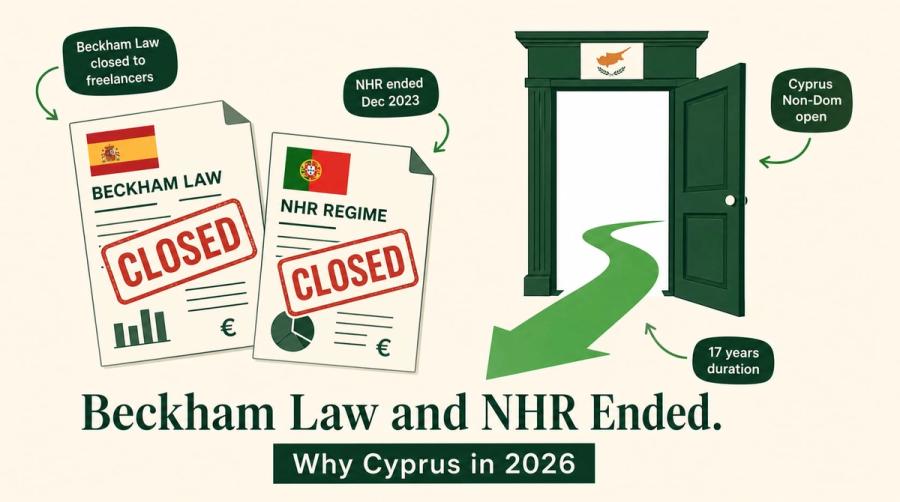
For over a decade, Spain's Beckham Law and Portugal's Non-Habitual Resident (NHR) regime were the go-to options for expats and entrepreneurs seeking favourable tax treatment in Southern Europe. Both are now effectively gone. Spain restricted the Beckham Law in 2024, and Portugal closed NHR to new applicants at the end of 2023, replacing it with the much narrower IFICI regime.
If you were counting on either of these programmes, or if you are currently on one and planning your next move, this guide breaks down what happened, what replaced them, and why Cyprus has emerged as the strongest alternative in 2026.
What Happened to Spain's Beckham Law?
Spain's Special Tax Regime for Inbound Workers, commonly called the "Beckham Law" after footballer David Beckham famously used it, allowed qualifying expats to pay a flat 24% income tax rate (up to 600,000 EUR) instead of Spain's progressive rates that climb to 47%.
The key restriction (2024): Spain narrowed eligibility significantly. The regime now excludes:
- Self-employed individuals and freelancers
- Company directors and administrators of Spanish entities
- Anyone who was a Spanish tax resident in the previous 5 years (previously 10 years)
For entrepreneurs and business owners, the most common profile looking at Spain, the Beckham Law is essentially dead. It now mainly benefits employed executives transferred to Spain by foreign companies, a much smaller pool.
Additionally, the flat rate only applies to employment income. Dividends, capital gains, and investment income are taxed at Spain's standard savings rates (19-28%). And Spain's wealth tax (up to 3.5%) still applies.
For context on Spain's full tax burden, see our Spain vs Cyprus comparison and our guide on non-resident tax obligations in Spain.
What Happened to Portugal's NHR?
Portugal's NHR (Non-Habitual Resident) was arguably the most popular tax regime in Europe for digital nomads, retirees, and entrepreneurs. It offered:
- Flat 20% tax on Portuguese-source employment and self-employment income from "high value" activities
- 0% tax on most foreign-source income (dividends, interest, royalties, capital gains, rental income, pensions) if taxed in the source country under a treaty
- Available for 10 years
NHR closed to new applicants on 31 December 2023. If you did not have Portuguese tax residency by that date, you cannot access NHR. Existing NHR holders keep their status for the remainder of their 10-year period, but once it expires, they face Portugal's standard progressive rates (up to 48%) plus potential solidarity surcharges.
Portugal's IFICI: The Replacement That Barely Replaces Anything
Portugal introduced the IFICI (Incentivo Fiscal a Investigacao Cientifica e Inovacao) in 2024 as the "replacement" for NHR. It is far more restrictive.
Who qualifies for IFICI:
- Researchers and scientists working in Portuguese institutions
- Highly qualified professionals in specific tech/innovation roles
- Startup founders and employees of certified startups
- Individuals in roles deemed of "exceptional economic interest"
What IFICI offers:
- Flat 20% tax on qualifying Portuguese income
- Potential exemptions on foreign-source income (similar structure to old NHR)
- Duration: 10 years
The catch: IFICI requires approval from a government committee. It is not automatic. You must prove your activity falls within the qualifying categories, and the list is narrow. Freelancers, general entrepreneurs, remote workers, retirees, and anyone without a specific tech/research role are excluded.
In practice, IFICI serves maybe 5-10% of the people who would have qualified for NHR. For the vast majority of expats and entrepreneurs, Portugal is no longer a viable low-tax destination.
For a deeper dive on Portugal specifically, see our Cyprus vs Portugal tax comparison.
Why These Changes Matter
The end of the Beckham Law and NHR represents a broader European trend: countries tightening their special tax regimes under pressure from the EU and domestic politics. This leaves a significant gap in the market. Tens of thousands of expats, entrepreneurs, and digital nomads who would have gone to Spain or Portugal now need an alternative that offers:
- Low effective tax rates on business and investment income
- A clear, accessible programme (not a lottery or committee approval)
- EU membership for business and lifestyle benefits
- A programme that is stable and not likely to be cancelled next year
Cyprus checks every box.
Cyprus Non-Dom: The Natural Replacement
Cyprus' Non-Domiciled (Non-Dom) status has been available since 2015 and offers:
Tax treatment:
- 0% tax on dividends from abroad (only 2.65% GHS/GESY contribution)
- 0% tax on interest income from abroad
- 15% corporate tax on company profits (competitive within the EU)
- No wealth tax, no inheritance tax, no property tax on foreign assets
- No Special Defence Contribution on foreign income
Effective tax rate for entrepreneurs: approximately 5%. This is achieved through a Cyprus Ltd company (15% corporate tax) combined with salary (first 22,000 EUR tax-free) and dividend extraction (2.65% GHS only). Business expenses (typically 25-35% of revenue) are deductible at the corporate level.
Who qualifies: Anyone who was not born in Cyprus and has not been a Cyprus tax resident for 17 of the last 20 years. There is no committee approval, no qualifying profession list, no income threshold. You qualify automatically.
Duration: The Non-Dom status lasts for 17 years from the date you become a Cyprus tax resident. That is 7 years longer than NHR or the Beckham Law ever offered.
Comparison: Old Beckham Law vs Old NHR vs Cyprus Non-Dom
| Feature | Spain Beckham Law (old) | Portugal NHR | Cyprus Non-Dom |
|---|---|---|---|
| Status in 2026 | Restricted | Closed to new applicants | Fully available |
| Tax on employment | 24% flat (up to 600K) | 20% flat (high-value roles) | 0% on first 22,000 EUR, then progressive |
| Tax on dividends | 19-28% | 0% (if treaty) | 0% income tax, 2.65% GHS |
| Tax on foreign interest | 19-28% | 0% (if treaty) | 0% |
| Corporate tax | 25% | 21% | 15% |
| Wealth tax | Up to 3.5% | 0% | 0% |
| Capital gains tax | 19-28% | 0% (foreign, if treaty) | 0% (foreign securities) |
| Inheritance tax | 7.65-34% | 0-10% | 0% |
| Duration | 6 years | 10 years | 17 years |
| Qualification | Employed by foreign co. | New resident, not in PT 5 yrs | Not born in CY, automatic |
| Approval process | Declaration | Registration | Automatic |
The comparison makes the case clearly. Cyprus Non-Dom offers lower effective rates on the income types that matter most to entrepreneurs (dividends, interest, capital gains), lasts longer, and requires no approval process.
Tax Rates Side by Side
For an entrepreneur earning 100,000 EUR through their own company:
Spain (post-Beckham, standard rates):
- Corporate tax: 25% on profits
- Personal income tax on salary: up to 47%
- Dividend tax: 19-28%
- Wealth tax: potentially applicable
- Effective combined rate: 35-45%
Portugal (standard rates, post-NHR):
- Corporate tax: 21% (plus municipal surcharge)
- Personal income tax: up to 48% + solidarity surcharge
- Dividend tax: 28% flat
- Effective combined rate: 30-40%
Cyprus (Non-Dom):
- Corporate tax: 15% on profits
- Salary: 0% on first 22,000 EUR
- Dividends: 0% income tax, 2.65% GHS
- No wealth tax
- Effective combined rate: approximately 5%
For a detailed look at optimizing your structure, read our guide on how to pay less taxes in Europe.
Residency: How Easy Is It?
EU citizens: Moving to Cyprus is straightforward. Register for a Yellow Slip (MEU1) residence certificate. No visa, no permits, no waiting. You can be a legal resident within weeks of arriving.
Non-EU citizens: More complex, but Cyprus offers several routes including employment permits, self-employment permits, and the permanent residency permit (requiring a 300,000 EUR property purchase). Processing takes 1-3 months.
The 60-day rule: Cyprus offers a unique 60-day tax residency rule that allows you to become a tax resident by spending just 60 days per year in Cyprus, as long as you do not spend more than 183 days in any other single country. This is far more flexible than Spain (183 days) or Portugal (183 days).
This means you could maintain Cyprus tax residency while spending significant time travelling or visiting other countries - something neither the Beckham Law nor NHR ever allowed.
Who Benefits Most from Switching to Cyprus?
If you were planning to use the Beckham Law:
- Entrepreneurs and freelancers who are now excluded from the restricted regime
- Business owners who want to extract profits as dividends (0% vs 19-28% in Spain)
- Anyone who wants to avoid Spain's wealth tax
If you were on NHR or planning to use it:
- Digital nomads and remote workers with no qualifying IFICI role
- Entrepreneurs with foreign-source income
- Retirees (Cyprus offers a flat 5% on foreign pensions, plus Non-Dom benefits on investment income)
- Anyone whose NHR is expiring and facing Portugal's 48% rates
If you are currently on NHR and it is expiring: Start planning now. The transition from NHR to Cyprus Non-Dom can be done within a single tax year if timed correctly. Establish Cyprus tax residency before your NHR expires to avoid a year at Portugal's standard rates.
Exit tax considerations: Both Spain and Portugal have exit tax provisions. Spain taxes unrealised capital gains when you leave if you have held significant shareholdings. Portugal has a similar mechanism. Factor this into your timeline. For Spain specifically, see our exit tax guide.
Practical Steps to Relocate to Cyprus
For EU Citizens
- Visit and explore. Spend a few weeks in Cyprus to choose your base city. Limassol for business, Larnaca for affordability, Paphos for the British community.
- Secure accommodation. Sign a rental contract (needed for residency registration).
- Register for residency. Get your Yellow Slip (MEU1) at the Civil Registry.
- Register for taxes. Obtain your Cyprus Tax Identification Number (TIN).
- Set up your company. If operating a business, form a Cyprus Ltd. This takes 5-7 business days.
- Open a bank account. Bank of Cyprus and Hellenic Bank are the main options. Expect the process to take 1-3 weeks with KYC requirements.
- Non-Dom confirmation. The status is automatic, but your accountant will confirm it in your first tax return.
For Non-EU Citizens
Follow the same steps, but also obtain the appropriate visa/permit before or upon arrival, consider the permanent residency route if you plan to purchase property, and allow 2-3 months for permit processing.
For anyone moving from Spain specifically, our moving from Spain guide covers the full process.
Is Cyprus Non-Dom at Risk of Being Cancelled?
This is the natural question after watching Spain and Portugal pull back their regimes. The short answer: Cyprus Non-Dom is structurally different and more resilient.
- It is not a "special regime" in the EU sense - it is part of Cyprus' standard tax code
- It aligns with the UK's former Non-Dom system, which was well-established in international tax law
- Cyprus' economy depends significantly on attracting international business and professionals
- The regime has been in place since 2015 with no legislative moves to restrict it
- It passed EU scrutiny during the EU Code of Conduct review
No tax regime comes with a lifetime guarantee. But Cyprus Non-Dom is more deeply embedded in the country's tax architecture than either the Beckham Law or NHR were in theirs.
Can I still apply for Spain's Beckham Law in 2026?
The Beckham Law still exists but with significantly narrowed eligibility. It now mainly covers employees transferred to Spain by foreign employers. Self-employed individuals, freelancers, and company directors are excluded. If you are an entrepreneur, it is no longer an option.
Can I still apply for Portugal NHR?
NHR closed to new applicants on 31 December 2023. If you did not register by that date, you cannot access it. The replacement, IFICI, is available only to researchers, tech professionals, and certain startup roles.
What is Portugal's IFICI regime?
IFICI (Incentivo Fiscal a Investigacao Cientifica e Inovacao) replaced NHR in 2024. It offers a 20% flat rate and foreign income exemptions, but only for researchers, scientists, qualified tech workers, and startup founders. It requires committee approval and covers a fraction of the people NHR did.
How does Cyprus Non-Dom compare to NHR for retirees?
Cyprus offers a flat 5% tax on foreign pension income (with 3,420 EUR annual exemption) plus 0% tax on dividends and interest under Non-Dom. NHR offered 0% on foreign pension income (later changed to 10% for new applicants). For retirees with significant investment income alongside pensions, Cyprus can be more favourable overall.
Do I need to live full-time in Cyprus?
The 60-day rule allows Cyprus tax residency with just 60 days per year in Cyprus, as long as you do not spend more than 183 days elsewhere. This is far more flexible than Spain or Portugal, which both require 183+ days.
What about the exit tax when leaving Spain or Portugal?
Both countries can tax unrealised capital gains when you leave. Spain applies exit tax on holdings worth over 4 million EUR (or 25%+ stakes in companies worth over 1 million EUR). Portugal has similar provisions. Plan the timing with a tax adviser and consider realising gains before departure if the tax cost is lower.
Is Cyprus in the EU?
Cyprus has been an EU member since 2004. This means freedom of movement for EU citizens, access to EU trade agreements, and your Cyprus company operates within the EU single market. Cyprus is not in the Schengen zone, which is a minor inconvenience for travel but irrelevant for tax and business purposes.
How long does it take to set up in Cyprus?
An EU citizen can have residency, a company, a bank account, and tax registration within 4-6 weeks. The company formation itself takes about 5-7 business days. Non-EU citizens should allow 2-3 months for the residence permit process.
Sources: Spain Ministry of Finance - Special Tax Regime for Inbound Workers (2024 reform); Portugal Tax Authority NHR closure notice; PwC Cyprus Tax Guide 2026; Harneys Cyprus Non-Dom overview 2026; EU Code of Conduct Group on Business Taxation.
Need personalized advice? Book a consultation with an expat tax specialist.
This guide is for informational purposes only and does not constitute tax or legal advice. Tax laws change frequently across jurisdictions. Consult qualified cross-border tax advisers before making relocation decisions.
![Cyprus Ltd vs Irish Ltd: Company Tax Compared [2026]](https://cdn.sanity.io/images/glqahhks/production/84e3d82538a859345d8d2447e8e097c5777fb238-1679x937.png?w=700&q=75&auto=format)
![Cyprus vs Malta Company Formation [2026]](https://cdn.sanity.io/images/glqahhks/production/97db89d0ce729a9e931d09bc1522631faa6c3474-1679x937.png?w=700&q=75&auto=format)